
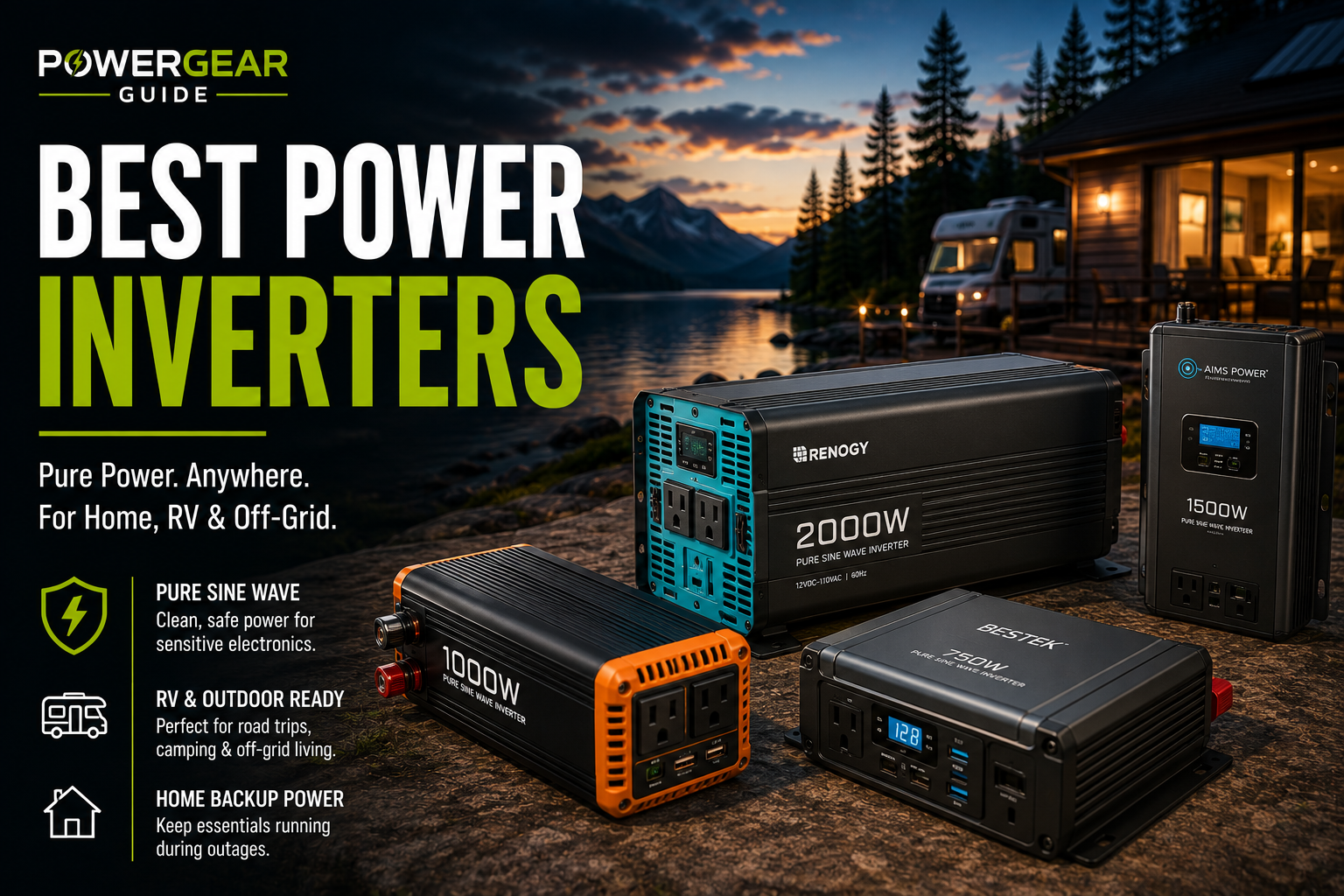
Best Power Inverters
Compare pure sine wave inverters for RVs, work trucks, cabins, home backup and off-grid systems—and learn how to match output, surge capacity and battery voltage to the job.
Reliable AC Power Starts With the Right Inverter
A power inverter converts battery DC power into household-style AC power. The right model can support tools, appliances, electronics and off-grid equipment, but output waveform, continuous wattage, startup surge, battery voltage, wiring and ventilation all matter. This guide focuses on practical use-case fit rather than treating every inverter as interchangeable.
Which Power Inverter Is Best?
For most RV, cabin and mobile backup installations, a properly sized pure sine wave inverter is the safest all-around choice. A 2000W class model offers useful flexibility for common appliances and tools, while smaller systems benefit from a 1000W–1200VA inverter and larger off-grid systems may be better served by a 24V or 48V inverter or inverter-charger.
Power Inverter Guide
Best Power Inverters at a Glance
These recommendations cover different installation sizes rather than forcing every buyer into the same wattage class.
Renogy 2000W Pure Sine Wave Inverter
A practical 12V pure sine wave option for RVs, vans, cabins and medium-size off-grid systems that need strong continuous output and useful startup headroom.
Victron Phoenix Inverter Smart
A premium pure sine wave platform for users who value robust design, high surge capability, system integration and multiple voltage options.
AIMS Power 2000W Pure Sine Inverter
A rugged option for work trucks, fleet vehicles, RV installations and professional users who prioritize certification and demanding mobile applications.
Victron Phoenix VE.Direct 1200VA
A compact inverter for efficient lower-load systems where dependable pure sine wave output and monitoring matter more than maximum wattage.
Power Inverter Comparison Table
Compare the main differences before choosing a model. Verify the exact listing, voltage and regional AC output before ordering.
| Model | Waveform | Output Class | Input Options | Best For | Score | Shop |
|---|---|---|---|---|---|---|
| Renogy 2000W | Pure sine wave | 2000W continuous | 12V | RV and off-grid | 9.3 | Check Options |
| Victron Phoenix Smart | Pure sine wave | 1600VA–5000VA family | 12V / 24V / 48V | Premium systems | 9.2 | Check Options |
| AIMS Power 2000W | Pure sine wave | 2000W continuous | 12V | Work trucks and fleets | 9.0 | Check Options |
| Victron Phoenix VE.Direct | Pure sine wave | Up to 1200VA class | 12V / 24V / 48V options | Compact systems | 8.8 | Check Options |
Our Top Power Inverter Recommendations
Renogy 2000W 12V Pure Sine Wave Inverter
Renogy’s 2000W inverter sits in a useful middle ground: large enough for many RV and cabin appliances, yet still practical for a carefully designed 12V battery system. The pure sine wave output is appropriate for sensitive electronics and motor-driven equipment, while the 4000W peak rating provides short-duration startup headroom.
✓ Pros
- Pure sine wave output
- Strong 2000W continuous class
- Useful surge capacity
- Designed for mobile and off-grid use
✕ Cons
- High current draw at 12V
- Requires heavy cable and proper fusing
- Not a substitute for a properly sized battery bank
Victron Phoenix Inverter Smart
The Phoenix Inverter Smart family is a better match for buyers building a serious electrical system rather than simply adding an outlet to a battery. Multiple battery-voltage choices, high-quality sine wave output and strong peak capability make it suitable for boats, caravans, cabins and integrated backup systems.
✓ Pros
- Multiple system voltages
- High-quality sine wave output
- Strong surge behavior
- Well suited to integrated systems
✕ Cons
- Premium pricing
- More system planning required
- May be more inverter than a basic vehicle setup needs
AIMS Power 2000W Pure Sine Wave Inverter
AIMS Power’s 2000W pure sine wave platform is aimed at more demanding mobile and professional applications. It is especially relevant to work trucks, fleet vehicles, RV manufacturers and users who value certified equipment and rugged installation-oriented design.
✓ Pros
- Professional-use focus
- Pure sine wave output
- Suitable for vehicle and RV installations
- Strong brand specialization in inverter systems
✕ Cons
- Can cost more than consumer-focused models
- Installation hardware may vary by configuration
- Careful ventilation and cable planning required
Victron Phoenix VE.Direct 1200VA
The Phoenix VE.Direct line is a good fit when efficiency, compact size and monitoring are more important than powering large appliances. It is well suited to electronics, small kitchen loads, communications equipment and efficient van or marine systems.
✓ Pros
- Compact and efficient
- Pure sine wave output
- Monitoring support
- Multiple battery-voltage variants
✕ Cons
- Not intended for high-draw appliances
- VA rating requires careful load matching
- Premium cost for the output class
How to Choose a Power Inverter
A safe inverter system begins with the load and battery bank—not the advertised wattage alone.
1. Continuous Watts
Add the running wattage of everything you expect to operate at the same time. Select an inverter with reasonable headroom rather than planning to run continuously at its maximum rating.
2. Startup Surge
Refrigerators, pumps, compressors and power tools can draw several times their running wattage at startup. The inverter must support that brief surge without shutting down.
3. Pure vs Modified Sine Wave
Pure sine wave is the preferred choice for sensitive electronics, motors, variable-speed equipment and modern power supplies. Modified sine wave may be acceptable for simple resistive loads but offers less universal compatibility.
4. Battery Voltage
At the same wattage, a higher-voltage battery system draws less current. That can reduce cable size, voltage drop and heat in larger installations. Match the inverter exactly to the battery-bank voltage.
5. Wiring and Fusing
Large 12V inverters can draw very high current. Use manufacturer-recommended cable gauge, short cable runs, appropriate overcurrent protection, correct grounding and secure terminations.
6. Inverter or Inverter-Charger?
A basic inverter converts DC to AC. An inverter-charger also recharges the battery bank from shore or generator power and may include transfer-switch functions for integrated backup systems.
Our Power Inverter Selection Method
We evaluated inverter families by comparing manufacturer specifications, waveform type, continuous-output class, surge capability, battery-voltage availability, installation requirements, safety features, monitoring, intended applications and overall value. We did not claim hands-on laboratory testing where none was performed. Scores reflect our editorial assessment of specifications and use-case fit.
The Best Inverter Depends on Your Electrical System
The Renogy 2000W pure sine wave inverter is our best overall recommendation for a practical 12V RV or off-grid installation. Buyers building a premium integrated system should consider the Victron Phoenix Inverter Smart, while the AIMS Power 2000W is particularly relevant to work trucks and demanding mobile applications. Smaller systems may be better served by the efficient Victron Phoenix VE.Direct platform rather than oversizing.
Power Inverter Frequently Asked Questions
What size power inverter do I need?
Add the running wattage of the devices you want to power, account for startup surge and choose an inverter with reasonable headroom above the continuous load.
Is pure sine wave better than modified sine wave?
Pure sine wave is more broadly compatible and is the safer choice for sensitive electronics, motors, medical equipment and modern power supplies.
Can a power inverter run a refrigerator?
Yes, provided the inverter and battery bank can handle both the refrigerator’s running wattage and the higher compressor startup surge.
Can I connect a large inverter to a cigarette-lighter socket?
No. High-output inverters normally require direct battery wiring with heavy cable, correct fusing and secure connections.
What is inverter surge power?
It is the brief extra output available to start motors, compressors, pumps and other equipment that draws more power at startup.
Does an inverter drain the battery when nothing is plugged in?
Yes. Inverters consume some idle power while switched on. ECO or power-saving modes can reduce that draw.
Should I choose a 12V, 24V or 48V inverter?
Match the inverter to the battery-bank voltage. Higher-voltage systems can reduce current and cable demands at high output levels.
Do I need an inverter charger?
An inverter charger is useful when the system should both supply AC from the battery and recharge the battery from shore or generator power.
How efficient are power inverters?
Efficiency varies by model and load. Conversion losses should always be included when estimating battery runtime.
Can I install a power inverter myself?
Small plug-in units are simple. Large hardwired inverters require correct cable sizing, fusing, grounding, ventilation and code compliance; professional installation may be appropriate.
Can a power inverter run an air conditioner?
Potentially, but the inverter, surge rating, battery bank, cabling and charging system must all support the air conditioner’s demanding load.
Are power inverters worth it?
They are worthwhile when you already have a suitable battery system and need AC power in an RV, vehicle, boat, cabin or off-grid installation.