
Best Power Inverters for Trucks: Four Practical Options
A truck inverter converts battery DC power into AC power, but choosing by the advertised wattage alone can overload a 12V outlet or drain a starting battery. Compare small plug-in units with properly installed hardwired models and understand the electrical limits before buying.
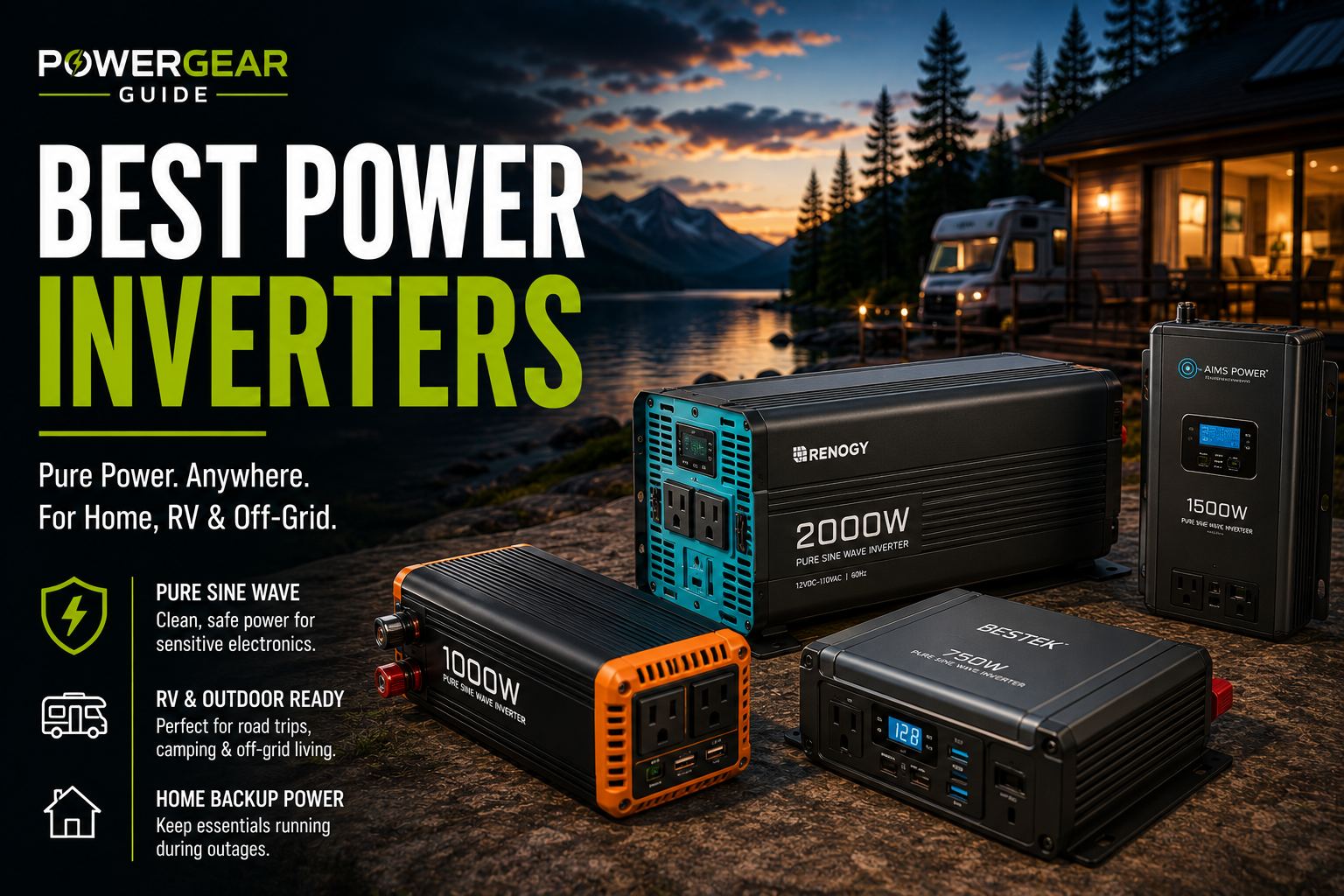
Quick Answer
For charging laptops and running small electronics, a compact 300W-class pure sine inverter may be enough if its input connection supports the draw. For an auxiliary-battery installation, the Renogy 1000W, Samlex PST-600-12 and Victron Phoenix 12/1200 represent different output and installation classes. A factory 12V accessory socket cannot safely deliver the full rating of most high-wattage inverters.
Truck Inverters by Use Case
BESTEK 300W Pure Sine Wave Inverter
Laptops and small electronics. Not suitable for large power tools or appliances.
Renogy 1000W Pure Sine Wave Inverter
Truck camping and moderate AC loads. Requires appropriate battery wiring, fuse and installation.
Victron Phoenix Inverter 12/1200
Dedicated auxiliary battery systems. VA rating is not the same as continuous watts; installation complexity.
Samlex PST-600-12
Sensitive electronics on a properly wired 12V circuit. Not a plug-and-play cigarette-lighter solution.
Truck Power Inverter Comparison
| Model | Published class | Best application | Critical limitation |
|---|---|---|---|
| BESTEK 300W Pure Sine Wave Inverter | 300W rated output | Laptops and small electronics | Not suitable for large power tools or appliances |
| Renogy 1000W Pure Sine Wave Inverter | 1000W rated output | Truck camping and moderate AC loads | Requires appropriate battery wiring, fuse and installation |
| Victron Phoenix Inverter 12/1200 | 12V input; 1200VA class | Dedicated auxiliary battery systems | VA rating is not the same as continuous watts; installation complexity |
| Samlex PST-600-12 | 600W rated output | Sensitive electronics on a properly wired 12V circuit | Not a plug-and-play cigarette-lighter solution |
Continuous power, peak surge, output waveform and input wiring are separate specifications. The listed output class is not a promise that a particular truck can supply that power. Always confirm the exact model revision and official manual before installation.
Detailed Truck Inverter Reviews
BESTEK 300W Pure Sine Wave Inverter
300W rated output
This small-inverter category is useful for laptop adapters and low-demand equipment, but a 300W output rating can require more than 25A from a 12V battery after losses. Many vehicle accessory sockets are fused for substantially less. Check the included plug and its specific input limit; use a properly rated direct connection for larger loads.
Advantages
- Laptops and small electronics
- Pure sine output for compatible AC equipment
- Distinct capacity class for measured truck loads
Trade-offs
- Not suitable for large power tools or appliances
- Power draw can discharge a starting battery
- Installation and thermal limits must be checked
Best for: Laptops and small electronics. Not ideal for: buyers who have not verified battery, fuse and cable limits.
See PricesRenogy 1000W Pure Sine Wave Inverter
1000W rated output
A 1000W pure sine inverter is better considered part of a dedicated electrical installation than a dashboard accessory. At full output a 12V system may draw roughly 90A or more depending on voltage and efficiency. Cable size, fuse location, ventilation and battery discharge capability determine whether it is viable.
Advantages
- Truck camping and moderate AC loads
- Pure sine output for compatible AC equipment
- Distinct capacity class for measured truck loads
Trade-offs
- Requires appropriate battery wiring, fuse and installation
- Power draw can discharge a starting battery
- Installation and thermal limits must be checked
Best for: Truck camping and moderate AC loads. Not ideal for: buyers who have not verified battery, fuse and cable limits.
See PricesVictron Phoenix Inverter 12/1200
12V input; 1200VA class
The Phoenix 12/1200 uses a VA-class model designation, which must not be mistaken for a guarantee of 1200W continuous real-power delivery. It suits buyers willing to design a proper auxiliary-battery system and consult Victron documentation for continuous output, temperature derating and remote-control features.
Advantages
- Dedicated auxiliary battery systems
- Pure sine output for compatible AC equipment
- Distinct capacity class for measured truck loads
Trade-offs
- VA rating is not the same as continuous watts; installation complexity
- Power draw can discharge a starting battery
- Installation and thermal limits must be checked
Best for: Dedicated auxiliary battery systems. Not ideal for: buyers who have not verified battery, fuse and cable limits.
See PricesSamlex PST-600-12
600W rated output
The Samlex 600W class fills the gap between small charging inverters and larger 1000W systems. Its hardwired input needs appropriately sized conductors and overcurrent protection. It is a reasonable size class for a measured modest load, not a solution for kettles, heaters or other high-demand appliances.
Advantages
- Sensitive electronics on a properly wired 12V circuit
- Pure sine output for compatible AC equipment
- Distinct capacity class for measured truck loads
Trade-offs
- Not a plug-and-play cigarette-lighter solution
- Power draw can discharge a starting battery
- Installation and thermal limits must be checked
Best for: Sensitive electronics on a properly wired 12V circuit. Not ideal for: buyers who have not verified battery, fuse and cable limits.
See PricesHow to Size and Wire a Truck Inverter
Estimate the DC current, not just the AC wattage
For a rough planning estimate, divide AC watts by battery voltage and expected inverter efficiency. For example, a 600W AC load at 12V with 85% efficiency draws about 59A DC. Actual battery voltage and inverter efficiency vary, and startup loads may be higher. This is a sizing illustration, not a cable or fuse specification.
Accessory sockets are not high-current connections
A truck 12V socket protected by a 15A fuse has a theoretical 180W input limit at 12V, before losses; a 10A socket is lower. Never bypass a vehicle fuse to run a larger inverter. Check the owner manual for the specific socket rating, and connect high-output inverters through a correctly protected dedicated circuit.
Starting battery versus auxiliary battery
Running AC appliances with the engine off can leave a truck unable to start. A dedicated deep-cycle auxiliary battery, appropriate isolation or DC-DC charging, and a low-voltage shutdown strategy are often better for sustained camping loads. Vehicle alternator capacity and charging behavior must be considered.
Pure sine versus modified sine
Pure sine output is generally the safer default for equipment with sensitive power supplies, motors or audio electronics, though each device still has its own compatibility requirements. Check both continuous watts and short-duration surge capacity, particularly for compressors and power tools.
Electrical and carbon monoxide safety
Install an inverter where the manufacturer permits adequate ventilation and moisture protection. Use the specified DC overcurrent protection close to the battery. Never run a vehicle engine in an enclosed garage or space to power an inverter; exhaust contains deadly carbon monoxide. Do not backfeed household wiring.
Related PowerGearGuide Guides
For RV-specific electrical configurations, see best power inverters for RVs. For generator-based RV power, see portable generators for RVs. Truck inverter sizing centers on 12V vehicle circuits, unlike those broader RV power choices.
Final Verdict
Start with the actual AC wattage and how the inverter will connect to the truck. A compact 300W class unit fits small charging jobs; a 600W hardwired system covers measured moderate loads; and 1000W or VA-class models belong in deliberately engineered auxiliary-battery installations. The best inverter is one the truck can safely supply, not simply the one with the largest advertised output.
Frequently Asked Questions
Can I run a 1000W inverter from a truck cigarette lighter?
No, not at its full rated output. A typical accessory socket cannot provide the required DC current. Follow the vehicle and inverter manuals for a dedicated, protected connection.
Will a power inverter drain my truck battery?
Yes. Any inverter draws battery energy, including some power while idle. Running it with the engine off can prevent starting unless battery capacity and shutdown limits are managed.
What size inverter is enough to charge a laptop?
Many laptops need far less than 300W, but check the adapter input and any other simultaneous loads. A smaller efficient inverter or suitable DC laptop charger may be preferable.
Is pure sine wave necessary in a truck?
Pure sine is a sensible default for broad device compatibility, but the device manufacturer requirements still govern. It does not remove the need for correct wiring and sufficient wattage.
Can a truck inverter run a refrigerator?
Only if continuous output, compressor startup surge, battery capacity and wiring all support it. Measure or obtain the refrigerator specifications first.
Do I need a second battery for a truck inverter?
Not for every small intermittent load, but an auxiliary battery is often the better approach for sustained engine-off use. Design it with proper charging and protection.
How do I calculate inverter battery current?
Divide approximate AC output watts by DC voltage times efficiency. For example, 600W at 12V and 85% efficiency is about 59A, before transient behavior.
Can I use a truck inverter while driving?
Often yes if the manufacturer and vehicle permit the installation, but the inverter must be secured, ventilated and wired correctly; alternator and charging-system limits still apply.
Sources and Editorial Methodology
Recommendations are based on manufacturer model families and electrical design principles, not hands-on testing. Confirm the exact current SKU, ratings, manuals and installation requirements before purchasing. Output ratings can differ by revision and region.