
Best 1000W Power Inverters: Four Models Compared
Compare real 1,000-watt continuous-output inverters for RVs, vans, off-grid batteries and backup installations. We separate pure sine wave quality, DC voltage, surge claims, inverter-charger features and installation requirements.
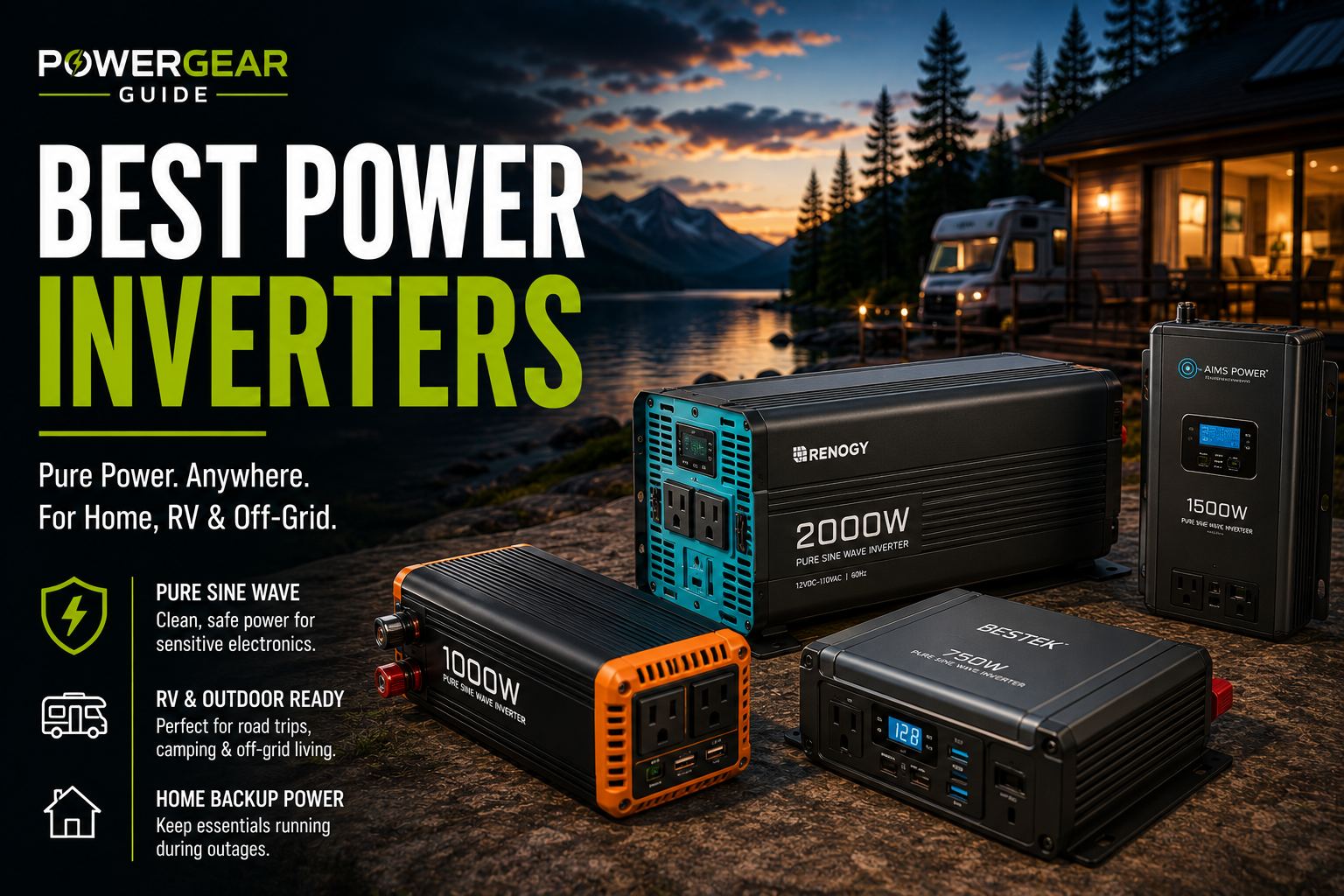
A 1,000W inverter converts compatible DC battery power into AC power. It does not create energy or necessarily charge the battery. For a typical 12V system, 1,000W of AC output can require roughly 93 - 105A of DC input depending on battery voltage and inverter efficiency, before allowing for surge or wiring margins.
This guide compares four clearly documented inverter products; it is a specification-based buying guide, not a hands-on test. Product listings and availability can change.
Renogy P2 for Simple 12V Installations; Victron for More Advanced Systems
Renogy P2 1000W: conventional pure sine wave inverter with a remote and documented safety listing.
Renogy 1000W UPS Bluetooth: for users who need its specific transfer and Bluetooth functions.
Victron Phoenix 12/1200: configurable standalone inverter with 1,000W output at 25°C.
Victron MultiPlus 12/1200/50: inverter-charger with transfer switch for more involved permanent systems.
Critical: All four are 12V-oriented examples. A 24V battery bank requires a compatible 24V inverter, not an adapter or an assumed substitution.
Best 1000W Inverters: Quick Picks
Renogy P2 1000W 12V
RV and van owners who want a documented, conventional inverter. Not a charger or a 24V-compatible inverter.
Renogy 1000W UPS Bluetooth
Fixed 12V systems needing a manufacturer-described transfer feature. Higher cost and not a substitute for a dedicated zero-interruption UPS.
Victron Phoenix 12/1200 VE.Direct
Installations prioritizing configurable low-voltage behavior and VE.Direct monitoring. 1,200VA is not 1,200W; output derates to 850W at 40°C.
Victron MultiPlus 12/1200/50
Hardwired systems needing inverter, charger and transfer switching in one device. More involved installation and significantly different role from a plug-and-play inverter.
1000W Inverter Specification Comparison
| Inverter | Continuous AC output | Peak/surge | DC input | Best role |
|---|---|---|---|---|
| Renogy P2 1000W 12V | 1,000W | 2,000W (1 second) | 12V DC | Best straightforward 12V pick |
| Renogy 1000W UPS Bluetooth | 1,000W | 2,000W (2 seconds) | 12V DC | Best transfer-feature option |
| Victron Phoenix 12/1200 VE.Direct | 1,000W at 25°C | 2,200W peak | 12V DC | Best configurable standalone inverter |
| Victron MultiPlus 12/1200/50 | 1,000W at 25°C | 2,400W peak | 12V DC | Best integrated inverter-charger |
Individual 1000W Inverter Reviews
Renogy P2 1000W 12V
RV and van owners who want a documented, conventional inverter
Renogy lists two AC outlets plus an AC terminal block, wired remote, included battery cables and ETL listing to UL 458. Its manufacturer documentation gives a 1-second 2,000W surge rating; that is not a continuous load allowance.
RV and van owners who want a documented, conventional inverter
Manufacturer-documented pure sine wave output.
Not a charger or a 24V-compatible inverter.
Confirm AC output variant, terminals, wiring requirements and actual seller listing.
Source: Official manufacturer specification.
Check PriceRenogy 1000W UPS Bluetooth
Fixed 12V systems needing a manufacturer-described transfer feature
The RIV1210PU-126-US is a different Renogy model from the P2. It adds built-in Bluetooth and an AC/DC transfer feature; the maker specifies 2,000W surge for two seconds. Confirm the transfer-time requirements of any sensitive device.
Fixed 12V systems needing a manufacturer-described transfer feature
Manufacturer-documented pure sine wave output.
Higher cost and not a substitute for a dedicated zero-interruption UPS.
Confirm AC output variant, terminals, wiring requirements and actual seller listing.
Source: Official manufacturer specification.
Check PriceVictron Phoenix 12/1200 VE.Direct
Installations prioritizing configurable low-voltage behavior and VE.Direct monitoring
Victron rates its 12/1200 unit at 1,200VA but only 1,000W continuous at 25°C and 850W at 40°C. This distinction matters in warm RV and enclosure installations. Check the correct North American output variant and socket arrangement.
Installations prioritizing configurable low-voltage behavior and VE.Direct monitoring
Manufacturer-documented pure sine wave output.
1,200VA is not 1,200W; output derates to 850W at 40°C.
Confirm AC output variant, terminals, wiring requirements and actual seller listing.
Source: Official manufacturer specification.
Check PriceVictron MultiPlus 12/1200/50
Hardwired systems needing inverter, charger and transfer switching in one device
The 120V MultiPlus 12/1200/50 combines a 1,000W continuous inverter at 25°C with a 50A battery charger and transfer switching. Victron specifies 900W continuous at 40°C. It is not a direct substitute for a small inverter with built-in household receptacles.
Hardwired systems needing inverter, charger and transfer switching in one device
Manufacturer-documented pure sine wave output.
More involved installation and significantly different role from a plug-and-play inverter.
Confirm AC output variant, terminals, wiring requirements and actual seller listing.
Source: Official manufacturer specification.
Check PriceHow to Size the Battery and Cables for 1000W
Inverter wattage is the maximum AC output rating, not a battery capacity. At 1,000W AC and an illustrative 90% efficiency, a 12V battery supplies about 92.6A (1,000 ÷ 0.90 ÷ 12). At 11V, that rises to roughly 101A. Your actual input draw depends on voltage, efficiency and inverter loading.
| AC load | 12V DC input at 90% efficiency | 1,200Wh nominal battery runtime at 85% usable AC |
|---|---|---|
| 100W | 9.3A | 10.2 hours |
| 500W | 46.3A | 2.0 hours |
| 1,000W | 92.6A | 1.0 hour |
The runtime column is a hypothetical energy-budget illustration, not a claim about any inverter or battery. Battery discharge limits, inverter standby consumption, ambient temperature and load cycling all affect real runtime. Check battery BMS discharge-current capability, especially with lithium batteries.
Installation, Safety and Buying Checks
- Match inverter DC input voltage to the battery system: 12V, 24V or 48V are not interchangeable.
- Use continuous AC watts for normal loading; surge specifications apply only for stated durations.
- Check the inverter's temperature derating, no-load consumption, warranty and supported output receptacles.
- Determine whether you need a basic inverter or a true inverter-charger with transfer switching.
- Running a 1,000W inverter through a vehicle cigarette-lighter outlet.
- Assuming 1,200VA means 1,200W continuous.
- Choosing cables or fuses solely from generic online charts without checking the manual.
- Connecting an inverter to house wiring without approved transfer equipment.
Pure Sine Wave vs Modified Sine Wave
All four documented picks here are pure sine wave products. This is a sensible default for sensitive electronics, motor loads and equipment with power-factor-corrected supplies. However, pure sine wave alone does not guarantee compatibility: startup surge, AC voltage, frequency, grounding, inverter protection and the appliance's requirements still matter.
1000W Inverter vs Portable Power Station
An inverter is typically one component of a battery system. A portable power station usually integrates a battery, inverter, charging electronics, battery management and outlets. Buy a standalone inverter if you already have a compatible battery and can safely install the wiring; consider a power station if portability and an integrated package are the main priorities.
Checklist Before Ordering
- Battery: Confirm 12V compatibility and sustained BMS discharge capacity.
- Load: Measure continuous watts and motor/compressor startup surge.
- Heat: Check power derating at the installation's ambient temperature.
- Electrical: Plan cable length, protection, ventilation and grounding using the exact manual.
- Functions: Decide whether you require transfer switching, charging or remote monitoring.
- Listing: Confirm precise model/SKU, US output voltage, seller and warranty.
Final Verdict: Choose the Inverter for Your Battery System
The Renogy P2 is a straightforward documented 12V choice. The Bluetooth/transfer Renogy model adds features that only some installations need. Victron Phoenix suits configurable standalone setups, while MultiPlus makes sense when battery charging and transfer switching are part of the design. Prioritize correct DC voltage, true continuous watts, surge duration and safe installation over headline wattage alone.
Frequently Asked Questions
Can a 1000W inverter run a refrigerator?
Sometimes. Check the refrigerator's running watts and compressor starting surge. The inverter must support both, and the battery must supply the DC input current.
Can I connect a 1000W inverter to a car cigarette lighter?
No for full output. At 1,000W a 12V system can demand roughly 100A, far beyond typical accessory sockets. Follow the inverter manufacturer's direct battery wiring instructions.
Does a 1000W inverter use 1000W all the time?
No. It draws power according to the AC load plus its own losses and standby consumption. A 100W appliance uses far less than a 1,000W appliance.
What size battery do I need for a 1000W inverter?
Choose based on peak current capability and desired runtime. A nominal 1,200Wh battery might power a steady 1,000W AC load for about an hour under an illustrative 85% usable-energy assumption, but actual results vary.
Is a 1200VA inverter the same as a 1200W inverter?
No. Victron lists its Phoenix 12/1200 at 1,200VA but 1,000W continuous at 25°C and 850W at 40°C. Always read the watt rating.
Can I use a 12V inverter on a 24V battery?
No. Use an inverter explicitly rated for your battery's nominal DC voltage and operating range.
Can a 1000W inverter charge the battery?
Not necessarily. A standalone inverter converts DC to AC; an inverter-charger, such as the listed MultiPlus model, also includes battery-charging functions.
Is pure sine wave worth choosing?
Generally yes for a versatile inverter, especially where appliance sensitivity or motor compatibility matters. Check surge, voltage and wiring requirements as well.
Sources and Editorial Methodology
Model-specific continuous output, peak ratings, DC voltage and temperature derating were checked against official manufacturer pages and manuals. We have not tested these products and do not claim current Amazon stock or pricing.