
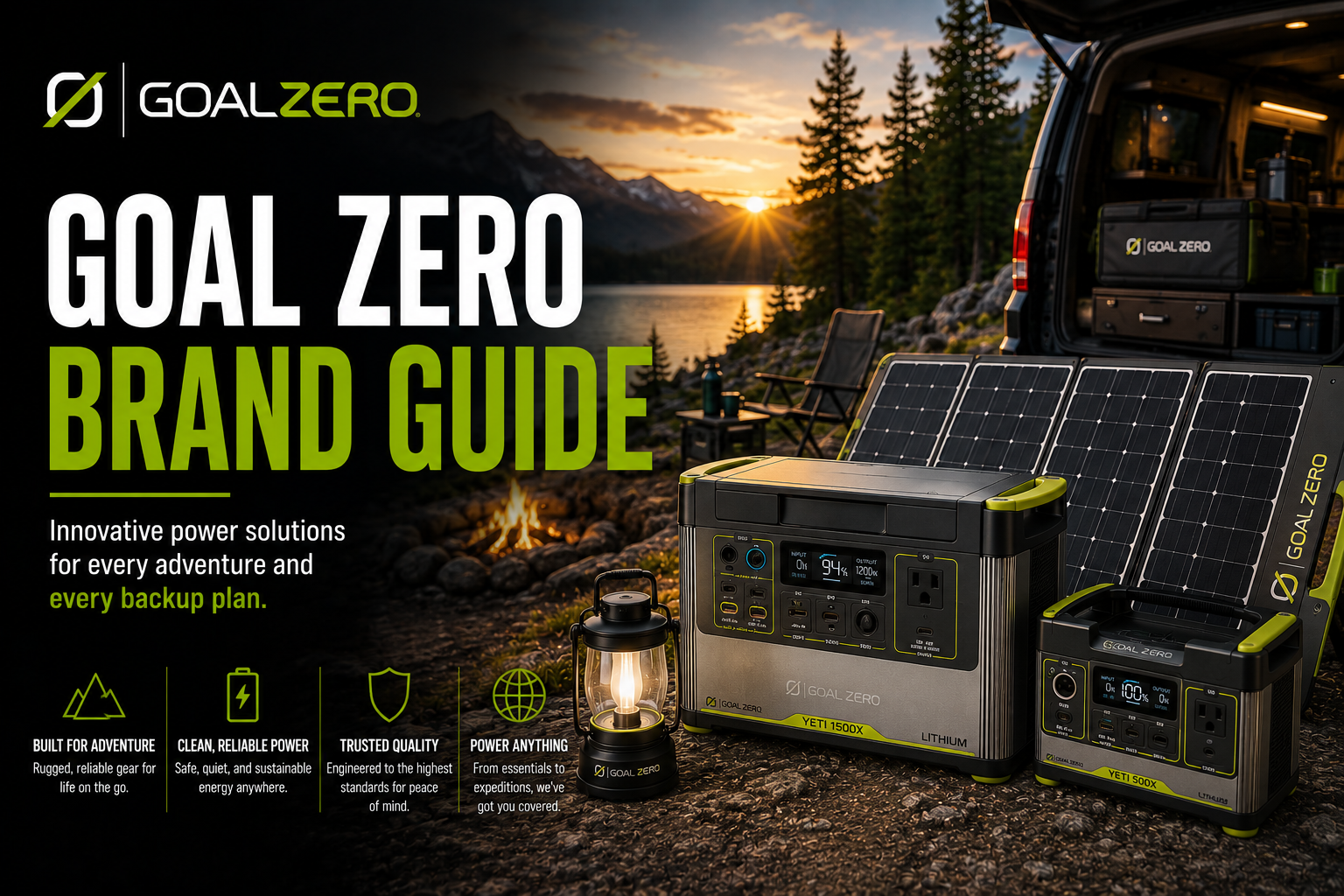
Goal Zero Yeti 1000X vs Yeti 1500X
Choose 1000X for lower weight and 1kWh use; choose 1500X for 52% more energy, 2000W output and compatible Link/Tank expansion.
Choose 1000X for lower weight and 1kWh use; choose 1500X for 52% more energy, 2000W output and compatible Link/Tank expansion.
This comparison separates current products from legacy platforms and examines capacity, output, charging, battery chemistry, accessories and ownership.
Main Difference
Choose 1000X for lower weight and 1kWh use; choose 1500X for 52% more energy, 2000W output and compatible Link/Tank expansion.
Comparison Verdict
Choose 1000X for lower weight and 1kWh use; choose 1500X for 52% more energy, 2000W output and compatible Link/Tank expansion.
Quick Comparison
| Factor | Yeti 1000X | Yeti 1500X |
|---|---|---|
| Capacity | 997Wh | 1516Wh |
| Output | 1500W | 2000W |
| Battery | NMC, 500 cycles to 80% | NMC legacy platform |
| Expansion | Not compatible with Link V3 | Link/Tank support |
| Status | Legacy | No longer available |
Runtime
1500X provides roughly half again as much energy and supports higher continuous loads.
Portability
1000X is the easier legacy unit to move.
Expansion
1500X works with selected Link/Tank systems; Goal Zero states Link V3 is not compatible with 1000X.
Modern Alternatives
The new Yeti 1000 and 1500 use LFP, charge much faster and are better new purchases.
Who Should Buy Each?
Choose Option A
Buy when its size, price or existing accessory compatibility matters most.
Choose Option B
Buy when its capacity, output or newer battery platform justifies the cost.
Skip Both
Choose another size class when neither meets runtime or voltage requirements.
Check Product Status
Legacy Goal Zero models may be discontinued or open-box only.
Verify Accessories
Link, Tank and PRO systems are not universally compatible.
Measure Real Loads
Use running and startup watts.
Frequently Asked Questions
Who should buy Goal Zero Yeti 1000X vs Yeti 1500X?
Buy it when rugged construction, Goal Zero solar compatibility, DC outputs and the model’s capacity class match your real use.
Who should skip Goal Zero Yeti 1000X vs Yeti 1500X?
Skip it when lowest cost per watt-hour, very light weight, native 240V output or deep modern app-controlled expansion is more important.
How should runtime be estimated?
Multiply rated watt-hours by roughly 0.80 to 0.90 for usable AC energy, then divide by average load watts.
Can it run a refrigerator?
Most Yeti 1000-class and larger models can run a refrigerator if startup surge remains inside inverter limits.
Can it charge from solar panels?
Yes, when voltage, current, connector and array wattage stay inside the Yeti input limits.
Can it work as a UPS?
Pass-through and backup behavior varies by generation; verify transfer performance for sensitive electronics.
How should it be stored?
Store cool and dry, avoid extreme temperatures and maintain charge according to the exact battery chemistry and manual.
How long will the battery last?
New LFP Yetis are rated for thousands of cycles, while older X-line NMC models commonly carried much lower cycle ratings.
Are Goal Zero expansion accessories universal?
No. Link, Tank, Tank PRO and model-generation compatibility must be verified carefully.
What is the most common buying mistake?
Assuming every Yeti belongs to one compatible ecosystem despite major differences between X-line, 6th-generation and PRO products.
Should I buy either model new in 2026?
Usually no; current sixth-generation models offer much stronger longevity and charging.
Which legacy model is better for an existing Tank system?
Yeti 1500X.