Goal Zero Portable Power Station Buying Guide
Choose Goal Zero by generation, capacity, inverter output, solar input, weather resistance, DC outputs and expansion compatibility.
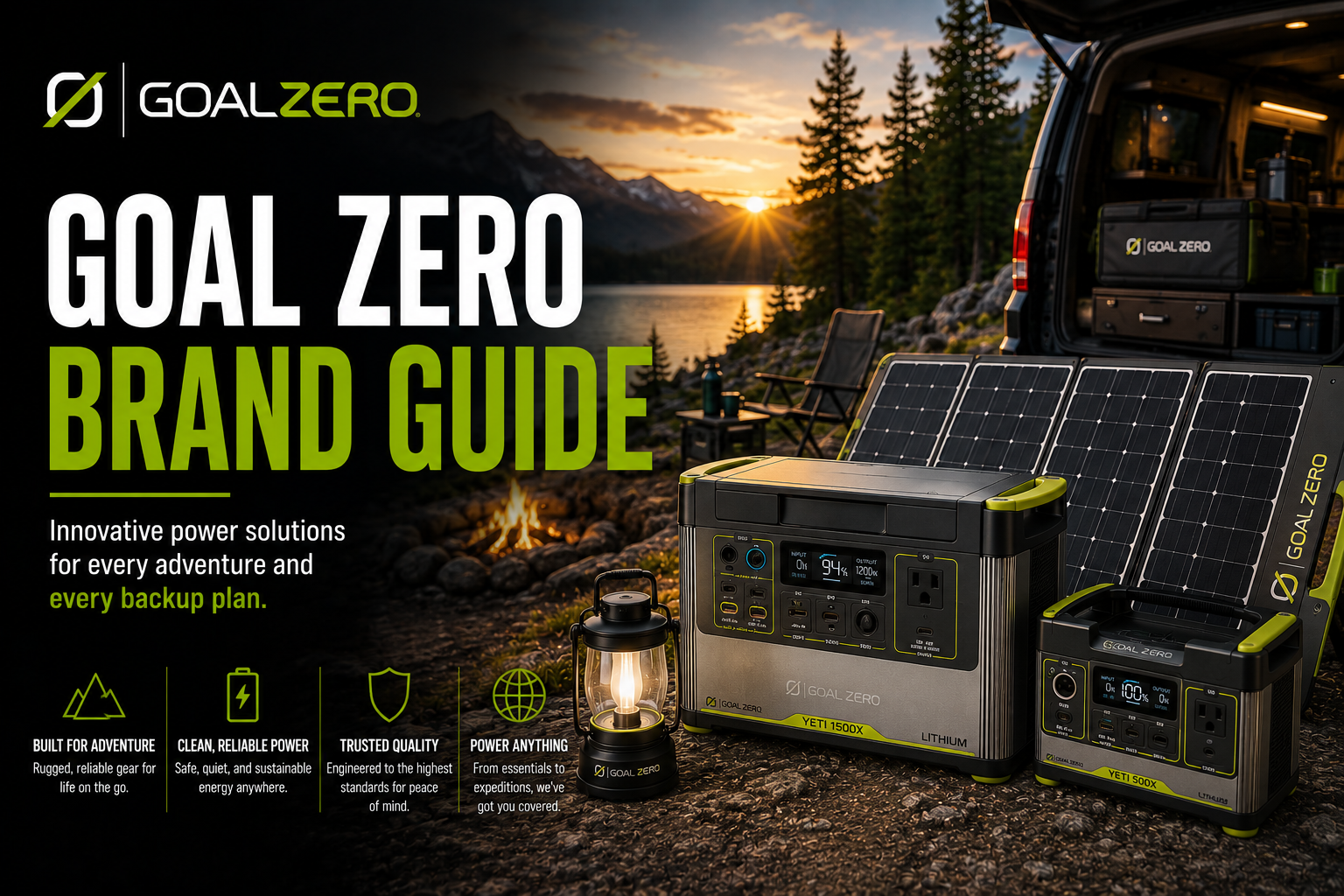
Choose Goal Zero by generation, capacity, inverter output, solar input, weather resistance, DC outputs and expansion compatibility.
Goal Zero’s current lineup is easier to understand once current LFP models are separated from legacy Yeti X products.
This guide explains which model family fits camping, RV, home backup and existing accessory owners.
Choose Current LFP Yetis for New Purchases
Yeti 700 covers camping, Yeti 1000 is the default appliance-capable pick, Yeti 1500 adds runtime and PRO 4000 handles home backup.
Buying Guidance
New buyers should prioritize 6th-generation LFP or PRO products. Legacy X models only make sense at steep discounts or with existing compatible expansion gear.
Goal Zero Product Families
| Family | Battery | Strength | Watch For |
|---|---|---|---|
| Compact 6th Gen | LFP | Rugged portability | Lower output |
| Yeti 1000/1500 | LFP | Fast 2000W-class portable power | Premium price |
| Yeti PRO | LFP | Large home backup | Weight and complexity |
| Yeti X legacy | NMC | Mature accessories | Lower cycle life |
Who Should Buy Which?
Yeti 300
Electronics and minimal travel.
Yeti 500
Camping coolers and laptops.
Yeti 700
Pellet grills and portable fridges.
Yeti 1000
RVs, tools and essentials.
Yeti 1500
Longer appliance backup.
Yeti PRO 4000
Home circuits and large systems.
Charging and Solar
Yeti 700 accepts up to 200W solar, while new Yeti 1500 supports up to 900W across its input system. PRO 4000 supports larger high-power charging and solar configurations.
Ownership and Compatibility
Goal Zero has used 8mm, High Power Port, Link, Tank and PRO accessories across generations. Confirm the exact model and cable standard before ordering.
Common Buying Mistakes
Buying Legacy at New Prices
NMC X-line should be discounted.
Assuming Tank Compatibility
PRO and X-line expansion differ.
Ignoring Output
Small Yetis cannot run kitchen appliances.
Ignoring Charge Time
Older included chargers can be slow.
Overestimating Weather Resistance
Follow the specific IP rating and manual.
Skipping Runtime Math
Premium build does not create extra energy.
Frequently Asked Questions
Who should buy a Goal Zero power station?
Buy it when rugged construction, Goal Zero solar compatibility, DC outputs and the model’s capacity class match your real use.
Who should skip a Goal Zero power station?
Skip it when lowest cost per watt-hour, very light weight, native 240V output or deep modern app-controlled expansion is more important.
How should runtime be estimated?
Multiply rated watt-hours by roughly 0.80 to 0.90 for usable AC energy, then divide by average load watts.
Can it run a refrigerator?
Most Yeti 1000-class and larger models can run a refrigerator if startup surge remains inside inverter limits.
Can it charge from solar panels?
Yes, when voltage, current, connector and array wattage stay inside the Yeti input limits.
Can it work as a UPS?
Pass-through and backup behavior varies by generation; verify transfer performance for sensitive electronics.
How should it be stored?
Store cool and dry, avoid extreme temperatures and maintain charge according to the exact battery chemistry and manual.
How long will the battery last?
New LFP Yetis are rated for thousands of cycles, while older X-line NMC models commonly carried much lower cycle ratings.
Are Goal Zero expansion accessories universal?
No. Link, Tank, Tank PRO and model-generation compatibility must be verified carefully.
What is the most common buying mistake?
Assuming every Yeti belongs to one compatible ecosystem despite major differences between X-line, 6th-generation and PRO products.
What makes the new Yeti 1500 different from 1500X?
LFP chemistry, much faster charging, IPX4 resistance and a newer output/input platform.
Which Yeti is best for an RV?
New Yeti 1000 for portability or Yeti 1500 for longer runtime.