
Best Goal Zero Portable Power Stations: 5 Yeti Models Compared
The best Goal Zero Yeti depends on how much energy you need, which appliances you plan to run, and whether portability or extended backup matters most. We compare five current-generation models, from compact camping batteries to the expandable Yeti PRO 4000.
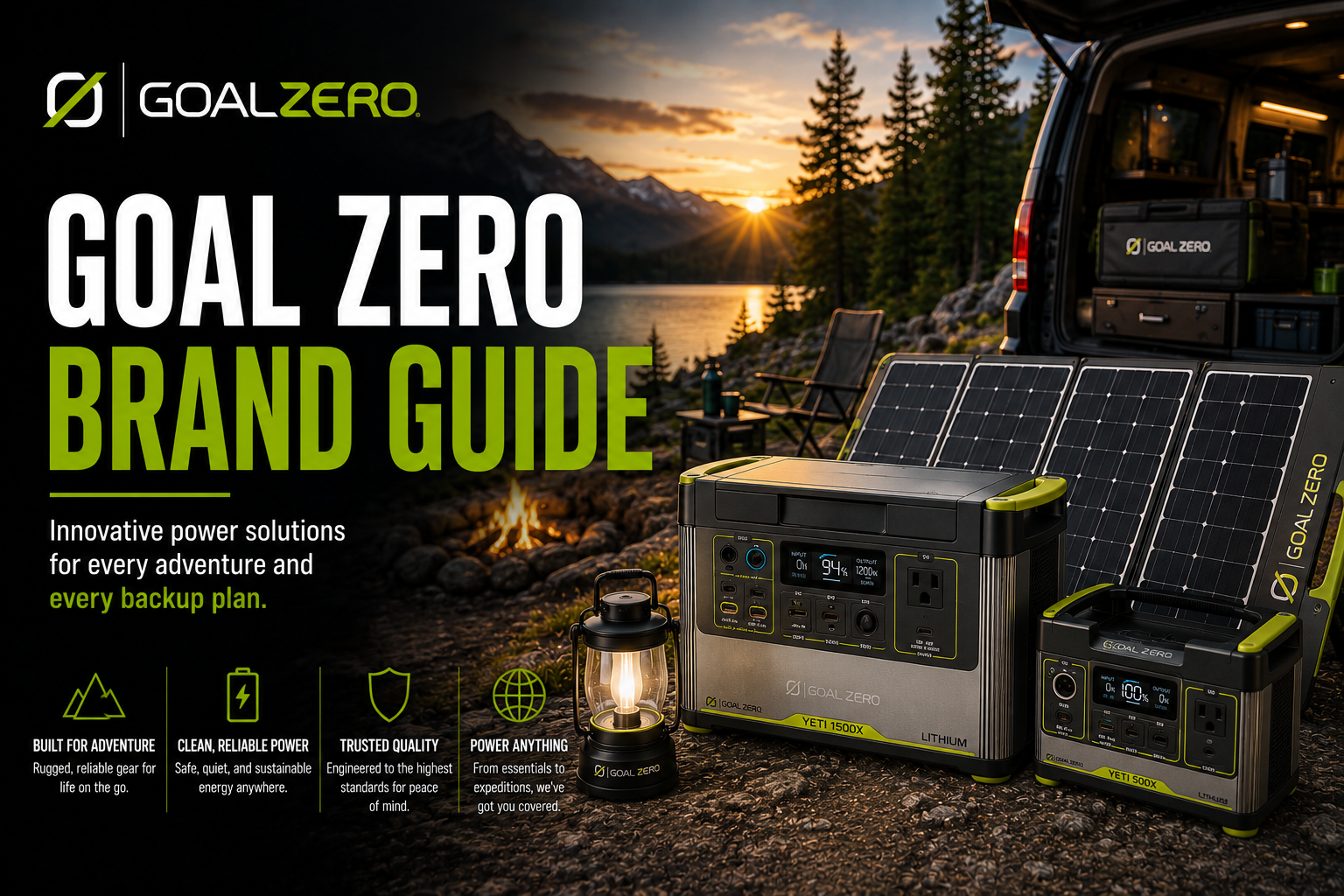
Our overall recommendation is the sixth-generation Goal Zero Yeti 1000 for buyers who want a versatile portable station with enough inverter output for demanding everyday appliances. The Yeti 700 is better for camping, the Yeti 1500 offers longer runtime, and the Yeti PRO 4000 is the specialist choice for substantial backup systems.
Goal Zero's newer sixth-generation Yeti family uses lithium iron phosphate (LiFePO4) batteries, adds faster charging and emphasizes rugged construction. That makes these models more relevant to a new purchase than older Yeti X stations unless the older product is offered at a compelling price and its limitations are understood.
Quick Verdict: Which Goal Zero Yeti Should You Buy?
Best overall — Yeti 1000 (6th Gen): A roughly 1kWh battery with a 2,000W continuous inverter, strong solar input capability and useful 12V outputs.
Best for camping — Yeti 700: A 677Wh battery with 600W continuous AC output. A practical middle ground for campsite electronics, lights and compatible portable coolers.
Best mid-size backup — Yeti 1500 (6th Gen): A 1,505Wh battery and 2,000W continuous inverter for buyers who need more runtime without moving into a 4kWh system.
Best for substantial home backup — Yeti PRO 4000: Nearly 4kWh of stored energy, a 3,600W continuous inverter and compatibility with the dedicated Tank PRO expansion ecosystem.
Best compact all-rounder — Yeti 500: A 499Wh battery with 500W continuous AC output for lighter travel and smaller electrical loads.
Our Five Recommended Goal Zero Models
Yeti 1000
Approximately 1kWh of energy, 2,000W continuous output and up to 900W combined solar input.
Best for: General portable power, camping appliances and emergency essentials.
Yeti 700
677Wh of capacity, 600W continuous output, compact construction and IPX4 water resistance.
Best for: Weekend camping, portable electronics and modest 120V loads.
Yeti 1500
1,505Wh of capacity, 2,000W continuous output and up to 900W combined solar input.
Best for: Longer outages and appliance-capable portable backup.
Yeti PRO 4000
3,993.6Wh capacity, 3,600W continuous output and dedicated expansion options.
Best for: Larger emergency loads and planned home backup systems.
Yeti 500
499Wh of capacity, 500W continuous output and up to 200W solar input.
Best for: Day trips, weekend camping and lower-power devices.
Goal Zero Yeti Comparison Table
These are manufacturer-published specifications for the newer sixth-generation models and the Yeti PRO 4000. Capacities are nominal battery energy, not guaranteed AC energy delivered to an appliance.
| Model | Battery | Continuous AC | Surge | Max Solar Input | Best Use |
|---|---|---|---|---|---|
| Yeti 500 | 499Wh | 500W | 1,000W | 200W | Compact camping |
| Yeti 700 | 677Wh | 600W | 1,000W | 200W | Longer campsite use |
| Yeti 1000 (6th Gen) | About 998Wh | 2,000W | 3,600W | 900W | Versatile portable power |
| Yeti 1500 (6th Gen) | 1,505Wh | 2,000W | 3,600W | 900W | Longer appliance backup |
| Yeti PRO 4000 | 3,993.6Wh | 3,600W | 7,200W | 3,000W | Large backup systems |
Detailed Goal Zero Yeti Reviews
Goal Zero Yeti 1000 — Sixth Generation
The most balanced Goal Zero choice for portable appliance power.
The sixth-generation Yeti 1000 is our best overall choice because it combines a practical battery size with a relatively powerful inverter. Goal Zero lists approximately 998Wh of battery capacity, 2,000W continuous AC output and 3,600W surge capability.
That inverter rating is unusually capable relative to the station's stored energy. It may support short-duration high-wattage tasks, but it does not make the battery suitable for running those loads for many hours.
The station also offers up to 900W combined solar input through separate low-voltage 8mm and high-power HPP connections. This is useful for buyers who plan to recharge from a suitably configured solar array.
Advantages
- 2,000W continuous inverter output.
- LiFePO4 battery chemistry.
- Up to 900W combined solar input.
- High-power 12V DC output.
- IPX4-rated construction.
- Five-year manufacturer warranty category.
Considerations
- About 1kWh of storage limits long high-wattage use.
- Less runtime than the Yeti 1500.
- Not part of the Tank PRO expansion system.
- Availability and pricing may vary by retailer.
Choose it if: you need a portable station capable of powering a variety of compatible appliances without carrying a large home-backup unit.
Skip it if: long runtime is your overriding priority. The Yeti 1500 provides roughly 50% more nominal battery energy.
Check PriceGoal Zero Yeti 700
More stored energy than the Yeti 500 without entering the larger 1kWh class.
The Yeti 700 occupies a useful middle ground for campers. Its 677Wh battery offers more energy than the Yeti 500, while the 600W inverter suits a range of lower-wattage AC devices.
Goal Zero lists 1,000W surge, IPX4 water resistance, app connectivity and up to 200W solar input. The manufacturer also specifies a 100W USB-C output.
The important limitation is inverter power. A 600W continuous rating is not suitable for many kettles, heaters, microwaves or other high-wattage heating appliances.
Advantages
- Useful 677Wh capacity.
- LiFePO4 battery chemistry.
- IPX4 water-resistance rating.
- 100W USB-C output.
- App-enabled monitoring.
Considerations
- 600W continuous AC limit.
- 200W solar-input ceiling.
- Not intended for large home loads.
- No Tank PRO expansion compatibility.
Choose it if: you want a camping station for electronics, lights, selected portable refrigeration and modest AC loads.
Skip it if: you need to operate appliances requiring more than 600W continuously.
Check PriceGoal Zero Yeti 1500 — Sixth Generation
Longer runtime with the same 2,000W continuous inverter class as the new Yeti 1000.
The newer Yeti 1500 increases nominal storage to approximately 1.5kWh while retaining a 2,000W continuous inverter. It is the better choice when runtime matters more than minimizing the station's size.
Goal Zero lists 3,600W surge output, 900W maximum combined solar input, LiFePO4 chemistry and an IPX4 rating. The manufacturer's technical specifications also list a weight of approximately 52.75 pounds.
For household essentials, the extra battery capacity can make a meaningful difference. It does not, however, increase the maximum continuous AC output above 2,000W.
Advantages
- 1,505Wh nominal storage.
- 2,000W continuous AC output.
- Up to 900W combined solar input.
- LiFePO4 battery.
- High-power 12V DC connections.
Considerations
- Much heavier than compact Yetis.
- No native 240V split-phase output.
- Not compatible with Tank PRO expansion.
- More storage does not mean more inverter watts.
Choose it if: you need longer backup duration for compatible household appliances, camping equipment or mobile power loads.
Skip it if: portability is critical or you need multi-kilowatt-hour battery expansion.
Check PriceGoal Zero Yeti PRO 4000
A large expandable battery platform for serious backup and off-grid applications.
The Yeti PRO 4000 is a different class of product from the compact Yetis. Goal Zero specifies 3,993.6Wh of battery capacity, 3,600W continuous AC output and 7,200W surge.
The platform supports dedicated Tank PRO expansion batteries, allowing compatible systems to increase storage capacity. It is intended for buyers who need much longer backup duration than a compact station can provide.
Solar capability is also substantially higher: Goal Zero lists up to 3,000W solar input through its supported high-power connection. Proper array configuration is essential.
Advantages
- Nearly 4kWh of nominal energy.
- 3,600W continuous inverter.
- 7,200W surge rating.
- Dedicated Tank PRO expansion.
- High solar charging capability.
- Manufacturer-supported home integration options.
Considerations
- Heavy and difficult to move frequently.
- Significantly larger investment.
- Home integration requires compatible equipment.
- Not a native 120/240V split-phase power source.
- Expansion accessories require exact model matching.
Choose it if: you are planning substantial emergency backup, long-duration off-grid use or a compatible expanded battery system.
Skip it if: you only need to recharge phones, run campsite lights or support small travel loads.
Check PriceGoal Zero Yeti 500
Compact portable power for electronics and smaller AC appliances.
The Yeti 500 is a practical choice for users who want more capability than a small USB power bank without carrying a 1kWh-class portable station.
Goal Zero lists 499Wh capacity, 500W continuous AC output, 1,000W surge and up to 200W solar input. It uses LiFePO4 cells and shares the newer compact Yeti family's IPX4 rating.
The Yeti 500 is most attractive when portability and moderate energy needs matter more than high inverter output.
Advantages
- Compact 499Wh capacity class.
- LiFePO4 chemistry.
- IPX4 water resistance.
- Fast manufacturer-rated AC recharge.
- Useful USB and AC outputs.
Considerations
- 500W continuous inverter limit.
- Shorter runtime than Yeti 700.
- Not suitable for high-wattage heating appliances.
- Limited solar input compared with larger models.
Choose it if: your loads are primarily phones, laptops, lighting, cameras and modest AC equipment.
Skip it if: you need sustained high-power appliance use or long outage runtime.
Check PriceHow Long Will a Goal Zero Yeti Actually Run?
Battery capacity is measured in watt-hours (Wh). Inverter output is measured in watts (W). They answer different questions:
- Watt-hours: approximately how much energy the battery stores.
- Continuous watts: how much electrical power the inverter can supply while operating within its rating.
- Surge watts: a temporary higher output for compatible startup loads.
A useful planning estimate for AC appliances is:
The 85% assumption allows for conversion losses and some unusable energy. Actual efficiency changes with load, temperature and station behavior.
Illustrative Runtime Estimates
| Model | 50W Average Load | 150W Average Load | 500W Average Load |
|---|---|---|---|
| Yeti 500 | 8.5 hours | 2.8 hours | 0.8 hours* |
| Yeti 700 | 11.5 hours | 3.8 hours | 1.2 hours |
| Yeti 1000 | 17.0 hours | 5.7 hours | 1.7 hours |
| Yeti 1500 | 25.6 hours | 8.5 hours | 2.6 hours |
| Yeti PRO 4000 | 67.9 hours | 22.6 hours | 6.8 hours |
Calculated estimates, not manufacturer test results. *A 500W load is at the Yeti 500's continuous AC rating; practical operation requires allowance for load variation and startup surge. At very low loads, inverter idle consumption can reduce actual runtime substantially.
What About Refrigerators?
Refrigerators cycle their compressors on and off, so their average consumption may be considerably lower than the nameplate running wattage. They can also require a brief higher starting current.
Check the appliance's running watts, starting demand and measured daily energy consumption before selecting a Yeti. Do not assume that a station will run every refrigerator simply because its inverter rating looks sufficient.
Solar Charging: The Compatibility Differences That Matter
Goal Zero supports solar charging across the Yeti lineup, but the input configurations differ significantly. Buying panels based only on wattage is a common mistake.
| Model | 8mm Solar Input | HPP Solar Input | Combined Limit |
|---|---|---|---|
| Yeti 500 | 200W max, 12.3–28V | Not available | 200W |
| Yeti 700 | 200W max, 12.3–28V | Not available | 200W |
| Yeti 1000 (6th Gen) | 300W max, 13.2–30V | 600W max, 12.3–60V | 900W |
| Yeti 1500 (6th Gen) | 300W max, 13.2–30V | 600W max, 12.3–60V | 900W |
| Yeti PRO 4000 | 275W max, 12.3–28V | 3,000W max, 13.3–150V | 3,000W |
These figures are Goal Zero's published input specifications. Each input also has a current limit, and the combined maximum does not override the individual port restrictions.
What Solar Panel Size Makes Sense?
Small Portable Arrays
A compatible portable panel in the 100–200W class is a logical starting point. The station's 200W input ceiling limits how much additional panel power can be used.
A panel's nameplate rating is not a guarantee of actual charging power.
Higher-Input Solar Setups
The separate 8mm and HPP inputs support more flexible solar configurations, with a published combined limit of 900W.
Match panel voltage, current, connector and wiring configuration to the correct input.
For the Yeti PRO 4000, larger solar arrays require more careful electrical planning. The 3,000W input rating does not eliminate the need to verify voltage, current and wiring limits.
How to Choose the Right Goal Zero Yeti
1. Start With Your Actual Loads
Write down the devices you need to operate, their running watts and any startup requirements. Then estimate the number of hours each device must run.
A 1,500W appliance can be compatible with a 2,000W inverter but still drain a 1kWh battery quickly. High output and long runtime are not the same thing.
2. Decide How Often You Will Carry It
For frequent trips, a smaller Yeti may be more useful than a higher-capacity unit that is difficult to move. The Yeti 1500 weighs approximately 52.75 pounds, while the PRO 4000 is a much larger platform.
3. Consider Your Recharge Options
Wall charging is convenient when grid electricity is available. Solar charging becomes more important for extended camping or outages. Car charging can be useful on the road but is typically limited by the vehicle outlet and charging accessory.
4. Check the Exact Battery Generation
Goal Zero has sold several generations with similar names. A Yeti 1000X, Yeti 1000 Core and sixth-generation Yeti 1000 should not be treated as interchangeable.
The older X-family products commonly used NMC lithium-ion batteries, while the newer sixth-generation lineup uses LiFePO4. This affects cycle-life expectations, charging behavior and the relevance of accessories.
5. Understand Expansion Compatibility
Goal Zero's Tank PRO expansion system is intended for compatible PRO-series equipment. Older Yeti Link and Tank accessories belong to different product ecosystems.
6. Compare Warranty Terms by Model
Goal Zero's published US warranty schedule places its sixth-generation Yeti 300, 500, 700, 1000, 1500 and PRO 4000 products in a five-year warranty category. Older X-series products generally fall into a two-year category.
Coverage depends on the written terms, purchase channel and applicable conditions. Review the current warranty before ordering.
Should You Buy an Older Goal Zero Yeti X?
Older Yeti X models remain relevant because they may appear in retail inventories or the used market. They are not automatically poor products, but they should be evaluated differently from the newer LiFePO4 generation.
- A substantially lower purchase price than a suitable newer model.
- Existing compatible accessories you already own.
- Occasional use that does not require frequent deep cycling.
- A clearly documented battery condition and purchase history.
- LiFePO4 chemistry and longer manufacturer-rated cycle life.
- Newer charging and output features.
- Longer published warranty category for eligible sixth-generation models.
- Reduced uncertainty about battery aging when buying new through an authorized seller.
The key buying mistake is comparing only nominal watt-hours and ignoring battery chemistry, age, warranty and output capability.
Common Goal Zero Buying Mistakes
- Buying too little battery: A powerful inverter cannot compensate for insufficient stored energy during a long outage.
- Confusing surge and continuous output: A surge rating is not a continuous operating limit.
- Assuming every Yeti uses the same battery: Older X and newer sixth-generation products differ.
- Buying incompatible solar accessories: Panel voltage, current, connectors and input limits must all match.
- Assuming expansion is universal: Tank PRO, older Tank systems and compact Yetis are not interchangeable.
- Ignoring weight: A station designed for home backup may be impractical for frequent camping.
- Expecting UPS-level protection without verification: Pass-through operation and switching behavior vary by model.
Goal Zero Portable Power Station FAQs
Which Goal Zero Yeti is best overall?
The sixth-generation Yeti 1000 is our best overall recommendation for buyers seeking a versatile portable station. It combines approximately 1kWh of battery energy with a 2,000W continuous inverter and up to 900W combined solar input.
Which Goal Zero Yeti is best for camping?
The Yeti 700 is a strong choice for weekend camping because it offers 677Wh of storage and 600W continuous output. The Yeti 500 is preferable when smaller size matters more than runtime.
Is Goal Zero Yeti 1000 better than Yeti 1500?
Neither is universally better. Both newer sixth-generation models have a 2,000W continuous inverter. The Yeti 1500 offers more battery capacity and longer potential runtime, while the Yeti 1000 is the smaller energy-storage option.
Can a Goal Zero Yeti run a refrigerator?
Some Yetis can operate compatible refrigerators if the compressor's running and startup requirements fall within the station's electrical limits. Runtime depends on the refrigerator's actual energy consumption and the station's usable battery capacity.
Can I use Goal Zero Yeti indoors?
Battery-powered Yeti stations do not produce gasoline generator exhaust during normal battery operation. Follow the manufacturer's ventilation, temperature, moisture and charging instructions. Solar panels may be placed outside while the station remains in an appropriate indoor location.
Can Goal Zero Yeti PRO 4000 power home circuits?
Goal Zero offers compatible home-integration equipment for the PRO platform. Connection to household circuits requires appropriate transfer equipment and qualified installation. Never backfeed a household receptacle.
Does the Yeti PRO 4000 provide 240V split-phase power?
The PRO 4000 should not be assumed to provide native 120/240V split-phase output. Verify the exact output configuration and any approved integration equipment before planning to run 240V household loads.
Are Goal Zero Yeti batteries expandable?
Selected models support specific expansion systems. The Yeti PRO 4000 supports compatible Tank PRO batteries. Do not assume that the compact sixth-generation Yetis support the same accessories.
Are Goal Zero solar panels required?
Not necessarily. Third-party panels may work when electrical specifications, connectors and polarity are compatible. Always verify the complete solar array against the station's input limits and manufacturer instructions.
Can a Yeti replace a dedicated UPS?
Not automatically. Pass-through and backup switching behavior differ between models. Sensitive computers, servers and medical equipment may require dedicated power protection. Confirm compatibility before relying on a portable station.
How long do newer Goal Zero Yeti batteries last?
Goal Zero advertises thousands of charge cycles for its sixth-generation LiFePO4 batteries. Actual battery lifespan depends on temperature, charging conditions, discharge depth and storage practices. A cycle-life rating is not a guarantee of identical performance for every owner.
Final Recommendation: The Best Goal Zero Yeti for Your Needs
Buy the sixth-generation Yeti 1000 for the best balance of portable capacity and inverter power. It is our preferred general-purpose model in the current lineup.
Choose the Yeti 700 for camping, the Yeti 500 for smaller loads and the Yeti 1500 when additional runtime is worth the extra size and weight.
Choose the Yeti PRO 4000 only when its large battery, high output and dedicated expansion capabilities match a genuine home-backup or off-grid requirement.
Before purchasing, confirm your appliance loads, desired runtime, solar input configuration and exact accessory compatibility. Those details matter more than buying the biggest battery available.
Compare Current OptionsSources and Editorial Methodology
This buying guide evaluates Goal Zero models using manufacturer-published capacity, inverter output, battery chemistry, solar input limits, expansion support and warranty documentation. Product rankings are editorial recommendations based on practical use cases rather than fabricated test scores.
We have not represented these evaluations as firsthand testing. Runtime figures are explicitly calculated estimates and not measured performance results. No current price, stock level or discount is guaranteed.
Official Goal Zero References
- Goal Zero Sixth-Generation Yeti Family — current model comparison, capacity, inverter and solar input specifications.
- Goal Zero Yeti 300, 500 and 700 — compact station battery, output and charging information.
- Goal Zero Portable Power Stations — model families and detailed technical specifications.
- Goal Zero Yeti Product Support — model-specific support and compatibility documentation.
- Goal Zero Product User Guides — manuals and technical reference documents.
- Goal Zero Warranty Terms — model-generation warranty categories and coverage conditions.