
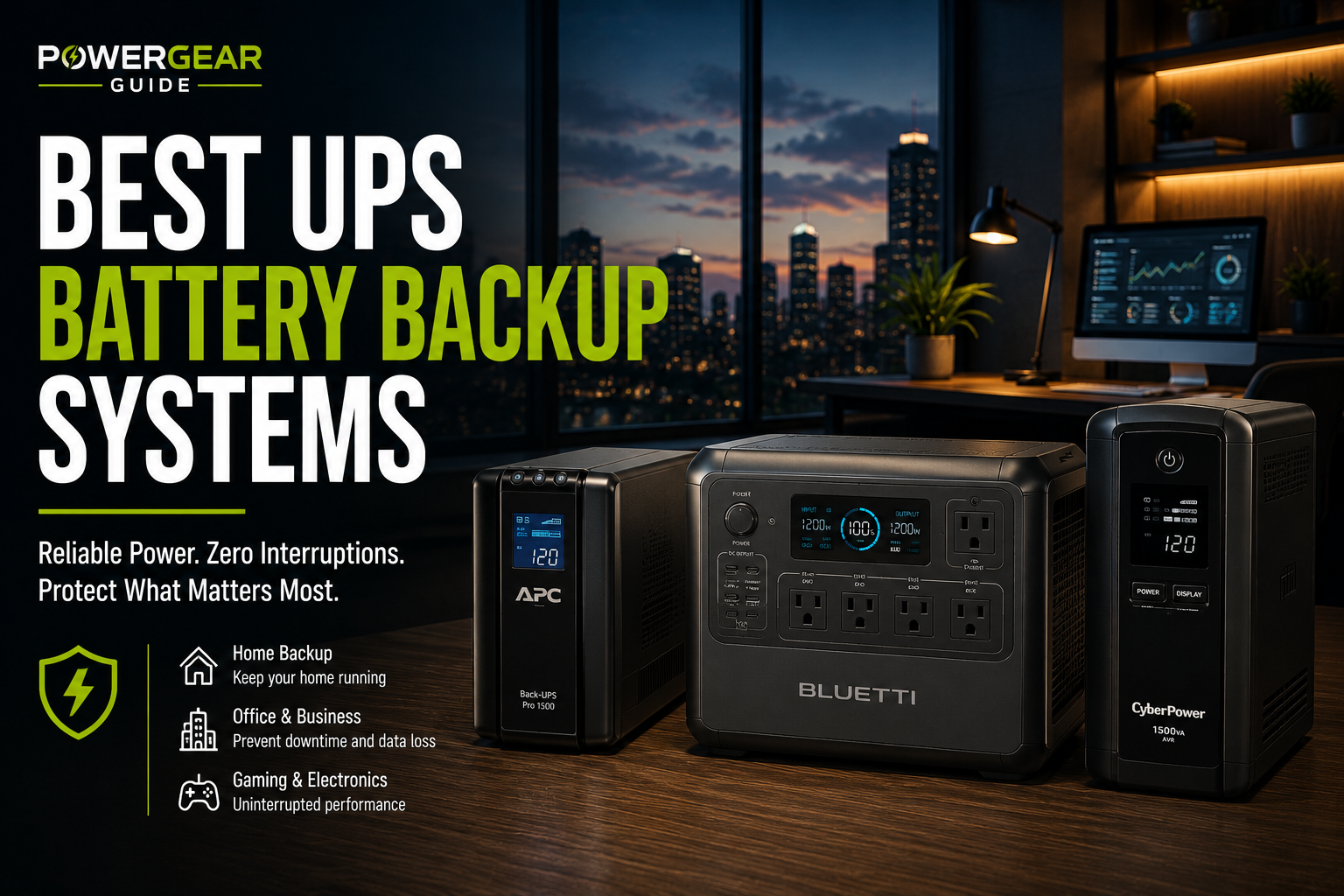
UPS vs Portable Power Station
UPS systems prioritize instant continuity; portable power stations prioritize much longer energy storage.
The best choice depends on whether the load needs seamless transition or long-duration energy.
Many homes and offices benefit from using both systems for different roles.
Use a UPS for Computers and a Power Station for Long Runtime
Choose a UPS for PCs, NAS devices, servers and routers. Choose a portable power station for refrigeration, camping and multi-hour backup.
Comparison Verdict
A power station is not automatically a UPS replacement, and a UPS is not a long-duration battery.
The Main Difference
A UPS is designed for immediate continuity, conditioning and controlled shutdown. A portable power station is designed for longer energy storage and broader appliance use.
UPS vs Portable Power Station
| Factor | UPS | Portable Power Station |
|---|---|---|
| Primary purpose | Electronics continuity | Longer backup and mobile power |
| Transfer | Milliseconds or zero for online UPS | Model dependent |
| Runtime | Minutes to hours | Hours to days |
| Shutdown software | Common | Rare |
| Solar charging | Uncommon | Common |
| Best loads | PCs, NAS, servers and routers | Refrigerators, tools and household essentials |
Best Use Cases
Choose a UPS
You need seamless continuity and shutdown.
Choose a Power Station
You need long runtime and broad appliance support.
Use Both
Combine electronic continuity with extended energy.
Choose Online UPS
The load cannot tolerate transfer delay.
Choose Expandable Storage
You need multi-hour backup.
Use a Dedicated UPS for NAS
Shutdown communication matters.
Runtime Difference
A 1500VA consumer UPS may provide only several minutes near full load, while a 1,000Wh power station can run a 100W load for roughly eight to nine hours after losses.
Limitations
UPS Capacity
Usually too small for appliances.
Power Station Transfer
May be too slow for sensitive PCs.
UPS Solar
Generally unavailable.
Power Station Software
Usually lacks graceful shutdown.
Battery Replacement
UPS batteries are often replaceable.
Weight
Large power stations are much heavier.
Best Combined Setup
Connect critical electronics to a UPS and use a home battery or compatible power station for extended energy when the manuals allow the arrangement.
Frequently Asked Questions
Can a power station replace a UPS?
Only if transfer time and compatibility are suitable.
Which has longer runtime?
Portable power stations usually do.
Which is better for a gaming PC?
A pure sine-wave UPS.
Can a UPS run a refrigerator?
Consumer UPS systems generally should not.
Can I connect a UPS to a power station?
Only if both manufacturers permit it.
Which is better for camping?
A portable power station.