
UPS Battery Backup Buying Guide
Choose a UPS by real watt load, waveform, topology, runtime curve, outlet layout, shutdown software and replaceable-battery support.
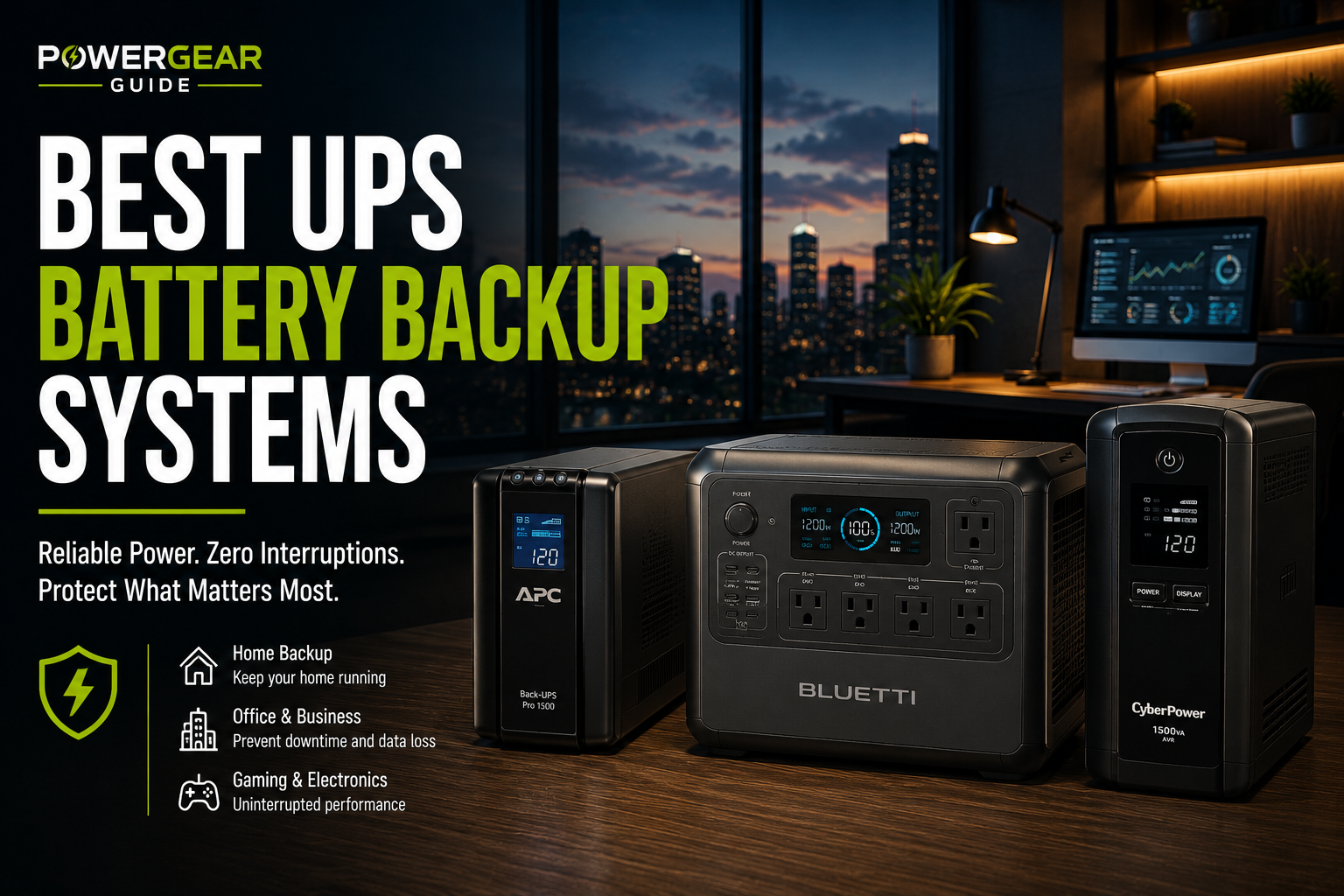
Choose a UPS by real watt load, waveform, topology, runtime curve, outlet layout, shutdown software and replaceable-battery support.
VA is only one specification; the watt rating and runtime at your actual load determine whether the UPS is suitable.
This guide covers home offices, gaming PCs, NAS devices and networking equipment.
For Most Home Offices, Choose a 1,000–1,500VA Line-Interactive Sine-Wave UPS
Leave output headroom and use shutdown software for computers and storage devices.
Buying Guidance
Buy enough runtime for safe shutdown, not an unrealistic attempt to power a workstation for hours.
UPS Types
| Type | Best Use | Tradeoff |
|---|---|---|
| Standby | Basic home electronics | Limited regulation |
| Line Interactive | Home office and gaming | Most common balance |
| Online Double Conversion | Servers and sensitive systems | Higher cost and heat |
| Lithium-Ion UPS | Long service life | Higher purchase price |
How to Size a UPS
Add the real watt draw of connected equipment and choose a UPS whose watt rating leaves at least 20–30% headroom. VA rating alone is not enough.
Sine Wave and Active PFC
Many modern computer power supplies use active power-factor correction and are best paired with a sine-wave UPS, particularly at higher loads.
Runtime Expectations
UPS runtime is designed for bridging and shutdown. At full load, even a 1,500VA unit may provide only a few minutes.
Battery Replacement
Check the Model Number
Use the correct cartridge.
Expect VRLA Aging
Common life is 3–5 years.
Test After Replacement
Run the self-test.
Recycle Properly
Lead-acid batteries require recycling.
Control Heat
High temperature shortens life.
Record the Date
Label replacement month/year.
Frequently Asked Questions
Who should buy a UPS battery backup?
Buy it when the system's continuous output, startup capability, usable capacity and charging method match the actual loads you need to protect.
Who should skip a UPS battery backup?
Skip it when the product is being chosen from headline watt-hours alone or when installation, medical, electrical or building rules make another solution more appropriate.
How should runtime be estimated?
Multiply rated watt-hours by roughly 0.80 to 0.90 for usable AC energy, then divide by the appliance's average running watts.
Why do starting watts matter?
Compressors, pumps and motors can draw several times their normal running power for a short period, so the inverter must handle both continuous and surge demand.
Is LiFePO4 better for frequent use?
LiFePO4 generally offers longer cycle life and strong thermal stability, making it attractive for systems that will be charged and discharged regularly.
Can solar panels recharge the system during an outage?
Yes when the panel voltage, current, polarity and connector match the power station's input limits and sunlight is adequate.
Can a power station be connected directly to a home panel?
Only through manufacturer-approved transfer equipment and qualified installation. Never backfeed a receptacle.
How much reserve capacity should be planned?
A 20% to 30% reserve helps cover inverter losses, cold weather, battery aging and loads that cycle unpredictably.
Should price be compared per watt-hour?
Cost per watt-hour is useful, but output, charging speed, warranty, battery chemistry and accessory compatibility can matter more.
What is the most common buying mistake?
Buying a unit that has enough stored energy but not enough continuous or surge output for the intended appliance.
What is the difference between watts and VA?
Watts are real usable load; VA is apparent power. The UPS must satisfy both ratings.
Is line-interactive UPS good for gaming?
Yes, especially a sine-wave model with enough watt headroom.
How long do UPS batteries last?
APC states typical VRLA battery life is commonly three to five years, while lithium-ion lasts longer.