
Best UPS Battery Backup Systems
The best UPS systems provide sine-wave output, enough watt capacity, automatic voltage regulation and replaceable batteries for computers and networking equipment.
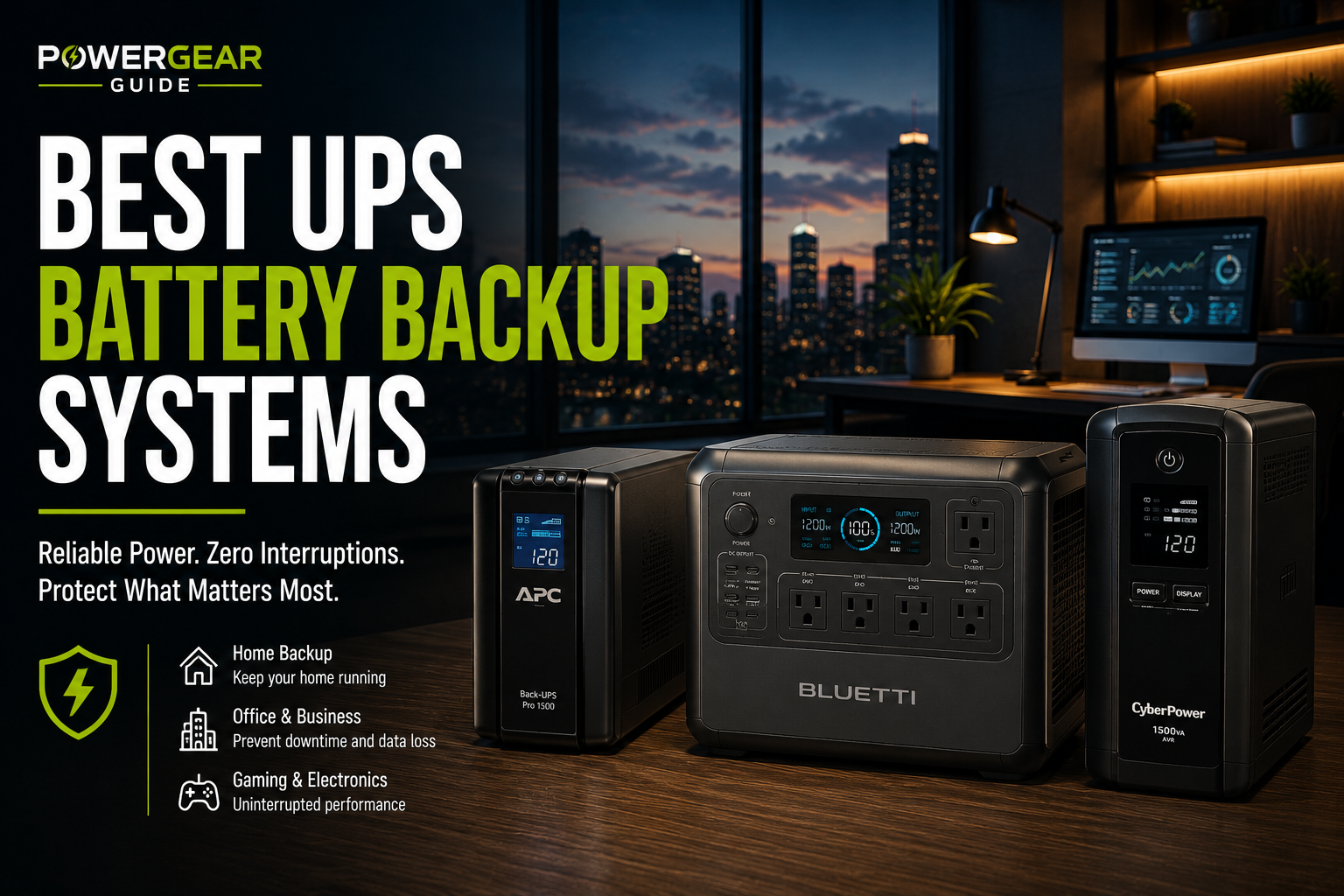
The best UPS systems provide sine-wave output, enough watt capacity, automatic voltage regulation and replaceable batteries for computers and networking equipment.
A UPS is designed for instant continuity and safe shutdown, not hours of household backup.
The strongest home and gaming models are 1,500VA line-interactive systems with 900–1,000W output.
Best Overall: CyberPower CP1500PFCLCD
Its true sine-wave output, 1,000W rating and 12 outlets suit demanding computers and active-PFC power supplies.
Editor's Verdict
Choose a UPS at 50–80% of its watt rating for useful runtime and battery longevity. Use a power station or generator for long outages.
Top Picks
CyberPower CP1500PFCLCD
1,500VA/1,000W line-interactive UPS with true sine-wave output and 12 outlets.
APC Back-UPS Pro BR1500MS2
1,500VA/900W UPS with AVR, LCD, ten outlets and user-replaceable battery.
CyberPower GX1500U
1,500VA/900W sine-wave UPS with 12 outlets and LCD.
Quick Comparison
| Model | Capacity | Output | Best Use |
|---|---|---|---|
| CyberPower CP1500PFCLCD | 1,500VA | 1,000W | Best overall |
| APC BR1500MS2 | 1,500VA | 900W | Best APC |
| CyberPower GX1500U | 1,500VA | 900W | Best value |
CyberPower CP1500PFCLCD
1,500VA/1,000W line-interactive UPS with true sine-wave output and 12 outlets.
CP1500PFCLCD is a strong general-purpose UPS for active-PFC computers, gaming systems and home-office equipment.
Why It Stands Out
- True sine wave
- 1,000W capacity
- Twelve outlets
- LCD
- Replaceable battery support
What to Consider
- Short high-load runtime
- Heavy
- Lead-acid battery replacement
- Not long-outage backup
Best for: gaming PCs, workstations and NAS shutdown.
APC Back-UPS Pro BR1500MS2
1,500VA/900W UPS with AVR, LCD, ten outlets and user-replaceable battery.
BR1500MS2 combines familiar APC support, automatic voltage regulation and replaceable batteries for home-office protection.
Why It Stands Out
- APC support ecosystem
- AVR
- Ten outlets
- USB-A/C
- Replaceable battery
What to Consider
- 900W limit
- Short runtime at high load
- Large tower
- Battery replacement cost
Best for: desktops, monitors, routers and office equipment.
CyberPower GX1500U
1,500VA/900W sine-wave UPS with 12 outlets and LCD.
GX1500U provides sine-wave output and broad outlet coverage at a competitive position.
Why It Stands Out
- Sine wave
- Twelve outlets
- LCD
- USB ports
- PowerPanel software
What to Consider
- 900W ceiling
- Lead-acid battery
- Limited runtime
- Large footprint
Best for: home entertainment and office systems.
How to Choose
Size by Watts, Not VA Alone
Leave 20–30% headroom.
Use Sine Wave for Active PFC
Important for many PCs.
Estimate Runtime at Your Load
UPS runtime drops sharply near full load.
Choose Replaceable Batteries
Extends service life.
Use Shutdown Software
For PCs and NAS.
Do Not Power Motors
Desktop UPS units are for electronics.
Frequently Asked Questions
Who should buy a UPS battery backup?
Buy it when the system's continuous output, startup capability, usable capacity and charging method match the actual loads you need to protect.
Who should skip a UPS battery backup?
Skip it when the product is being chosen from headline watt-hours alone or when installation, medical, electrical or building rules make another solution more appropriate.
How should runtime be estimated?
Multiply rated watt-hours by roughly 0.80 to 0.90 for usable AC energy, then divide by the appliance's average running watts.
Why do starting watts matter?
Compressors, pumps and motors can draw several times their normal running power for a short period, so the inverter must handle both continuous and surge demand.
Is LiFePO4 better for frequent use?
LiFePO4 generally offers longer cycle life and strong thermal stability, making it attractive for systems that will be charged and discharged regularly.
Can solar panels recharge the system during an outage?
Yes when the panel voltage, current, polarity and connector match the power station's input limits and sunlight is adequate.
Can a power station be connected directly to a home panel?
Only through manufacturer-approved transfer equipment and qualified installation. Never backfeed a receptacle.
How much reserve capacity should be planned?
A 20% to 30% reserve helps cover inverter losses, cold weather, battery aging and loads that cycle unpredictably.
Should price be compared per watt-hour?
Cost per watt-hour is useful, but output, charging speed, warranty, battery chemistry and accessory compatibility can matter more.
What is the most common buying mistake?
Buying a unit that has enough stored energy but not enough continuous or surge output for the intended appliance.
How long will a 1,500VA UPS run a computer?
Runtime depends on load; at high load it may be only a few minutes, while lighter office loads can run longer.
Can a UPS run a refrigerator?
Desktop UPS systems are not designed for refrigerator compressor startup or long runtime.