
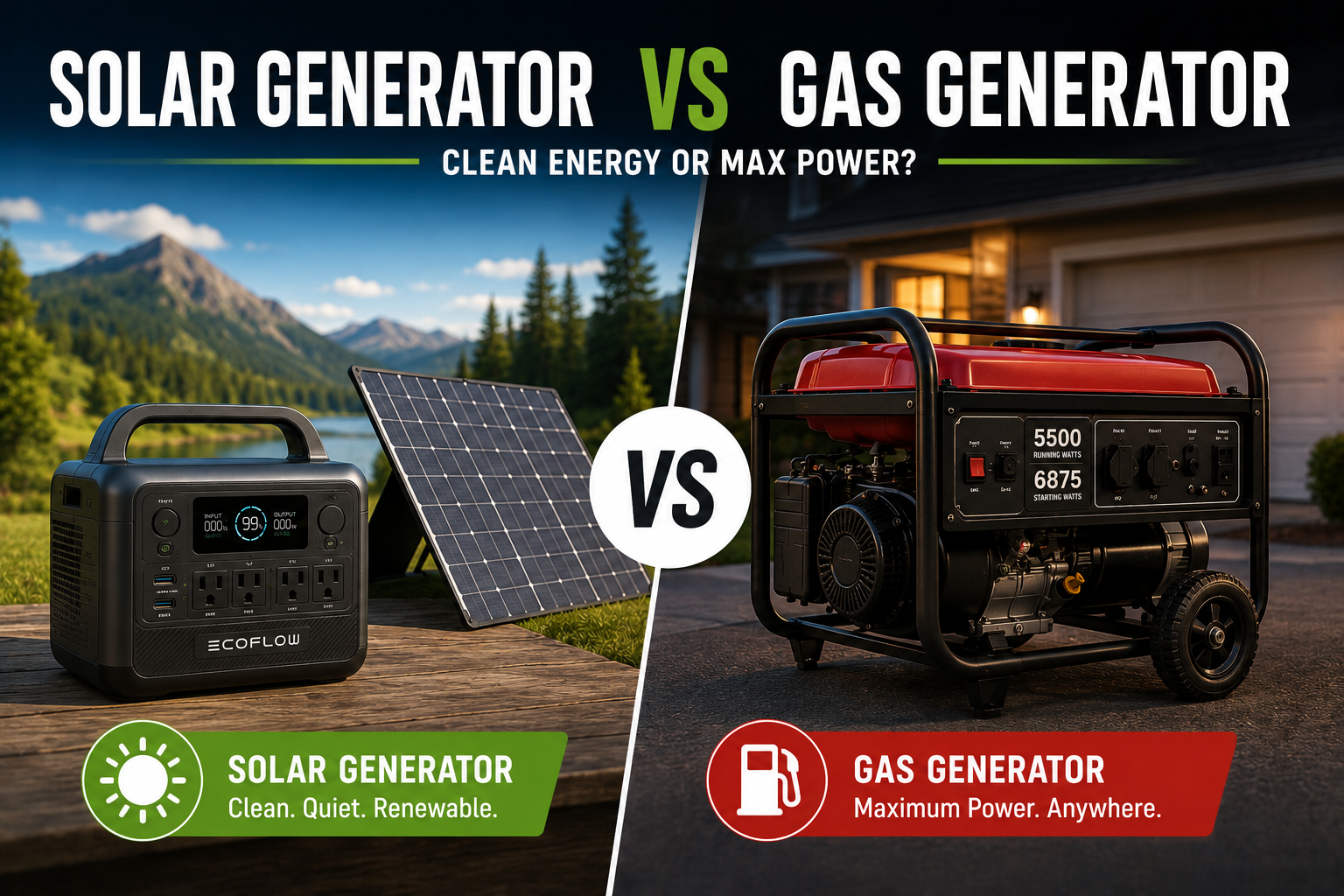
Solar Generator vs Gas Generator
Which Backup Power Option Is Better?
PowerGearGuide may earn a commission from qualifying purchases made through links on this page, at no extra cost to you.
Solar generators and gas generators can both keep essential devices running during an outage, but they solve the problem in very different ways. Solar generators store electricity in a battery and recharge from solar panels, wall power or a vehicle. Gas generators burn fuel to produce electricity on demand. The better option depends on your power needs, outage length, available outdoor space, fuel access, noise tolerance and budget.
Is a Solar Generator Better Than a Gas Generator?
A solar generator is better for quiet indoor backup, electronics, apartments, camping and short-to-moderate outages. A gas generator is better for very high loads and long outages when fuel is available and safe outdoor operation is possible. For broad emergency preparedness, the strongest setup may combine a battery-based solar generator for indoor essentials with a fuel generator outdoors for extended runtime or heavy appliances.
What Is a Solar Generator?
A solar generator is a portable power station paired with one or more solar panels. The power station contains a rechargeable battery, inverter, charge controller and output ports. Solar panels convert sunlight into electricity, which is stored in the battery for later use.
Most systems can also recharge from a household outlet or a vehicle. Because the battery supplies electricity without combustion, a solar generator produces no exhaust during normal operation and is suitable for indoor use when used according to the manufacturer’s instructions.
Solar Generator Advantages
- Quiet operation
- No gasoline or engine oil
- Suitable for indoor use
- Low routine maintenance
- Can recharge from sunlight
- Simple push-button operation
Solar Generator Limitations
- Runtime is limited by battery capacity
- Solar charging depends on weather and panel size
- Large-capacity systems can be expensive
- Heavy loads drain batteries quickly
- Battery capacity declines gradually over time
What Is a Gas Generator?
A gas generator uses an internal-combustion engine to turn an alternator and produce electricity. It can continue running as long as fuel is available, making it useful for long outages, high-wattage appliances, pumps, power tools and equipment that would quickly drain a battery system.
Gas generators must operate outdoors in a safe location because they produce carbon monoxide, heat and exhaust. They also require fuel storage, oil changes and periodic engine maintenance.
Gas Generator Advantages
- Strong continuous power output
- Fast refueling
- Extended runtime while fuel is available
- Lower purchase cost per watt on many models
- Better suited to prolonged high-demand loads
Gas Generator Limitations
- Never safe to operate indoors
- Produces noise, exhaust and vibration
- Requires fuel and engine maintenance
- Fuel can degrade during storage
- May be difficult to start after long periods unused
Solar Generator vs Gas Generator Comparison
| Category | Solar Generator | Gas Generator | Better Choice |
|---|---|---|---|
| Indoor Use | Yes | Never | Solar |
| Noise | Very quiet | Noticeable engine noise | Solar |
| Runtime | Limited by stored energy and recharge rate | Continues while fuel is available | Gas |
| High-Wattage Loads | Depends on inverter size | Strong on properly sized units | Gas |
| Maintenance | Minimal | Oil, fuel and engine care | Solar |
| Operating Cost | Low after purchase | Ongoing fuel expense | Solar |
| Refueling or Recharging | AC, solar or vehicle charging | Fast fuel refill | Depends |
| Weather Dependence | Solar recharge slows in poor sunlight | Less dependent on sunlight | Gas |
| Ease of Use | Plug-and-play | Fueling, starting and outdoor setup | Solar |
| Long Outages | Strong with enough battery and solar input | Strong when fuel remains available | Depends |
Power Output and Appliance Performance
Gas generators generally provide more continuous power for the purchase price. A properly sized model can support larger air conditioners, well pumps, power tools and multiple appliances at once. This makes fuel generators attractive for homes with heavy emergency loads.
Solar generators range from compact units for phones and laptops to expandable systems capable of supporting refrigerators, microwaves, medical equipment and selected household circuits. The key limits are the inverter’s continuous output, surge rating and available battery capacity.
Do not compare only maximum wattage. Check continuous output, surge capability and total stored energy. A system may be powerful enough to start an appliance but still lack enough energy to run it for long.
Runtime During a Power Outage
A solar generator’s runtime is determined by battery capacity and the connected load. A 2,000Wh-class battery does not deliver the full rated capacity through AC outlets because some energy is lost through the inverter and system electronics. Lower average loads extend runtime; heaters, air conditioners and cooking appliances drain batteries much faster.
A gas generator can run for many hours on one tank and continue after refueling. That gives it an advantage during prolonged outages, provided fuel remains available and the generator can be operated safely outdoors.
Solar Charging vs Gas Refueling
Solar charging is renewable and inexpensive after the panels are purchased, but the charging rate depends on panel wattage, weather, season and the power station’s maximum solar-input limit. A system with a small panel may need most of a day or longer to replace a large amount of used energy.
Gas generators are faster to replenish because adding fuel takes only a few minutes. However, fuel must be purchased, transported and stored correctly. During severe regional emergencies, gasoline may be difficult to obtain even when the generator itself is ready to run.
Safety and Indoor Use
A solar generator does not burn fuel while powering devices, so it can normally be used inside a home, apartment, tent or vehicle when the manufacturer permits it and the unit remains dry and unobstructed.
A gas generator produces carbon monoxide and must never run inside a house, garage, basement, shed or other enclosed area. It must also be positioned away from doors, windows and vents according to the manufacturer’s safety guidance. Backfeeding a home through an improvised connection is dangerous; use a properly installed transfer switch or approved interlock system when connecting a generator to household circuits.
Never operate a gas generator indoors or in a partially enclosed space. Install working carbon monoxide alarms and follow all generator placement instructions.
Which Is Better for Nighttime Use?
Solar generators are much better for bedrooms, apartments, campsites and nighttime backup because they produce little more than cooling-fan noise under heavier loads. They can quietly support a router, refrigerator, lights, television, laptop or CPAP machine.
Gas generators remain audible even when placed outdoors. Inverter generators are usually quieter than conventional open-frame models, but they still create engine noise that may disturb neighbors or violate campground quiet-hour rules.
Upfront Cost, Fuel Cost and Maintenance
For occasional heavy emergency use, a gas generator may deliver better value per watt. For frequent quiet use, camping, electronics and recurring short outages, a solar generator can justify its higher initial price through convenience, low operating cost and minimal maintenance.
Which Is Easier to Store and Move?
Compact solar generators are easier to carry and store than many fuel generators because they do not require gasoline containers, engine oil or outdoor operation. Larger battery systems can still be heavy, especially when expansion batteries and solar panels are included.
Gas generators often use wheels and folding handles, but the engine, fuel tank and steel frame add weight. Transport also requires attention to fuel leakage, ventilation and hot engine parts.
Which Generator Is Better for Your Situation?
Short Home Outages
A solar generator is usually better for refrigerators, routers, phones, lights and electronics because it works quietly indoors.
Multi-Day Outages
A gas generator is often stronger for prolonged high loads, while a large solar system can work well when battery capacity and panel input are sufficient.
Apartments and Condos
A solar generator is generally the practical choice because many residents lack a safe outdoor location for a fuel generator.
Camping and RV Use
Solar is ideal for quiet electronics and small appliances. Gas is better when an RV air conditioner or other heavy load must run for extended periods.
Medical Equipment
A solar generator is preferable for quiet indoor use. Verify runtime, output and transfer behavior for the exact device.
Tools, Pumps and Large Appliances
A gas generator is often more practical because it can deliver high output for longer without waiting for a battery to recharge.
Who Should Choose a Solar Generator?
Choose Solar If You Need
- Indoor emergency power
- Quiet nighttime operation
- Backup for electronics and medical devices
- Apartment-friendly power
- Low maintenance
- Solar recharging for camping or off-grid use
Solar May Not Be Enough If You Need
- Central air conditioning for long periods
- Continuous electric heating
- Large well pumps or workshop loads
- Several days of heavy power without strong solar input
Who Should Choose a Gas Generator?
Choose Gas If You Need
- High continuous output
- Fast refueling
- Long runtime for large appliances
- Backup for pumps, tools or air conditioners
- Lower upfront cost per watt
Gas May Be a Poor Fit If You Have
- No safe outdoor operating location
- Noise restrictions
- Limited fuel-storage space
- Low tolerance for engine maintenance
- Apartment or indoor-only use
Solar Generator or Gas Generator: Which Should You Buy?
Choose a solar generator when quiet indoor operation, simple controls, low maintenance and backup for essential electronics matter most. Choose a gas generator when you need more power for longer periods and can safely operate it outdoors with a reliable fuel supply.
For many households, a solar generator is the better everyday backup tool, while a gas generator remains the stronger emergency option for prolonged high-demand loads. A hybrid setup offers the broadest protection by combining clean indoor power with refillable outdoor generation.
Solar Generator vs Gas Generator FAQ
Can a solar generator replace a gas generator?
A solar generator can replace a gas generator for phones, laptops, lights, routers, televisions, CPAP machines, refrigerators and selected small appliances. It may not replace a fuel generator for prolonged central air conditioning, electric heating, large pumps or other continuous high-wattage loads unless the battery system is very large.
Which is better during a long power outage?
A gas generator is often better for long outages when fuel remains available because it can be refilled quickly. A solar generator can also work well when paired with enough battery capacity and solar-panel input, but recharge speed depends on sunlight and system size.
Can a gas generator be used indoors?
No. A gas generator produces carbon monoxide and must never be used inside a home, garage, basement, shed or partially enclosed area. Follow the manufacturer’s required outdoor placement distances and use working carbon monoxide alarms.
Are solar generators really silent?
They are not completely silent because cooling fans may run under load or while charging, but they are dramatically quieter than engine generators and are generally suitable for nighttime indoor use.
How long does a solar generator last?
Runtime depends on usable battery capacity and the connected load. Long-term service life depends on battery chemistry, cycle count, temperature and storage habits. LiFePO4-based systems generally support more charge cycles than older lithium-ion chemistries.
Is solar power cheaper than gasoline?
After the solar panels and battery system are purchased, solar charging can be very inexpensive. Gas generators usually cost less upfront for a given power output but continue to require fuel and maintenance.
Can a solar generator run a refrigerator?
Yes, provided the inverter can handle the refrigerator’s starting surge and the battery has enough usable capacity. Runtime varies by refrigerator efficiency, ambient temperature, compressor cycling and battery size.
Which is better for camping?
A solar generator is usually better for quiet campsites, electronics, lights and portable refrigerators. A gas generator may be better for extended RV air-conditioner use where generators are permitted.