
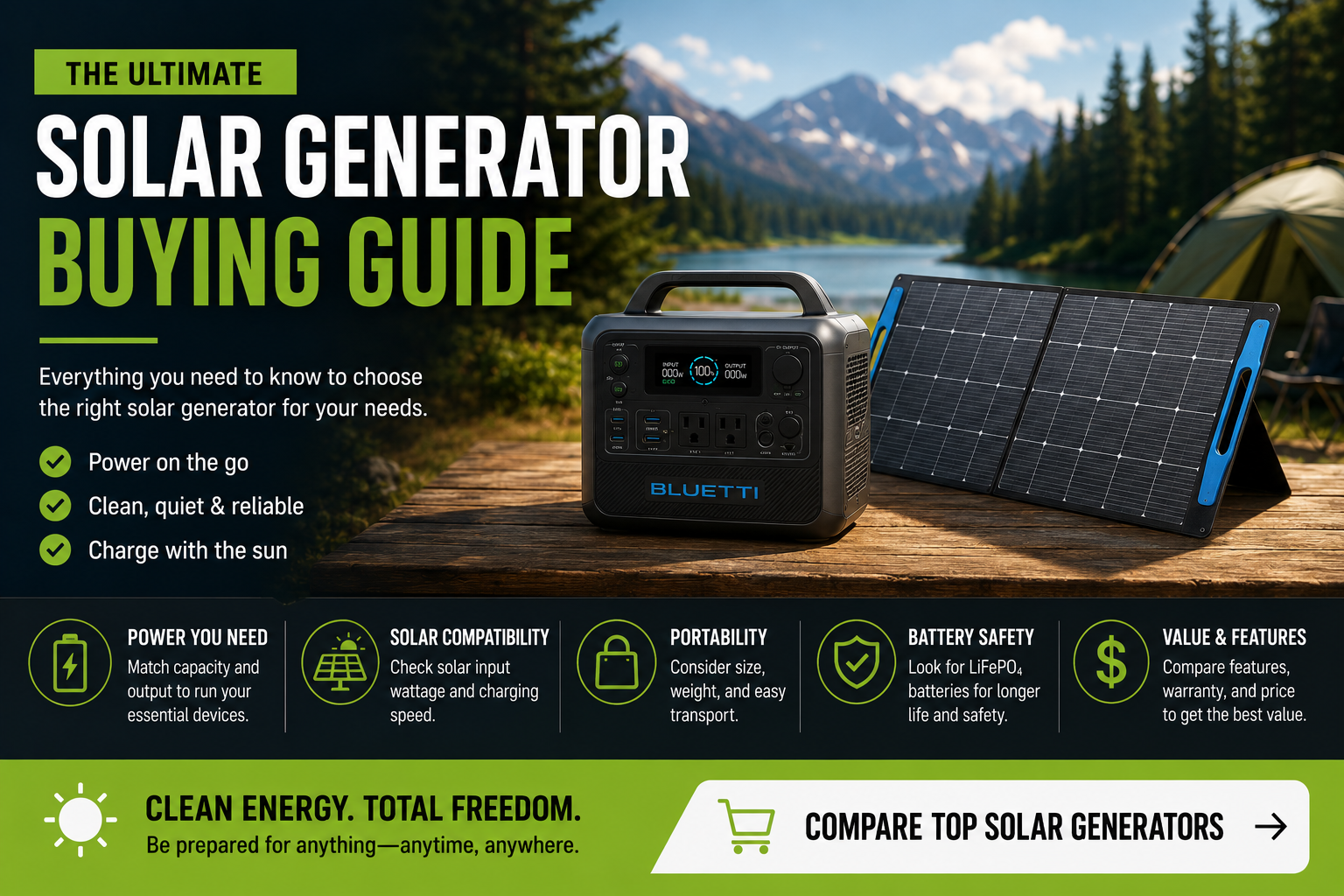
Solar Generator Buying Guide (Everything You Need to Know)
Learn how solar generators work, which specifications matter, and how to choose the right system for home backup, camping, RV travel, emergencies, or off-grid use.
PowerGearGuide may earn a commission from qualifying purchases made through links on this page, at no extra cost to you.
Learn how solar generators work, which specifications matter, and how to choose the right system for home backup, camping, RV travel, emergencies, or off-grid use.
Buying a solar generator can feel complicated because capacity, inverter output, charging speed, battery chemistry, solar-input limits, weight, and expansion options all affect real-world performance.
Two systems with similar prices can serve completely different buyers. A lightweight unit may be ideal for camping but too small for a refrigerator during a long outage. A large home-backup platform may offer excellent runtime but be unnecessarily expensive and difficult to move.
The goal is not to buy the largest battery available. The goal is to match the system to your appliances, expected runtime, charging plan, portability needs, and budget.
Focus on Seven Specifications
For most buyers, the key specifications are battery capacity in watt-hours, continuous inverter output, surge output, battery chemistry, maximum solar input, charging speed, and expansion options.
A mid-size LiFePO4 system with enough output for your largest appliance, adequate solar input, and room for future battery expansion usually offers the best long-term value.
What Is a Solar Generator?
A solar generator is a rechargeable battery power system that stores electricity and delivers it through AC, USB, and DC outputs. It usually combines a battery, inverter, solar charge controller, display, ports, and safety electronics in one enclosure.
The system does not generate electricity in the same way as a gasoline engine. Solar panels produce electricity, while the power station stores and converts that energy for later use.
Solar panelsConvert sunlight into DC electricity. Charge controllerRegulates incoming solar power before it reaches the battery. BatteryStores electrical energy for later use. InverterConverts stored DC energy into household AC power.Most solar generators can also recharge from a wall outlet, vehicle connection, or compatible fuel generator. That flexibility is important during cloudy weather or extended outages.
Battery Capacity Explained
Battery capacity is measured in watt-hours, abbreviated Wh. It indicates how much energy the battery can store.
| Capacity | Typical Uses | Best For |
|---|---|---|
| 300–600Wh | Phones, laptops, lights, cameras | Day trips and light camping |
| 700–1,200Wh | CPAP, fans, TVs, portable refrigerators | Weekend camping and emergency essentials |
| 1,500–2,500Wh | Refrigerators, cooking appliances, tools | RVs and medium home backup |
| 3,000Wh+ | Multiple appliances and longer outages | Home backup and off-grid use |
| Expandable systems | Large appliances and household circuits | Whole-home backup |
How to Estimate Runtime
Start with the appliance's average wattage, then divide the battery's usable watt-hours by that load. Real runtime will be lower than the simple calculation because of inverter losses, standby consumption, temperature, and changing appliance behavior.
Simple exampleA 1,000Wh power station running a steady 100W load may provide roughly eight to nine hours after normal conversion losses. A refrigerator is harder to estimate because its compressor cycles on and off.
Do Not Oversize Automatically
Larger batteries cost more, weigh more, and take longer to recharge. Buy enough capacity for your real backup plan, then add a reasonable reserve for losses, unexpected loads, and battery aging.
Inverter Output: What the System Can Run
Battery capacity determines how long a system can run. Inverter output determines which appliances it can operate.
| Device | Typical Running Power | Important Note |
|---|---|---|
| Phone charger | 10–30W | Very low demand |
| Laptop | 45–140W | USB-C output may avoid inverter losses |
| Television | 60–200W | Depends heavily on screen size |
| Refrigerator | 100–400W | Startup surge can be much higher |
| Coffee maker | 800–1,500W | High draw but usually short runtime |
| Microwave | 1,000–1,800W | Input wattage may exceed advertised cooking wattage |
Continuous vs Surge Output
Continuous output is the power the inverter can sustain. Surge output is the short burst available when motors and compressors start. Refrigerators, pumps, compressors, and tools may briefly draw several times their normal running wattage.
Do not size from average watts aloneVerify both running and startup requirements for your most important appliance. A battery can have plenty of stored energy and still fail to start a load if the inverter is undersized.
LiFePO4 vs Traditional Lithium-Ion
Battery chemistry affects cycle life, weight, thermal behavior, and long-term value.
| Factor | LiFePO4 | Traditional Lithium-Ion |
|---|---|---|
| Cycle life | Usually much longer | Usually shorter |
| Thermal stability | Excellent | Good with proper battery management |
| Weight | Often heavier | Often lighter |
| Best use | Frequent use and home backup | Maximum portability |
| Long-term value | Usually stronger | Depends on weight priorities and price |
LiFePO4 is generally the preferred choice for new solar generators intended for regular charging, home backup, RV use, or long ownership. Traditional lithium-ion can still make sense when minimizing weight is the top priority.
For a detailed chemistry comparison, read LiFePO4 vs Lithium-Ion Power Stations.
Solar Input and Panel Sizing
Maximum solar input tells you how much panel power the station can accept. Higher solar input can shorten recharge time, but only when the connected panels, sunlight, voltage, current, and temperature allow it.
Up to 300WAppropriate for compact camping systems and light daily use. 500–1,200WWell suited to mid-size power stations, RV use, and meaningful outage recovery. 2,000W+Designed for larger home-backup and off-grid platforms.Panel Ratings Are Idealized
A 400W panel array will not produce 400W all day. Real output falls with clouds, shade, heat, poor angle, seasonal sun, wiring losses, and dirt.
Check Voltage and Current Limits
Panel wattage is not the only compatibility requirement. Verify the power station's accepted solar voltage range, current limit, connector type, polarity, and maximum open-circuit voltage before connecting panels.
Panels may not be includedMany listings sell the power station alone. Confirm whether the exact package includes panels, cables, adapters, extension leads, and mounting hardware.
Charging Speed and Charging Methods
Most solar generators support several charging methods. The best choice depends on how quickly you need to recover and which power sources are available.
01AC Wall Charging
Usually the fastest and most predictable method. Some systems can reach a high state of charge in about one to two hours.
02Solar Charging
Ideal for renewable recovery and off-grid use, but performance changes with weather and panel positioning.
03Vehicle Charging
Useful during road trips, though basic 12V outlets are often slow. Dedicated alternator chargers can be much faster.
04Generator Charging
A fuel generator can recharge the battery quickly during long cloudy periods, reducing the time the engine must run.
Expansion Batteries and Future Growth
Expandable systems allow you to add battery modules later. This can be more economical than replacing the entire platform when your needs grow.
Longer runtimeAdditional batteries increase stored energy without changing the main power station. Gradual investmentStart with the base unit and add capacity when your budget or needs change. Home-backup flexibilityModular systems can support longer outages and more circuits. Important limitationExtra batteries may increase runtime without increasing inverter output.Confirm compatible battery models, maximum expansion capacity, cable requirements, stacking rules, warranty coverage, and whether all batteries can charge simultaneously.
Portability and Physical Design
Weight becomes a major ownership factor once capacity exceeds roughly 1–2kWh.
| System Size | Typical Weight Range | Mobility |
|---|---|---|
| Compact | 10–25 lb | Easy one-person carrying |
| Mid-size | 30–60 lb | Portable, but less convenient over distance |
| Large | 70–120 lb | Best with wheels or a cart |
| Whole-home modules | Often 100 lb or more per component | Usually semi-permanent |
Also check handles, wheels, telescoping grips, dimensions, stair access, vehicle loading, storage space, fan noise, and ventilation requirements.
Ports, Outlets, and Special Features
01AC Outlets
Count matters, but total inverter output matters more. Multiple outlets still share the same overall power limit.
02USB-C Power Delivery
High-output USB-C can run laptops directly and reduce conversion losses compared with an AC charger.
03RV and High-Current Ports
RV outlets, Anderson connectors, and regulated DC outputs may be important for travel and off-grid equipment.
04UPS or EPS Mode
Automatic transfer can protect routers, computers, medical devices, and home-office equipment, but transfer times vary.
05Mobile App
Apps can monitor usage, schedule charging, set battery limits, manage ports, and update firmware.
06120V and 240V Support
Large pumps, dryers, HVAC, and other household equipment may require split-phase 240V power or specialized integration.
Choosing a Solar Generator by Use Case
Home Backup
Prioritize capacity, inverter output, surge capability, battery expansion, high solar input, and compatible transfer or home-panel equipment.
| Home Backup Level | Suggested Capacity | Suggested Output |
|---|---|---|
| Apartment essentials | 1–2kWh | 1,500–2,400W |
| Average household essentials | 2–5kWh | 2,400–4,000W |
| Whole-home platform | 6kWh and expandable | High-output 120V/240V system |
Camping
Prioritize manageable weight, quiet operation, USB-C power, efficient solar charging, weather protection, and enough capacity for refrigeration, lighting, and electronics.
RV Travel
Look for RV outlets, alternator charging support, roof-panel compatibility, regulated DC outputs, expandable batteries, and secure storage dimensions.
Off-Grid Living
Evaluate the full energy system rather than the battery alone. Daily consumption, seasonal sunlight, panel size, battery reserve, charging redundancy, and expansion matter more than a single headline specification.
Emergency Preparedness
Choose a system that can remain charged, operate essential loads safely, recharge through more than one method, and be moved or stored reliably during storms and outages.
Common Solar Generator Buying Mistakes
Buying too smallCompact units may charge electronics but fail to run refrigerators, microwaves, or pumps. Buying too largeAn oversized system costs more, weighs more, and may remain underused. Ignoring startup surgeMotor-driven appliances may exceed the inverter limit for a few seconds. Ignoring solar inputA large battery with a small solar limit can take days to recover. Assuming panels are includedMany listings are power-station-only packages. Ignoring connector limitsWrong voltage, current, or polarity can prevent charging or damage equipment. Forgetting expansion limitsNot every platform supports future batteries or higher output. Underestimating weightLarge systems may be movable on wheels but impractical for stairs or frequent travel.Confirm These Details Before Ordering
- Battery capacity matches your required runtime.
- Continuous output exceeds your combined running loads.
- Surge output can start compressors, pumps, and tools.
- Battery chemistry matches your lifespan and weight priorities.
- Solar input is large enough for realistic daily recovery.
- Panel voltage, current, polarity, and connectors are compatible.
- The exact package includes the panels and cables you expect.
- Weight and dimensions fit your storage and transport plan.
- Expansion batteries are available and compatible.
- Warranty, support, firmware, and replacement accessories are credible.
Buy for Your Appliances, Not the Marketing Headline
The best solar generator is the one that safely powers your essential devices for the required time and can recharge through a realistic panel setup.
For most buyers, LiFePO4 chemistry, adequate surge output, strong solar input, multiple charging methods, and expansion support are more valuable than chasing the largest advertised battery.
Home-backup buyers should prioritize scalable systems and 120V/240V compatibility. Campers should prioritize weight and efficient charging. RV and off-grid users should focus on the entire energy ecosystem, including panels, alternator charging, DC outputs, and battery expansion.
Frequently Asked Questions
Are solar generators worth buying?
They can be worthwhile for quiet backup power, camping, RV use, and emergency preparedness. Their value is strongest when the system is correctly sized and used regularly.
How large of a solar generator do I need?
Add the energy used by your essential devices, include conversion losses and reserve capacity, then choose an inverter that can handle both running and startup loads.
Can a solar generator replace a gas generator?
It can replace a gas generator for many indoor, camping, and essential-backup situations. Gas generators may remain better for continuous high-power operation when fuel is readily available.
Is LiFePO4 better than lithium-ion?
LiFePO4 is generally better for frequent use and long ownership because of its cycle life and thermal stability. Traditional lithium-ion can still be useful when lower weight is more important.
Do I need solar panels immediately?
No. Most systems can charge from an AC wall outlet or vehicle. Solar panels can be added later if the power station supports the required voltage, current, and connector type.
How long do solar generators last?
Service life depends on battery chemistry, cycle rating, storage conditions, temperature, charging behavior, and usage. Modern LiFePO4 systems are commonly designed for thousands of cycles.
How many solar panels do I need?
Divide your desired charging power by the rated wattage of each panel, then confirm the total array remains within the power station's voltage, current, and wattage limits.
Can a solar generator run a refrigerator?
Many can, provided the inverter supports the refrigerator's startup surge and the battery has enough capacity for the expected duty cycle and outage duration.
Can I use third-party solar panels?
Often yes, but compatibility must be confirmed. Check connector type, polarity, operating voltage, open-circuit voltage, current, and maximum solar-input limits.
Related PowerGearGuide Articles
PowerGearGuide researches portable power stations, solar generators, battery technologies, and home-backup systems using manufacturer specifications, technical documentation, and practical use-case analysis. We do not claim hands-on testing unless it actually occurred.