
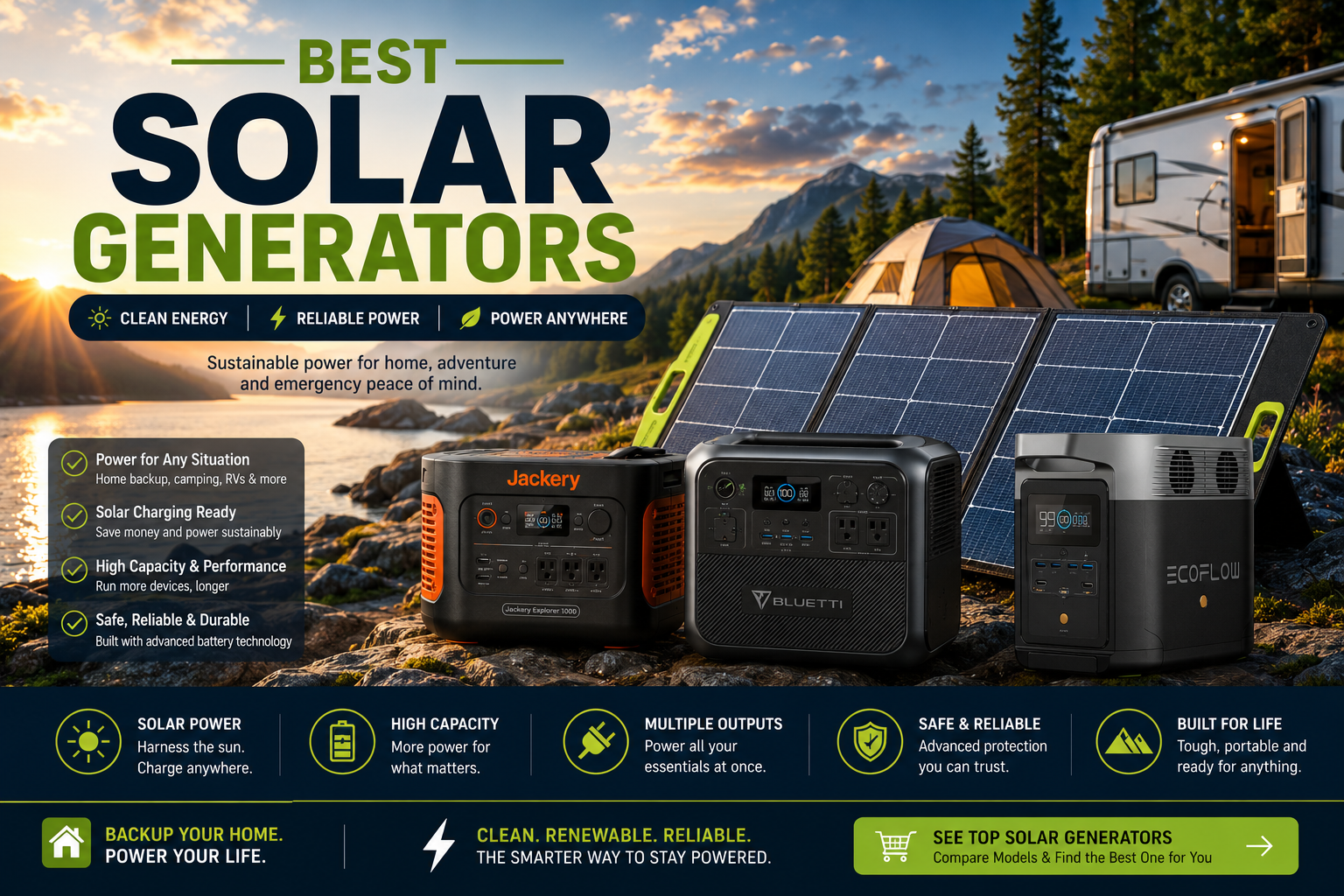
Best Solar Generators (Reliable Backup Power Without Fuel)
Compare dependable solar generators for home backup, camping, RV travel, emergencies, and off-grid power—without storing gasoline or running a noisy engine.
PowerGearGuide may earn a commission from qualifying purchases made through links on this page, at no extra cost to you.
Compare dependable solar generators for home backup, camping, RV travel, emergencies, and off-grid power—without storing gasoline or running a noisy engine.
The best solar generators combine a capable portable power station with compatible solar panels, giving you rechargeable backup power without fuel storage, exhaust, or the constant noise of a gas engine.
Modern systems are far more capable than early portable batteries. Leading models now use long-life LiFePO4 cells, powerful pure sine wave inverters, fast wall charging, expandable battery packs, high solar-input limits, and app-based energy monitoring.
The right system depends on how you plan to use it. A compact camping setup should prioritize weight and manageable panel size. A home-backup system needs more capacity, higher inverter output, expandable batteries, and enough solar input to recover meaningful energy during daylight hours.
We compared current manufacturer specifications, battery technology, capacity, output, solar charging, expansion options, portability, and use-case value. We did not claim hands-on testing where none occurred.
The Best Solar Generator Depends on How Much Power You Need
EcoFlow DELTA Pro Ultra is our top home-backup choice because it starts with 6kWh of battery storage and 7,200W of output, then scales for larger whole-home systems.
Anker SOLIX F3800 is the strongest heavy-duty alternative, offering 120V/240V output, 6,000W AC power, high solar input, and expandable storage. For a more portable balance of output and capacity, the BLUETTI AC200L stands out, while the Jackery Solar Generator 1000 Plus is the easiest recommendation for frequent travel and camping.
Editor’s Shortlist
Best Overall Home BackupEcoFlow DELTA Pro Ultra
A high-output, expandable whole-home platform for buyers who want serious outage protection and room to grow.
9.8PowerGearScore Read Review Best Heavy-Duty System
Anker SOLIX F3800
Strong 120V/240V output, high solar input, EV and RV connections, and flexible battery expansion.
9.7PowerGearScore Read Review Best Mid-Size Value
BLUETTI AC200L
A versatile 2kWh-class platform with strong output, fast charging, useful expansion, and manageable mobility.
9.5PowerGearScore Read Review Best Portable System
Jackery Solar Generator 1000 Plus
A travel-friendly LFP system with expandable capacity and a familiar, beginner-friendly solar ecosystem.
9.3PowerGearScore Read Review Best Fast-Charging All-Rounder
EcoFlow DELTA 2 Max
A flexible 2kWh-class option with fast AC charging, strong solar input, expandable capacity, and broad appliance support.
9.4PowerGearScore Read Review Best Compact Value
BLUETTI AC180
A practical 1,152Wh LFP power station for camping, outages, small appliances, and buyers avoiding oversized systems.
9.1PowerGearScore Read Review
Best Solar Generators Compared
| Solar Generator | Best For | Base Capacity | AC Output | Solar Input | Score | CTA |
|---|---|---|---|---|---|---|
| EcoFlow DELTA Pro Ultra | Whole-home backup | 6kWh per battery | 7,200W per inverter | High-capacity home solar support | 9.8 | CHECK ECOFLOW DELTA PRO ULTRA PRICE |
| Anker SOLIX F3800 | Heavy-duty backup | 3.84kWh | 6,000W, 120V/240V | Up to 2,400W | 9.7 | CHECK ANKER SOLIX F3800 PRICE |
| BLUETTI AC200L | Mid-size backup value | 2,048Wh | 2,400W | Up to 1,200W | 9.5 | CHECK BLUETTI AC200L PRICE |
| EcoFlow DELTA 2 Max | Fast-charging versatility | About 2kWh | 2,400W rated | Up to 1,000W | 9.4 | CHECK ECOFLOW DELTA 2 MAX PRICE |
| Jackery Solar Generator 1000 Plus | Camping and travel | 1,264Wh | 2,000W | Depends on panel configuration | 9.3 | CHECK JACKERY SOLAR GENERATOR 1000 PLUS PRICE |
| BLUETTI AC180 | Compact value | 1,152Wh | 1,800W | Up to 500W | 9.1 | CHECK BLUETTI AC180 PRICE |
Best Solar Generator Reviews
EcoFlow DELTA Pro Ultra
A scalable whole-home solar generator designed for serious outage protection.
Pros
- High 7,200W output
- Large 6kWh starting battery
- Extensive capacity expansion
- Home-panel integration
- Strong fit for long outages
Cons
- Premium purchase price
- Heavy and not truly portable
- Full home integration adds complexity
Anker SOLIX F3800
High-output 120V/240V backup with large solar input and flexible expansion.
Pros
- 120V/240V split-phase output
- 6,000W AC power
- High 2,400W solar input
- Expandable battery ecosystem
- EV and RV outlet support
Cons
- Large and heavy
- Additional batteries are expensive
- Home-panel accessories add cost
BLUETTI AC200L
A balanced 2kWh-class system with strong output, fast charging, and useful expansion.
Pros
- Strong 2,400W output
- Fast AC charging
- High 1,200W solar input
- Expandable storage
- Strong value for the capacity
Cons
- Too heavy for frequent carrying
- Not a whole-home solution by itself
- Expansion increases total system cost
EcoFlow DELTA 2 Max
Fast charging, strong solar support, and expandable capacity in a versatile 2kWh-class platform.
Pros
- Fast wall charging
- Up to 1,000W solar input
- Expandable capacity
- Long-life LFP battery
- Mature app and accessory ecosystem
Cons
- Premium pricing within its size class
- No native 240V output from one unit
- High-power loads reduce runtime quickly
Jackery Solar Generator 1000 Plus
A travel-friendly 1.26kWh LFP system with expandable storage and strong AC output.
Pros
- Manageable 32-pound weight
- 2,000W AC output
- Expandable capacity
- Long-life LFP chemistry
- Beginner-friendly ecosystem
Cons
- Lower base capacity than 2kWh systems
- Expansion batteries add cost
- Panel bundles can become expensive
BLUETTI AC180
A practical 1,152Wh LFP power station for compact solar-generator setups.
Pros
- Strong output for its size
- Durable LFP battery
- Competitive value
- Fast AC charging
- Good fit for compact panel kits
Cons
- Limited runtime for large appliances
- Lower solar input than larger models
- Not intended for whole-home backup
Our Solar Generator Selection Method
We compared published manufacturer specifications and evaluated each system for practical backup use. Scores are editorial assessments—not laboratory measurements—and are intended to show relative strengths by use case.
Battery and capacityUsable storage class, chemistry, cycle-life claims, and expansion options. Inverter capabilityContinuous output, 120V/240V support, outlet selection, and suitability for common appliances. Solar chargingMaximum solar input, panel compatibility, and whether the input is realistic for the system’s battery size. PortabilityWeight, wheels, handles, footprint, and whether one person can reasonably move the system. EcosystemExpansion batteries, home panels, apps, accessories, and future upgrade flexibility. Overall valueCapability relative to system size, likely use case, and long-term ownership value.Solar Generator Buying Guide
A solar generator is only as useful as its sizing and charging plan. Start with the appliances you need to run, estimate daily energy use, then choose enough battery capacity and solar input to replenish that energy under realistic sunlight.
01Choose Capacity in Watt-Hours
A 1,000Wh battery is suitable for electronics, lights, a CPAP, fans, and limited appliance use. Around 2,000Wh gives more flexibility for refrigerators and cooking appliances. Whole-home systems usually start much higher and often require expandable batteries.
02Match Inverter Output to Appliances
Continuous watts determine what the system can run at once. Check startup surge for refrigerators, pumps, compressors, and power tools. Capacity alone does not guarantee that a high-wattage appliance will start.
03Size the Solar Input Realistically
Panel ratings assume ideal laboratory conditions. Real output changes with clouds, temperature, shade, panel angle, and season. A system accepting more solar input can recover faster when sunlight is limited.
04Prefer LiFePO4 for Frequent Use
LFP batteries generally offer longer cycle life and strong thermal stability, making them well suited to home backup, RV use, and repeated solar charging.
05Plan for Expansion
Extra batteries can be more valuable than buying an oversized system immediately. Confirm which battery models are compatible and whether output increases or only runtime increases.
06Check Every Connector
Verify solar voltage and current limits, panel connectors, RV outlets, high-current DC ports, USB-C wattage, and any home-panel requirements before ordering.
Runtime estimateApproximate runtime by multiplying battery capacity by expected inverter efficiency, then dividing by the appliance’s average wattage. Real runtime changes with load behavior, temperature, battery reserve, and conversion losses.
Solar panels are not always includedMany products are sold as a power station alone, while “solar generator” bundles include one or more panels. Confirm the exact bundle contents, panel wattage, cables, and adapters before buying.
Common Buying Mistakes
Buying only by battery sizeA large battery with insufficient inverter output may not run your most important appliance. Expecting rated panel output all daySolar generation rises and falls throughout the day and is reduced by shade and poor panel angle. Ignoring 240V requirementsCentral air conditioning, well pumps, dryers, and other loads may require split-phase output or special integration. Forgetting recharge timeA large battery paired with a small panel may take several good solar days to refill. Overlooking weightA 70–130 pound system may be movable on wheels but is not convenient for stairs or vehicle loading. Assuming silent means invisibleSolar generators are quiet, but cooling fans can still run during charging and high-output use.For a deeper sizing and feature explanation, read our solar generator buying guide. Buyers deciding between battery and fuel systems should also compare a solar generator vs gas generator.
Choose the System That Matches Your Backup Plan
EcoFlow DELTA Pro Ultra is the strongest overall choice for serious home backup because it combines high output, substantial battery capacity, and exceptional expansion potential.
Anker SOLIX F3800 is an excellent heavy-duty alternative for buyers who want 120V/240V power and high solar input. The BLUETTI AC200L offers the best balance for many households, while the Jackery Solar Generator 1000 Plus is easier to recommend for travel and camping.
Buy the smallest system that safely covers your essential appliances, but leave enough solar-input and battery-expansion headroom for cloudy days, longer outages, and future needs.
Frequently Asked Questions
What is a solar generator?
A solar generator is a portable or expandable battery power station that can recharge from solar panels. It typically combines a battery, inverter, charge controller, outlets, display, and charging electronics in one system.
Can a solar generator power a house?
Large systems can support selected home circuits or broad whole-home loads when paired with enough battery capacity, output, solar input, and the correct transfer or home-panel equipment. Smaller portable models are better for essential appliances rather than an entire house.
How many watts should a solar generator have?
Choose inverter wattage based on the highest combined load you expect to run. Small electronics may need only a few hundred watts, while refrigerators, microwaves, pumps, tools, and HVAC equipment can require 1,500–7,000W or more, including startup surge.
How much battery capacity do I need?
Add the watt-hours used by your essential devices during the intended backup period, then add a margin for inverter losses, changing loads, and reserve capacity. Around 1kWh suits light portable use, 2–4kWh supports more appliances, and home systems often require significantly more.
Do solar generators work on cloudy days?
Yes, but solar panels usually produce less energy under cloud cover. Larger panel arrays, high solar-input limits, good panel positioning, and alternative AC or generator charging improve resilience during poor weather.
Are solar generators better than gas generators?
Solar generators are quieter, require no fuel storage, and can operate indoors when used according to manufacturer guidance. Gas generators usually refuel faster and may provide longer continuous high-output operation as long as fuel is available. The better choice depends on the outage and load.
Can I leave a solar generator plugged in?
Many modern systems support standby or UPS-style use, but behavior varies. Follow the manufacturer’s instructions for charge limits, ventilation, firmware, storage, and continuous connection.
Do solar generators include solar panels?
Not always. Power stations are commonly sold alone, while bundles may include one or more panels. Check the exact listing, panel wattage, connector type, cables, and adapters.
What battery chemistry is best for a solar generator?
LiFePO4 is generally preferred for frequent solar charging and long-term backup because it offers long cycle life and strong thermal stability. Other lithium-ion chemistries can still be useful when lower weight is more important.
Related PowerGearGuide Articles
PowerGearGuide compares portable power stations, solar generators, battery systems, and home-backup equipment using published manufacturer specifications, product documentation, and practical use-case analysis. We do not claim hands-on testing unless it actually occurred.