
Best Solar Generators for Home Backup: Compare the Right Systems
Keep essential appliances running when the grid fails. Compare expandable battery systems, 120V and 240V capabilities, solar charging, realistic runtime and the hidden installation details that matter for home backup.
Compare Current Options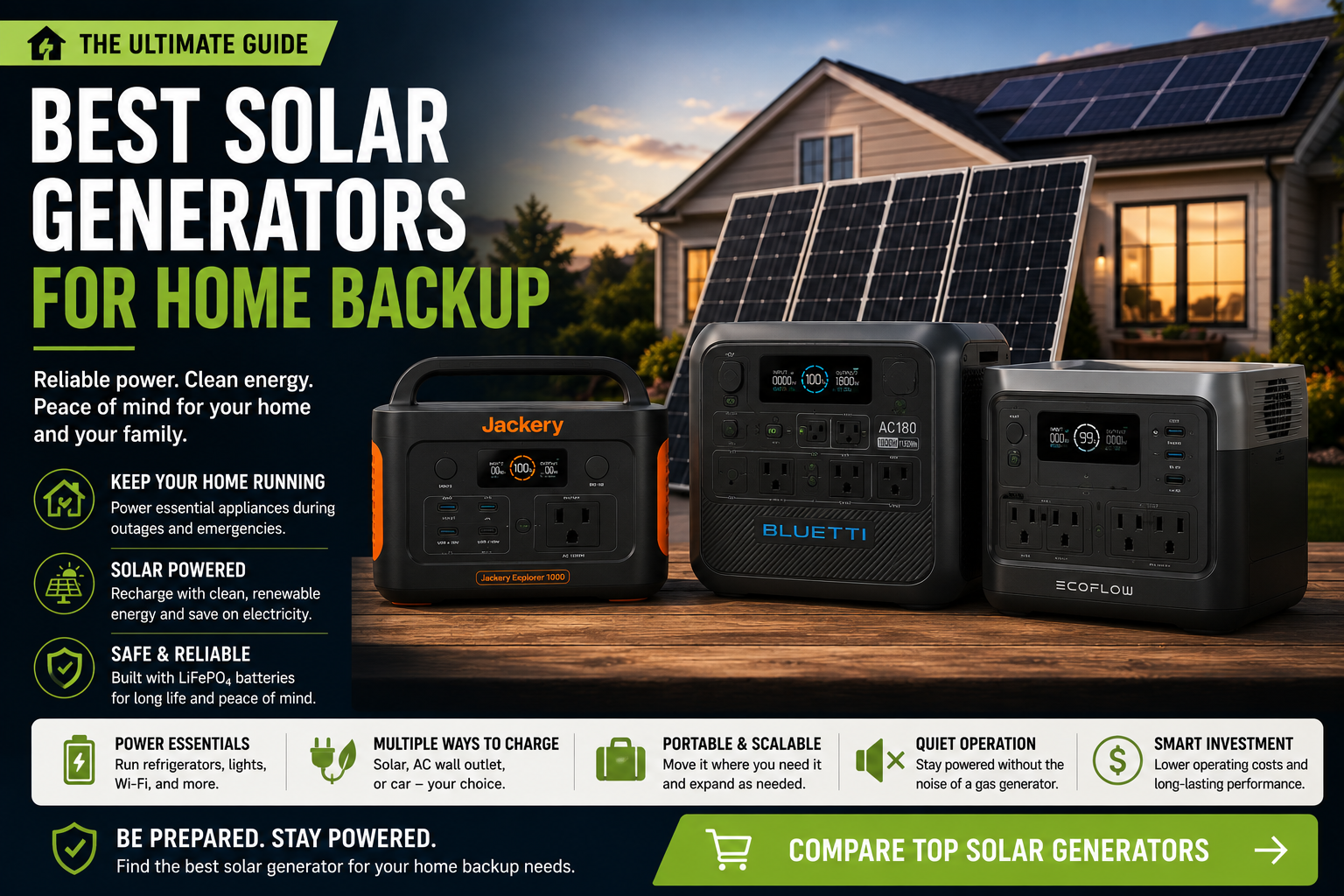
A solar generator for home backup is usually a battery power station with an inverter, charging electronics and the ability to accept compatible solar panels. It stores electricity and supplies it when needed. Unlike a gasoline generator, it can operate without combustion exhaust—but the amount of power it can deliver is limited by its inverter and stored battery energy.
The best home-backup choice depends on which circuits or appliances you need, how many hours you need them, and whether your loads require 120V or 240V. A compact 2kWh system may handle a refrigerator, router and lighting for part of an outage. A larger expandable system may support more loads for longer, but only when its output configuration and electrical integration are appropriate.
Quick Answer: The Best Solar Generator for Each Home Backup Need
Best expandable high-output system: EcoFlow DELTA Pro 3 — 4,096Wh base capacity, 4,000W AC output and 120/240V capability.
Best flexible modular alternative: Anker SOLIX F3800 — 3,840Wh capacity, 6,000W output and 120/240V support.
Best expandable 120V backup: BLUETTI AC200L — 2,048Wh capacity, 2,400W AC output and expansion-battery support.
Best straightforward 2kWh-class option: Jackery Explorer 2000 Plus — 2,042Wh base capacity and 3,000W AC output, with optional expansion.
Best compact home-essential backup: EcoFlow DELTA 2 Max — 2,048Wh base capacity and 2,400W AC output for selected 120V loads.
Important: A solar generator is not automatically a whole-house backup system. Battery expansion, 240V output, automatic switching and safe circuit connection are separate questions.
Top Solar Generators for Home Backup
These recommendations cover distinct levels of backup capability. Compare the exact configuration being sold: a base power station, a power station with extra batteries and a bundle including solar panels are not equivalent purchases.
EcoFlow DELTA Pro 3
Designed for households needing more inverter output, a larger starting battery and the possibility of 120/240V backup arrangements.
Anker SOLIX F3800
A high-output modular power station with 120/240V capabilities and expansion options for longer outages.
BLUETTI AC200L
A practical option for running selected household essentials, with optional batteries for additional stored energy.
Jackery Explorer 2000 Plus
Good for buyers who want a substantial portable power station with expansion options rather than a permanently installed battery system.
EcoFlow DELTA 2 Max
A smaller 2kWh-class option for refrigerators, lights, communications equipment and other compatible 120V loads.
Solar Generator Comparison: Capacity, Power and Best Use
| Model | Base capacity | Rated AC output | Voltage | Best suited to | Important limitation |
|---|---|---|---|---|---|
| EcoFlow DELTA Pro 3 | 4,096Wh | 4,000W | 120/240V | Higher-output expandable home backup | Cost, weight and installation complexity |
| Anker SOLIX F3800 | 3,840Wh | 6,000W | 120/240V | Modular higher-output backup | Large physical footprint and system cost |
| BLUETTI AC200L | 2,048Wh | 2,400W | 120V | Expandable essential-appliance backup | No native 240V output from base unit |
| Jackery Explorer 2000 Plus | 2,042Wh | 3,000W | 120V base unit | Portable expandable backup | 240V requires a supported multi-unit configuration |
| EcoFlow DELTA 2 Max | 2,048Wh | 2,400W | 120V | Smaller household essentials | Limited base runtime for sustained loads |
Base capacities and rated output are manufacturer specifications. Expanded battery configurations and special output modes may differ. Check the exact regional model and accessories.
Detailed Reviews and Buying Trade-Offs
1. EcoFlow DELTA Pro 3 — Best Expandable High-Output Home Backup
A strong choice when 240V capability and larger battery expansion matter.
The DELTA Pro 3 combines a 4,096Wh LFP battery with a 4,000W rated AC inverter. Its 120/240V capability makes it more suitable than a standard 120V-only portable station for certain home-backup applications.
That does not mean one unit can operate every household circuit. You must consider the power draw of individual 240V loads, the unit's specific output ratings, the available battery energy and the electrical connection method.
Its strongest advantage is expandability: the base system can grow with compatible batteries, allowing a buyer to start with selected essential loads and plan for longer coverage.
Advantages
- 4,096Wh starting capacity
- 4,000W rated AC output
- 120/240V capability
- LFP battery chemistry
- Supported battery expansion
Trade-offs
- Large and heavy
- Significant cost once expanded
- Home-circuit connection needs appropriate equipment
- High-output appliances can drain the battery rapidly
Choose it if: You need more than a simple portable outlet bank and are planning an expandable backup system with carefully selected 120V or 240V loads.
Avoid it if: You only need to charge phones and keep a router running, or you expect one base battery to power an entire house for days.
Check Price2. Anker SOLIX F3800 — Best Modular High-Output Alternative
Higher inverter output with a modular expansion path.
The Anker SOLIX F3800 starts with 3,840Wh of battery capacity and provides up to 6,000W rated AC output, with 120/240V capability.
Its higher inverter rating is useful when multiple appliances operate together or when a compatible load has a substantial operating demand. However, the F3800's 3,840Wh base battery stores slightly less energy than the DELTA Pro 3's 4,096Wh base battery.
This illustrates an important distinction: more inverter watts do not mean longer runtime. Inverter output controls how much power the system can deliver at once; watt-hours determine how much energy is available over time.
Advantages
- 6,000W rated AC output
- 120/240V capability
- 3,840Wh base capacity
- Expandable system design
- Suitable for selected higher-demand backup loads
Trade-offs
- Large and heavy
- Base runtime still limited by 3,840Wh capacity
- Accessories and expansion add cost
- Installation requirements vary by configuration
Choose it if: Your priority is higher simultaneous AC output and a modular path toward more stored energy.
Avoid it if: Your only goal is maximizing runtime for a small load; a lower-output system with more battery capacity may be better value.
Check Price3. BLUETTI AC200L — Best Expandable 120V Essential-Load Backup
A practical middle ground for appliances that do not require 240V.
The BLUETTI AC200L provides a 2,048Wh LFP battery and 2,400W rated AC output. It supports compatible expansion batteries, allowing the owner to increase runtime without necessarily replacing the power station.
For a household focused on a refrigerator, communications equipment, lights and occasional small-appliance use, this may be a more proportionate purchase than a much larger high-output system.
Its limitation is voltage: the standard U.S. AC200L supplies 120V AC. A 240V well pump, electric range or other 240V appliance cannot simply be connected and expected to work.
Advantages
- 2,048Wh LFP battery
- 2,400W rated output
- Compatible battery expansion
- Solar charging support
- Useful for selected 120V essentials
Trade-offs
- 120V-only AC output
- Base battery can be exhausted in hours under heavier loads
- Expansion increases total cost and weight
Choose it if: You want expandable backup for a carefully selected set of 120V appliances.
Avoid it if: Your backup plan requires native 240V output or large simultaneous appliance loads.
Check Price4. Jackery Explorer 2000 Plus — Best Straightforward Expandable Backup
Portable home-essential backup with room to add compatible batteries.
The Explorer 2000 Plus has 2,042Wh base capacity and a 3,000W rated AC inverter. Its relatively high inverter output for a 2kWh-class battery is useful for short-duration, higher-demand loads.
However, a 2,000W appliance can consume most of the base unit's usable energy in roughly an hour or less once conversion losses are considered. The high output rating should not be confused with all-day endurance.
Jackery supports expansion with compatible battery packs. Some higher-voltage applications require a supported multi-unit arrangement and specific accessories; the base unit itself should be treated as a 120V power station.
Advantages
- 3,000W rated AC output
- 2,042Wh base capacity
- Expandable battery system
- Portable alternative to permanent storage
Trade-offs
- Base capacity limits high-load runtime
- 240V is not a standard single-unit feature
- Additional batteries add cost and storage requirements
Choose it if: You want a portable backup station with higher inverter headroom and the ability to add compatible batteries later.
Avoid it if: You expect its 3,000W output to provide many hours of operation at 3,000W without substantial battery expansion.
Check Price5. EcoFlow DELTA 2 Max — Best Compact Essential-Load System
A 2kWh-class backup station for households prioritizing selected appliances rather than full-home coverage.
The DELTA 2 Max offers 2,048Wh of LFP battery storage and 2,400W rated AC output. It supports compatible extra batteries and solar charging.
It is particularly sensible when the plan is to keep a refrigerator, router, a few lights and device chargers operating during a short outage, rather than attempting to energize every circuit in the home.
Like the AC200L, its standard U.S. output is 120V. For larger homes with 240V appliances, it is not a direct substitute for a purpose-designed split-phase backup system.
Advantages
- 2,048Wh LFP capacity
- 2,400W rated AC output
- Compatible extra-battery support
- Solar charging capability
- Useful balance for selected essentials
Trade-offs
- No native 240V output
- Limited base capacity for long outages
- Not a whole-home system by itself
Choose it if: Your backup list is modest and you value a portable, expandable 120V system.
Avoid it if: You need to run central air conditioning, an electric water heater or multiple major appliances simultaneously.
Check PriceHow Long Will a Solar Generator Power Your Home?
Battery capacity is measured in watt-hours (Wh). Appliance consumption is measured in watts (W). Dividing available energy by average power gives an approximate runtime.
The 85% efficiency factor in this example is an illustrative planning assumption—not a measured efficiency claim for every model. Real results vary with inverter losses, temperature, battery condition, operating mode and load pattern.
Estimated Runtime at Common Average Loads
| Base battery | 100W average | 200W average | 500W average | 1,000W average |
|---|---|---|---|---|
| 2,042Wh | 17.4 hr | 8.7 hr | 3.5 hr | 1.7 hr |
| 2,048Wh | 17.4 hr | 8.7 hr | 3.5 hr | 1.7 hr |
| 3,840Wh | 32.6 hr | 16.3 hr | 6.5 hr | 3.3 hr |
| 4,096Wh | 34.8 hr | 17.4 hr | 7.0 hr | 3.5 hr |
Illustrative estimates using 85% usable energy efficiency, no solar charging and constant average load. Values are rounded and are not guaranteed runtimes.
Why Refrigerators Are Different
A refrigerator compressor cycles on and off. Its nameplate power may be higher than its long-term average consumption, and its starting surge may exceed its running power. For a useful estimate, measure energy consumption over a representative period rather than assuming the compressor runs continuously.
Why Battery Expansion Often Matters More Than More Inverter Watts
Suppose your essentials average 350W over a long outage. A 2,048Wh system, using the illustrative 85% factor, provides roughly five hours of backup without charging. Increasing the inverter from 2,400W to 4,000W does not meaningfully extend that duration. Adding usable battery energy does.
Solar Charging: What the Panels Can Actually Replace
A solar generator is only a solar-powered backup system when you connect compatible solar panels. Many products are sold as the power station alone; panels may be optional and sold separately.
Solar Input Rating Is Not Daily Energy Production
A station that accepts 1,000W of solar input will not necessarily receive 1,000W all day. Panel orientation, weather, shading, temperature, cable losses and charging limits affect actual production.
This is a planning estimate, not a forecast. Actual peak-sun-hours depend on location, season and weather. The 0.75 factor is an illustrative allowance for losses and imperfect conditions.
Solar Charging During a Storm or Outage
Cloudy conditions can sharply reduce production, and solar panels must be deployed where they receive light while staying within the manufacturer's environmental and electrical limits. A multi-day outage during heavy cloud cover may require more stored battery capacity or an additional safe charging strategy.
Check Panel Compatibility Before Buying
- Maximum solar input watts: The station's charging limit.
- Input voltage range: Panel string voltage must remain within the specified operating range.
- Maximum open-circuit voltage: Cold-weather panel voltage must not exceed the station's input limit.
- Input current: Respect the model's current restrictions and approved configurations.
- Connector type: Use manufacturer-supported connectors and wiring.
Do not connect panels based on total wattage alone. Incorrect solar voltage or polarity can damage equipment and create hazards.
120V vs. 240V: The Most Important Home Backup Compatibility Check
Many U.S. homes use split-phase 120/240V electrical service. Standard outlets generally supply 120V, while equipment such as central air conditioners, electric dryers, some well pumps and ranges may require 240V.
What a 120V Power Station Can Do
A 120V power station can supply compatible 120V appliances directly through its outlets. With appropriate electrical equipment and professional installation, selected 120V circuits may also be supported. It cannot directly provide native 240V power just because its inverter wattage is high.
What a 120/240V Power Station Changes
Systems such as the EcoFlow DELTA Pro 3 and Anker SOLIX F3800 provide 120/240V capability. This opens up additional possibilities, but it does not automatically mean every 240V appliance is supported. Check the continuous output available in the intended voltage mode and the specific electrical requirements of the load.
Direct Appliance Connection vs. Home-Circuit Integration
Direct appliance connection
Plug compatible appliances into the station's appropriately rated outlets. This is often the simplest way to provide emergency backup for a refrigerator, router, lights and other essentials.
Best for: Smaller, temporary backup plans that do not require energizing household circuits.
Transfer switch or approved home integration
Use manufacturer-compatible equipment and a properly installed transfer system to supply selected home circuits. Voltage, neutral configuration, grounding, capacity and code compliance must all be considered.
Best for: Households seeking a more integrated backup arrangement.
What About Automatic Backup or UPS Functions?
Some power stations support automatic or fast transfer when grid power fails. Transfer times, supported outlets and operating modes vary. A device with a fast transfer feature is not automatically a zero-interruption UPS for every computer, medical device or other sensitive load.
For critical equipment, check the manufacturer's transfer-time specification and the connected equipment's requirements. Consider a dedicated UPS when uninterrupted operation is essential.
How to Build a Home Backup Plan Without Overspending
Identify your essentials
List the refrigerator, networking equipment, lighting, fans, medical or communications equipment and any other must-have loads.
Measure energy and peak demand
Estimate daily Wh consumption and identify startup surges. Separate 120V and 240V appliances.
Choose storage and charging
Size the battery for the outage duration you want, then evaluate expansion batteries and realistic solar recharge.
Example: Essential-Load Planning
Consider a household with an average combined essential load of 250W over 12 hours.
Energy required at the outlets: 250W × 12 hours = 3,000Wh.
Using an illustrative 85% usable-energy factor, the nominal battery requirement would be approximately 3,530Wh. That is already larger than a typical 2kWh base station, even before allowing extra margin.
This example demonstrates why a 4kWh-class base system or an expanded smaller system may be more appropriate for long-duration backup. It does not account for solar charging or unusual starting surges.
Do You Need Solar Panels Immediately?
Not necessarily. A power station can be charged from the grid ahead of an outage and used as stored backup energy. Solar panels become more important when you want to replenish energy during an extended outage without depending on grid electricity.
Portable System vs. Permanently Installed Home Battery
A portable solar generator can be a good fit for selected appliances, temporary backup and flexible use. A permanently installed home battery system may be better suited to automatic whole-home integration, regular solar self-consumption or high-capacity household loads—but it involves different installation, permitting and cost considerations.
Safety, Storage and Long-Term Ownership
Battery power stations do not create carbon monoxide during normal battery operation, making them different from fuel-burning generators. That does not eliminate electrical, battery or environmental hazards.
- Ventilation and clearance: Follow the manufacturer's spacing requirements and keep cooling vents unobstructed.
- Moisture: Protect equipment from rain, flooding and water exposure unless specifically rated for those conditions.
- Temperature: Stay within the manufacturer's charging, operating and storage temperature limits.
- Battery health: Follow recommended storage state-of-charge and maintenance guidance.
- Connections: Avoid overloaded extension cords, damaged cables and unsupported adapters.
- Solar wiring: Respect maximum input voltage, current and connector requirements.
- Medical equipment: Verify compatibility, expected runtime and an appropriate independent backup plan; never rely on a single untested power source for life-critical support.
LFP battery chemistry is used in many modern backup stations and can offer long cycle life, but actual lifespan depends on conditions and manufacturer design. Do not treat an advertised cycle-life figure as a guaranteed number of years of service.
Frequently Asked Questions
Can a solar generator power an entire house?
Some expandable systems can support substantial portions of a home, but a base portable power station rarely provides unlimited whole-house coverage. Capacity, 120/240V support, appliance demand and approved electrical integration determine what is possible.
How big a solar generator do I need for a refrigerator?
Check the refrigerator's starting surge and measured daily energy consumption. A 2kWh-class power station may provide useful refrigerator backup, but runtime varies widely by model, ambient temperature, door openings and other connected loads.
Can solar generators run central air conditioning?
Some high-output 120/240V systems may support certain central AC configurations, especially with appropriate expansion and professionally installed equipment. Compressor startup, continuous power and total battery capacity must all be verified.
How long does a 2,000Wh solar generator last?
Using an illustrative 85% usable-energy factor, a 2,000Wh battery might run a steady 200W load for approximately 8.5 hours. Actual results depend on losses, load variability, battery condition and environmental factors.
Do I need solar panels for a solar generator to work?
No. Most can charge from household AC power. Solar panels are an optional or bundled charging source, depending on the package purchased.
Will solar panels recharge my battery during a blackout?
Yes, if the station supports solar input and compatible panels are connected within its electrical limits. Production depends on sunlight and weather; charging is not guaranteed during storms or heavy cloud cover.
Is a solar generator safer than a gasoline generator?
A battery power station does not emit engine exhaust or carbon monoxide during battery operation, eliminating a major hazard of fuel-burning generators. It still requires safe electrical connections, correct charging and suitable storage conditions.
Can I plug a solar generator into a wall outlet to power the house?
No. Never backfeed a wall receptacle. Use approved transfer equipment and qualified electrical installation if you intend to supply home circuits.
What is the difference between 2,000W and 2,000Wh?
2,000W is a power rate: how much electricity a system can deliver at once. 2,000Wh is an energy quantity: roughly enough nominal stored energy to supply 200W for ten hours before accounting for losses.
Can I use a solar generator as a UPS?
Only when its documented transfer behavior meets the connected equipment's needs. Many stations provide EPS or fast-transfer modes rather than a guaranteed zero-interruption UPS.
Is it better to buy a bigger inverter or more batteries?
If your appliances already fit the inverter's continuous and surge ratings, more battery capacity usually provides a more direct runtime benefit. A larger inverter is useful when simultaneous power demand is the limiting factor.
How These Recommendations Were Evaluated
This guide compares published manufacturer specifications and the practical consequences of battery size, inverter output, voltage, expandability, charging and home integration. The recommendations are editorial assessments based on intended use, not claims of hands-on testing.
Exact regional variants, accessory compatibility, expansion limits, firmware features and current availability should be confirmed before purchase. No fabricated prices, ratings or test results are used.
Manufacturer Resources
Final Verdict: Buy for Runtime and Electrical Compatibility
EcoFlow DELTA Pro 3: A strong fit for expandable backup where 120/240V capability and a 4kWh-class starting battery matter.
Anker SOLIX F3800: A compelling alternative when higher simultaneous inverter output and modular expansion are priorities.
BLUETTI AC200L: A sensible expandable option for selected 120V household essentials.
Jackery Explorer 2000 Plus: Worth considering when portable operation and 3,000W inverter output matter more than maximum base runtime.
EcoFlow DELTA 2 Max: A practical choice for smaller 120V backup needs with an option to expand later.
The most important decision is not which product has the biggest headline wattage. It is whether the system can safely power your exact loads for the duration you need—and how you will recharge it if the outage continues.
Compare Current Options