
Portable Power Station vs Generator: Which Is Better?
A battery power station and a fuel-powered generator can both keep essential equipment running during an outage—but they solve different problems. Compare indoor safety, runtime, noise, charging, operating costs and real-world limitations before choosing.
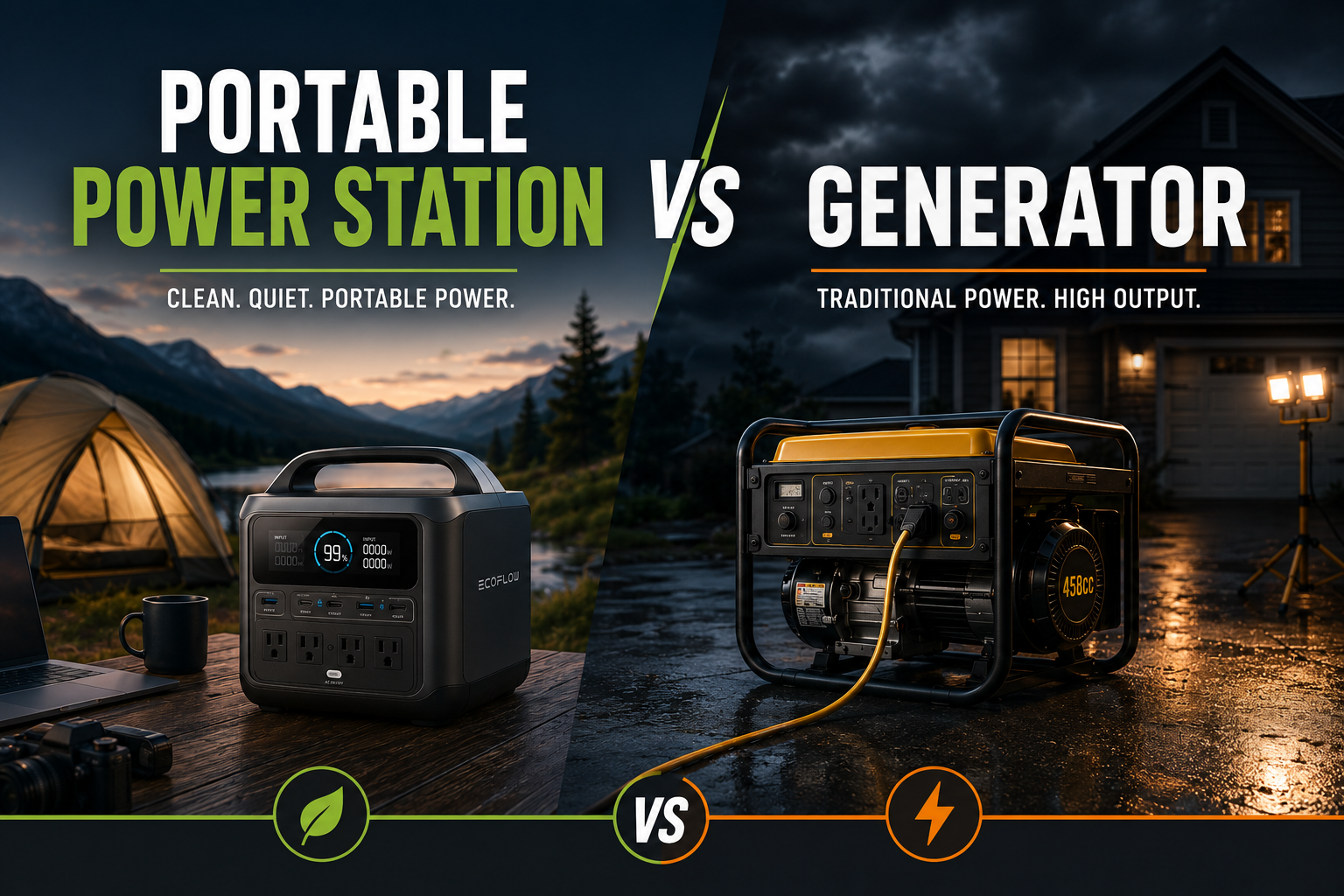
A portable power station is usually the better choice when you need quiet, exhaust-free power for electronics, refrigeration or other compatible appliances. A gasoline or propane generator is often more practical when you need higher output for extended periods and can safely operate the equipment outdoors with a dependable fuel supply.
But that answer changes with your electrical load, outage duration, location and budget. A 2,000Wh battery and a 2,000W generator do not provide the same amount of energy, and a generator's advertised peak watts do not tell you how long it will run.
The Short Answer
Choose a portable power station for indoor-compatible backup, low noise, minimal routine maintenance and shorter outages—provided its battery capacity and inverter output meet your needs.
Choose a fuel-powered generator for longer outages, high-demand equipment and situations where you can store or obtain fuel and operate the generator safely outside.
Consider both if you want quiet indoor power for small essential loads plus an outdoor generator for recharging batteries or handling larger demands. Any charging arrangement must follow both manufacturers' instructions.
Portable Power Station vs Generator: Side-by-Side Comparison
The most important difference is the energy source. A portable power station stores a finite amount of electricity in a battery. A conventional portable generator converts fuel into electricity while its engine runs.
| Factor | Portable Power Station | Fuel-Powered Generator |
|---|---|---|
| Energy source | Rechargeable battery | Gasoline, propane, natural gas or another supported fuel |
| Indoor operation | Generally suitable when used as directed; no combustion exhaust | Never indoors; carbon monoxide hazard |
| Operating noise | Typically much quieter; fans may operate | Engine noise, varying substantially by model and load |
| Runtime | Limited by usable battery energy and recharging | Limited by fuel supply, consumption and operating requirements |
| Refueling / recharging | AC charging, compatible solar panels or other supported inputs | Fuel replenishment; refuel only according to safety instructions |
| High-output options | Available, but larger systems can be heavy and expensive | Many high-output portable and standby options |
| Routine maintenance | Generally lower; battery care and periodic checks still required | Engine maintenance, fuel management and periodic operation |
| Solar compatibility | Many models accept compatible solar charging | Not ordinarily solar-charged; hybrid systems require separate equipment |
| Storage considerations | Battery charge, temperature and manufacturer storage instructions | Fuel storage, ventilation, maintenance and fire safety |
| Best typical use | Quiet, indoor-compatible essential-load backup | Extended backup and larger loads with safe outdoor operation |
Portable Power Stations: Advantages and Limitations
A portable power station combines a rechargeable battery, power electronics and one or more output connections. Many models provide AC outlets through an inverter, plus USB and DC outputs.
The two specifications that matter most are battery capacity in watt-hours (Wh) and continuous AC output in watts (W). Capacity affects how long loads can run; output determines which loads the unit can operate at all.
Advantages
- No combustion exhaust during battery operation.
- Generally quiet, especially at modest loads.
- Useful for indoor-compatible essential loads.
- Can be convenient for apartments and camping where permitted.
- Some models support solar charging and expansion batteries.
- Usually less routine mechanical maintenance than an engine generator.
Limitations
- Stored energy is finite; larger loads drain batteries quickly.
- Recharging can take hours or longer depending on the input.
- High-capacity systems may be heavy and costly.
- Not every model supports 240V or large motor-starting loads.
- Battery capacity gradually changes with age and use.
- Some products have only limited EPS or UPS functionality.
When a Power Station Makes Sense
Consider a battery power station if you need to operate a router, laptop, lighting, CPAP or other compatible medical device, television or refrigerator for a limited period. Verify the device's electrical and continuity requirements, especially for medical equipment.
A battery station can also be useful when generator noise, exhaust restrictions or fuel storage make combustion equipment impractical.
For refrigeration, check both compressor startup demand and battery runtime. A power station that can start the compressor may still lack enough stored energy to keep it operating for the desired duration.
Compare Current OptionsFuel-Powered Generators: Advantages and Limitations
Portable fuel-powered generators produce electricity by running an engine. The output continues while sufficient fuel is available and the equipment is operating within its rated limits.
Two important specifications are running watts and starting watts. Running watts describe sustained output; starting watts describe brief additional capacity available for some motor loads.
Advantages
- Fuel can extend operation without waiting for battery charging.
- Many models offer substantial continuous power.
- Can support larger appliances when properly sized.
- Gasoline, propane and multi-fuel options are available.
- Suitable for some extended outage scenarios.
- Standby systems can be configured for automatic operation when professionally installed.
Limitations
- Combustion exhaust creates a potentially deadly carbon monoxide hazard.
- Must be operated outdoors according to manufacturer and safety guidance.
- Produces engine noise and emissions.
- Requires fuel storage or a dependable fuel source.
- Engine maintenance and periodic checks are necessary.
- Output can vary by fuel, altitude and other operating conditions.
When a Generator Makes Sense
A fuel-powered generator is often worth considering when outages may last multiple days, you need to operate several appliances, or your equipment requires more continuous power than a practical battery station can provide.
For home backup, determine whether the generator supports the voltage and receptacles required by your loads. A generator's total wattage does not guarantee compatibility with 240V circuits, central air conditioning or a home transfer system.
Compare Current OptionsRuntime: How Long Will Each Option Last?
Runtime is where the comparison becomes especially important. A battery station has a known nominal energy capacity. A generator's runtime depends on how quickly it consumes fuel at a particular load.
Portable Power Station Runtime
A simplified estimate for AC-powered appliances is:
Consider an illustrative 2,000Wh power station supplying a steady 200W AC load. If we assume 85% usable energy for this example:
At a steady 1,000W load, the same assumptions yield only about 1.7 hours. This illustrates why battery capacity alone does not determine suitability for high-power appliances.
Actual runtime depends on inverter efficiency, temperature, standby consumption, battery management, cycling loads and the product's usable capacity. Refrigerators and air conditioners do not necessarily consume their nameplate running wattage continuously.
Fuel Generator Runtime
A generator's runtime is determined by usable fuel, fuel consumption at the operating load and operating conditions.
For example, a generator with 4 gallons of usable fuel consuming 0.5 gallon per hour would have an estimated 8-hour runtime under those assumptions. This is arithmetic, not a claim about any particular model.
Adding more fuel can extend total operating time, but the generator must be shut down, cooled and refueled according to manufacturer instructions. Never refuel a running or hot generator.
| Average AC Load | 1,000Wh Battery | 2,000Wh Battery | 4,000Wh Battery |
|---|---|---|---|
| 100W | 8.5 hours | 17 hours | 34 hours |
| 200W | 4.25 hours | 8.5 hours | 17 hours |
| 500W | 1.7 hours | 3.4 hours | 6.8 hours |
| 1,000W | 0.85 hours | 1.7 hours | 3.4 hours |
All figures assume 85% usable battery energy and a constant load. Real results will differ, especially at very light loads or near a unit's output limits.
Can Solar Charging Replace a Gas Generator?
Solar charging can extend the usefulness of a compatible power station, but it is not equivalent to having an unlimited fuel supply.
The amount of energy recovered depends on panel wattage, sunlight, shading, orientation, weather, charging efficiency and the power station's solar input limits.
For example, 400W of panels producing an average of 250W into the system for four hours would contribute approximately 1,000Wh before any additional downstream losses. This is an illustrative scenario, not a guaranteed daily harvest.
Three Things to Check Before Buying Solar Panels
Solar Input Compatibility
Verify the power station's permitted solar voltage range, maximum current, maximum input power and connector requirements. An incompatible panel arrangement can damage equipment.
Realistic Daily Energy
Estimate how many watt-hours the panels may replenish under local conditions, then compare that with daily appliance consumption—not just the battery's advertised capacity.
Backup for Cloudy Days
Plan for reduced charging during storms, heavy clouds or short winter days. Solar panels do not guarantee that a depleted battery can be fully recharged every day.
A solar-capable power station can be an excellent fit for lower-energy loads and recurring off-grid use. High-consumption home backup may require substantial solar capacity, additional batteries or another backup source.
Which Is Cheaper: A Power Station or a Generator?
The cheaper option depends on how often you use it, how much electricity you need, and how many years you plan to own it.
Power Station Cost Factors
- Initial battery and inverter purchase.
- Optional expansion batteries.
- Solar panels and compatible accessories.
- Electricity used for charging.
- Battery aging and eventual replacement needs.
Generator Cost Factors
- Initial generator purchase.
- Fuel consumption during use.
- Oil, filters and engine maintenance.
- Fuel storage and management.
- Transfer equipment and installation where required.
Example: Electricity Cost for Battery Charging
Suppose a battery system takes 2.2kWh from the wall to replenish a charge and your electricity rate is $0.16 per kWh:
That may make occasional charging inexpensive, but the initial cost of a large battery system can be substantial.
Fuel generators can be more economical for certain high-power, long-duration applications. However, their fuel and maintenance costs accumulate with use. There is no reliable universal break-even point without comparing specific equipment, local fuel and electricity prices, and usage patterns.
Home Backup: Which Works Better During a Blackout?
For most households, the first decision is not which technology to buy. It is which appliances must remain operational and for how long.
| Backup Need | Option Worth Considering First | Reason |
|---|---|---|
| Router, laptop, phones and lights | Portable power station | Low-noise indoor-compatible power with modest energy demand |
| Refrigerator for a short outage | Portable power station | Convenient if capacity and compressor startup requirements are met |
| Several days of refrigeration and essential loads | Fuel generator or adequately sized rechargeable system | Energy replenishment becomes the deciding factor |
| High-demand pumps or multiple large appliances | Properly sized generator or larger battery system | Continuous output, surge capacity and voltage matter |
| Apartment with no safe generator operating area | Portable power station | Combustion generator operation is unsuitable indoors |
| Whole-home backup | Engineered standby or home battery system | Requires load analysis, compatible electrical equipment and installation |
What About Automatic Backup?
Some power stations advertise EPS or UPS-like functions, but transfer times and supported loads vary. They should not automatically be treated as equivalent to a dedicated uninterruptible power supply.
For computers, networking equipment, medical devices or other interruption-sensitive loads, verify the exact transfer specification and device compatibility. If continuous operation is critical, use an appropriately designed backup system.
Camping and RV Use: Power Station or Generator?
Camping changes the comparison because noise, campsite rules, portability and access to charging or fuel can matter more than maximum output.
Portable Power Station
Well suited to charging devices, powering lighting and supporting compatible small appliances without engine exhaust or continuous engine noise.
Watch out for: Limited battery energy, solar charging variability and air-conditioner startup requirements.
Inverter Generator
Worth considering when you need extended operation, higher AC output or the ability to replenish energy with fuel.
Watch out for: Campground generator-hour restrictions, exhaust placement, noise limits and fuel storage.
For RV air conditioning, verify compressor starting requirements, the generator or inverter's output rating, and the RV's electrical configuration. A 30-amp or 50-amp RV connection label alone does not determine whether a particular generator or power station will work.
Can You Use a Portable Power Station and Generator Together?
Yes, a combined approach can make sense, provided the equipment is compatible and operated according to manufacturer instructions.
For example, a power station might run small essential loads indoors while an outdoor generator handles higher-demand equipment or recharges the battery during an extended outage.
Use the Battery for Quiet Loads
Power compatible electronics, lights and other essentials without continuously running a combustion engine.
Operate the Generator Safely Outdoors
Use the generator only in an appropriate outdoor location, away from occupied spaces and building openings.
Recharge Only Through Supported Inputs
Confirm generator output quality, charging limits, grounding requirements and compatibility with the power station's AC charging system.
Do not improvise parallel electrical connections or connect multiple power sources together without equipment specifically designed for that purpose.
Which Should You Buy? A Practical Decision Guide
Buy a Portable Power Station If...
- You primarily need backup for electronics, lights and selected appliances.
- Quiet operation is important.
- You need a solution suitable for indoor use according to its instructions.
- You can recharge from AC power or compatible solar panels.
- Your calculated energy requirement fits a practical battery capacity.
Buy a Portable Generator If...
- You anticipate longer outages and can maintain a fuel supply.
- Your loads require substantial continuous or starting watts.
- You have a suitable, safe outdoor operating location.
- You accept engine noise and maintenance requirements.
- You can meet all required voltage and connection requirements.
Before You Purchase: Four Checks That Matter More Than Marketing
1. Continuous Power
Add the running watts of appliances that must operate simultaneously. Do not compare this number only with a generator's peak rating.
2. Motor Starting Demand
Check refrigerator, pump and air-conditioner startup requirements. A unit with sufficient running watts may still fail to start a motor.
3. Required Energy
Estimate watt-hours for the desired operating time. For a fuel generator, estimate consumption and fuel requirements at the intended load.
4. Electrical Compatibility
Verify 120V/240V output, receptacles, charging inputs, circuit limits, grounding and any home transfer equipment.
Common Mistakes When Comparing Battery Stations and Generators
- Comparing watts with watt-hours: A 2,000W inverter rating and a 2,000Wh battery capacity describe different things.
- Assuming solar panels provide rated output all day: Solar production changes with sunlight and conditions.
- Ignoring inverter standby consumption: Small continuous loads may achieve less runtime than a simple capacity calculation suggests.
- Buying based on generator peak watts: Sustained loads must remain within the continuous rating.
- Overlooking motor starting surges: Refrigeration and pumps can demand additional power during startup.
- Assuming all battery stations are UPS devices: Transfer behavior and reliability depend on the model.
- Assuming a portable generator can power every home circuit: Voltage, connection design and transfer equipment must be compatible.
- Using combustion equipment too close to occupied spaces: Carbon monoxide can enter buildings even when the generator is outside.
Frequently Asked Questions
Is a portable power station better than a generator?
It is often better for quiet, indoor-compatible essential-load backup and shorter outages. A fuel generator may be better for longer outages and larger power demands when safe outdoor operation and fuel supply are available.
Can a portable power station power a refrigerator?
Many can, provided their inverter supports the refrigerator's running and starting requirements. Runtime depends on battery capacity, actual compressor duty cycle and other loads.
Can a portable power station run a house?
Some large battery systems can support selected household circuits, and engineered home battery systems can provide broader backup. A small portable station should not be assumed to support an entire house. Electrical connections require appropriate equipment and installation.
How long will a 2,000Wh power station last?
At a constant 200W AC load and an illustrative 85% usable-energy assumption, about 8.5 hours. Higher loads shorten runtime; lower loads may last longer. Actual results depend on the equipment and operating conditions.
Is a solar generator the same as a portable power station?
In consumer marketing, “solar generator” often refers to a battery power station capable of charging from compatible solar panels. The panels may be sold separately. Unlike a combustion generator, the battery station stores energy rather than generating electricity from fuel.
Can I use a gas generator indoors if a window is open?
No. Combustion generators must never be operated indoors or in enclosed or partially enclosed spaces. Open windows and doors do not make indoor operation safe.
Is an inverter generator quieter than a conventional generator?
Many inverter generators are designed for relatively quiet operation, especially at lighter loads, but noise varies by model and operating conditions. Compare manufacturer sound measurements under comparable test conditions.
Which option is better for an apartment?
A battery power station is generally the more practical option because combustion generators cannot be operated indoors and may be restricted by building rules or the absence of a safe outdoor operating area. Follow battery equipment and building safety requirements.
Do portable power stations need maintenance?
They generally require less routine mechanical maintenance than engine generators, but owners still need to follow battery charging, storage, temperature, inspection and firmware guidance where applicable.
Which is better for a three-day power outage?
It depends on daily energy consumption and the ability to replenish energy. A sufficiently large battery and solar system may work for low loads, while a properly sized fuel generator with adequate fuel may be more practical for high loads. Neither approach guarantees uninterrupted operation.
Final Verdict: Battery Convenience vs Fuel Endurance
For shorter outages, indoor-compatible essential loads, camping electronics and quiet operation, a portable power station is often the more convenient solution.
For prolonged outages, larger electrical demands and situations where fuel can be safely stored and replenished, a fuel-powered generator may offer greater operating flexibility.
For some households, the most resilient arrangement is not choosing one technology exclusively, but designing a backup plan that uses each for the loads it handles best.
Research Methodology and Safety References
This comparison evaluates the underlying technology, electrical specifications, practical operating limitations, charging and refueling requirements, and safety considerations. It does not claim that Power Gear Guide physically tested particular products.
Runtime calculations are transparent worked examples with stated assumptions. Actual performance must be verified against the specifications and manuals of the equipment being considered.
Authoritative References
- U.S. Consumer Product Safety Commission — Carbon Monoxide Safety
- Ready.gov — Power Outage Preparedness
- U.S. Department of Energy — Using Electricity
- U.S. Department of Energy — Solar Energy
For purchasing decisions, confirm current product manuals, fuel-specific output ratings, battery specifications, charging limits, warranty terms and applicable installation requirements.