
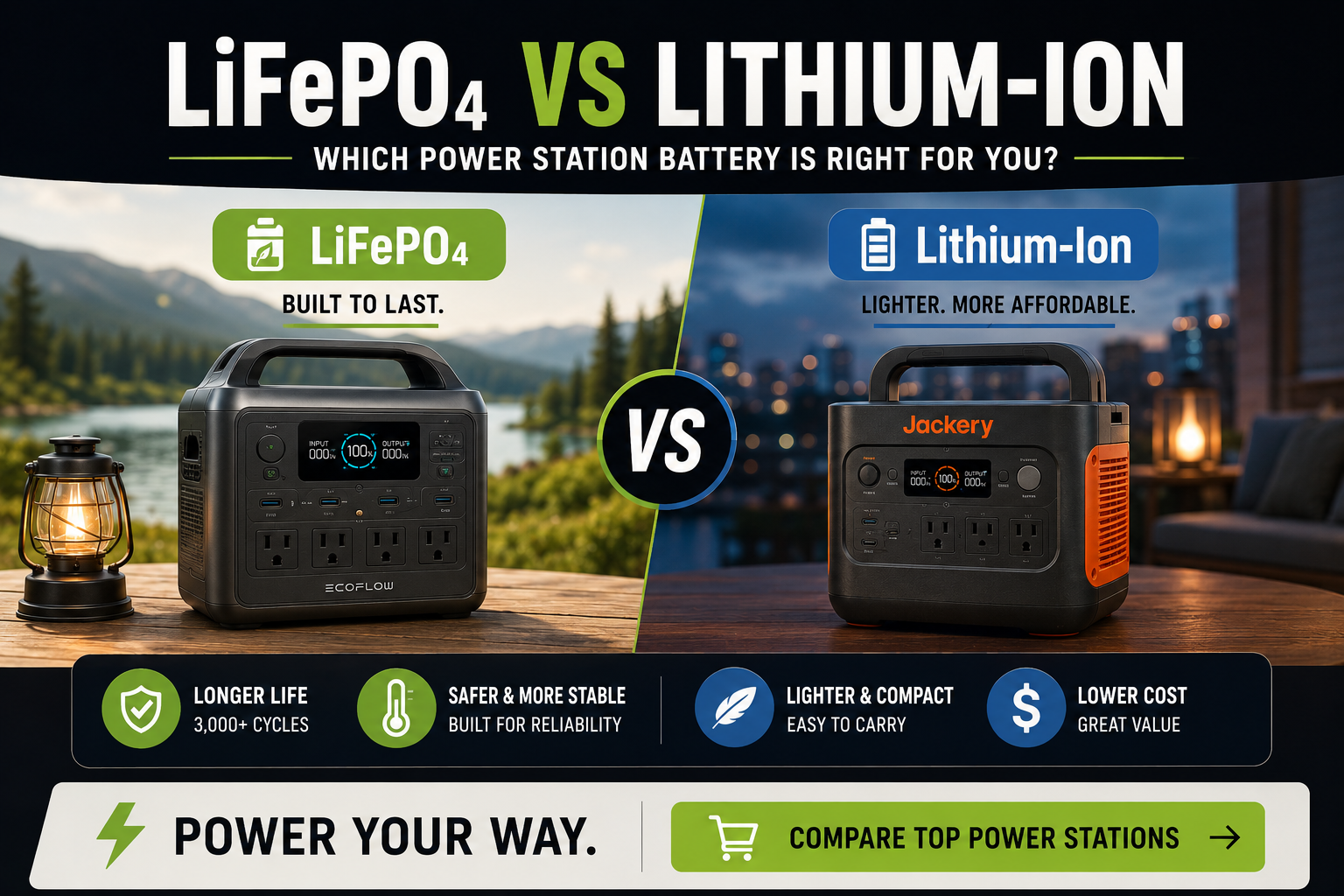
LiFePO4 vs Lithium-Ion Power Stations (Battery Technology Compared)
Compare battery lifespan, safety, charging, weight, cost, and long-term value before choosing your next portable power station.
PowerGearGuide may earn a commission from qualifying purchases made through links on this page, at no extra cost to you.
The battery chemistry inside a portable power station affects far more than its technical specifications. It influences how many years the unit may remain useful, how heavy it feels, how comfortably it handles repeated charging, and whether the lower purchase price today will still look like a good value after hundreds of cycles.
LiFePO4, also called lithium iron phosphate or LFP, has become the dominant choice in many newer portable power stations because it combines long cycle life with strong thermal stability. Traditional lithium-ion chemistry—most commonly nickel-manganese-cobalt, or NMC, in this category—still has an important advantage: higher energy density, which can produce a lighter and more compact power station at a given capacity.
This guide explains the practical difference between LiFePO4 and traditional lithium-ion power stations without treating either chemistry as automatically right for every buyer. The better choice depends on whether you prioritize daily use, home backup, portability, initial cost, or long-term ownership value.
LiFePO4 Is Better for Most Long-Term Buyers
Choose LiFePO4 when you expect frequent charging, home-backup use, regular solar input, RV living, or years of repeated cycling. Its main advantages are longer cycle life, strong thermal stability, and better lifetime value.
Choose traditional lithium-ion when minimum weight, compact dimensions, and a lower initial price matter more than maximum service life. It remains a practical choice for occasional camping, light travel, and emergency-only use.
What Is the Difference Between LiFePO4 and Lithium-Ion?
LiFePO4 (LFP)
Lithium iron phosphate is a type of lithium-ion battery chemistry that uses iron phosphate in the cathode. In portable power stations, it is valued for long cycle life, chemical stability, tolerance of repeated charging, and relatively low flammability compared with nickel-rich chemistries.
Traditional Lithium-Ion (Usually NMC)
When portable-power brands say “lithium-ion” without specifying LFP, they often mean an NMC-based chemistry. NMC batteries can store more energy per unit of weight, helping manufacturers make lighter power stations, but they usually trade some cycle longevity and thermal stability for that higher energy density.
LiFePO4 is technically part of the broader lithium-ion family. In consumer comparisons, “LiFePO4 vs lithium-ion” generally means LFP versus older nickel-based lithium-ion chemistries such as NMC.
LiFePO4 vs Lithium-Ion: Side-by-Side Comparison
| Factor | LiFePO4 | Traditional Lithium-Ion | Practical Winner |
|---|---|---|---|
| Cycle life | Usually much longer | Usually shorter | LFP |
| Thermal stability | Excellent | Good with proper BMS | LFP |
| Energy density | Lower | Higher | NMC |
| Weight at equal capacity | Usually heavier | Usually lighter | NMC |
| Upfront price | Often higher | Often lower | NMC |
| Lifetime value | Strong for frequent use | Strong for occasional use | LFP |
| Home backup | Excellent fit | Usable, but less ideal for frequent cycling | LFP |
| Travel and carrying | Good | Often easier | NMC |
| Solar-generator use | Excellent | Good | LFP |
Battery Lifespan and Cycle Life
Cycle life is the clearest advantage of LiFePO4 power stations. A cycle represents the equivalent of discharging and recharging the battery’s full usable capacity. Two 50% discharges, for example, roughly equal one full cycle.
Many current LiFePO4 power stations are marketed with ratings around several thousand cycles before the battery declines to a specified remaining capacity, commonly 80%. Traditional NMC-based power stations are frequently rated for fewer cycles. Exact figures vary by cell design, charging limits, temperature, depth of discharge, and manufacturer testing methods, so the rating on the specific model matters more than a universal number.
Best for Frequent Cycling
Daily solar charging, repeated outage support, RV living, and regular workshop use can add cycles quickly. LiFePO4 better suits these demanding patterns because its useful capacity generally declines more slowly across repeated cycling.
Enough for Occasional Use
A power station used for a few camping weekends and occasional outages may accumulate cycles very slowly. In that scenario, the theoretical lifespan advantage of LFP may be less important than weight or price.
Compare the manufacturer’s cycle rating at the same remaining-capacity threshold. “3,000 cycles to 80%” and “1,000 cycles to 70%” are not directly equivalent claims.
Safety and Thermal Stability
LiFePO4 is generally considered the more thermally stable chemistry. Its cathode structure is less likely to release oxygen under abusive high-temperature conditions than nickel-rich lithium-ion chemistries, which reduces—but does not eliminate—the risk of thermal runaway.
That advantage matters for large batteries kept in homes, garages, RVs, and work vehicles. Still, chemistry is only one part of safety. Cell quality, pack design, ventilation, wiring, charging controls, physical protection, certifications, and the battery management system all influence the safety of the finished power station.
LiFePO4 Safety Advantages
- High thermal and chemical stability
- Well suited to repeated deep cycling
- Lower flammability than common nickel-rich chemistries
- Strong fit for larger stationary backup systems
Safety Still Depends on the Product
- No lithium battery is risk-free
- Damaged cells can still become hazardous
- Improper chargers can create unsafe conditions
- Storage and operating-temperature limits still apply
Keep any portable power station away from standing water, direct heat, and enclosed spaces that exceed the manufacturer’s temperature limits. Stop using a unit that is swollen, cracked, unusually hot, leaking, or producing an abnormal odor.
Charging Speed and Solar Compatibility
Battery chemistry alone does not determine how fast a power station charges. The AC charger, inverter architecture, thermal controls, firmware, and allowable charge rate all matter. A well-designed LiFePO4 model can charge much faster than an older NMC model, while a conservative LFP design may charge more slowly than a high-performance NMC unit.
The same principle applies to solar charging. Maximum solar-input wattage, input-voltage range, connector compatibility, and MPPT controller performance usually matter more than whether the battery uses LFP or NMC.
Weight, Size, and Energy Density
Traditional NMC lithium-ion batteries usually provide higher energy density than LiFePO4. That means they can store more energy for a given battery weight or volume. For portable power stations, the result can be a lighter enclosure or a smaller footprint at a similar watt-hour capacity.
LiFePO4 chemistry has improved considerably, and manufacturers can now build relatively compact LFP stations. Nevertheless, an equivalent NMC design often retains an advantage when every pound matters.
Choose LFP When It Mostly Stays Put
For a home, garage, RV compartment, van, cabin, or emergency closet, a few extra pounds may be a minor compromise compared with the longer service life.
Choose NMC When You Carry It Often
For photography, field work, car camping with long walks, or frequent loading and unloading, a lighter power station can be noticeably easier to live with.
Power Output and Real-World Performance
Battery chemistry does not directly tell you how many appliances a power station can run. Continuous inverter output, surge rating, outlet design, battery voltage, thermal management, and firmware determine practical performance.
Both LiFePO4 and NMC power stations can deliver high AC output. A 1,000-watt LFP station is not automatically more powerful than a 1,000-watt NMC station. What LFP often offers is better suitability for repeating those charge-and-discharge sessions over a longer ownership period.
Capacity tells you how much energy is stored. Output tells you what the inverter can run. Battery chemistry tells you more about longevity, stability, and weight. You need all three to choose correctly.
Hot- and Cold-Weather Performance
LiFePO4’s thermal stability is helpful in warm conditions, but neither chemistry should be stored or operated beyond its specified temperature range. Heat accelerates battery aging, so avoiding prolonged exposure to hot vehicles or direct sunlight benefits any power station.
Cold-weather charging requires particular care. Many lithium batteries should not be charged below freezing unless the system includes internal heating or a battery-management strategy designed for low temperatures. Discharging may still be possible at reduced performance, but charging a very cold battery can cause permanent cell damage.
Buyers who camp in winter should check for low-temperature charge protection, self-heating capability, and the exact charging and discharging limits in the manual.
Upfront Cost and Long-Term Value
LiFePO4 power stations have historically carried a higher initial price, although the gap has narrowed as LFP production has expanded. The important question is not only how much the power station costs, but how much useful service it delivers before battery degradation becomes limiting.
For a daily-use system, a longer cycle rating can make LiFePO4 cheaper per cycle even when its purchase price is higher. For emergency-only use, an NMC station may sit unused most of the year and never approach its cycle limit, making the lower initial price more meaningful.
| Usage Pattern | Better Value | Reason |
|---|---|---|
| Daily solar charging | LiFePO4 | Long cycle life is used and monetized over time. |
| Home-outage backup | LiFePO4 | Durability and thermal stability suit long ownership. |
| Occasional camping | Either | Weight, price, and features may matter more than cycle count. |
| Frequent carrying | Lithium-ion/NMC | Higher energy density can reduce weight. |
| RV or off-grid use | LiFePO4 | Repeated cycling rewards the longer-lasting chemistry. |
| Lowest initial budget | Lithium-ion/NMC | Older or compact designs may cost less upfront. |
Best Battery Chemistry by Use Case
Home Backup
LiFePO4 is usually the better fit. Long ownership, indoor storage, repeated outage use, and possible expansion favor a durable and thermally stable chemistry.
Camping
Either can work. Choose LFP for frequent trips and long ownership; choose NMC when lower weight and compact dimensions are more important.
RV and Van Life
LiFePO4 has the advantage. Daily appliance use and regular solar charging can accumulate cycles quickly.
Emergency-Only Storage
Either can work. Calendar aging, storage charge, self-discharge, warranty, and maintenance may matter more than cycle count.
Photography and Field Work
NMC can be attractive. Higher energy density may make the station easier to transport with other equipment.
Solar Generator Systems
LiFePO4 is generally preferred. Repeated renewable charging benefits from a battery designed for many cycles.
Which Battery Technology Should You Choose?
Choose LiFePO4 If You:
- Expect to charge the station frequently
- Want the longest practical service life
- Need home, RV, or off-grid backup
- Plan to use solar panels regularly
- Value thermal stability over minimum weight
- Prefer stronger long-term value
Choose Traditional Lithium-Ion If You:
- Carry the station often
- Need the most compact design possible
- Use backup power only occasionally
- Prioritize a lower initial purchase price
- Will not accumulate many charge cycles
- Find a model whose features better match your needs
Bottom line: LiFePO4 is the default recommendation for most new power-station buyers, but a lighter NMC model can still be the smarter tool for occasional, highly portable use.
Portable Power Station Buying Checklist
For a broader explanation of capacity, output, ports, charging, and sizing, read our portable power station buying guide. You can also compare current options in our guide to the best portable power stations.
LiFePO4 Wins for Longevity; Lithium-Ion Wins for Weight
LiFePO4 is the stronger all-around battery chemistry for most buyers investing in a modern portable power station. Its longer cycle life, high thermal stability, and suitability for frequent charging make it especially compelling for home backup, RV use, solar-generator systems, and off-grid power.
Traditional NMC lithium-ion power stations are not obsolete. Their higher energy density can deliver a lighter, smaller unit, and that can be more valuable than maximum cycle life for travelers and occasional users.
Choose the chemistry that matches your usage pattern, then compare capacity, inverter output, recharge speed, solar-input limits, warranty, and product weight before buying.
Frequently Asked Questions
Is LiFePO4 actually a lithium-ion battery?
Yes. LiFePO4 is a specific lithium-ion chemistry. In consumer comparisons, “lithium-ion” usually refers to nickel-based chemistries such as NMC, while LiFePO4 is identified separately because its lifespan, stability, energy density, and weight profile differ.
Is LiFePO4 better than lithium-ion for power stations?
LiFePO4 is better for most frequent-use and long-term applications because it generally offers longer cycle life and strong thermal stability. Traditional NMC lithium-ion may be better when low weight and compact size are the main priorities.
Which battery chemistry lasts longer?
LiFePO4 generally lasts longer in terms of full charge cycles. The exact lifespan depends on the specific cell design, temperature, charging behavior, depth of discharge, storage conditions, and manufacturer rating.
Are LiFePO4 power stations safer?
LiFePO4 has a strong thermal-stability advantage and lower flammability than common nickel-rich lithium-ion chemistries. However, final product safety also depends on the battery-management system, cell quality, pack construction, charging hardware, certifications, and correct use.
Why are LiFePO4 power stations heavier?
LiFePO4 typically has lower energy density than NMC, so more cell mass may be required to store the same amount of energy. Enclosure, inverter, cooling system, handles, and additional hardware also affect total product weight.
Does LiFePO4 charge faster than lithium-ion?
Not automatically. Recharge speed depends heavily on the power station’s charger, thermal controls, firmware, and permitted charge rate. Compare the published recharge times and input limits for the exact models you are considering.
Which chemistry is better for solar charging?
LiFePO4 is often preferred for solar-generator systems because frequent solar charging can create many cycles over time. Actual solar performance depends more directly on panel wattage, input-voltage range, MPPT efficiency, weather, and panel placement.
Which battery is best for home backup?
LiFePO4 is usually the better choice for home backup because it combines long cycle life, thermal stability, and strong long-term value. Capacity, inverter output, transfer behavior, and circuit integration still need to match the appliances you plan to support.
Can a lithium-ion power station still be a good purchase?
Yes. A lighter NMC unit can be an excellent choice for occasional camping, travel, photography, field work, or emergency storage—especially when the model offers the right output, ports, charging features, warranty, and price.