
Best Portable Power Stations for Camping
The best camping power station should be quiet enough for a campsite, light enough to move without frustration and powerful enough for the gear you actually bring. We compared compact and 1kWh-class LFP models for portable refrigerators, lights, cameras, laptops, fans, coffee makers, solar charging and multi-day trips.
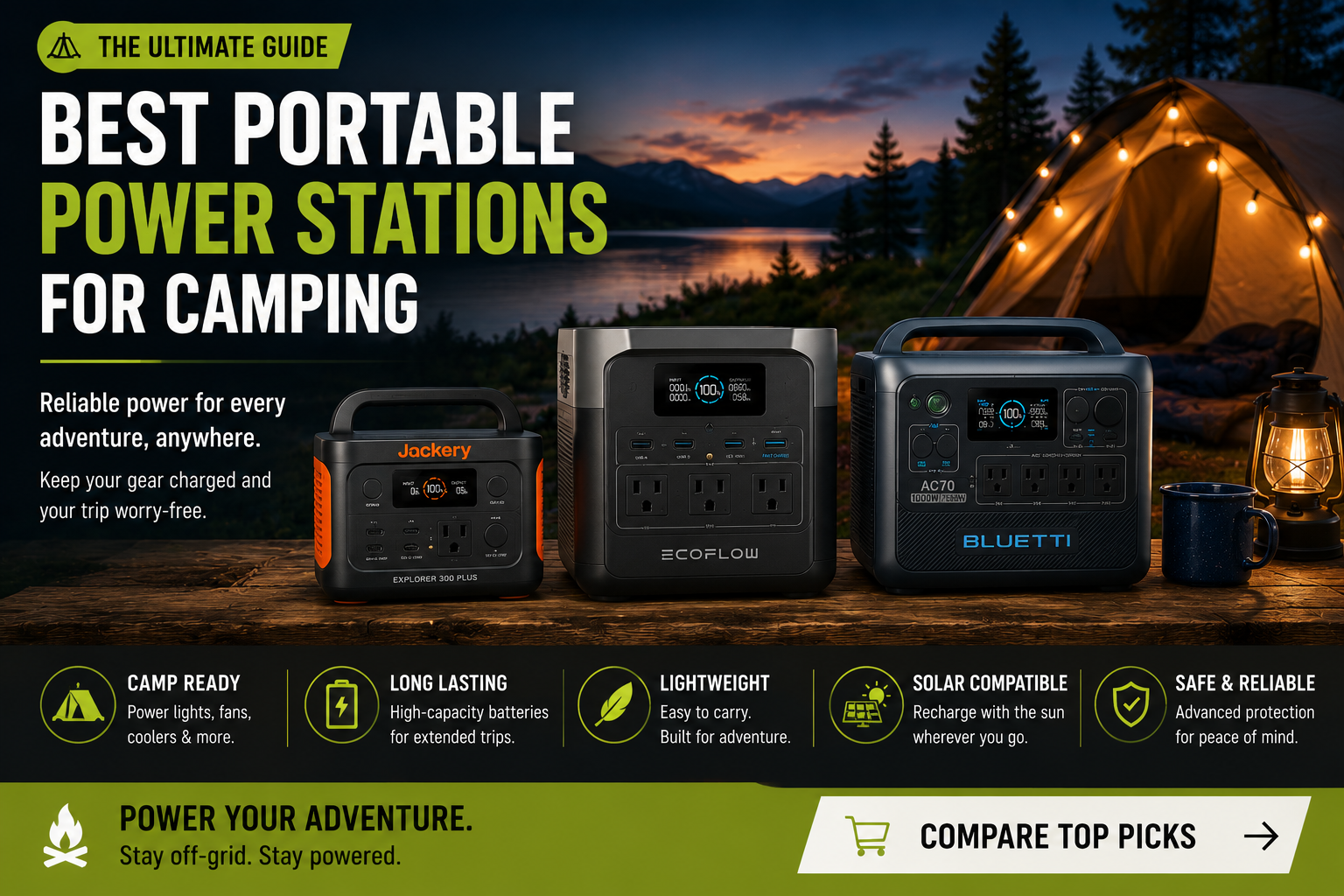
Quiet, Portable Options for Tents, Cars and RV Trips
PowerGearGuide may earn a commission from qualifying purchases made through links on this page, at no extra cost to you.
The best camping power station should be quiet enough for a campsite, light enough to move without frustration and powerful enough for the gear you actually bring. We compared compact and 1kWh-class LFP models for portable refrigerators, lights, cameras, laptops, fans, coffee makers, solar charging and multi-day trips.
The Best Portable Power Station for Camping
BLUETTI Elite 100 V2 is the best overall camping choice because it combines a full 1,024Wh battery, 1,800W output, high solar input and a relatively light 25-pound design. Choose the Jackery Explorer 1000 v2 for the lightest full-size 1kWh option, the Anker SOLIX C1000 for value, or the EcoFlow RIVER 3 Plus for minimalist trips and small electronics.
CHECK CURRENT PRICESBest Camping Power Stations at a Glance
BLUETTI Elite 100 V2
A lightweight 1kWh station with strong output, quiet operation and unusually fast solar charging.
9.7PowerGear Score Read review →Jackery Explorer 1000 v2
A compact 1,070Wh station with a foldable handle and one of the lowest weights in its class.
9.6PowerGear Score Read review →Anker SOLIX C1000
A dependable 1kWh station with fast charging, expandable capacity and strong everyday value.
9.4PowerGear Score Read review →EcoFlow DELTA 3 Plus
A flexible 1kWh station with very fast charging, high solar input and useful UPS capability.
9.4PowerGear Score Read review →DJI Power 1000
A quiet 1kWh station with 2,200W continuous output and excellent USB-C charging.
9.3PowerGear Score Read review →EcoFlow RIVER 3 Plus
A small 286Wh station for lights, phones, cameras, laptops and short minimalist trips.
9.1PowerGear Score Read review →Camping Power Station Comparison
| Product | Best For | Capacity / Output | Score | Price |
|---|---|---|---|---|
| BLUETTI Elite 100 V2 | Overall | 1,024Wh / 1,800W | 9.7 | CHECK BLUETTI ELITE 100 V2 PRICE |
| Jackery Explorer 1000 v2 | Lightweight 1kWh | 1,070Wh / 1,500W | 9.6 | CHECK JACKERY EXPLORER 1000 V2 PRICE |
| Anker SOLIX C1000 | Value | 1,056Wh / 1,800W | 9.4 | CHECK ANKER SOLIX C1000 PRICE |
| EcoFlow DELTA 3 Plus | Fast Charging | 1,024Wh / 1,800W | 9.4 | CHECK ECOFLOW DELTA 3 PLUS PRICE |
| DJI Power 1000 | Quietest High Output | 1,024Wh / 2,200W | 9.3 | CHECK DJI POWER 1000 PRICE |
| EcoFlow RIVER 3 Plus | Compact Option | 286Wh / 600W | 9.1 | CHECK ECOFLOW RIVER 3 PLUS PRICE |
Best Portable Power Stations for Camping Reviewed
BLUETTI Elite 100 V2
The BLUETTI Elite 100 V2 is the best overall camping choice because it packs a full 1,024Wh battery and 1,800W inverter into a body that weighs roughly 25 pounds. That is light enough for regular car camping while still providing enough energy for portable refrigerators, lights, laptops, cameras, fans, coffee makers and many small cooking appliances.
It also stands out for charging speed. BLUETTI lists up to 1,000W of solar input, which is unusually high for a station this compact, and the quiet operating profile makes it easier to use near tents or sleeping areas.
Pros
- Excellent capacity-to-weight ratio
- Strong 1,800W output
- Very high solar-input ceiling for its size
- Quiet operation and compact footprint
Cons
- Premium pricing compared with older 1kWh models
- No built-in wheels, so it still requires lifting
Jackery Explorer 1000 v2
The Jackery Explorer 1000 v2 is the easiest 1kWh-class model to recommend when carrying weight matters most. It weighs about 23.8 pounds yet still provides 1,070Wh of LFP storage, making it well suited to powered coolers, lights, cameras, phones, laptops and overnight campsite use.
Its 1,500W inverter is slightly less powerful than the 1,800W class leaders, but it is still enough for most camping appliances. The compact dimensions and foldable handle make it especially practical for smaller vehicles and frequent setup changes.
Pros
- Very light for a 1kWh-class station
- Compact shape and foldable handle
- Long-life LFP battery
- Strong balance of runtime and portability
Cons
- 1,500W output is lower than several rivals
- Solar input is more limited than BLUETTI and EcoFlow
Anker SOLIX C1000
The Anker SOLIX C1000 is the best value pick for campers who want a proven 1kWh platform without paying for the lightest or most feature-heavy model. Its 1,800W inverter can run a broad range of campsite appliances, and the 1,056Wh battery provides enough energy for a refrigerator, lights, electronics and intermittent cooking.
An optional expansion battery doubles the capacity, giving campers a practical upgrade path for longer trips. It is not the absolute lightest option, but the combination of output, recharge speed and warranty makes it a safe all-around buy.
Pros
- Strong 1,800W output
- Fast AC charging
- Expandable to 2,112Wh
- Excellent overall value
Cons
- Slightly heavier than the lightest 1kWh rivals
- Expansion battery increases total system cost
EcoFlow DELTA 3 Plus
The EcoFlow DELTA 3 Plus is the best choice for campers who need to recharge quickly between travel days. EcoFlow lists a 1,024Wh battery, 1,800W output and up to 1,000W of solar input, making it one of the most flexible 1kWh systems for AC, solar and vehicle-based charging.
It is especially useful for road trips where the station may need to power a cooler overnight and recharge during the next drive or solar window. The tradeoff is that it costs more than simpler models and is not quite as light as the Jackery or BLUETTI.
Pros
- Very fast AC charging
- High solar-input capability
- Strong 1,800W inverter
- Useful app and UPS features
Cons
- Premium price
- More features than basic campers may need
DJI Power 1000
The DJI Power 1000 is the standout choice for campers who need more inverter output without moving to a larger battery system. Its 2,200W continuous output can run appliances that may overload ordinary 1,500W or 1,800W stations, while DJI rates operating noise as low as 23dB under suitable conditions.
Dual 140W USB-C ports make it especially useful for photographers, videographers and drone pilots. Solar charging is less straightforward than on some competitors because DJI-specific charging accessories may be required.
Pros
- Exceptional 2,200W output for a 1kWh station
- Very quiet operation
- Dual 140W USB-C ports
- Strong fit for DJI drones and production gear
Cons
- Solar setup can require proprietary accessories
- Fewer conventional AC outlets than some rivals
EcoFlow RIVER 3 Plus
The EcoFlow RIVER 3 Plus is the best compact option for campers who do not need to run a large refrigerator or electric cooking gear. At roughly 10.4 pounds, it is easy to carry to a tent, picnic table or remote campsite and still provides enough output for lights, cameras, laptops, phones, fans and selected low-wattage devices.
Its 286Wh battery is intentionally small, so runtime must be managed carefully. The advantage is true portability: it fits situations where a 25–30-pound 1kWh station would be unnecessary or inconvenient.
Pros
- Extremely light and compact
- 600W output is strong for its size
- Fast AC and solar charging
- Quiet enough for use near sleeping areas
Cons
- Too little capacity for long refrigerator runtime
- Not suitable for high-draw cooking appliances
How We Chose These Camping Power Stations
We compared manufacturer-published battery capacity, inverter output, weight, dimensions, noise, solar input, charging speed, LFP cycle life, outlet selection and warranty coverage. Scores reflect a structured editorial comparison rather than a claim that every unit was laboratory-tested by PowerGearGuide.
PortabilityWeight, footprint, handles and how practical the station is to move around camp. Camping PerformancePortable refrigerators, lights, fans, electronics, cooking devices and surge demands. ChargingAC speed, solar-input ceiling, car charging and off-grid flexibility. ValueCapacity, output, warranty and usefulness relative to size and price class.What Size Power Station Do You Need for Camping?
250–300Wh
Best for phones, lights, cameras, laptops and short tent-camping trips where portability matters more than appliance runtime.
500–700Wh
A useful middle ground for fans, small coolers, electronics and weekend trips without heavy cooking appliances.
1,000Wh
The most versatile camping size for portable refrigerators, coffee makers, laptops, fans, lights and multi-day travel.
2,000Wh+
Best for RV appliances, electric cooking, large refrigerators or extended off-grid stays where weight is less important.
How to Choose a Camping Power Station
Prioritize Weight
A station that looks compact online may still weigh 30–40 pounds. Consider how far it must travel from your vehicle and whether you will move it daily.
Match Output to Appliances
Check continuous and surge wattage for coffee makers, induction cooktops, pumps and refrigerators. Battery capacity alone does not determine whether an appliance will run.
Check Quiet Operation
Battery stations are far quieter than generators, but cooling fans can still be noticeable under heavy load or fast charging. Low-noise models are better near tents.
Plan Solar Charging
Confirm solar voltage limits, connector compatibility and maximum input. A large panel does not help when the station accepts only a small amount of solar power.
Choose the Right Ports
Look for enough AC outlets, high-power USB-C, a regulated 12V car socket and direct DC outputs for your camping equipment.
Prefer LFP Batteries
LiFePO4 chemistry is ideal for repeated travel because it typically provides long cycle life and strong thermal stability.
Why a Battery Power Station Is Better for Most Campsites
A portable power station operates without combustion exhaust, fuel storage or engine maintenance and is quiet enough for most campgrounds. It can also run inside a tent vestibule, vehicle or RV when the manufacturer’s ventilation and moisture instructions are followed. A gas generator is more appropriate only when very high output or continuous multi-day power outweighs noise, fuel and campground restrictions.
Which Camping Power Station Should You Buy?
The BLUETTI Elite 100 V2 offers the best overall mix of capacity, output, solar charging and low weight. The Jackery Explorer 1000 v2 is the easiest full-size option to carry, while the Anker SOLIX C1000 delivers excellent value and expansion. Choose the EcoFlow DELTA 3 Plus for charging flexibility, the DJI Power 1000 for quiet high output, or the EcoFlow RIVER 3 Plus when portability matters more than runtime.
CHECK CURRENT PRICESFrequently Asked Questions
What size portable power station is best for camping?
A 300–500Wh station is enough for phones, lights, cameras and laptops. A 1,000Wh model is more versatile for portable refrigerators, fans, coffee makers and multi-day trips. Choose 2,000Wh or more for RV appliances or electric cooking.
Can a portable power station run a camping refrigerator?
Yes. Most portable compressor refrigerators draw modest average power, although startup demand can be higher. A 1,000Wh station commonly provides overnight or multi-day operation depending on refrigerator size, temperature and battery efficiency.
Are portable power stations quiet enough for campsites?
Battery power stations are much quieter than fuel generators. Fan noise varies with load and charging speed, but many modern models operate below normal conversation level during light use.
Can I charge a power station with solar panels while camping?
Yes, provided the panel voltage, connector and current are compatible with the station. Solar charging speed depends on panel wattage, sun angle, shade, weather and the station’s maximum solar input.
How heavy is a good camping power station?
Compact 250–300Wh units often weigh about 8–11 pounds. Modern 1kWh stations usually weigh around 24–30 pounds. Larger 2kWh systems can exceed 40–60 pounds and are better suited to RVs or fixed vehicle camps.
Is LiFePO4 better for camping?
LiFePO4 batteries are a strong camping choice because they generally offer long cycle life and good thermal stability. They may weigh slightly more than older lithium chemistries, but the longevity is usually worth the tradeoff.
Related Portable Power Guides
We compare portable power systems, backup equipment and charging technology to help readers choose the right products for outages, travel and off-grid use.