
Best Portable Power Stations for Home Backup
The best portable power station for home backup must do more than charge phones. It needs enough battery capacity to keep essential appliances running, enough inverter output to start refrigerators and pumps, and enough charging flexibility to recover between outages. We compared compact 1kWh stations, expandable 3–5kWh systems and higher-output 120V/240V platforms for real emergency use.
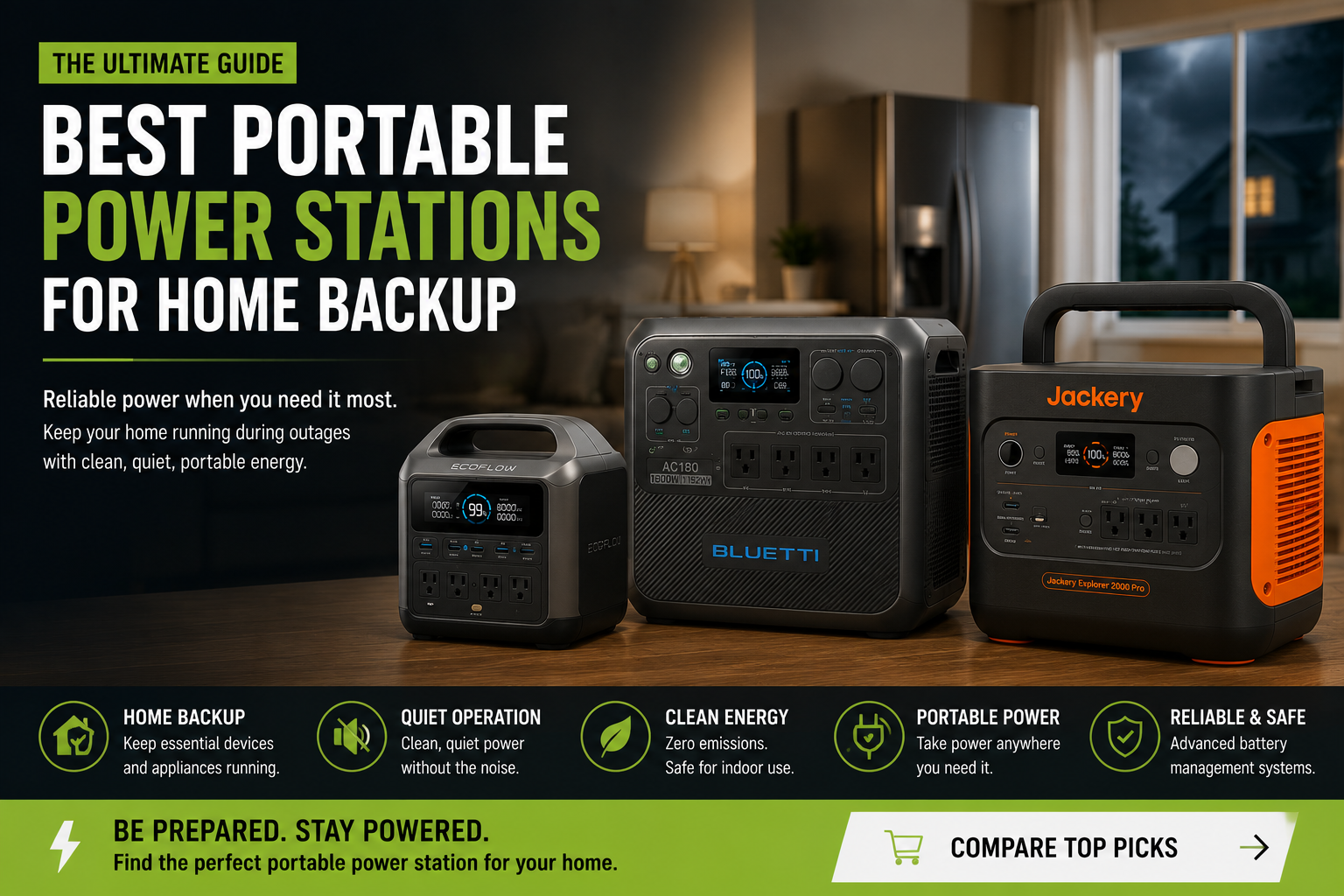
Reliable Emergency Power for Outages and Essential Appliances
PowerGearGuide may earn a commission from qualifying purchases made through links on this page, at no extra cost to you.
The best portable power station for home backup must do more than charge phones. It needs enough battery capacity to keep essential appliances running, enough inverter output to start refrigerators and pumps, and enough charging flexibility to recover between outages. We compared compact 1kWh stations, expandable 3–5kWh systems and higher-output 120V/240V platforms for real emergency use.
The Best Home-Backup Power Station for Most People
EcoFlow DELTA Pro 3 is the best overall home-backup choice because it combines a 4,096Wh LFP battery, 4,000W output, 120V/240V capability, fast charging and substantial expansion options. Choose the Anker SOLIX F3800 when native 240V output and 6,000W power matter most, the Jackery Explorer 5000 Plus for maximum output, or the EcoFlow DELTA 3 Plus for compact essential-load backup.
CHECK CURRENT PRICESBest Home Backup Power Stations at a Glance
EcoFlow DELTA Pro 3
The best balance of serious backup power, 120V/240V capability, expansion and practical home integration.
9.7PowerGear Score Read review →Anker SOLIX F3800
A plug-and-play 120V/240V platform with strong output and unusually broad expansion potential.
9.6PowerGear Score Read review →Jackery Explorer 5000 Plus
A 5kWh-class system with 7,200W output for demanding appliances and longer emergency coverage.
9.5PowerGear Score Read review →BLUETTI AC300 + B300K
A flexible inverter-and-battery system that offers strong capacity expansion at a competitive system cost.
9.3PowerGear Score Read review →EcoFlow DELTA 3 Plus
A compact 1kWh station for refrigerators, routers, lights, CPAP machines and short outages.
9.2PowerGear Score Read review →Anker SOLIX C1000
A dependable, expandable 1kWh station that covers basic emergency needs without premium-system pricing.
9.1PowerGear Score Read review →Home Backup Power Station Comparison
| Product | Best For | Capacity / Output | Score | Price |
|---|---|---|---|---|
| EcoFlow DELTA Pro 3 | Overall | 4,096Wh / 4,000W | 9.7 | CHECK ECOFLOW DELTA PRO 3 PRICE |
| Anker SOLIX F3800 | for 240V Appliances | 3,840Wh / 6,000W | 9.6 | CHECK ANKER SOLIX F3800 PRICE |
| Jackery Explorer 5000 Plus | High-Output System | 5,040Wh / 7,200W | 9.5 | CHECK JACKERY EXPLORER 5000 PLUS PRICE |
| BLUETTI AC300 + B300K | Modular Value | 2,764.8Wh / 3,000W | 9.3 | CHECK BLUETTI AC300 + B300K PRICE |
| EcoFlow DELTA 3 Plus | Compact Backup | 1,024Wh / 1,800W | 9.2 | CHECK ECOFLOW DELTA 3 PLUS PRICE |
| Anker SOLIX C1000 | Budget Choice | 1,056Wh / 1,800W | 9.1 | CHECK ANKER SOLIX C1000 PRICE |
Best Portable Power Stations for Home Backup Reviewed
EcoFlow DELTA Pro 3
The EcoFlow DELTA Pro 3 is the strongest all-around home-backup choice because it combines a large 4,096Wh battery with 4,000W continuous output and both 120V and 240V capability. That gives it enough flexibility to support refrigerators, freezers, lighting, communications equipment, kitchen appliances, sump pumps and selected larger household loads when configured correctly.
Its major advantage is scalability. The base unit can handle a short outage by itself, while extra batteries and home-integration accessories allow the same platform to grow into a more capable emergency system. It also supports high solar input, fast recharging and UPS-style transfer for critical electronics.
Pros
- 4,000W continuous output with 120V/240V support
- Expandable capacity for longer outages
- High solar-input ceiling
- Fast transfer capability for critical equipment
Cons
- Heavy and expensive compared with 1–2kWh units
- Whole-home integration requires compatible accessories and installation
Anker SOLIX F3800
The Anker SOLIX F3800 is the most compelling choice for homeowners who specifically need 240V output from a single unit. Its 6,000W output can support demanding appliances, well pumps, selected HVAC equipment, workshop tools and EV-related loads that are outside the reach of ordinary 120V power stations.
The system begins at 3.84kWh and can be expanded substantially with additional batteries. It is also compatible with Anker home-backup accessories, making it easier to build a more integrated outage solution than with a basic portable station.
Pros
- Native 120V/240V split-phase output
- 6,000W continuous output
- Large expandable battery ecosystem
- Strong solar charging capability
Cons
- Very heavy for frequent movement
- Best value appears only when its 240V capability is actually needed
Jackery Explorer 5000 Plus
The Jackery Explorer 5000 Plus is built for buyers who want more battery and inverter headroom from the beginning. Its 5,040Wh base capacity and 7,200W rated output give it the ability to run multiple large appliances at once and support both 120V and 240V loads.
This is closer to a movable home-energy system than a conventional camping battery. It is especially attractive for long outages, larger refrigerators and freezers, sump pumps, cooking appliances and households that want to reduce the chance of choosing a system that is too small.
Pros
- Very high 7,200W rated output
- 5,040Wh base capacity
- Supports 120V and 240V loads
- Expandable for multi-day backup
Cons
- Large, heavy and costly
- More system than most apartments or small homes need
BLUETTI AC300 + B300K
The BLUETTI AC300 paired with a B300K battery is one of the best modular-value choices for home backup. The inverter and battery are separate, which makes individual components easier to move and allows owners to add storage later instead of replacing the entire system.
Its 3,000W output is enough for most essential household circuits and appliances, while the modular battery architecture can scale far beyond the starting capacity. It is especially practical for buyers who care more about runtime and expandability than having the lightest single enclosure.
Pros
- Separate inverter and battery modules are easier to handle
- Expandable to a large total capacity
- Strong solar charging support
- Good capability per dollar in the modular category
Cons
- Requires multiple components and cables
- 3,000W output is lower than premium 240V competitors
EcoFlow DELTA 3 Plus
Not every home needs a 100-pound system. The EcoFlow DELTA 3 Plus is the best compact option for keeping essentials running during short outages. Its 1,024Wh capacity and 1,800W output are well suited to refrigerators, internet equipment, lamps, televisions, laptops, CPAP machines and device charging.
It recharges quickly, supports substantial solar input for its size and is easy enough to move between rooms. The limitation is runtime: it is ideal for essential loads and brief outages, not whole-home coverage.
Pros
- Much easier to move and store than large backup systems
- Fast AC charging
- Useful UPS transfer for electronics
- Strong solar input for a 1kWh station
Cons
- Limited runtime for multi-day outages
- Cannot support most 240V appliances
Anker SOLIX C1000
The Anker SOLIX C1000 is the best budget-oriented home-backup pick for buyers who want a reputable LFP station without moving into the price and weight of a large modular system. Its 1,800W inverter supports most basic emergency appliances, and the 1,056Wh battery is enough for shorter interruptions and carefully managed essential loads.
An optional expansion battery gives it a useful upgrade path. It remains a compact system, however, so buyers expecting multi-day refrigerator operation or simultaneous high-draw appliances should start with a larger platform.
Pros
- Strong value in the 1kWh class
- Fast charging and compact design
- Expandable with an additional battery
- Good output for common household essentials
Cons
- Not intended for whole-home or 240V backup
- Solar input is lower than some premium compact rivals
How We Chose These Home Backup Systems
We compared manufacturer-published capacity, battery chemistry, continuous output, 120V/240V capability, surge support, expansion options, solar input, charging speed, transfer capability, portability and warranty coverage. Scores are based on a structured editorial comparison rather than a claim that every system was laboratory-tested by PowerGearGuide.
Essential-Load PerformanceRefrigerators, freezers, lights, routers, medical devices, pumps and kitchen appliances. Battery and RuntimeBase capacity, practical usable energy, chemistry and expansion potential. Home Integration120V/240V support, transfer options, circuit compatibility and scalable accessories. ValueCapability, warranty, expansion cost and usefulness relative to system size.How Much Runtime Do You Need?
Short Outages
A 1kWh station can keep internet equipment, lights, phones, a CPAP machine and a refrigerator running for a limited period when loads are carefully managed.
Overnight Coverage
A 2–3kWh system provides more comfortable overnight refrigerator and freezer coverage, plus room for lights, electronics and intermittent appliance use.
One to Two Days
A 4–5kWh platform is a better starting point for prolonged outages, especially when several essential appliances must operate together.
Multi-Day Backup
Expandable batteries, solar charging or a compatible fuel generator become important when outages may continue for several days.
How to Choose a Portable Power Station for Home Backup
List Your Essential Loads
Start with the appliances that must remain powered: refrigerator, freezer, internet equipment, lights, medical devices, sump pump, well pump and selected cooking equipment.
Separate Watts From Watt-Hours
Watts determine whether the station can run the appliance. Watt-hours determine runtime. A large battery with a weak inverter may still fail to start a pump or compressor.
Decide Whether You Need 240V
Many central air conditioners, electric dryers, well pumps and workshop tools require 240V. Do not pay for split-phase output unless your emergency plan includes those loads.
Prefer Expandable LFP Systems
LFP chemistry is well suited to backup duty because of its long cycle life and thermal stability. Expansion batteries let the system grow as your outage plan becomes more demanding.
Plan Recharging Before the Outage
Fast AC charging is useful before storms. Solar input and generator compatibility matter during long outages, but only when the charging hardware and voltage ranges match.
Understand Installation Requirements
Directly powering appliances with extension cords is simple. Connecting selected home circuits generally requires approved transfer equipment and professional installation.
Should You Use a Power Station or a Gas Generator?
A power station is quiet, produces no combustion exhaust during normal use and can run indoors according to the manufacturer’s instructions. It is ideal for refrigerators, electronics, medical equipment and overnight use. A gas or dual-fuel generator is better for very long outages when fuel is available and high continuous output is required. Many homes benefit from a hybrid plan: battery power indoors for quiet essential loads and a generator outdoors for recharging or sustained heavy loads.
Which Home Backup Power Station Should You Buy?
The EcoFlow DELTA Pro 3 offers the best overall balance for most serious backup buyers. The Anker SOLIX F3800 is the strongest choice for native 240V loads, while the Jackery Explorer 5000 Plus delivers the most output and base capacity in this group. BLUETTI’s AC300 + B300K is the modular-value pick, and the EcoFlow DELTA 3 Plus or Anker SOLIX C1000 make more sense when the goal is short-outage essential power rather than partial-home backup.
CHECK CURRENT PRICESFrequently Asked Questions
How large should a portable power station be for home backup?
A 1,000Wh station is suitable for short outages and essential electronics. A 3–5kWh system is more realistic for refrigerators, freezers, pumps and multiple appliances. Multi-day or partial-home backup often requires expandable storage.
Can a portable power station power an entire house?
Some high-output systems can power selected household circuits or a large portion of a home when paired with an approved transfer switch or home-integration panel. Whole-home capability depends on the system output, battery capacity, wiring configuration and the loads being used.
Can a power station run a refrigerator overnight?
Yes. Most modern refrigerators can run overnight from a properly sized power station, but runtime depends on compressor cycling, ambient temperature, inverter efficiency and battery capacity. A 1kWh station may cover a refrigerator for part of a day, while 3–5kWh systems provide more margin.
Do I need 240V output for home backup?
You need 240V only for appliances or circuits that require it, such as many central air conditioners, electric dryers, well pumps and some workshop equipment. Refrigerators, lights, routers and many small appliances normally use 120V.
Is a portable power station safer than a gas generator indoors?
A battery power station does not produce combustion exhaust during normal use, so it can be operated indoors according to the manufacturer’s ventilation and temperature instructions. Gas, propane and dual-fuel generators must remain outdoors and away from openings.
How long will a 4kWh power station last during an outage?
Runtime depends on the total load. A 4kWh battery may provide roughly 3.2–3.6kWh of practical AC energy after conversion losses. At a 400W average load, that is approximately eight to nine hours; at 200W, it may last closer to sixteen hours.
Related Portable Power Guides
We compare portable power systems, backup equipment and charging technology to help readers choose the right products for outages, travel and off-grid use.