
Portable Power Station Buying Guide: How to Choose the Right Size, Output & Battery
A practical guide to battery capacity, inverter wattage, charging, portability, safety, and the features worth paying for—plus a calculator for your own devices.
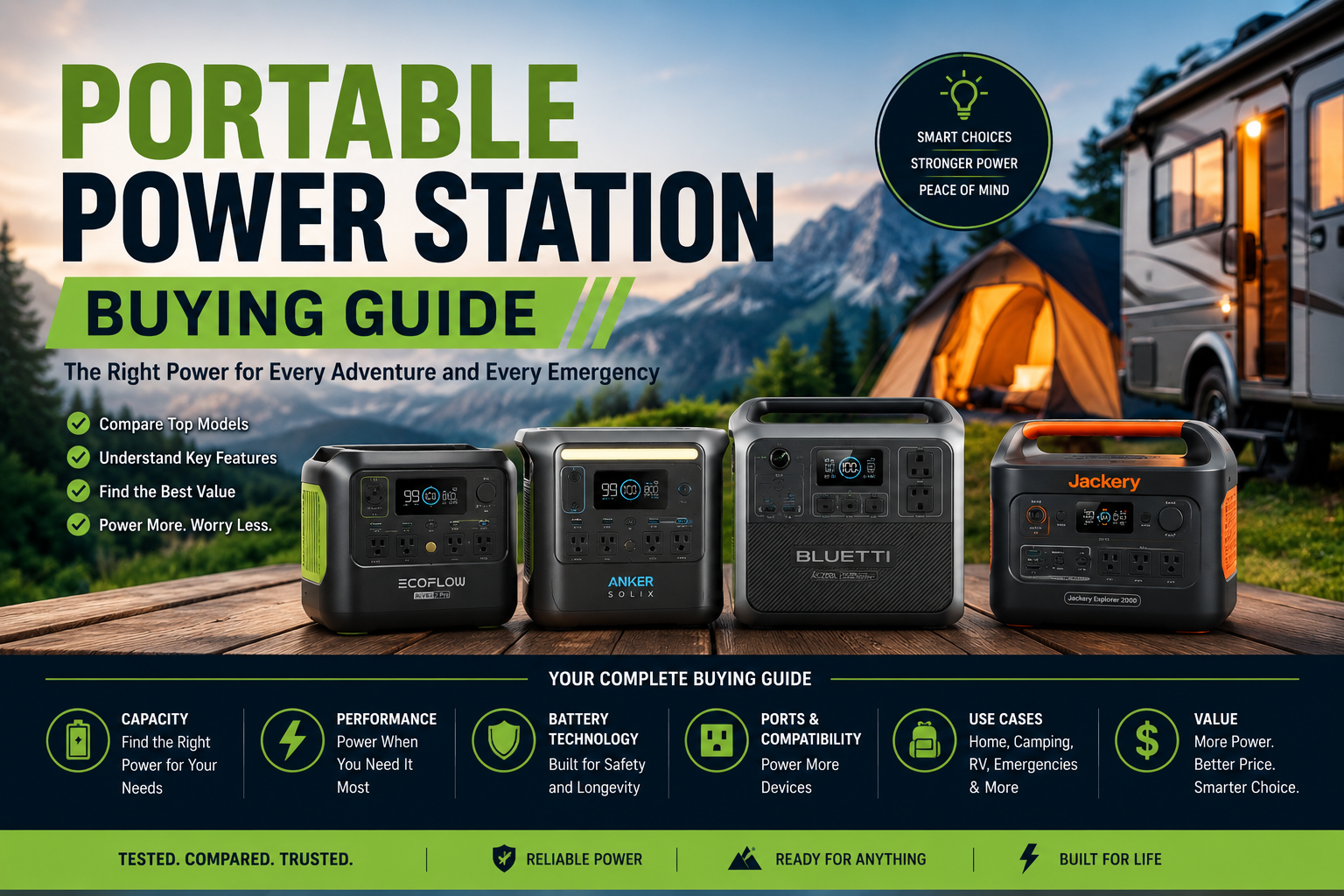
The best portable power station is not necessarily the one with the biggest battery or the highest advertised wattage. It is the one that can operate your essential devices for the time you need, recharge in the conditions you expect, and remain practical to own and transport.
Start with three questions: What will you power? How long must it run? How will you recharge it? Everything else—including battery chemistry, outlet selection, weight, and expandable storage—follows from those answers.
Quick Answer: What Size Should You Buy?
For phones, laptops, cameras, and lights, a 300–500Wh station is a reasonable starting point. For camping, home office backup, and selected appliances, compare 700–1,200Wh models. For longer outages, RVs, and larger energy demands, consider 1,500–3,000Wh or an expandable system.
These are shopping categories, not guarantees of appliance compatibility. Battery capacity determines approximate runtime; continuous AC output determines which loads the inverter can support.
Choose the Right Battery Capacity
Watt-hours (Wh) measure nominal stored energy. A 1,000Wh battery contains approximately twice the nominal energy of a 500Wh battery, but the actual energy delivered to connected devices depends on conversion losses, temperature, battery condition, and operating mode.
Electronics & Short Trips
Best suited to phones, laptops, cameras, lighting, networking devices, and modest overnight electricity needs.
Watch for: Limited runtime and lower inverter ratings.
Compare Options on AmazonCamping & Essentials
Useful for multiple electronics, selected household appliances, short outages, and some refrigerator backup setups.
Watch for: High-power devices depleting the battery quickly.
Compare Options on AmazonExtended Use & RVs
Greater energy storage for longer outages, more demanding camping setups, RV use, and appliances with sustained consumption.
Watch for: Weight, cost, and recharge time.
Compare Options on AmazonPortable Power Station Size Comparison
| Capacity Class | Common Applications | Main Consideration | Explore |
|---|---|---|---|
| 200–300Wh | Phones, cameras, brief electronic backup | Very limited energy reserve | See options |
| 300–500Wh | Laptops, lights, small fans, travel | Check inverter output | See options |
| 700–1,200Wh | Camping, short outages, selected appliances | Balance output and runtime | See options |
| 1,500–3,000Wh | RV use, extended backup, larger loads | Weight and charging plan | See options |
| 3,000Wh+ | Larger essential-load backup systems | Voltage, installation, expansion | See options |
Amazon links open category search results, not verified individual product listings. Check the exact model, specifications, seller, and warranty before purchasing.
Calculate Your Power Station Size
Enter the devices you want to power, their running wattage, the number of hours you expect to use them, and the quantity. The calculator estimates energy consumption and the nominal battery capacity needed under your selected assumptions.
A planning assumption for combined battery and conversion losses, not a measured efficiency rating.
Additional allowance for uncertainty and future demand.
Starting capacity class: Approximately 800–1,200Wh under these assumptions.
The running-load figure assumes all entered devices operate simultaneously. Startup surge is not included. For refrigerators and other cycling equipment, use realistic average power over the period being calculated, not simply the maximum nameplate wattage.
Worked Example
A 15W router running eight hours uses 120Wh. A 60W laptop running four hours uses 240Wh. Four 10W LED lights running five hours use 200Wh. Together, they need 560Wh of delivered energy.
With 85% assumed usable energy and a 20% additional reserve, the nominal battery target is approximately 791Wh. A model in the 800–1,200Wh category is a sensible place to compare options, provided its inverter also supports the connected equipment.
Understand Watts, Watt-Hours & Inverter Output
Watts (W)
Describe how quickly electricity is consumed or supplied. The inverter's continuous output rating determines the sustained load it can support.
Watt-Hours (Wh)
Describe stored or consumed energy. Battery capacity, usable energy, and average load determine approximate runtime.
A 2,000Wh battery with a 600W inverter cannot run a 1,200W appliance at its normal rated load. It has substantial stored energy but insufficient continuous output.
Calculate Simultaneous Running Power
Add the wattage of devices that may operate at the same time. If you expect to run a 100W laptop, a 60W television, and a 20W router, the combined running load is 180W.
Check Starting Surge
Refrigerators, pumps, compressors, and motor-driven tools can draw substantially more power when starting. Check the appliance requirements and the station's surge behavior separately.
Allow Practical Headroom
Avoid designing around the absolute inverter limit. Headroom helps accommodate changing loads, but a fixed percentage cannot guarantee compatibility with every motor.
Verify AC Voltage
Most compact U.S. stations provide 120V AC. Some larger backup systems support 240V. Check voltage, outlets, frequency, and any special configuration requirements before buying.
What Is Pure Sine Wave Output?
A pure sine wave inverter produces AC power intended to resemble conventional utility electricity. It is generally preferable for computers, electronic equipment, and many appliances. However, the phrase does not by itself guarantee compatibility with every sensitive or medical device.
How Much Power Do Common Devices Use?
Actual wattage varies considerably by model, settings, duty cycle, and usage. The examples below are broad planning ranges rather than appliance-specific measurements.
| Device | Illustrative Power | Important Consideration |
|---|---|---|
| Smartphone charging | 5–30W | Charging power changes with battery level |
| Laptop | 30–120W | Gaming and workstation laptops may draw more |
| Wi-Fi router | 8–25W | Include modem and network equipment |
| LED lighting | 5–15W per bulb | Multiply by quantity and hours |
| Television | 50–200W | Screen size and brightness matter |
| CPAP machine | Varies by model and settings | Humidification and heating can increase consumption |
| Refrigerator | Varies widely | Measure cycling energy and compressor startup |
| Coffee maker | 800–1,500W | High draw, often used briefly |
| Microwave | 1,000–1,800W input | Cooking output is not electrical input |
| Electric kettle | 1,000–1,500W | Rapid battery depletion at high load |
| Portable air conditioner | Highly model-dependent | Compressor startup and sustained demand |
For the most reliable calculation, measure the appliance's actual energy consumption over a representative period. A plug-in energy meter can be useful for compatible household devices.
LiFePO4 vs. Other Lithium-Ion Batteries
LFP / LiFePO4
Lithium iron phosphate batteries generally provide strong cycle-life potential and thermal stability. They are common in modern stations intended for frequent charging and backup use.
- Often suited to frequent cycling
- Strong long-term ownership potential
- Common in current backup-focused models
Other Lithium-Ion Chemistries
Other lithium-ion chemistries can provide higher energy density, potentially reducing weight. The actual trade-offs depend on cell design, thermal management, and the complete battery system.
- Potential weight advantages
- Used in some compact designs
- Cycle-life claims vary by product
Compare the manufacturer's stated cycle life, the retained-capacity threshold used for that claim, warranty terms, operating temperature limits, and battery-management protections. Chemistry alone is not a complete reliability assessment.
Compare AC, Solar & Vehicle Charging
AC Wall Charging
Compare supported input wattage and recharge times. Fast-charging settings may change noise, temperature, or operating behavior.
Solar Charging
Check input voltage, current, maximum power, connectors, and approved wiring arrangements. Panel wattage alone is insufficient.
Vehicle Charging
Standard 12V outlets are often slow. Dedicated alternator charging systems may be faster but require compatibility and proper installation.
How Many Solar Panels Do You Need?
Start with the energy you want to replace. If a station needs 1,000Wh of replenishment and receives an average of 250W of actual charging power, the idealized time is four hours before further charging losses.
Real solar production varies with sunlight, panel angle, shading, temperature, and the station's charging controller. A panel array rated at 400W does not continuously deliver 400W in ordinary conditions.
Never exceed the manufacturer's solar input voltage limit. Confirm current, polarity, connector compatibility, and series/parallel wiring requirements before connecting panels.
Pass-Through Charging and UPS Modes
Some stations allow loads to operate while the battery is charging. Others offer automatic transfer during an outage. Verify the manufacturer's supported operating modes and transfer times. A portable station with a backup feature is not necessarily equivalent to a dedicated uninterruptible power supply.
Choose by Use Case
Camping
Prioritize weight, carrying convenience, quiet operation, DC and USB-C ports, and realistic solar or vehicle recharging.
Home Office
Calculate the combined demand of networking equipment, computers, monitors, and lighting. Check transfer-time compatibility.
Refrigerator Backup
Confirm compressor startup requirements and measure or estimate average energy use. A refrigerator's running watts alone do not establish overnight runtime.
Extended Outages
Prioritize stored energy, charging opportunities, expansion compatibility, safe electrical connections, and essential-load management.
For critical medical equipment, confirm power compatibility, backup duration, and required continuity with the equipment manufacturer and appropriate professional. Do not rely solely on general power station marketing claims.
Features Worth Paying For
| Feature | Why It Matters | What to Check |
|---|---|---|
| USB-C Power Delivery | Convenient direct laptop and electronics charging | Per-port and combined output limits |
| Pure Sine Wave Inverter | Suitable AC output for many devices | Manufacturer specifications |
| Solar Input | Off-grid recharging potential | Voltage, current, wattage, connectors |
| Expandable Batteries | Increase energy storage | Exact compatibility and total cost |
| UPS/EPS Function | Backup transition during outages | Transfer time and device tolerance |
| Warranty | Ownership protection | Authorized sellers, coverage, exclusions |
| App Control | Monitoring and settings | Core functions without connectivity |
Portable Power Station Buying Checklist
- Capacity: Enough nominal watt-hours for your intended runtime and a realistic loss allowance.
- Continuous output: Supports the highest simultaneous running load with sensible headroom.
- Starting surge: Compatible with compressors, pumps, motors, and other demanding appliances.
- Voltage: Correct AC voltage, frequency, outlets, and connection requirements.
- Battery: Suitable chemistry, cycle-life expectations, warranty, and operating limits.
- Charging: AC, solar, and vehicle options fit your actual recharging plan.
- Portability: Weight and dimensions work for your storage and travel needs.
- Expansion: Extra batteries are compatible and financially worthwhile.
- Safety: Installation, ventilation, storage, and charging follow manufacturer instructions.
- Seller: Confirm exact model generation, accessories, warranty eligibility, and total purchase cost.
Common Buying Mistakes
Choosing by Peak Watts
Advertised surge or boost numbers are not substitutes for the continuous AC rating.
Ignoring Battery Runtime
An inverter may operate a 1,500W appliance while a small battery provides only minutes of useful energy.
Assuming Solar Compatibility
Not every panel works with every station. Electrical limits and connectors must match.
Buying Too Much Weight
A large system may be practical at home but inconvenient for camping or frequent transport.
Ignoring Recharge Time
Multi-day backup requires a realistic way to replenish the battery.
Confusing Product Generations
Similar names can conceal different battery capacities, inverter ratings, and accessory support.
Portable Power Station Safety
Battery power stations do not produce combustion exhaust during normal battery operation, but they still require proper ventilation, temperature management, safe charging, and appropriate electrical connections.
Never energize household wiring through an improvised backfeed connection. Backup connections to home circuits require suitable equipment and appropriate professional installation.
Fuel-burning generators must never be operated indoors, inside garages, or in enclosed or partially enclosed spaces because of potentially fatal carbon monoxide exposure.
Read our portable power station vs. generator comparison for more on choosing between battery and fuel-based backup.
Frequently Asked Questions
What size portable power station should I buy?
Calculate the energy required by your devices and their intended runtime. A 300–500Wh model can suit light electronics, 700–1,200Wh offers versatile portable backup, and larger systems suit extended energy requirements.
How do I calculate portable power station runtime?
Divide estimated usable battery energy in watt-hours by average load in watts. For example, a 1,024Wh station at an illustrative 85% usable-energy assumption powering a constant 100W load gives about 8.7 hours.
Is a 1,000Wh station enough for home backup?
It may support selected essentials during a short outage. It is not a substitute for sustained whole-home power.
Can a power station run a refrigerator overnight?
Some combinations can, but the answer depends on refrigerator energy consumption, compressor startup demand, ambient conditions, and available battery energy. Calculate rather than assume.
Is LiFePO4 better than other lithium-ion batteries?
LFP generally offers attractive cycle-life potential and thermal stability. Compare complete product specifications, weight, warranty, and operating limits.
Can I use a portable power station indoors?
Many battery stations are intended for indoor use when operated according to the manufacturer's instructions. Follow ventilation, charging, temperature, and moisture restrictions.
Can a portable power station replace a UPS?
Not automatically. Verify transfer time, output behavior, and compatibility with the specific connected equipment. Critical applications may need dedicated UPS equipment.
How much solar input should I buy?
Calculate how much energy must be replenished per day, estimate realistic sunlight and production, then check the station's voltage, current, and maximum input limits.
Are expandable batteries worth it?
They can be useful for growing backup requirements. Compare compatible battery availability and total system cost against a larger standalone unit.
Do higher watts mean longer runtime?
No. Watts describe power capability. Watt-hours describe stored energy. A higher inverter rating does not increase battery capacity.
How We Research Portable Power Stations
Power Gear Guide evaluates portable power equipment through published manufacturer specifications, technical documentation, electrical calculations, and practical use-case comparisons.
We distinguish nominal manufacturer ratings from independently measured performance. The examples and calculator in this guide are planning tools, not claims of hands-on testing. Verify model-specific specifications and current documentation before purchasing.
Continue Your Research
Final Recommendation
For most first-time buyers, the 700–1,200Wh class is a useful starting point for comparing versatile portable stations. Move smaller when weight matters most and larger when you need longer appliance runtime.
Do not buy on battery size alone. Calculate your required watt-hours, verify continuous and startup power, plan your recharging method, and compare the full ownership cost.
Once you know your requirements, see our best portable power stations guide to compare specific models.