
What Can a Portable Power Station Run?
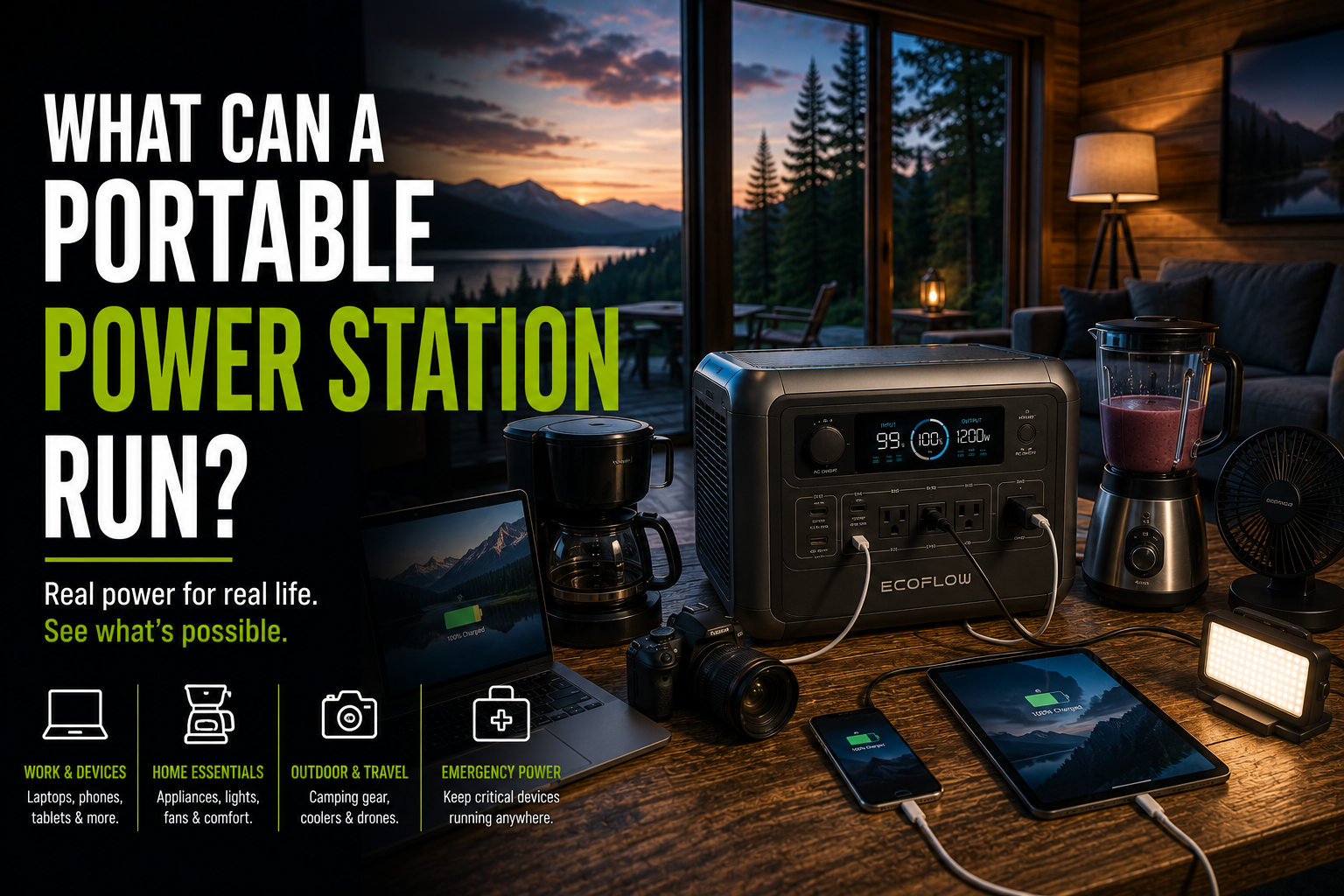
Portable power stations can run everything from phones, routers and laptops to refrigerators, CPAP machines, power tools and selected kitchen appliances. The real limit comes down to battery capacity, inverter output, surge power and how long you need each device to operate.
 Portable Power Station Runtime Guide
Portable power stations can run everything from phones, routers and laptops to refrigerators, CPAP machines, power tools and selected kitchen appliances. The real limit comes down to battery capacity, inverter output, surge power and how long you need each device to operate.
Calculate Runtime Compare Power StationsThe Five Numbers That Decide What You Can Run
A portable power station can run a device only when its inverter can handle the device’s continuous draw and startup surge. Runtime then depends on battery capacity and conversion losses.
Battery Capacity(Wh) Continuous Output
(W) Surge Output
(W) Device Wattage
(W) Required Runtime
(Hours)
Common Devices Portable Power Stations Can Run
Home Essentials
Refrigerators, freezers, routers, modems, TVs, lights, laptops and phone chargers.
Kitchen
Microwaves, coffee makers, blenders, kettles, air fryers, toasters and slow cookers.
Camping
Portable fridges, electric coolers, fans, camp lights, drones and camera batteries.
Work
Laptops, desktops, monitors, printers, networking equipment and small tools.
Medical
CPAP machines, mobility-device chargers, medical refrigerators and selected concentrators.
Typical Power Draw and Practical Compatibility
Actual wattage varies by model. Always check the device label or measure with a watt meter before relying on estimated values.
| Device | Typical Running Watts | Startup Surge | Usually Suitable For |
|---|---|---|---|
| Smartphone charger | 5–20W | Minimal | Nearly any power station |
| Wi-Fi router and modem | 10–30W | Minimal | Small to large models |
| LED light | 5–15W | Minimal | Nearly any power station |
| Laptop | 40–100W | Minimal | Small to large models |
| Television | 60–180W | Low | Small to large models |
| CPAP without heated humidifier | 30–60W | Low | Small to large models |
| Portable refrigerator | 35–70W | Moderate | Small to large models |
| Full-size refrigerator | 100–250W cycling | 600–1,200W+ | Medium to large models |
| Coffee maker | 800–1,500W | Low | Large-inverter models |
| Microwave | 1,000–1,500W input | Moderate | Large-inverter models |
| Electric kettle | 1,200–1,800W | Low | Large-inverter models |
| Window air conditioner | 500–1,500W | High | Large or expandable models |
What Different Capacity Classes Can Handle
Under 300Wh
Best for phones, tablets, lights, routers, cameras and short laptop use.
Explore Small Models300–700Wh
Useful for camping, CPAP backup, fans, TVs, laptops and efficient portable fridges.
Explore Camping Models700–1500Wh
Suitable for refrigerators, longer outages, workstations and brief high-wattage appliance use.
Explore Home Backup1500Wh+
Better for multi-device backup, RV use, longer refrigerator runtime and expandable systems.
Compare Large ModelsApproximate Runtime From a 1000Wh Power Station
The examples below assume about 85% usable AC energy. Compressor appliances cycle on and off, so real results can vary widely.
| Device or Setup | Estimated Average Load | Approximate Runtime | Important Note |
|---|---|---|---|
| Wi-Fi router and modem | 20W | About 42 hours | Excellent outage priority load |
| Laptop | 60W | About 14 hours | Actual draw changes with charging and workload |
| CPAP without heated humidifier | 40W | About 21 hours | Heated tubing and humidification can reduce runtime substantially |
| LED TV | 100W | About 8.5 hours | Brightness and screen size affect draw |
| Portable refrigerator | 45W average | About 18 hours | Ambient temperature and compressor cycling matter |
| Full-size refrigerator | 80W average cycling | About 10 hours | Inverter must also handle startup surge |
| Microwave | 1,200W | About 40 minutes total | Usually used for only a few minutes at a time |
| Remote office setup | 180W | About 4.7 hours | Laptop, monitor, router and phone charging |
Use Battery Capacity, Load and Efficiency
Estimated runtime = Battery capacity × 0.85 ÷ Device wattageExample: 1000Wh × 0.85 ÷ 100W = approximately 8.5 hours.
Remember: Runtime estimates are planning tools, not guarantees. Temperature, battery age, inverter efficiency, standby draw and appliance cycling all affect real-world results.How People Commonly Use Portable Power Stations
Overnight Blackout
Refrigerator, router, a few LED lights and phone charging.
Camping Weekend
Portable fridge, fan, lights, drone batteries and camera equipment.
Remote Office
Laptop, monitor, router, phone and occasional printer use.
Medical Backup
CPAP, lighting, communications and approved medical accessories.
What Most Portable Power Stations Usually Cannot Run
Central Air Conditioning
Whole-home HVAC systems typically require more continuous and startup power than portable units provide.
Electric Water Heaters
Resistance heating commonly draws several thousand watts for extended periods.
Electric Clothes Dryers
Large heating elements and motors exceed the output of most portable power stations.
Large Electric Ovens
Full-size ovens and ranges are normally impractical because of sustained high wattage.
Large Welders
High current demand and surge loads can exceed inverter and outlet limits.
Whole-Home Loads
Running every circuit at once generally requires a dedicated home battery or generator system.
Avoid These Runtime Planning Errors
Ignoring Surge Wattage
Motors and compressors may require several times their normal running wattage when starting.
Using the Full Wh Rating
Not all battery capacity reaches the outlet because conversion losses and reserve protection reduce usable energy.
Adding Only Average Loads
Simultaneous startup events can overload an inverter even when average wattage looks safe.
Prioritizing Heating Loads
Kettles, heaters, hot plates and hair dryers consume battery capacity very quickly.
Size Your Power Station Before You Buy
Use your own appliance wattage and desired runtime instead of relying only on generic examples.
Use the Power Runtime Calculator Use the Size CalculatorContinue Your Portable Power Research
Best Portable Power Stations
Compare top models by battery capacity, inverter output, portability and overall value.
Read GuidePortable Power Station Buying Guide
Understand capacity, battery chemistry, charging options and inverter sizing.
Read GuideBest Models for Home Backup
Find systems designed for refrigerators, communications, lighting and essential appliances.
Read GuideBest Models for Camping
Compare portable options for fridges, fans, lighting and charging gear outdoors.
Read GuidePortable Power Station vs Generator
Compare battery power with fuel-based backup for noise, runtime, maintenance and output.
Read ComparisonLiFePO4 vs Lithium-Ion
Compare cycle life, weight, safety characteristics and long-term value.
Read ComparisonPractical Planning Notes
The most useful way to apply what can a portable power station run is to connect the concept to a real load and a real runtime target. Backup-power systems are easier to understand when watts, watt-hours, inverter limits and charging are treated as parts of the same system rather than isolated specifications.
Use measured consumption whenever possible. Appliance labels are useful for screening, but actual power can vary with operating mode, temperature and duty cycle. A plug-in energy meter can turn a rough estimate into a much stronger battery-sizing calculation.
Leave operating margin. Designing around the absolute maximum output or the exact theoretical battery capacity makes the plan fragile. Conversion losses, temperature, battery-management reserves and unexpected extra loads all reduce real-world headroom.
For emergency planning, simplicity matters. Label cables, keep charging accessories together, periodically test equipment and document which loads are priorities. A slightly smaller system that the household understands how to use can be more effective than a complex setup nobody has practiced with.
Portable Power Station Runtime FAQ
Can a portable power station run a refrigerator?
Yes, many medium and large models can. Check both the refrigerator's running wattage and compressor startup surge before connecting it.
Can a portable power station run a microwave?
Yes, but the inverter often needs to support 1,000 to 1,500 watts or more. The microwave's advertised cooking wattage may be lower than its actual electrical input.
Can a portable power station run a coffee maker?
Many can, provided the inverter supports the coffee maker's heating element. Expect roughly 800 to 1,500 watts during brewing.
Can a portable power station run an air conditioner?
Large models may run selected window or portable air conditioners. Central air conditioning usually requires a home backup system with much greater output.
Can a portable power station run a CPAP overnight?
Often yes. Turning off heated humidification and using an approved DC adapter can improve runtime, but follow the CPAP manufacturer's guidance.
How many appliances can it run at the same time?
As many as the outlets support, provided combined continuous load and all startup surges remain below the rated inverter limits.
Can it charge an electric vehicle?
Some high-output systems can provide limited emergency charging, but portable power stations are generally not practical for adding meaningful EV range.
Does a 1000Wh battery provide exactly 1000Wh at the AC outlets?
No. Inverter losses, battery reserve, standby consumption and operating conditions reduce usable AC energy.
What is surge wattage?
Surge wattage is the brief burst of power required when motors, pumps or compressors start.
What size power station is best for a refrigerator?
A medium or large model with enough surge output and at least several hundred watt-hours is a practical starting point. Longer outages require more capacity or solar recharging.
Find the Right Portable Power Station
Estimate your real appliance loads, calculate the runtime you need and compare models with enough battery capacity and inverter output for your setup.
Compare Portable Power Stations Use Runtime Calculator