
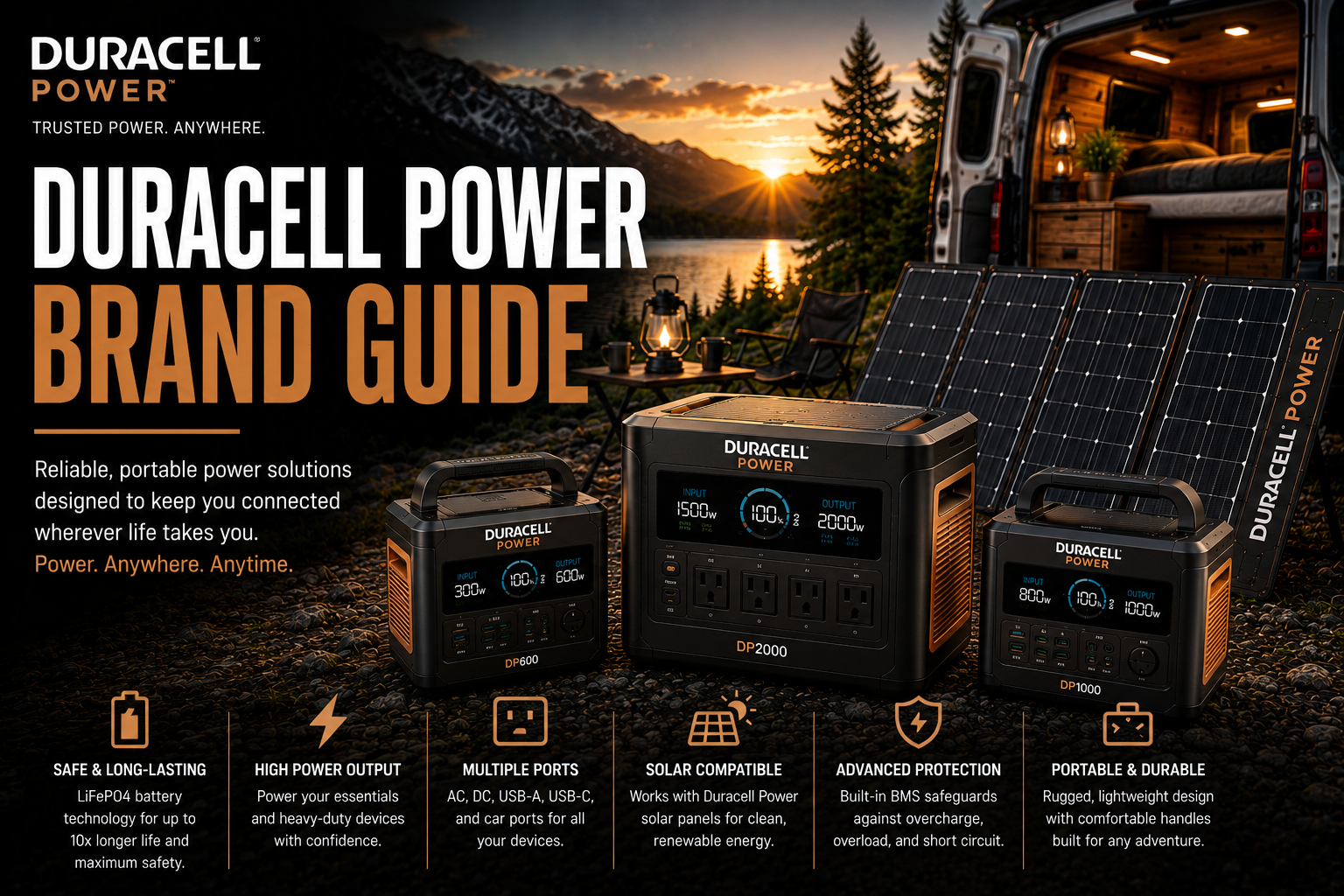
Duracell Portable Power Station Buying Guide
Choose Duracell by use case, continuous output, battery generation, waveform, solar compatibility and whether fixed capacity is acceptable.
Duracell’s lineup is simple, but the PowerSource 1800 and Power 1000 are fundamentally different technologies.
This guide explains the practical differences before purchase.
Power 1000 for Modern Portable Use; Avoid Treating PowerSource 1800 as an Upgrade
The older PowerSource has more inverter output but less energy, modified-sine power and heavy AGM batteries.
Buying Guidance
Buy Duracell for occasional simple backup, not for the deepest modern power ecosystem.
Choose by Use Case
| Use | Best Model | Why |
|---|---|---|
| Phones/laptops | Power 300 | Lowest weight |
| Camping/cooler | Power 500 | More output and two AC outlets |
| Refrigerator/home office | Power 1000 | About 1kWh capacity |
| Legacy always-plugged backup | PowerSource 1800 | Built-in AGM backup design |
| Installed home storage | Duracell Power Center | Separate professional system |
Battery Chemistry Matters
The current Power 300–1000 pages position them as lithium portable stations, while PowerSource 1800 uses replaceable-style sealed AGM lead-acid batteries. Neither should be assumed to have the LFP cycle life of current EcoFlow, Jackery or BLUETTI models.
Charging and Solar
Duracell includes wall and car charging with the portable stations and offers a matched 100W folding panel. Charging speed is modest compared with modern one-hour LFP platforms.
Common Buying Mistakes
Confusing Output and Capacity
Power 1000 refers to watt output.
Assuming PowerSource Is Modern Lithium
It is AGM.
Expecting Expansion
Current portable models are fixed capacity.
Ignoring Pure vs Modified Sine
PowerSource uses modified sine.
Buying for Daily Cycling
Newer LFP models are stronger.
Confusing Power Center
It is a separate installed ecosystem.
Frequently Asked Questions
Who should buy a Duracell power station?
Buy it when simple controls, a familiar battery brand and occasional indoor backup matter more than expansion or app features.
Who should skip a Duracell power station?
Skip it when you need LiFePO4 chemistry, very fast charging, high inverter output or a modular battery ecosystem.
How should Duracell runtime be estimated?
Multiply watt-hours by roughly 0.80 to 0.90 for usable AC energy, then divide by the appliance’s average watts.
Can Duracell Power 1000 run a refrigerator?
It can run many refrigerators when the compressor startup demand remains within its inverter capability.
Can third-party solar panels be used?
Potentially, but voltage, current, polarity and connectors must match the exact station input.
Is PowerSource 1800 the same generation as Power 1000?
No. PowerSource 1800 is an older AGM lead-acid platform with modified-sine output.
Are Duracell portable stations expandable?
The current Power 300, 500 and 1000 do not use a broad plug-in expansion-battery ecosystem.
How should a Duracell station be stored?
Store it cool and dry and recharge it on the interval specified in the manual, commonly every few months.
Does Duracell offer whole-home batteries?
Duracell Power Center is a separate licensed residential storage ecosystem, not an expansion path for the portable Power stations.
What is the biggest Duracell buying mistake?
Assuming the Duracell name means the portable stations share chemistry, charging speed and lifespan with newer LFP competitors.
Which model has pure sine output?
The current Power 300–1000 line uses pure-sine AC output.
Which model uses AGM batteries?
PowerSource 1800.