
Best Duracell Power Stations: Power 300 vs 500 vs 1000
Duracell's portable power stations cover three different needs: lightweight electronics backup, midsize camping power and larger emergency battery storage. We compare their actual battery capacities, inverter ratings, charging limitations and ownership trade-offs so you can choose the right model.
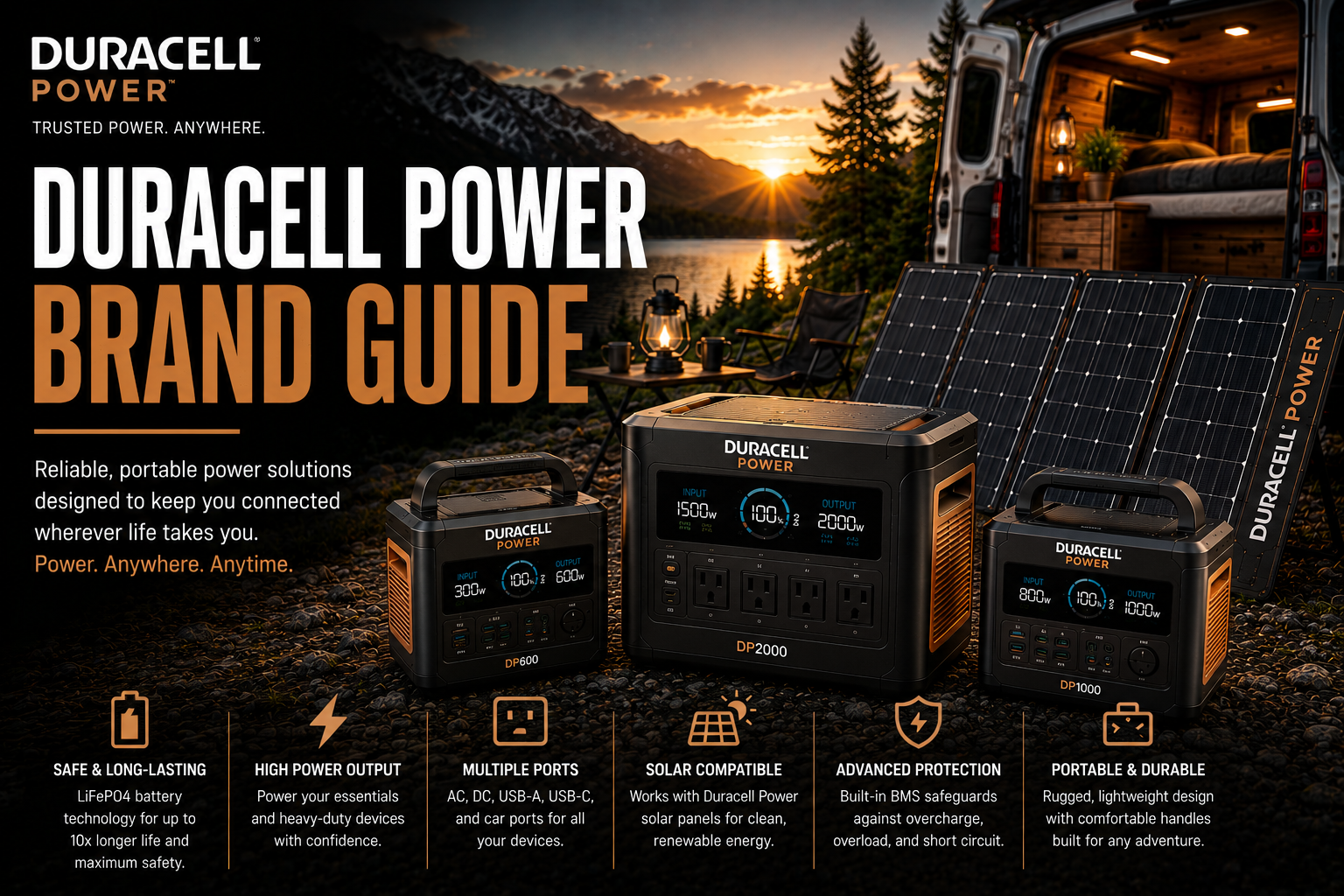
Our recommendation: The Duracell Power 1000 is the strongest choice in this group for occasional home essentials because it combines a 1,050Wh battery with 1,000W continuous AC output. The Power 500 is better for camping and moderate loads, while the Power 300 makes the most sense when low weight matters.
Best Duracell Power Stations at a Glance
Duracell Power 1000
1,050Wh battery · 1,000W AC
Best for longer electronics backup, home-office equipment, lighting and appropriately sized appliances.
Main trade-off: 24.6-pound weight, slower wall charging and older lithium-ion chemistry.
Check PriceDuracell Power 500
515Wh battery · 500W AC
A practical middle ground for small electronics, campsite lighting and modest AC devices.
Main trade-off: Limited inverter output and several hours of wall charging.
Check PriceDuracell Power 300
292Wh battery · 300W AC
Suited to phones, laptops, portable lighting and shorter backup needs.
Main trade-off: Limited energy storage and a 300W continuous inverter ceiling.
Check PriceDuracell Power 300 vs 500 vs 1000: Specifications
The table separates stored energy from inverter output. A model's wattage name does not tell you how long it can run an appliance.
| Specification | Power 300 | Power 500 | Power 1000 |
|---|---|---|---|
| Model identifier | PPS300-292-120-01 | PPS500-515-120-02 | PPS1000-1050-120-01 |
| Battery capacity | 292Wh | 515Wh | 1,050Wh |
| Battery chemistry | Lithium-ion | Lithium-ion NMC | Lithium-ion |
| Continuous AC output | 300W | 500W | 1,000W |
| Published peak output | 600W | 1,000W | 2,000W |
| AC waveform | Pure sine wave | Pure sine wave | Pure sine wave |
| AC outlets | 2 | 2 | 3 |
| USB-C | 60W bidirectional | 100W output | 100W bidirectional plus 27W output |
| Weight | 7.5 lb | 13.4 lb | 24.6 lb |
| Dimensions | 8.5 × 6.2 × 6.3 in | 11.6 × 7.4 × 8.1 in | 13.38 × 9.29 × 8.11 in |
| Manual-listed wall charging | 5–6 hours | 6–7 hours | 10–11 hours |
| Manual-listed cycle rating | 1,000 cycles to 80% | 1,000 cell cycles to 80% | 500 cycles to 80% |
| Manual-listed warranty | 24 months | 24 months | 24 months |
| Best fit | Portable electronics | Camping and moderate loads | Home essentials and larger loads |
Source: Duracell Power 300, Power 500 and Power 1000 published user manuals. Charging figures refer to the specified included wall-charging arrangements; other methods can differ. Confirm the exact manual supplied with your unit.
1. Duracell Power 1000
The strongest of the three Power-series models for occasional emergency backup and higher-output portable use.
The Power 1000 is the most capable option here because it provides more than twice the stored energy of the Power 500 and double its continuous inverter output.
Its three 120V pure-sine AC outlets make it suitable for powering several modest devices, provided their combined running demand stays within 1,000W.
The 100W bidirectional USB-C connection adds flexibility for compatible laptops and charging. The manual also lists a separate 27W USB-C output.
Where It Makes Sense
- Keeping a router, modem and essential electronics running during a short outage.
- Supporting televisions, lighting and office equipment.
- Running compatible small appliances whose continuous and startup requirements fit the inverter.
- Providing a larger portable battery reserve than the Power 300 or 500.
The Biggest Drawback: Charging Speed
Duracell's manual lists approximately 10–11 hours for charging with the 120W wall charger. A combined wall-plus-USB-C arrangement is listed at approximately 5–6 hours.
That makes recharge planning important during repeated outages. If you regularly need to replenish a battery quickly between power interruptions, compare newer alternatives before purchasing.
- Largest battery in this comparison
- 1,000W pure-sine inverter
- Three AC outlets
- 100W bidirectional USB-C
- Solar charging input
- 24.6-pound weight
- Slow standard wall charging
- 500-cycle manual rating
- No modular battery expansion system
- Not a 2,000W continuous inverter
Who should buy it? Someone who needs approximately 1kWh of portable stored energy and whose devices remain within the 1,000W continuous limit.
Who should avoid it? Buyers needing fast recharging, higher continuous output, LiFePO4 chemistry or battery expansion.
Check Price2. Duracell Power 500
A midsize portable station with a 515Wh battery, 500W pure-sine inverter and manageable weight.
The Power 500 is a more portable alternative to the Power 1000. It weighs approximately 11.2 pounds less while still providing enough energy for many electronics-focused camping and backup tasks.
Its 500W continuous inverter is appropriate for equipment with relatively modest running demands. It is not designed for high-wattage kitchen appliances or large heating loads.
Duracell specifies a 100W USB-C output, two 120V AC outlets and a 13V vehicle-style DC socket.
Why It Is a Good Middle Choice
The Power 500 offers roughly 76% more rated battery capacity than the Power 300, while weighing 13.4 pounds rather than 24.6 pounds like the Power 1000.
For a campsite where you need lighting, laptops and small compatible appliances, that balance can be more useful than simply buying the largest station.
- 515Wh rated capacity
- Pure-sine AC output
- 100W USB-C output
- Reasonable carrying weight
- Two AC outlets
- 500W continuous output ceiling
- Less runtime than Power 1000
- 6–7-hour manual-listed wall charging
- No battery expansion system
Who should buy it? Campers and occasional backup users whose connected equipment fits within 500W.
Who should avoid it? Buyers needing longer emergency runtime or appliances with significant startup and running loads.
Check Price3. Duracell Power 300
The easiest model in this group to carry, designed around phones, laptops, lights and low-power electronics.
The Power 300 is a small portable battery station, not a general-purpose appliance backup system.
Its 292Wh battery and 300W continuous inverter are most useful for keeping essential electronics running when wall power is unavailable.
The 60W USB-C input/output connection is useful for compatible laptops and devices. It also provides two pure-sine AC outlets.
Where It Works Best
- Charging phones and tablets
- Supporting compatible laptops
- Powering small LED lights
- Short-duration networking backup
- Portable work and travel setups
Its biggest advantage is simple portability: at 7.5 pounds, it is significantly easier to carry than the other two models.
- Lightest model in the group
- 292Wh battery
- Two pure-sine AC outlets
- 60W bidirectional USB-C
- Suitable for smaller emergency kits
- 300W continuous AC limit
- Shorter runtime than larger models
- Not suited to high-draw appliances
- No battery expansion system
Who should buy it? Buyers prioritizing light weight, compact storage and electronics.
Who should avoid it? Anyone expecting meaningful backup for large appliances, multiple high-draw devices or long-duration outages.
Check PriceWhat About the Duracell PowerSource 1800?
Duracell PowerSource 1800
The PowerSource 1800 belongs to a different generation of backup-power equipment. It should not be compared with the Power 300, 500 and 1000 as though it were simply a larger lithium power station.
Historical specifications identify a sealed lead-acid battery arrangement, approximately 58.2-pound weight, 1,440W maximum continuous AC output and modified-sine-wave power.
Its 1,800W figure refers to a five-minute output rating, not its continuous inverter rating. The historical specification also lists a 3,600W peak surge capacity.
A used unit should be assessed for battery condition and supported operation before purchase. Do not assume an old sealed lead-acid battery still delivers its original capacity.
How Long Will a Duracell Power Station Run?
Battery capacity determines the amount of energy stored. Continuous inverter output determines how much AC power can be delivered at once.
Simple Runtime Estimate
The 0.85 factor is an illustrative assumption for usable AC energy, not a measured efficiency rating for these products.
It accounts approximately for energy lost through conversion and operation. Actual results will vary.
| Constant AC Load | Power 300 | Power 500 | Power 1000 |
|---|---|---|---|
| 20W | 12.4 hr | 21.9 hr | 44.6 hr |
| 50W | 5.0 hr | 8.8 hr | 17.9 hr |
| 100W | 2.5 hr | 4.4 hr | 8.9 hr |
| 200W | 1.2 hr | 2.2 hr | 4.5 hr |
| 400W | Above continuous rating | 1.1 hr | 2.2 hr |
| 800W | Above continuous rating | Above continuous rating | 1.1 hr |
Why Refrigerator Runtime Is Harder to Predict
A refrigerator typically cycles its compressor on and off. Its instantaneous wattage is not the same as its average energy consumption.
For refrigerator backup, confirm both compressor startup demand and measured average energy use. A station may have enough battery energy for several hours but still fail to start a compressor whose surge demand exceeds its capabilities.
Solar Charging: What Buyers Need to Check
Duracell offers a foldable 100W solar panel as part of its portable power ecosystem.
A 100W panel is useful for extending smaller outdoor power setups, but its rated wattage is measured under standardized test conditions. Real sunlight rarely delivers rated output continuously.
For the Power 1000, the manual specifies a solar input arrangement of 12–30V and 6.5A, with a 195W maximum input rating.
The Power 300 and Power 500 have different input requirements. Do not assume that a solar panel or adapter compatible with one model is automatically suitable for another.
Duracell 100W Solar Panel
Consider this only when its exact connectors and electrical specifications match your power station. A matched solar accessory can simplify an off-grid setup, but panel output and weather determine charging time.
Check PriceHow to Choose the Right Duracell Power Station
Start With Running Watts
Check the nameplate or measured power draw of every device you want to connect.
The combined continuous AC demand must fit the station's output rating. Motors may also require additional startup power.
Estimate the Energy You Need
Multiply the expected average wattage by the desired number of hours.
A 100W constant load running for five hours consumes approximately 500Wh before accounting for conversion losses.
Consider How Often You Carry It
A 7.5-pound station is much easier to transport than a 24.6-pound model.
For a stationary emergency kit, capacity may matter more. For frequent travel, weight can dominate.
Check Recharge Time
A larger battery can be less useful if you cannot recharge it between outages.
The Power 1000's manual-listed standard wall charging time is much longer than that of many newer fast-charging stations.
Do You Need LiFePO4 Instead?
The three Power-series models in this comparison use lithium-ion battery technology rather than being marketed as modern LiFePO4 stations.
The Power 1000 manual lists 500 cycles to 80% capacity, while the Power 300 and Power 500 manuals specify higher cycle figures.
If you intend to cycle a station daily, battery longevity, charging speed and replacement economics deserve greater weight than they would for occasional emergency use.
In that case, compare modern LiFePO4 alternatives before deciding solely on the Duracell brand name.
Safety and Ownership Considerations
Keep power stations away from rain, standing water, excessive heat and blocked ventilation. Follow the temperature and storage limits in the exact model manual.
Never connect a portable power station to household wiring through a wall outlet. Home circuit backup requires an appropriate professionally installed transfer arrangement.
Storage and Battery Care
Duracell's manuals instruct owners to recharge these stations periodically during storage, commonly every three to six months.
Avoid storing a unit in a hot vehicle or exposing it to moisture. Review the manufacturer's storage guidance before long periods of inactivity.
Do Not Assume UPS Performance
These portable power stations should not automatically be treated as dedicated uninterruptible power supplies.
For computers, network storage or other sensitive devices, verify documented transfer behavior and compatibility. A dedicated UPS may be preferable when uninterrupted operation is essential.
Which Duracell Should You Buy for Each Use?
| Primary Use | Recommended Model | Why |
|---|---|---|
| Phone and tablet charging | Power 300 | Compact size and adequate energy for smaller electronics |
| Portable laptop workstation | Power 300 or 500 | Choose based on laptop wattage and desired runtime |
| Camping lights and electronics | Power 500 | Balanced capacity and portability |
| Home-office outage kit | Power 500 or 1000 | More energy for longer backup |
| Higher-demand portable appliances | Power 1000 | 1,000W continuous inverter, subject to startup compatibility |
| Extended outage preparation | Power 1000, with limitations | Largest battery here; recharge logistics remain important |
| Daily cycling and frequent fast recharging | Compare newer alternatives | Battery longevity and charging technology may be more important |
| Whole-home backup | None of these | Portable stations of this size are not whole-home battery systems |
Frequently Asked Questions
What is the best Duracell portable power station?
The Power 1000 is the strongest of the Power 300, 500 and 1000 models for higher loads and longer standalone runtime. The Power 500 may be more practical for camping, while the Power 300 is easier to carry.
How much battery capacity does the Duracell Power 1000 have?
The Power 1000 manual specifies 1,050Wh of rated battery capacity. Its 1,000W figure is the continuous AC inverter rating.
Is the Duracell Power 500 a 500Wh station?
Not exactly. The manual specifies 515Wh of battery capacity and 500W continuous AC output. Those are different measurements.
Can a Duracell Power 1000 run a refrigerator?
It may run a compatible refrigerator if the running and compressor startup demands fit its inverter capabilities. Check the refrigerator's actual requirements rather than relying on appliance category alone.
Are Duracell Power stations LiFePO4?
The Power 300, 500 and 1000 models covered here use lithium-ion battery chemistry. The Power 500 manual specifically identifies NMC. Do not assume they use LiFePO4 cells.
Can Duracell power stations charge from solar panels?
Yes, the models discussed have documented solar or DC charging arrangements. Panel voltage, current, connector and polarity must match the exact station.
Can I expand a Duracell Power 1000 with another battery?
The Power 1000 does not offer the modular external expansion-battery system found on some newer portable power stations.
Is the PowerSource 1800 better than the Power 1000?
Not as a general modern portable power station. The PowerSource 1800 is a legacy sealed lead-acid system with modified-sine output and very different ownership considerations.
Are these Duracell power stations good for daily use?
They can serve appropriate daily loads, but buyers planning frequent battery cycles should compare cycle ratings, recharge times, warranty terms and newer LiFePO4 alternatives.
Final Verdict: Which Duracell Power Station Is Worth Buying?
Best overall within this Duracell group: Power 1000. It provides the largest battery and strongest continuous AC inverter of the three main Power-series models.
Best balance: Power 500. It is better suited to buyers who want moderate battery capacity without carrying a 24.6-pound station.
Best compact: Power 300. It makes sense for portable electronics and smaller emergency power kits.
Before buying, check the actual model, seller, warranty eligibility and current price. If fast charging, LiFePO4 longevity or modular expansion is a priority, compare newer competing models as well.
Sources and Editorial Methodology
This guide evaluates Duracell portable power stations using manufacturer-published product specifications, technical manuals, documented charging requirements and practical use-case analysis.
Rankings reflect suitability for particular buyers, not laboratory testing or invented product scores. Runtime figures are explicitly calculated estimates.
- Duracell — Power 1000 Official Product Page
- Duracell — Power 500 Official Product Page
- Duracell — Power 300 Official Product Page
- Duracell — Instruction Manuals and User Guides — Primary reference for model-specific capacity, battery chemistry, charging and safety information.
- Duracell — Portable Power Station Product Range
The legacy PowerSource 1800 is discussed separately because its lead-acid battery and modified-sine-wave architecture differ fundamentally from the lithium Power-series stations.
For additional Duracell model selection guidance, see the existing Duracell Power Buying Guide .