
Duracell Portable Power Stations and Backup Power
Duracell’s portable lineup centers on Power 300, 500 and 1000, while the older PowerSource 1800 belongs to a separate AGM backup generation.
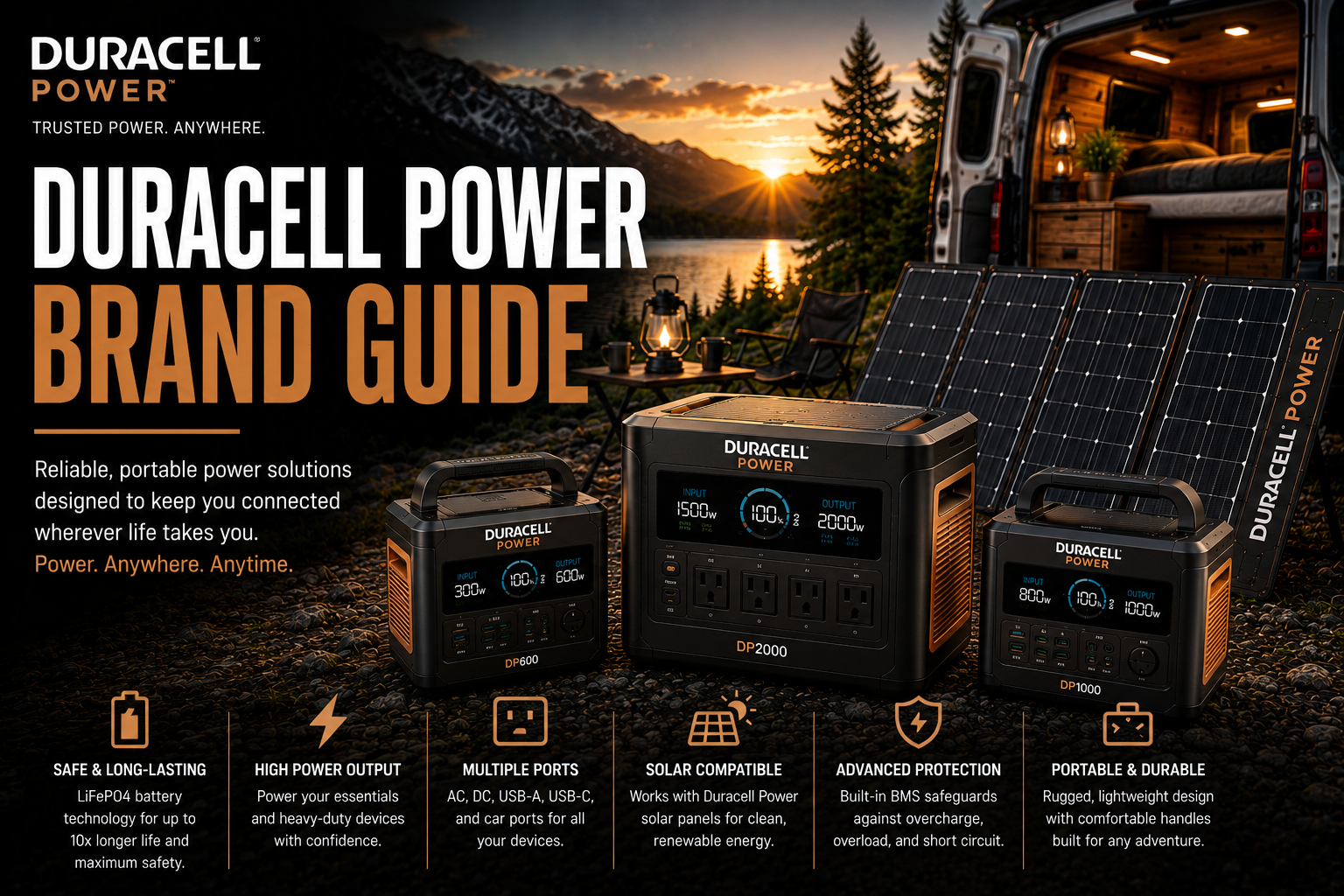
Duracell’s portable lineup centers on Power 300, 500 and 1000, while the older PowerSource 1800 belongs to a separate AGM backup generation.
Duracell offers simple portable stations rather than a deep expandable ecosystem.
This guide separates the current pure-sine lithium models, the older lead-acid PowerSource and the unrelated installed Duracell Power Center platform.
Power 1000 Is the Best Current Duracell Portable Station
Choose it for roughly 1kWh of energy and simple backup; choose newer LFP competitors for daily cycling or higher output.
Hub Verdict
Duracell makes the most sense for occasional emergency use and buyers who value simplicity over expansion and software.
Duracell Portable Lineup
| Model | Output | Capacity/Platform | Weight | Best Use |
|---|---|---|---|---|
| Power 300 | 300W class | Compact lithium | 7.5 lb | Electronics |
| Power 500 | 500W class | Mid-size lithium | 13.4 lb | Camping |
| Power 1000 | 1,000W / about 1,050Wh | Lithium | 24.6 lb | Home essentials |
| PowerSource 1800 | 1,440W continuous / 660Wh | AGM lead-acid | Heavy | Legacy UPS backup |
What Duracell Does Well
Simple Controls
No complicated app required.
Pure Sine Current Line
Power 300–1000 protect sensitive devices.
Good Portability
Power 1000 is only 24.6 lb.
Matched Solar
Official 100W panel.
Brand Familiarity
Easy-to-understand consumer positioning.
Separate Home Ecosystem
Duracell Power Center serves installed storage.
How to Choose
Choose Power 300
For phones and laptops.
Choose Power 500
For camping and coolers.
Choose Power 1000
For refrigerator-class essentials.
Choose PowerSource 1800
Only for legacy UPS needs.
Choose Power Center
For installed home storage.
Compare LFP Rivals
For daily cycling.
How to Evaluate Duracell Power as a Backup-Power System
Treat the Duracell Power lineup as a system rather than choosing by battery capacity alone. Start with the appliances you need to support, add simultaneous continuous watts, identify compressor or motor startup surges, and then estimate the watt-hours required for the desired runtime. That separates inverter sizing from battery sizing and prevents a large-capacity model from being mistaken for one that can necessarily run every high-draw load.
Recharge strategy matters almost as much as stored energy. Compare AC charging, solar-input limits and any vehicle-charging options with the way the station will actually be used. Fast wall charging is valuable for repeated cycling, while adequate solar input becomes more important when the goal is multi-day off-grid or outage use.
Also evaluate the surrounding Duracell Power ecosystem. Expansion batteries, proprietary cables, solar adapters, app requirements and accessory availability can materially change long-term ownership. A lower base-unit price is not necessarily lower total cost if the configuration you need requires expensive or hard-to-source extras.
For emergency use, reliability and support deserve extra weight. Check current warranty terms, service channels and the availability of replacement accessories before committing to an ecosystem. Brand and product lines change, so verify current specifications rather than assuming an older review or model generation still represents what is sold today.
Four Questions to Answer Before Choosing a Model
What must run at the same time?
Use simultaneous continuous watts plus realistic startup surge to establish the inverter requirement.
How many hours of backup do you need?
Convert the intended loads and operating time into watt-hours, then leave reserve for conversion losses and changing conditions.
How will you recharge it?
Match wall, solar and vehicle charging options to the actual outage, travel or off-grid scenario.
Will the ecosystem still work for you later?
Consider expansion batteries, cable compatibility, accessories, warranty support and the cost of growing the system.
Frequently Asked Questions
Who should buy Duracell backup power?
Buy it when simple controls, a familiar battery brand and occasional indoor backup matter more than expansion or app features.
Who should skip Duracell backup power?
Skip it when you need LiFePO4 chemistry, very fast charging, high inverter output or a modular battery ecosystem.
How should Duracell runtime be estimated?
Multiply watt-hours by roughly 0.80 to 0.90 for usable AC energy, then divide by the appliance’s average watts.
Can Duracell Power 1000 run a refrigerator?
It can run many refrigerators when the compressor startup demand remains within its inverter capability.
Can third-party solar panels be used?
Potentially, but voltage, current, polarity and connectors must match the exact station input.
Is PowerSource 1800 the same generation as Power 1000?
No. PowerSource 1800 is an older AGM lead-acid platform with modified-sine output.
Are Duracell portable stations expandable?
The current Power 300, 500 and 1000 do not use a broad plug-in expansion-battery ecosystem.
How should a Duracell station be stored?
Store it cool and dry and recharge it on the interval specified in the manual, commonly every few months.
Does Duracell offer whole-home batteries?
Duracell Power Center is a separate licensed residential storage ecosystem, not an expansion path for the portable Power stations.
What is the biggest Duracell buying mistake?
Assuming the Duracell name means the portable stations share chemistry, charging speed and lifespan with newer LFP competitors.
Which model is best overall?
Power 1000.
Is PowerSource 1800 current?
It is an older AGM platform and is commonly listed as discontinued or legacy inventory.