
Renogy vs Jackery
Renogy offers stronger DIY solar and RV integration; Jackery offers lighter current stations and simpler matched portable-solar bundles.
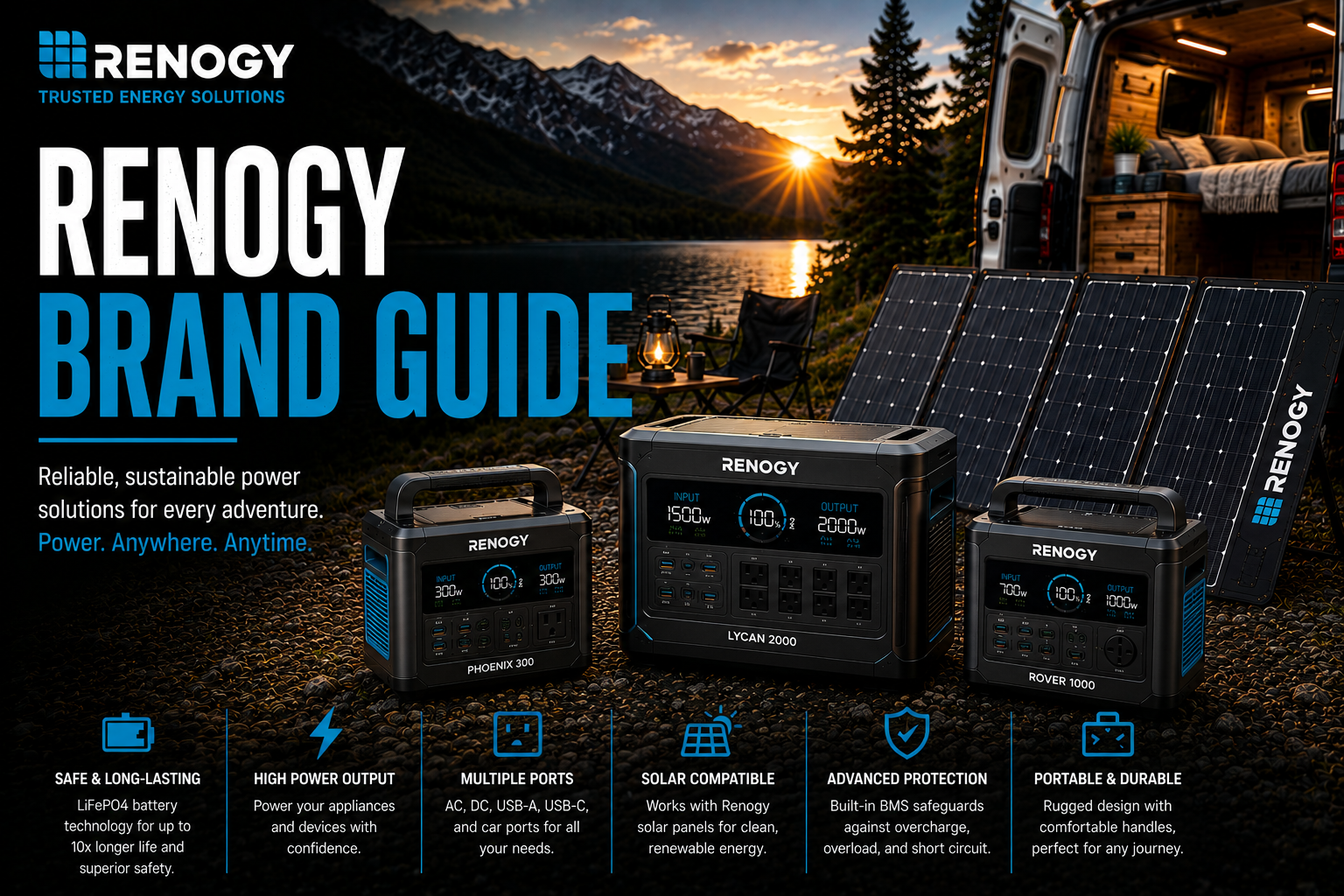
Renogy offers stronger DIY solar and RV integration; Jackery offers lighter current stations and simpler matched portable-solar bundles.
Renogy offers stronger DIY solar and RV integration; Jackery offers lighter current stations and simpler matched portable-solar bundles.
This comparison focuses on capacity, output, charging, solar, portability, expansion and long-term ownership.
Main Difference
Renogy offers stronger DIY solar and RV integration; Jackery offers lighter current stations and simpler matched portable-solar bundles.
Comparison Verdict
Renogy offers stronger DIY solar and RV integration; Jackery offers lighter current stations and simpler matched portable-solar bundles.
Quick Comparison
| Factor | Renogy | Competitor |
|---|---|---|
| 1kWh example | PHOENIX 1000: 998.4Wh/2100W total | Explorer 1000 v2: 1070Wh/1500W |
| 2kWh example | PowerStation 2000: 2048Wh/2400W | Explorer 2000 v2: 2042Wh/2200W |
| Portability | Moderate | Often lighter |
| Solar ecosystem | Very broad component range | Simple SolarSaga bundles |
| Best for | RV/DIY users | Travel simplicity |
Output
Renogy leads rated/total output in the compared examples.
Portability
Jackery’s v2 line is generally easier to carry.
Solar
Renogy offers more panel types and system components.
Ownership
Jackery is simpler; Renogy is more configurable.
Who Should Buy Each?
Choose Renogy
For RV integration, solar breadth or modular DIY systems.
Choose the Competitor
For a simpler consumer expansion ecosystem or stronger retail availability.
Skip Both
When native 240V is essential.
Compare Current Stock
Renogy availability varies by model.
Check Solar Limits
Input ceilings differ.
Use Qualified Installation
For permanent REGO wiring.
What Matters in Real-World Use
The useful way to evaluate renogy vs jackery portable power stations is to start with the electrical job rather than the brand name. List the devices that may run together, their continuous wattage, any startup surge and the number of hours of operation required. That tells you whether the system is appropriately sized before price or ecosystem preferences enter the decision.
Output and energy capacity solve different problems. Continuous inverter watts determine what can run at once; watt-hours largely determine how long the battery can support that load. A larger battery does not automatically make a station suitable for a high-draw appliance, and high output does not guarantee useful runtime.
Once the electrical requirement is covered, compare recharge behavior, solar input, expansion options, weight, noise, port selection and warranty support. These ownership differences can matter more than a modest headline-spec advantage, particularly when the equipment will be moved or cycled frequently.
Compare current complete-system cost rather than MSRP. Include any expansion batteries, panels, adapters and proprietary cables needed for the planned setup. Promotions move quickly, so the better value can change even when the technical comparison does not.
A Better Way to Decide
1. Define the load
Add simultaneous continuous watts and identify startup surges from refrigerators, pumps, compressors and tools.
2. Set runtime
Estimate required watt-hours from actual hours of operation and leave margin for conversion losses.
3. Price the full setup
Include expansion batteries, solar panels, adapters and accessories needed for the intended configuration.
4. Weight ownership
Portability, recharge speed, support and accessory availability can outweigh small specification differences.
Long-Term Ownership Considerations
Value changes over the life of the equipment. Replacement cables, compatible panels, expansion batteries, firmware support and warranty handling can matter years after the original specification comparison is forgotten. Check the surrounding ecosystem before treating a lower purchase price as the complete cost.
Battery life also depends on use and storage, not only the advertised cycle figure. Temperature, depth of discharge, storage state of charge and sustained high loads can all affect longevity. Leaving reasonable operating margin and storing the system according to the manufacturer’s guidance can be more useful than chasing the largest theoretical cycle count.
Frequently Asked Questions
Who should buy Renogy vs Jackery?
Buy it when Renogy’s solar, RV and battery ecosystem matches the way you intend to build or recharge the system.
Who should skip Renogy vs Jackery?
Skip it when you need the simplest consumer ecosystem, native 240V or a broad plug-in expansion-battery family.
How should Renogy runtime be estimated?
Multiply rated watt-hours by roughly 0.80 to 0.90 for usable AC energy, then divide by average load watts.
Can Renogy run a refrigerator?
PHOENIX 1000 and PowerStation 2000 can generally run common refrigerators when startup remains within inverter limits.
Can third-party solar panels be used?
Yes, when voltage, current, polarity and connectors match the exact station or charge controller.
Is REGO a portable power station?
No. REGO is a modular 12V RV and off-grid electrical system.
Are Renogy portable stations expandable?
The current portable stations do not use a broad consumer plug-in battery ecosystem comparable with some rivals.
Does Renogy offer app control?
PowerStation 2000 and selected PHOENIX/REGO devices support Renogy app monitoring or Bluetooth-connected components.
How should Renogy equipment be stored?
Keep it cool, dry and ventilated and follow the exact battery or station storage schedule.
What is the biggest Renogy buying mistake?
Confusing a portable station with a modular REGO or DIY battery system and assuming the components are interchangeable.
Which is better for beginners?
Jackery.
Which is better for RV system builders?
Renogy.