
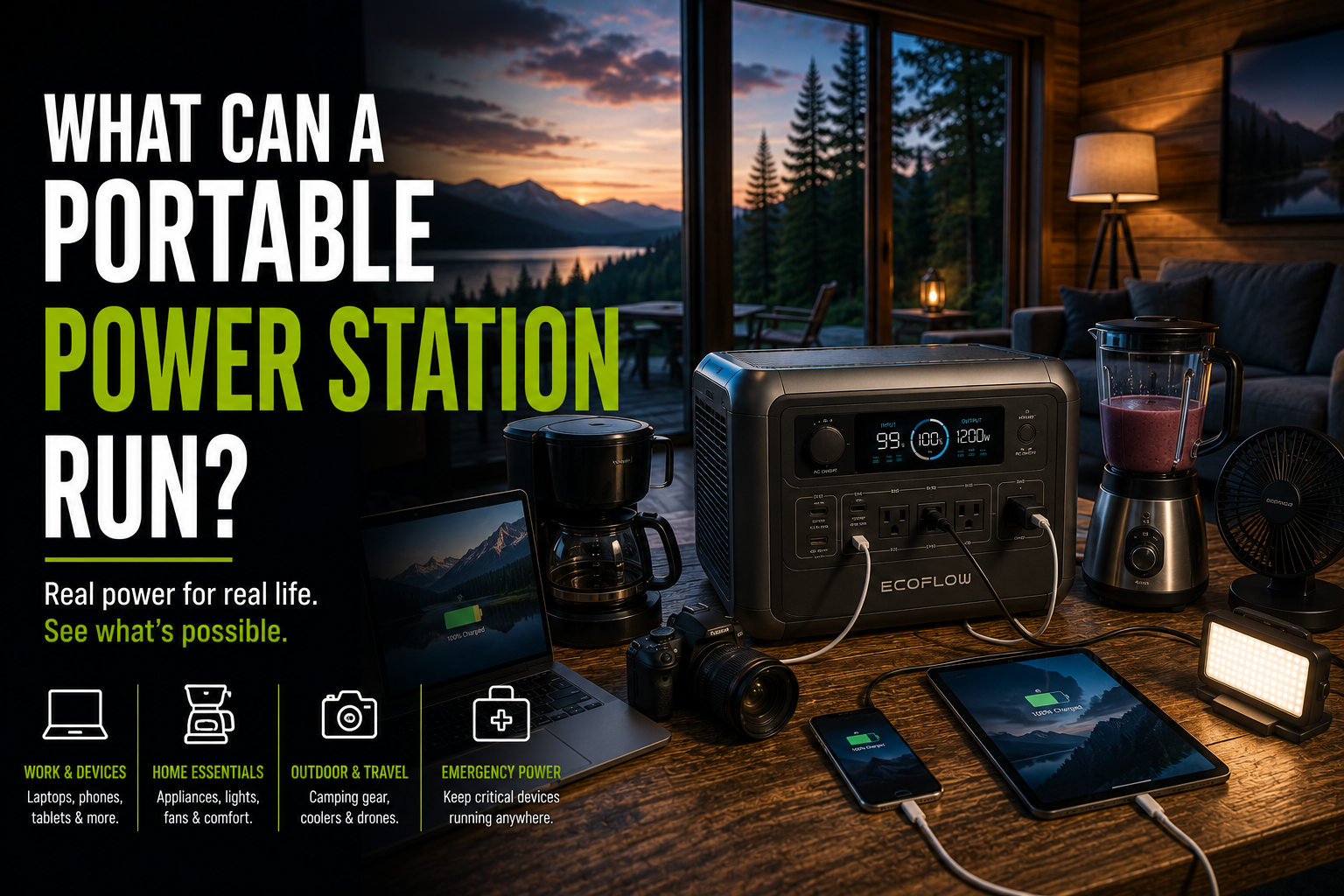
Can a Portable Power Station Run a Coffee Maker?
Yes. Coffee makers draw high power briefly, so even a 1kWh station can usually complete many brew cycles if the inverter supports the heating element.
A portable power station can run many coffee maker models when its inverter and battery are sized correctly.
The key is to separate continuous power, startup behavior and total energy use rather than relying on one advertised watt number.
Yes—With the Right Inverter and Battery Capacity
Yes. Coffee makers draw high power briefly, so even a 1kWh station can usually complete many brew cycles if the inverter supports the heating element.
Bottom Line
A portable power station can run a coffee maker when voltage, continuous output, startup surge and usable battery capacity all match the appliance.
Typical Coffee Maker Power Requirements
| Specification | Typical Range | Why It Matters |
|---|---|---|
| Running power | 600–1,500W during heating | Sets continuous inverter demand |
| Startup surge | Minimal startup surge | Determines whether motors or compressors start |
| Recommended inverter | At least 1,000–1,800W depending on model | Provides practical operating headroom |
| Waveform | Pure sine wave preferred | Improves appliance compatibility |
Estimated Runtime by Battery Size
| Battery Capacity | Estimated Practical Runtime | Best Use |
|---|---|---|
| 500Wh | About 5–12 brew cycles | Small emergency kit |
| 1,000Wh | About 10–25 brew cycles | Home backup |
| 2,000Wh | About 20–50 brew cycles | Extended use |
| 3,000Wh | About 30–75 brew cycles | Large reserve |
How to Choose a Power Station for a Coffee Maker
Measure the Appliance
Use a plug-in energy meter when possible.
Check Startup Demand
Compressors and motors can surge far above running power.
Leave Output Headroom
Avoid operating continuously at the inverter limit.
Size for Desired Runtime
Use watt-hours, not only inverter watts.
Use Pure Sine Wave
Preferred for modern controls and motors.
Plan Recharge
Solar or generator support may be needed for long outages.
Main Limitations
Limitation 1
Single-serve and espresso machines can have higher peaks.
Limitation 2
Keep-warm plates waste energy after brewing.
Limitation 3
Large commercial brewers may exceed portable inverter limits.
Limitation 4
Other simultaneous loads reduce headroom.
How to Extend Runtime
Disable the warming plate, brew only what you need and store coffee in an insulated carafe.
Frequently Asked Questions
Can a 1,000W station run a coffee maker?
Only if the coffee maker’s electrical input stays within the inverter rating.
How much energy does one pot use?
Often tens to low hundreds of watt-hours depending on brew size and keep-warm time.
Is a drip maker easier than espresso?
Usually, because espresso pumps and heaters may have higher peak demand.
Should I use the warming plate?
Turning it off after brewing saves substantial battery energy.
Can I use a kettle instead?
Electric kettles often draw 1,200–1,800W and may require a larger inverter.
What is the most efficient method?
Brew only the amount needed and transfer it to an insulated carafe.