
Can a Portable Power Station Run a TV?
Yes. Most modern LED, LCD and OLED televisions can run from a portable power station with a compatible AC outlet. The real question is how many hours your TV will run before the battery needs recharging.
This guide explains TV wattage, battery capacity, realistic runtime estimates, what changes when you add a streaming device or soundbar, and which power station sizes make sense.
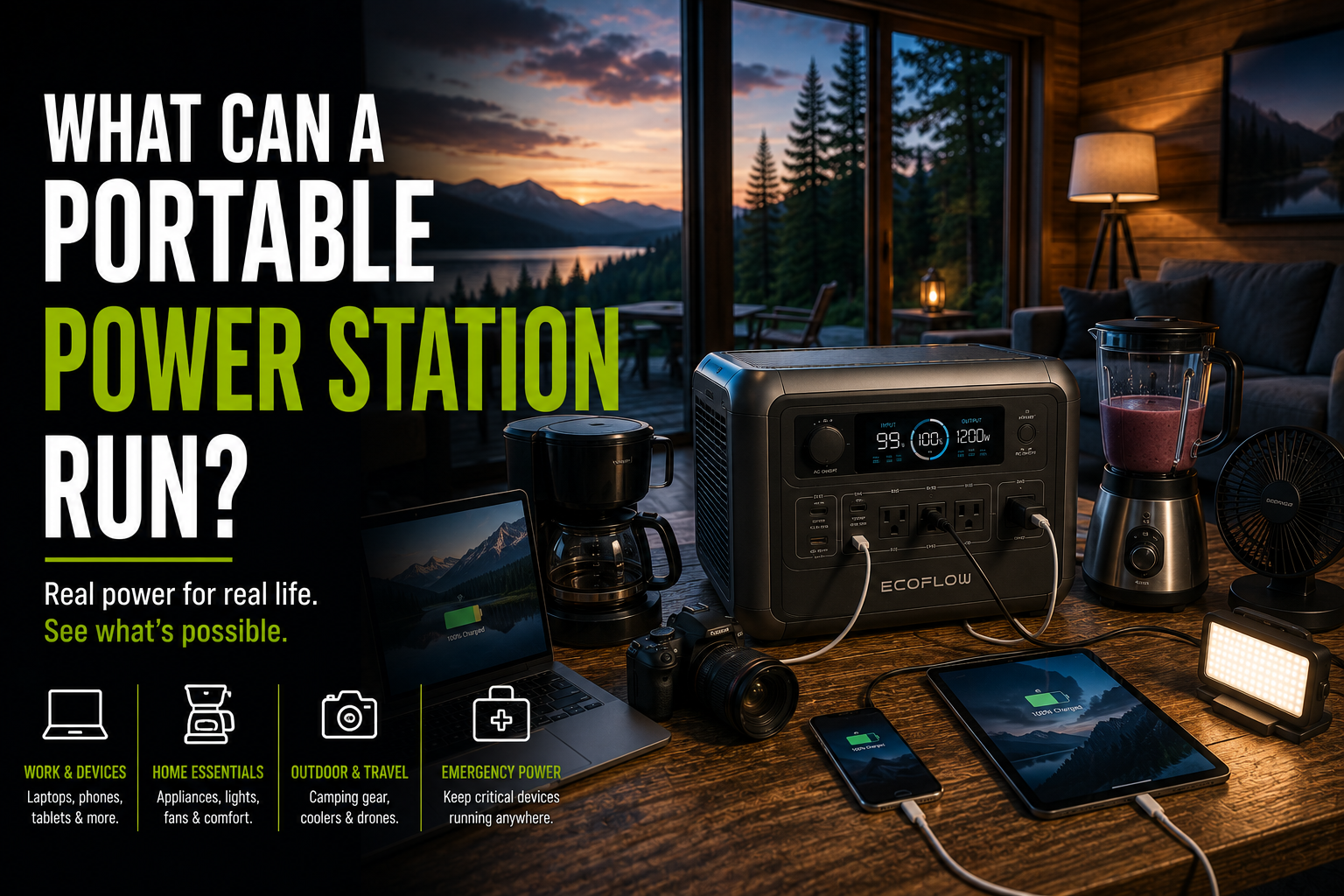
Quick answer: A portable power station with a 300W pure sine wave AC inverter can typically operate a modern television drawing well under 300W. For runtime, a 300Wh battery may provide a few hours, while a 1,000Wh battery can provide substantially longer viewing. Always verify your TV's actual wattage and the station's continuous AC rating.
How Much Power Does a TV Need?
Most modern televisions are relatively modest electrical loads compared with appliances such as refrigerators, microwaves and heaters.
For a quick planning estimate, many contemporary LED and OLED televisions fall somewhere around 40–200W while operating. Actual power draw varies substantially with screen size, display technology, brightness, picture mode and content.
A television drawing 100W needs a power station that can continuously supply at least that amount through its AC outlet. A 300W inverter may be sufficient, but the battery capacity determines how long the TV will run.
Practical recommendation: For a typical single-TV setup, prioritize enough watt-hours for your intended viewing time rather than paying for an unnecessarily large inverter.
How Many Watts Does a TV Use?
Television size alone does not determine electricity consumption. Two 55-inch TVs can have different power requirements because of brightness settings, panel design and picture processing.
| TV Type | Illustrative Running Watts | What Affects Consumption? |
|---|---|---|
| Small LED TV, roughly 24–32 inches | 25–60W | Brightness, age and panel efficiency |
| Medium LED TV, roughly 40–50 inches | 40–100W | Picture mode, resolution and backlight |
| 55-inch LED TV | 60–130W | Brightness and display technology |
| 65-inch LED TV | 80–160W | Panel efficiency and HDR brightness |
| Large OLED or high-brightness TV | 80–250W or more | Screen content, brightness and size |
These ranges are illustrative planning values, not measurements of specific televisions. Check the manufacturer's specifications or measure your own TV for a reliable estimate.
How to Find Your TV's Actual Wattage
- Check the TV's model-specific energy information or manufacturer's specifications.
- Look for an on-mode consumption figure, not just a maximum input rating.
- For better accuracy, use a plug-in watt meter to measure normal viewing.
- Test different brightness settings and typical streaming content.
- Include any soundbar, streaming box, router or game console that will share the station.
ENERGY STAR provides television energy-efficiency information and explains how on-mode power requirements relate to display characteristics.
How Long Can a Portable Power Station Run a TV?
Battery capacity is usually expressed in watt-hours (Wh). A 1,000Wh battery stores substantially more energy than a 300Wh battery, even if both power stations can supply enough watts to operate the TV.
Estimated runtime in hours = battery capacity (Wh) × assumed usable-energy fraction ÷ total device wattage (W)
Example: 1,024Wh × 0.85 ÷ 100W = 8.7 hours. The 85% assumption allows for conversion losses and other system overhead; actual usable energy varies by station and load.
Estimated TV Runtime by Battery Size
The following estimates assume 85% of rated battery capacity is available for AC-powered viewing. They are calculations, not manufacturer guarantees.
| Battery Capacity | 60W TV | 100W TV | 150W TV |
|---|---|---|---|
| 288Wh | 4.1 hours | 2.4 hours | 1.6 hours |
| 500Wh | 7.1 hours | 4.3 hours | 2.8 hours |
| 768Wh | 10.9 hours | 6.5 hours | 4.4 hours |
| 1,024Wh | 14.5 hours | 8.7 hours | 5.8 hours |
| 2,048Wh | 29.0 hours | 17.4 hours | 11.6 hours |
At low loads, a power station's own idle consumption can make the effective efficiency worse than the simple 85% assumption. For critical planning, allow additional margin.
55-Inch TV at 100W
A 768Wh station provides an illustrative 6.5 hours at 100W.
A 1,024Wh station increases that estimate to 8.7 hours.
65-Inch TV at 150W
A 768Wh station provides an illustrative 4.4 hours at 150W.
A 1,024Wh station provides approximately 5.8 hours.
TV Power Station Runtime Calculator
Enter your TV's running wattage and your power station's rated battery capacity. Include other connected equipment in the total wattage.
Calculations assume constant device wattage. Real TVs vary in consumption, and station overhead may reduce runtime.
What Size Power Station Do You Need for a TV?
Start with your desired viewing time and actual combined wattage.
| Viewing Goal | Example Load | Calculated Minimum Capacity at 85% | Practical Capacity Class |
|---|---|---|---|
| 2 hours | 80W | 188Wh | 250–300Wh or larger |
| 4 hours | 100W | 471Wh | 500–700Wh or larger |
| 6 hours | 120W | 847Wh | 1,000Wh or larger |
| 8 hours | 150W | 1,412Wh | 1,500–2,000Wh or larger |
| 12 hours | 100W | 1,412Wh | 1,500–2,000Wh or larger |
The calculated minimum is not necessarily the best purchase size. Battery aging, cold conditions, additional devices and inverter overhead justify extra margin.
Portable Power Stations Worth Considering for TV Backup
These models represent different battery-capacity classes rather than claiming that every household needs a large power station.
1. Jackery Explorer 300 Plus
A lightweight option for short viewing sessions and modest TV loads.
The Explorer 300 Plus has a 288Wh LiFePO4 battery and a 300W pure sine wave AC output.
That is enough continuous output for many ordinary televisions, provided the TV and connected accessories remain within the 300W combined limit.
Its biggest advantage is portability. Its biggest limitation is battery capacity. At a 100W load and an illustrative 85% usable-energy assumption, estimated runtime is only about 2.4 hours.
- Compact and lightweight
- 288Wh LiFePO4 battery
- 300W pure sine wave AC output
- Appropriate for short TV sessions
- Limited runtime for large TVs
- Only one AC outlet
- Not ideal for several hours of high-load viewing
- 300W total AC output limit
Choose it if: You want a compact station for a smaller television or short outage.
Avoid it if: You want to power a large TV and several accessories throughout an extended outage.
Check Price2. BLUETTI AC70
A practical capacity class for longer viewing without moving to a very large battery.
The BLUETTI AC70 offers a 768Wh LiFePO4 battery and 1,000W continuous pure sine wave AC output.
For television use, the extra battery capacity is more meaningful than its relatively high inverter rating.
With a 100W TV and an illustrative 85% usable-energy assumption, it provides approximately 6.5 hours of calculated runtime.
BLUETTI also documents solar charging and an EPS/UPS-style transfer feature. The transfer function should not be assumed interruption-free for every television.
- 768Wh battery capacity
- 1,000W continuous AC output
- Pure sine wave inverter
- Solar charging support
- Useful middle-ground size
- Heavier than compact stations
- May be larger than necessary for occasional short use
- Transfer behavior is device-dependent
- Not enough for indefinite viewing without recharging
Choose it if: You want several hours of TV backup with some capacity for modest accessories.
Avoid it if: You only need a very lightweight emergency battery or require a full day of viewing without recharging.
Check Price3. EcoFlow DELTA 3 Plus
A 1kWh-class station for extended viewing and additional household electronics.
The EcoFlow DELTA 3 Plus combines a 1,024Wh LiFePO4 battery with 1,800W continuous AC output.
The large inverter is not necessary for most TVs, but it provides headroom for other compatible devices.
For a 100W television, calculated runtime is approximately 8.7 hours under the same 85% assumption.
EcoFlow documents a fast UPS-style transfer function, but that does not guarantee every TV or connected device will stay on without interruption.
- 1,024Wh battery capacity
- 1,800W continuous AC output
- Pure sine wave output
- Additional capacity for electronics
- Solar charging support
- Heavier and bulkier
- More inverter capacity than a TV alone needs
- Higher capacity does not mean unlimited runtime
- UPS compatibility still needs testing
Choose it if: You want extended TV backup and flexibility to power a router, lighting or other appropriate household electronics.
Avoid it if: Your only goal is to operate a small TV for an hour or two.
Check PricePortable Power Station Comparison for TV Use
| Power Station | Battery | Continuous AC | Estimated Runtime at 100W | Best Fit |
|---|---|---|---|---|
| Jackery Explorer 300 Plus | 288Wh | 300W | 2.4 hours | Short viewing sessions |
| BLUETTI AC70 | 768Wh | 1,000W | 6.5 hours | Several hours of backup |
| EcoFlow DELTA 3 Plus | 1,024Wh | 1,800W | 8.7 hours | Longer TV and electronics backup |
Runtime estimates use 85% of rated capacity and a constant 100W AC load. Actual results vary. Availability and pricing should be checked separately.
What Happens When You Add a Streaming Device, Router or Soundbar?
A television may not be the only device needed for a working entertainment setup.
| Equipment | Illustrative Wattage | Why It Matters |
|---|---|---|
| TV | 100W | Main viewing load |
| Streaming stick | 5W | Small additional load |
| Router and modem | 20W | Needed for many internet services |
| Soundbar | 25W | Varies with volume and equipment |
| Total Example | 150W | Use combined wattage for sizing |
At 150W, the illustrative runtime of a 1,024Wh battery falls from about 8.7 hours to 5.8 hours.
Internet service may also fail during an outage even if your home router remains powered. Local antenna television or downloaded content may be more reliable alternatives.
Will a Portable Power Station Damage Your TV?
A correctly rated, properly functioning portable power station with pure sine wave AC output is generally suitable for a compatible modern television.
Before connecting, check:
- The station's AC output voltage matches the TV's requirements.
- The station provides adequate continuous wattage for the complete load.
- The AC output is a suitable pure sine wave.
- The station is operated within its temperature and ventilation limits.
- Cables and plugs are undamaged and correctly rated.
Avoid using unknown or poorly specified modified-sine-wave inverters with sensitive electronics when a suitable pure sine wave option is available.
Will the TV Stay On During a Power Outage?
Not necessarily. A power station with EPS or UPS-style functionality may transfer from wall power to battery power after a brief delay.
Whether the TV remains on depends on its power supply, the transfer time, the station's operating mode and the connected load.
If uninterrupted operation is essential, test the exact equipment combination safely in advance. Do not assume that a manufacturer's transfer-time figure guarantees seamless operation for every device.
Can You Use Solar Panels to Keep a TV Running?
Yes, a compatible solar panel can replenish the power station while sunlight is available, subject to the manufacturer's charging and pass-through rules.
For example, a 200W-rated panel producing an illustrative 120W of actual charging power may approximately offset a 100W TV load during that period, before accounting for additional system losses.
However, solar output changes with clouds, temperature, panel angle and shading. It cannot be counted on after sunset.
Ways to Make Your TV Run Longer on Battery
- Lower screen brightness. This can reduce power consumption, especially on brighter displays.
- Use an energy-saving picture mode. Compare actual wattage if you have a plug-in meter.
- Disconnect unnecessary devices. Soundbars, consoles and other equipment consume additional energy.
- Turn off the AC output when finished. Inverter standby consumption can drain the battery even without an active TV.
- Keep the station at a suitable temperature. Extreme conditions can affect battery performance.
- Recharge during daylight when practical. Compatible solar charging can extend usable time during longer outages.
Frequently Asked Questions
Can a 300W portable power station run a 55-inch TV?
Often, yes. A 300W continuous pure sine wave inverter can run a 55-inch TV whose actual operating wattage stays below the station's output limit, including connected accessories. Battery capacity determines runtime.
How long will a 500Wh power station run a TV?
At a constant 100W load, a 500Wh battery provides an illustrative 4.3 hours using an 85% usable-energy assumption. Actual results may differ.
How long will a 1,000Wh power station run a 65-inch TV?
If the TV averages 150W, a 1,000Wh battery provides approximately 5.7 hours at 85% assumed usable energy. A more efficient TV may run longer.
Can a portable power station run a TV and Wi-Fi router?
Yes, if the combined wattage stays within the station's continuous AC rating. Remember that your internet provider's service may still be unavailable during an outage.
Does a TV need pure sine wave power?
Pure sine wave output is the preferred choice for compatibility with modern televisions and other sensitive electronics. Verify the TV's electrical requirements.
Can I leave a TV connected to a power station all the time?
Only if the manufacturer's instructions support the intended operating mode. Continuous use, charging and pass-through behavior differ between models. Test transfer behavior rather than assuming seamless backup.
Is a gas generator better for running a TV?
For short television use, a suitable battery station is often simpler and quieter. A fuel-powered generator may be useful for longer, higher-energy requirements, but it must always be operated outdoors at a safe distance from buildings, windows and openings because of carbon monoxide risk.
Final Verdict: Yes, a Portable Power Station Can Run a TV
Most modern televisions are compatible with an appropriately rated portable power station. The biggest purchasing decision is usually battery capacity, not maximum inverter wattage.
For short viewing sessions, a compact 250–300Wh station may be enough. For several hours of TV backup, a 700–1,000Wh class battery is often more practical. For extended outages or additional electronics, calculate the complete load and size upward.
Measure your TV's wattage, include every connected device, and use the runtime calculator before buying.
Compare Current OptionsSources and Editorial Methodology
Product specifications are drawn from manufacturer documentation. TV wattage ranges and runtime examples are illustrative. No firsthand testing or current retail availability is claimed.
- ENERGY STAR — Televisions — television energy-efficiency information.
- ENERGY STAR — TV Key Product Criteria — on-mode consumption requirements and standby criteria.
- Jackery — Explorer 300 Plus Specifications — capacity, AC output and operating characteristics.
- BLUETTI — AC70 Specifications — capacity, inverter output and charging information.
- EcoFlow — DELTA 3 Plus User Manual — battery capacity, continuous AC output and operating limits.
Runtime estimates are calculated using rated battery capacity and an illustrative usable-energy fraction. Actual runtime depends on station overhead, TV settings, connected loads, battery condition and environmental conditions.