
What Is a UPS Battery Backup?
A UPS is a battery-backed device designed to keep electronics online during short outages and support safe shutdown.
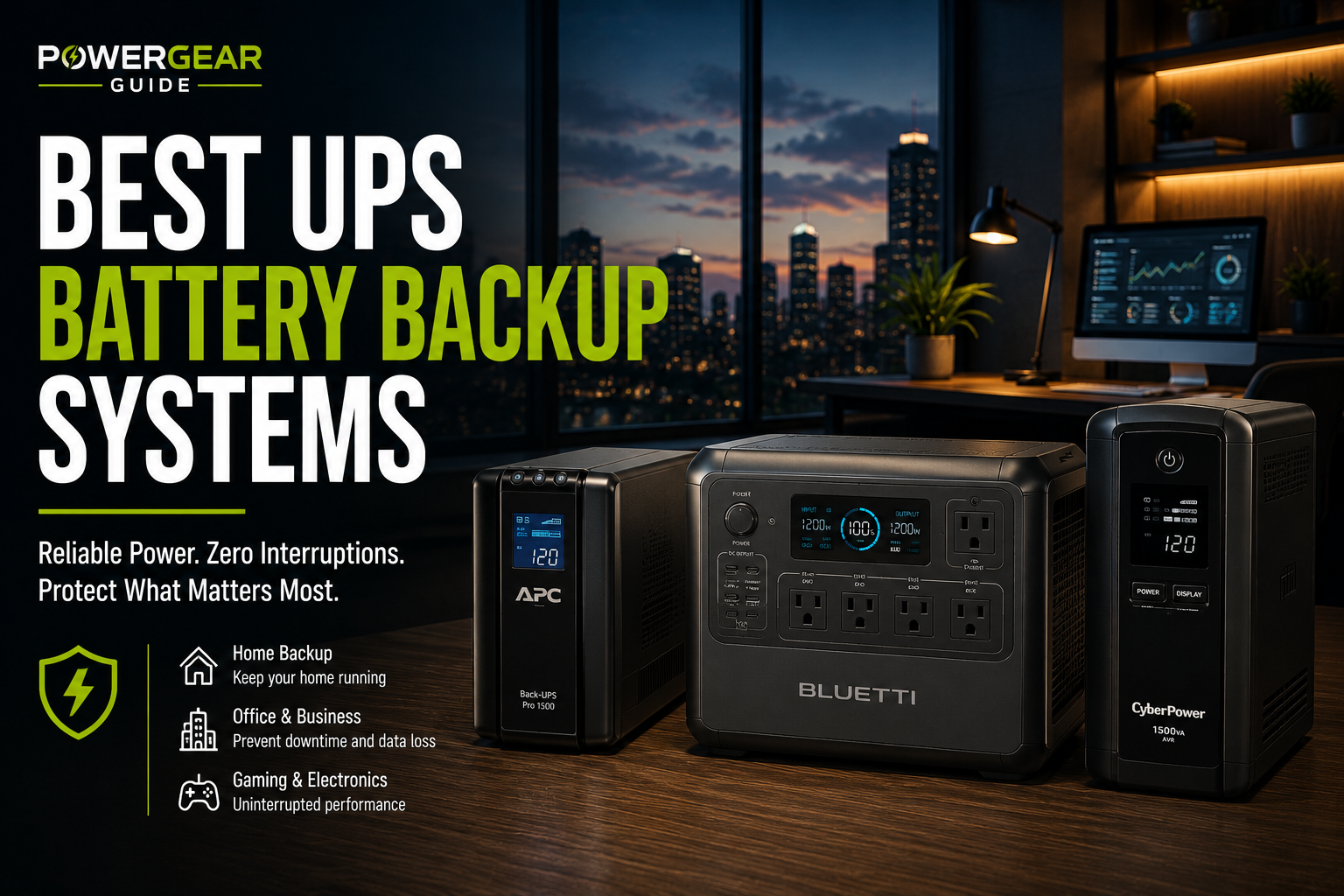
A UPS is a battery-backed device designed to keep electronics online during short outages and support safe shutdown.
UPS systems differ from surge protectors because they include a battery, inverter and transfer system.
They range from compact router backups to online systems for critical servers.
It Provides Immediate Short-Term Power and Conditioning
A UPS keeps connected electronics running during an outage, often long enough to ride through a short interruption or shut down safely.
Who Should Buy One
UPS systems are essential for desktops, NAS devices, servers, routers and smart-home controllers, but not for high-draw appliances.
What a UPS Is
An uninterruptible power supply is a battery-backed device that keeps connected equipment operating during short outages and can condition utility power.
Main Components
Battery
Stores short-duration energy.
Inverter
Creates AC during battery use.
Charger
Maintains the battery.
Transfer System
Moves the load to battery.
AVR
Corrects voltage.
Communication Port
Supports shutdown software.
UPS Topologies
| Topology | Operation | Best Use |
|---|---|---|
| Standby | Transfers after failure | Routers and basic electronics |
| Line interactive | Adds AVR | Home offices, PCs and NAS |
| Online double conversion | Continuously powers through inverter | Critical servers and sensitive systems |
How Long It Runs
Runtime depends on battery size and connected watts. Manufacturer runtime charts are more reliable than simple linear estimates.
Output Waveform
Pure sine wave is preferred for active-PFC computers and sensitive electronics.
Common Uses
Home Offices
Save work.
NAS Devices
Prevent abrupt writes.
Servers
Maintain continuity.
Routers
Keep internet online.
Smart Homes
Maintain hubs.
Medical Equipment
Only when approved.
Limitations
Short Runtime
Most consumer units are not long-duration.
Battery Aging
Replacement is required.
Load Limits
VA and watts differ.
Not for Appliances
High-draw loads overload them.
Transfer Time
Not all are zero-transfer.
Maintenance
Testing is required.
How to Choose
Measure Load Watts
Include all protected equipment.
Choose Topology
Match risk.
Select Waveform
Use sine wave for sensitive loads.
Set Runtime Goal
Ride-through or shutdown.
Check Communication
USB or network may matter.
Review Battery Availability
Affects ownership value.
Practical Planning and Ownership
The useful way to apply what is a ups battery backup is to connect the guidance to the actual equipment, environment and duty cycle. Power systems age and behave differently depending on load, temperature, storage, maintenance and how frequently they are cycled.
Follow the equipment manufacturer's limits for charging, ventilation, storage and service. Generic rules are useful for understanding the system, but model-specific instructions control when they are more restrictive.
Build margin into backup plans. Batteries lose capacity with age, engines can be harder to start after storage, and real loads can draw more than expected. A system designed with reserve is more dependable than one that works only at ideal ratings.
Periodic testing is part of ownership. An emergency is the wrong time to discover a weak battery, stale fuel, missing cable or incompatible load. Keep accessories together, document the basic operating procedure and test the setup on a sensible schedule.
Planning Margin That Actually Helps
Avoid designing a backup system around the exact edge of its ratings. Leave headroom in continuous output, surge capability and stored energy. That margin absorbs conversion losses, battery aging, temperature effects and loads that draw more than their nominal specification suggests.
Prioritize essential loads and consider rotating equipment instead of running everything simultaneously. Load management can extend runtime dramatically and may let a smaller, more portable system cover the real emergency requirement without sacrificing the devices that matter most.
Where a UPS Fits Best
A UPS is designed primarily to bridge interruptions and protect electronics, not to replace a large portable power station or generator for long outages. Its strongest use cases are computers, networking equipment, storage devices and other loads that benefit from immediate transfer when utility power fails.
For longer runtime, reduce the connected load to equipment that actually needs uninterrupted operation. Monitors, printers and nonessential peripherals can consume battery energy that would be more valuable keeping a modem, router, server or workstation alive.
One More Practical Check
UPS capacity should also match the purpose of the shutdown window. For a desktop computer, even a modest runtime can be valuable if it provides enough time to save work and shut down cleanly instead of trying to operate through a prolonged outage.
Final Planning Note
For network equipment, a UPS can also preserve internet connectivity during brief utility interruptions if the modem, router and any required fiber or network terminal are all backed up. Protecting only one device in that chain may still leave the connection offline.
Frequently Asked Questions
What does UPS stand for?
Uninterruptible Power Supply.
Is it a surge protector?
It includes battery backup and often surge protection.
How long does it run?
Minutes to hours depending on load.
What is line interactive?
A topology with AVR and battery transfer.
What is online UPS?
A double-conversion design.
Can it power appliances?
Consumer models are for electronics, not high-draw appliances.