
What Is a Home Battery Backup System?
A home battery stores electricity and automatically supplies selected circuits or the whole home when the grid fails, often working with rooftop solar.
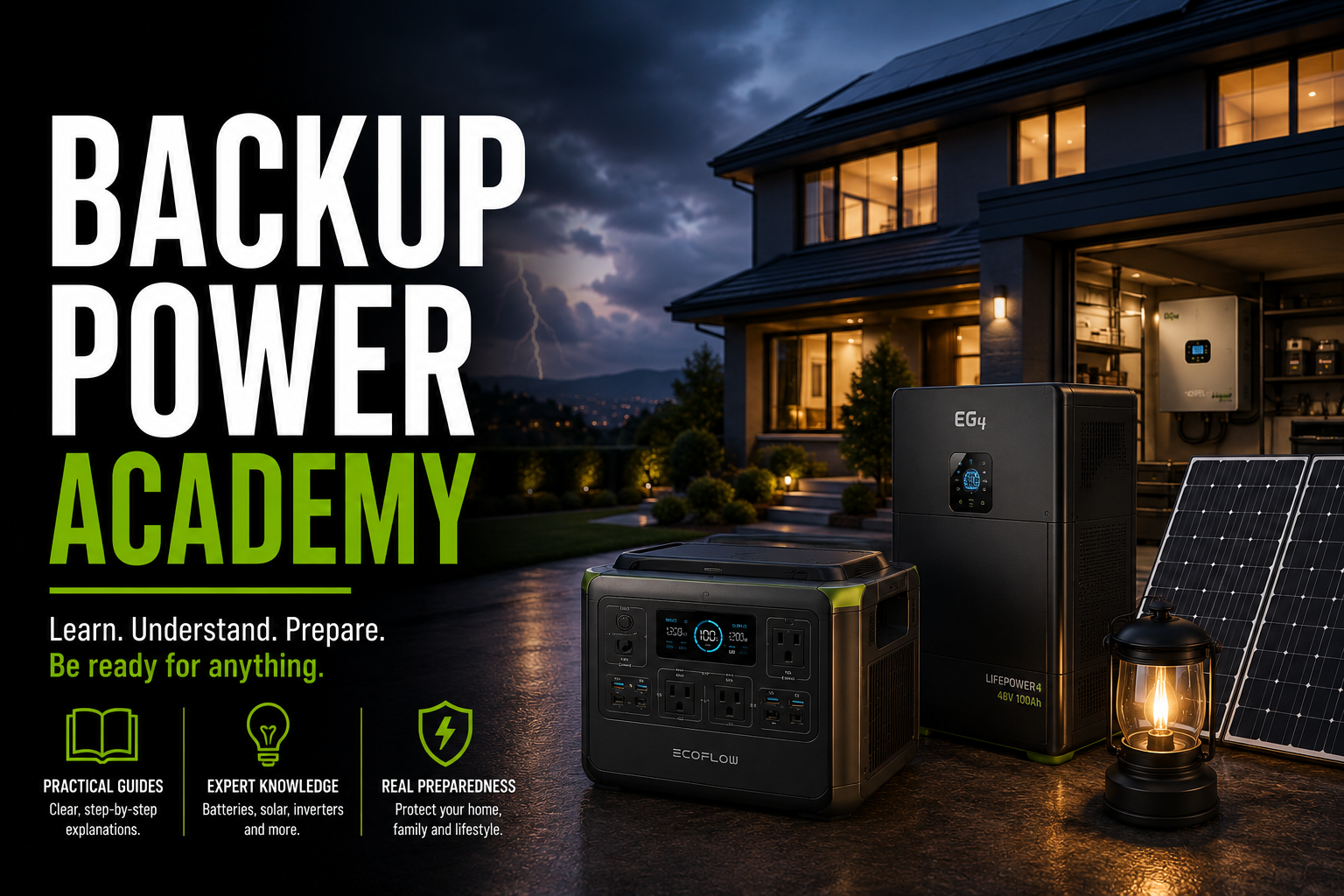
A home battery stores electricity and automatically supplies selected circuits or the whole home when the grid fails, often working with rooftop solar.
Unlike a portable station, an installed home battery is integrated with the electrical panel and transfer equipment.
Its performance depends on both stored energy in kilowatt-hours and inverter output in kilowatts.
A Home Battery Is an Automatic, Rechargeable Alternative to Fuel-Based Backup
It is quiet and solar-compatible, but runtime is finite and professional design is required.
Guide Summary
Home batteries are best for homeowners who value automatic, quiet backup and can justify the installed cost.
Core Components
Battery Modules
Store DC energy.
Inverter
Converts battery DC to household AC.
Transfer Equipment
Isolates the home from the grid.
Energy Controller
Prioritizes loads and charging.
Solar Interface
Stores excess PV generation.
App or Gateway
Monitors power and outages.
How It Works During an Outage
The controller detects grid loss, isolates the backed-up circuits and supplies them from the battery inverter. Solar may continue charging when the system is designed for islanded operation.
Typical System Sizes
| System Size | Common Role | Limitation |
|---|---|---|
| 5kWh | Essential circuits and short outages | Limited whole-home runtime |
| 10–15kWh | Broader household backup | Heavy loads need output checks |
| 20–30kWh+ | Longer or whole-home backup | Higher cost and space |
Benefits
Automatic Backup
No manual starting.
Quiet Operation
No engine noise.
Indoor-Safe Energy
No combustion exhaust.
Solar Storage
Use daytime production later.
Rate Management
Shift energy by time of use.
Low Routine Maintenance
No fuel system.
Limitations
Finite Energy
Long outages require recharging.
Installed Cost
Professional project.
Output Limits
Heavy loads may need multiple units.
Permitting
Utility and local approval.
Battery Aging
Capacity declines over time.
Cold/Heat Constraints
Installation environment matters.
Practical Planning and Ownership
The useful way to apply what is a home battery backup system is to connect the guidance to the actual equipment, environment and duty cycle. Power systems age and behave differently depending on load, temperature, storage, maintenance and how frequently they are cycled.
Follow the equipment manufacturer's limits for charging, ventilation, storage and service. Generic rules are useful for understanding the system, but model-specific instructions control when they are more restrictive.
Build margin into backup plans. Batteries lose capacity with age, engines can be harder to start after storage, and real loads can draw more than expected. A system designed with reserve is more dependable than one that works only at ideal ratings.
Periodic testing is part of ownership. An emergency is the wrong time to discover a weak battery, stale fuel, missing cable or incompatible load. Keep accessories together, document the basic operating procedure and test the setup on a sensible schedule.
Frequently Asked Questions
Who should buy a home battery backup system?
Buy it when the system's continuous output, startup capability, usable capacity and charging method match the actual loads you need to protect.
Who should skip a home battery backup system?
Skip it when the product is being chosen from headline watt-hours alone or when installation, medical, electrical or building rules make another solution more appropriate.
How should runtime be estimated?
Multiply rated watt-hours by roughly 0.80 to 0.90 for usable AC energy, then divide by the appliance's average running watts.
Why do starting watts matter?
Compressors, pumps and motors can draw several times their normal running power for a short period, so the inverter must handle both continuous and surge demand.
Is LiFePO4 better for frequent use?
LiFePO4 generally offers longer cycle life and strong thermal stability, making it attractive for systems that will be charged and discharged regularly.
Can solar panels recharge the system during an outage?
Yes when the panel voltage, current, polarity and connector match the power station's input limits and sunlight is adequate.
Can a power station be connected directly to a home panel?
Only through manufacturer-approved transfer equipment and qualified installation. Never backfeed a receptacle.
How much reserve capacity should be planned?
A 20% to 30% reserve helps cover inverter losses, cold weather, battery aging and loads that cycle unpredictably.
Should price be compared per watt-hour?
Cost per watt-hour is useful, but output, charging speed, warranty, battery chemistry and accessory compatibility can matter more.
What is the most common buying mistake?
Buying a unit that has enough stored energy but not enough continuous or surge output for the intended appliance.
Can a home battery work without solar?
Yes. It can charge from the grid, although solar adds outage recharging and energy-shifting value.
Is a home battery the same as a UPS?
No. A home battery is much larger and panel-integrated; a UPS is typically outlet-level electronics protection.
How long does installation take?
Project timing depends on permitting, utility approval, panel work and installer scheduling.