
Best Geneverse Accessories
SolarPower panels add the most practical off-grid value, while correct extension and car-charging cables improve flexibility and mobility equipment helps with TWO PRO.
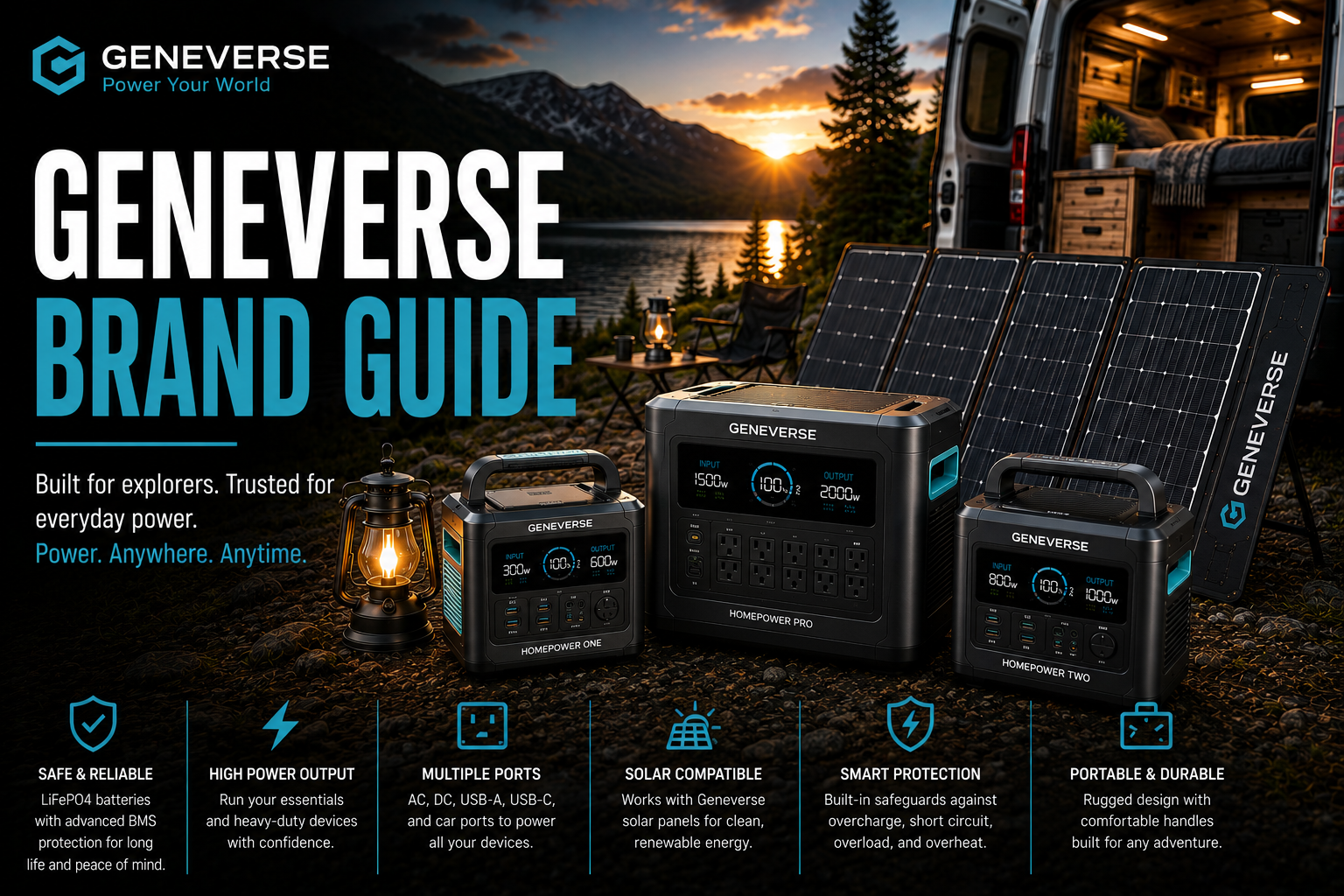
SolarPower panels add the most practical off-grid value, while correct extension and car-charging cables improve flexibility and mobility equipment helps with TWO PRO.
Geneverse accessories are mainly about charging and transport because HomePower stations do not use a broad plug-in battery expansion ecosystem.
The most important rule is matching the accessory to the exact HomePower generation.
Best Upgrade: SolarPower 2 Panels for PRO Models
Up to four 200W panels can use the PRO models’ dual 400W solar inputs under suitable conditions.
Editor's Verdict
Buy matched solar first. Avoid speculative cables or panels unless voltage, current and connector requirements are confirmed.
Best Geneverse Accessories
| Accessory | Purpose | Best For |
|---|---|---|
| SolarPower 2 200W Panel | Portable solar charging | ONE/2 PRO systems |
| SolarPower ONE 100W Panel | Lighter solar charging | Original ONE |
| PRO Solar Extension Cable | Panel placement | Camping and backup |
| Car Charging Cable | Vehicle charging | Road travel |
| Protective Cover or Cart | Storage and mobility | TWO PRO |
| PowerPillar Hardware | Installed 240V storage | Professional home system |
Solar Panels
SolarPower 2 panels are the most important portable accessory because PRO models can accept up to four 200W panels across two 400W input channels.
Charging Cables
Replacement AC, car and solar cables must match the exact HomePower generation and connector. Do not assume an original ONE cable is correct for a PRO model.
Mobility and Protection
TWO PRO is large enough that a rated cart and dry protective storage can improve ownership more than another small adapter.
PowerPillar Accessories
PowerPillar is a professionally installed 240V system with battery modules, inverter, mounting hardware and cables. It is not an expansion battery for portable HomePower stations.
What to Buy First
Buy Solar
For outage recharging.
Buy Extension Cables
For safer panel placement.
Buy Car Charging
For road backup.
Buy a Cart
For TWO PRO mobility.
Match the Generation
Connectors and limits differ.
Use Licensed Installers
For PowerPillar.
Frequently Asked Questions
Who should buy Geneverse accessories?
Buy it when straightforward indoor backup, simple controls and Geneverse solar compatibility matter more than deep expansion.
Who should skip Geneverse accessories?
Skip it when expandable capacity, native 240V, advanced app automation or the highest output per pound matters most.
How should Geneverse runtime be estimated?
Multiply rated watt-hours by about 0.85 for a practical estimate, then divide by the appliance’s average watts.
Can Geneverse run a refrigerator?
Most HomePower models can run common refrigerators when startup surge and continuous draw stay within the inverter limits.
Can third-party solar panels be used?
Potentially, but voltage, current, polarity and connector requirements must match the exact HomePower model.
Does Geneverse support pass-through or UPS operation?
Behavior varies by generation and charging method. Verify the exact model manual before using sensitive equipment.
How long do Geneverse batteries last?
PRO models use LiFePO4 chemistry and are positioned for longer cycle life than the original HomePower ONE generation.
Can Geneverse batteries be expanded?
The mainstream HomePower stations do not use the broad plug-in expansion-battery ecosystems common to some competitors.
How should a Geneverse station be stored?
Store it cool and dry, recharge periodically, and follow Geneverse guidance for long-term battery care.
What is the biggest Geneverse buying mistake?
Choosing by capacity alone without checking the relatively modest inverter output and current accessory availability.
Can PowerPillar batteries expand HomePower TWO PRO?
No. PowerPillar is a separate installed system.
How many 200W panels can a PRO model use?
Up to four panels across two 400W input channels, subject to voltage and current limits.