
Can a Portable Power Station Run a Laptop?
Yes. Laptops are among the easiest devices to run, and direct USB-C charging can improve efficiency by avoiding AC conversion.
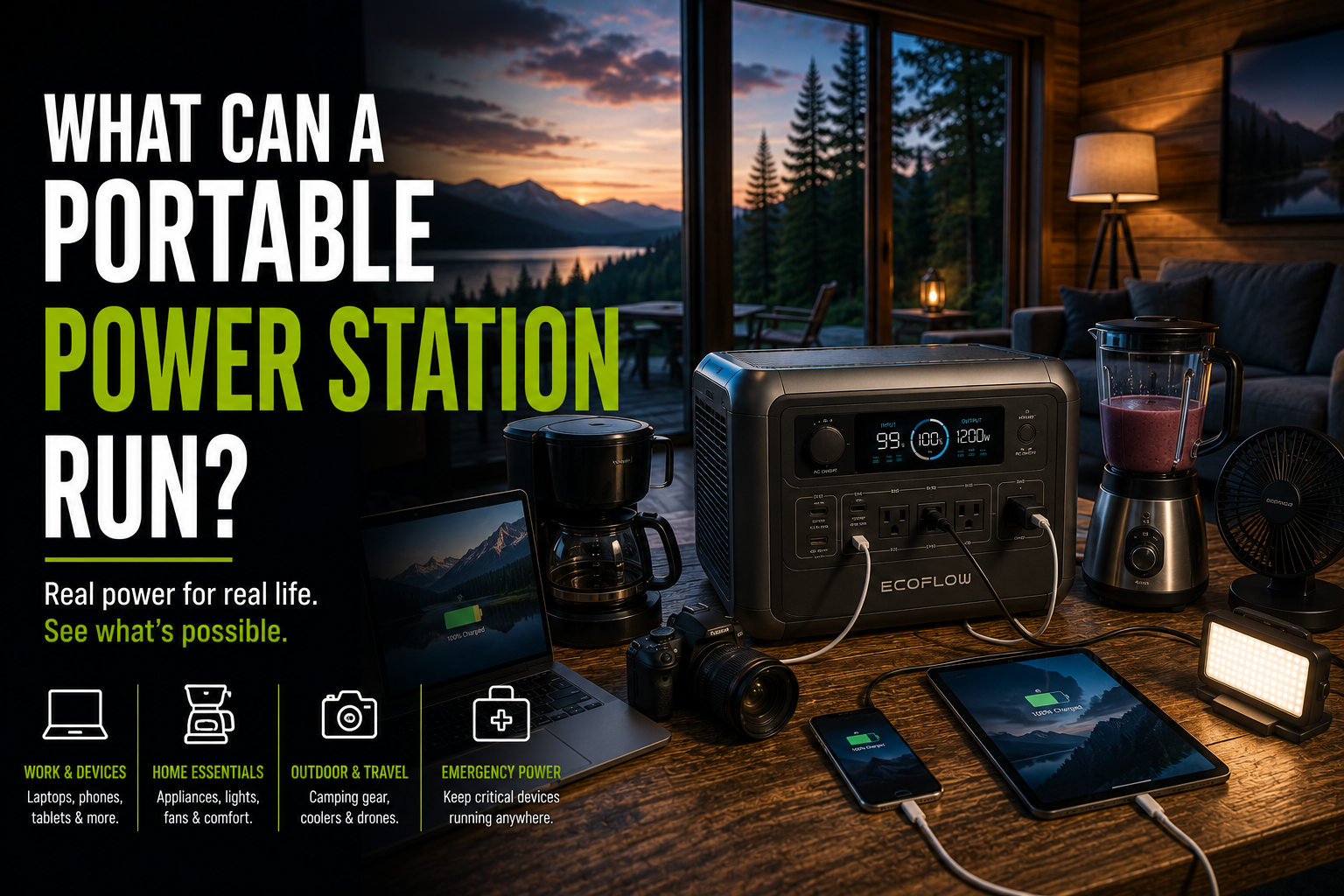
Yes. Laptops are among the easiest devices to run, and direct USB-C charging can improve efficiency by avoiding AC conversion.
A portable power station can run many laptop setups when output, surge and battery capacity are correctly matched.
This guide separates continuous watts, peak demand and total energy use so the battery is sized realistically.
Yes—With the Right Output and Battery Capacity
Yes. Laptops are among the easiest devices to run, and direct USB-C charging can improve efficiency by avoiding AC conversion.
Bottom Line
A portable power station can run a laptop when voltage, continuous output, startup demand and usable capacity all match the actual equipment.
Typical Laptop Power Requirements
| Specification | Typical Range | Why It Matters |
|---|---|---|
| Running power | 30–140W depending on model and workload | Sets continuous inverter demand |
| Startup or peak demand | Minimal | Determines whether the source starts or supports the load |
| Recommended inverter | 150–300W or USB-C PD output | Provides practical headroom |
| Waveform | Pure sine wave preferred | Improves compatibility |
Estimated Runtime by Battery Size
| Battery Capacity | Estimated Practical Runtime | Best Use |
|---|---|---|
| 500Wh | About 4–12 hours | One workday |
| 1,000Wh | About 8–24 hours | Multiple work sessions |
| 2,000Wh | About 16–48 hours | Extended remote work |
| 3,000Wh | About 24–72 hours | Multi-day reserve |
How to Choose a Power Station for a Laptop
Measure the Real Load
Use a plug-in power meter or manufacturer data.
Check Startup Demand
Motors and pumps can surge far above running power.
Leave Output Headroom
Avoid planning at the inverter’s absolute limit.
Size for Runtime
Use watt-hours, not only watts.
Use Pure Sine Wave
Preferred for electronics, motors and medical equipment.
Test Before an Outage
Verify startup and sustained operation safely.
Main Limitations
Limitation 1
Gaming laptops may draw over 200W.
Limitation 2
External monitors and docks add load.
Limitation 3
AC adapters can waste more energy than USB-C.
Limitation 4
Battery charging and active use occur together.
How to Extend Runtime
Use USB-C PD when supported, lower screen brightness, close high-load applications and disconnect unnecessary monitors or docks.
How to Size This Load Correctly
For can a portable power station run a laptop, the first number to check is continuous wattage, but it is not the only one. Appliances with compressors, pumps, heating elements or motors can behave very differently at startup and during cycling. A power station needs enough inverter output for the operating load and enough surge headroom for startup events.
Runtime is an energy calculation. Multiply the appliance's average watts by the hours you need it to operate, then allow for inverter losses and the fact that real loads cycle. Nameplate watts can overstate or understate average consumption, so a plug-in power meter provides a better estimate when the decision is important.
Do not size a battery to exactly the theoretical requirement. Leaving reserve improves reliability when temperatures, duty cycles or other simultaneous loads change. For outage planning, reserve also gives you room for phone charging, lights, networking equipment or other small essentials that are easy to forget.
If the appliance is mission-critical, test the actual combination before an emergency. Confirm that the station starts the device cleanly, runs it without overload warnings and provides the expected runtime. Calculations narrow the range; a real test verifies compatibility.
A Simple Safety Margin
When sizing backup power, avoid planning around 100% of any rating. Continuous inverter output, battery capacity and solar input all benefit from headroom. The margin helps absorb startup events, conversion losses, temperature effects and loads that draw more than expected.
For outage preparation, decide in advance which loads are essential and which can be rotated. Running a refrigerator, freezer or medical device does not necessarily mean every appliance must operate simultaneously. Load management can extend runtime dramatically without buying a much larger battery.
Real-World Runtime Factors
Laptop loads are comparatively easy for most power stations, but charger wattage is not the same as constant laptop consumption. A 65W or 100W USB-C adapter can supply up to that amount while the computer may draw much less during light work once the battery is charged.
For maximum efficiency, use a station's USB-C Power Delivery output when it supports the voltage and wattage your laptop requires. That can avoid the extra DC-to-AC and AC-to-DC conversion involved in plugging the laptop's wall charger into an inverter outlet.
Frequently Asked Questions
Can a small power station run a laptop?
Yes. Even many 200–300Wh units can support several hours.
Is USB-C better than AC charging?
Usually, because it can reduce conversion losses.
Can it run a gaming laptop?
Yes if USB-C or AC output supports the laptop’s power demand.
How long will 500Wh last?
Often four to twelve hours depending on workload.
Can I use the laptop while charging?
Yes, but total energy use will be higher.
Does the charger wattage equal actual use?
No. Adapter wattage is a maximum, not constant consumption.