
Can a Portable Power Station Run a Coffee Maker?
Yes, if the coffee maker's real operating watts fit within the station's continuous AC rating. Compare actual brewing power, surge behavior and energy per cup before choosing a battery.
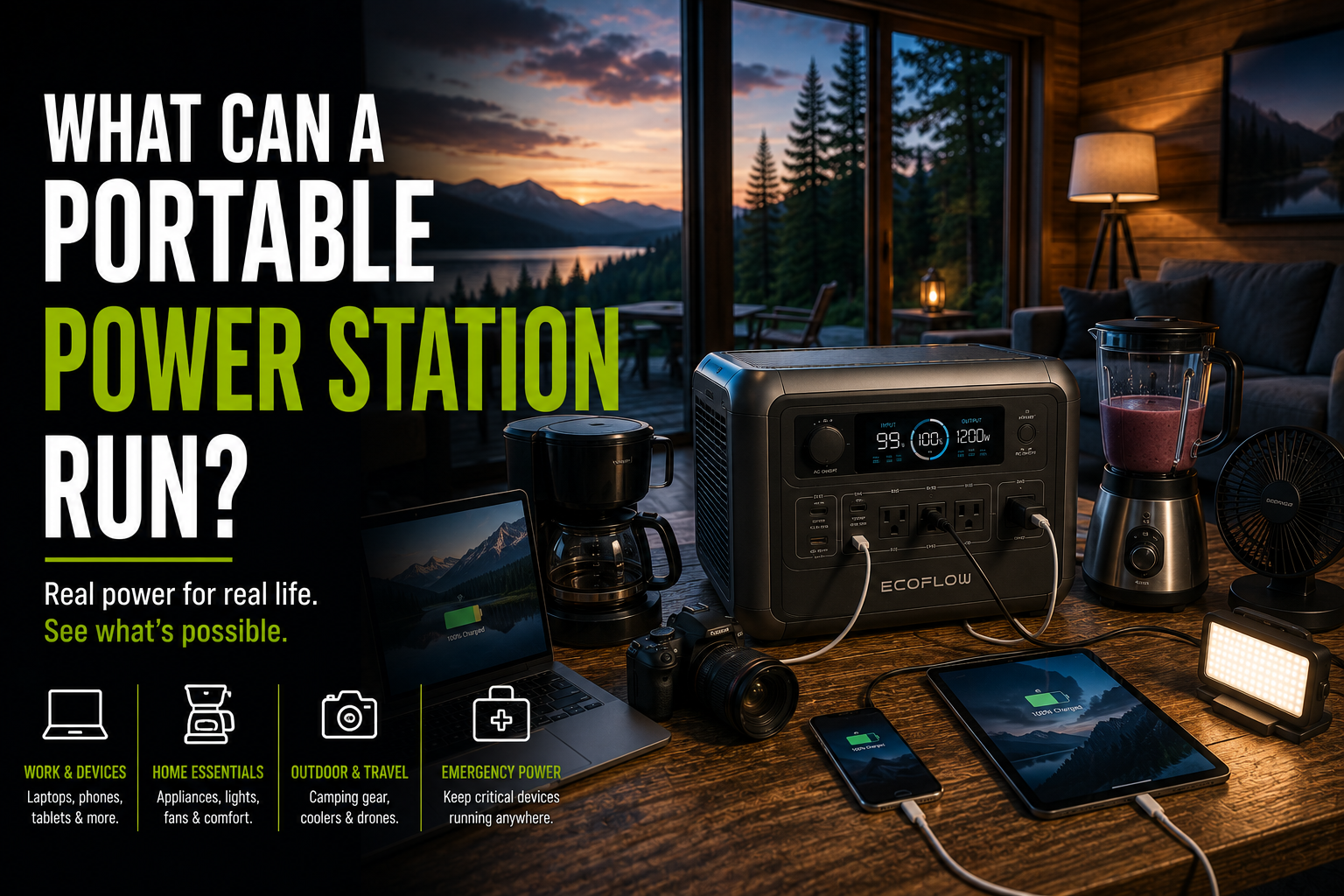
Power-station specifications below come from published Jackery, EcoFlow and BLUETTI manufacturer documentation. Coffee-maker wattages and brewing times are illustrative examples, not verified ratings of a particular brewer. We have not measured a station and coffee maker together in a hands-on test.
Yes - But the Coffee Maker's Watts Decide Whether It Works
Small 600 - 900W brewer: many 1,000W-or-higher continuous AC stations can operate it. Typical 1,000 - 1,200W drip or single-serve machine: choose at least the nameplate wattage, ideally with comfortable headroom. 1,500 - 1,800W machine: a documented 1,800W-or-higher continuous AC station is the safer starting point. Beyond 1,800W: choose a larger inverter or a lower-wattage coffee maker.
A 1,000Wh battery can often handle several short brewing cycles, but it cannot run a 1,500W heater continuously for an hour. Capacity (Wh) determines energy; continuous AC output (W) determines whether the appliance can run at all.
Best Power Stations for Coffee Makers: Quick Picks
Jackery Explorer 1000 v2
A 1,500W-rated inverter can operate many single-serve and compact drip coffee makers rated below its continuous limit.
EcoFlow DELTA 2
The DELTA 2 has an 1,800W continuous pure-sine-wave AC rating, giving more headroom for high-wattage brewers than a 1,500W-class station.
BLUETTI AC180
The AC180 pairs an 1,800W rated pure-sine-wave output with 1,152Wh storage.
Technical Specifications: Which Station Can Brew Coffee?
| Model | Battery (Wh) | Rated AC (W) | Surge (W) | Solar input | Approx. weight |
|---|---|---|---|---|---|
| Jackery Explorer 1000 v2 | 1,070 | 1,500 | 3,000 | 400W maximum | about 23.8 lb |
| EcoFlow DELTA 2 | 1,024 | 1,800 | 2,700 | 500W maximum | about 27 lb |
| BLUETTI AC180 | 1,152 | 1,800 | 2,700 | 500W maximum | about 35 lb |
Detailed Power Station Reviews for Brewing Coffee
Jackery Explorer 1000 v2
Lightweight 1,500W Choice: manufacturer-documented specifications, not a hands-on brewing test.
A 1,500W-rated inverter can operate many single-serve and compact drip coffee makers rated below its continuous limit. Its lower weight helps for camping, but a 1,500W machine leaves no spare AC output headroom for other devices.
Illustrative brewing budget: a 1,000W coffee maker heating for six minutes uses about 100Wh at the appliance (1,000 × 6 ÷ 60). Allowing an illustrative 85% AC conversion factor, that represents about 118Wh drawn from the station battery, before idle and other losses. On paper, this station's 1,070Wh nominal capacity provides about 9.1 such 100Wh appliance-energy cycles; actual results vary with heating duty cycle, temperature, state of charge and other loads.
- LFP battery with manufacturer-listed 1,070Wh capacity.
- 1,500W continuous output is suitable for many 800-1,200W brewers.
- Portable form factor compared with heavier high-output models.
- Not suitable for a 1,600-1,800W brewer at its rated power.
- Do not treat 3,000W surge as a sustained brewing rating.
- Verify the particular coffee maker wattage and station AC-output settings.
Best for: lightweight 1,500w choice buyers whose brewer stays within the rated output. Not ideal for: brewing appliances exceeding 1,500W continuous or users needing indefinite heating without recharging.
Check PriceEcoFlow DELTA 2
Balanced 1,800W Output: manufacturer-documented specifications, not a hands-on brewing test.
The DELTA 2 has an 1,800W continuous pure-sine-wave AC rating, giving more headroom for high-wattage brewers than a 1,500W-class station. X-Boost is not a reason to ignore a coffee maker's rated wattage; performance of resistive heating may change when voltage is reduced.
Illustrative brewing budget: a 1,000W coffee maker heating for six minutes uses about 100Wh at the appliance (1,000 × 6 ÷ 60). Allowing an illustrative 85% AC conversion factor, that represents about 118Wh drawn from the station battery, before idle and other losses. On paper, this station's 1,024Wh nominal capacity provides about 8.7 such 100Wh appliance-energy cycles; actual results vary with heating duty cycle, temperature, state of charge and other loads.
- 1,024Wh LFP battery and documented 1,800W continuous AC output.
- Can support many 1,500W coffee machines with other AC loads switched off.
- 500W maximum solar input offers a recharging path when correctly configured.
- Large heating loads drain 1kWh batteries quickly.
- X-Boost is not equivalent to full-rated output for every appliance.
- Confirm exact DELTA 2 generation, warranty and availability.
Best for: balanced 1,800w output buyers whose brewer stays within the rated output. Not ideal for: brewing appliances exceeding 1,800W continuous or users needing indefinite heating without recharging.
Check PriceBLUETTI AC180
More Stored Energy: manufacturer-documented specifications, not a hands-on brewing test.
The AC180 pairs an 1,800W rated pure-sine-wave output with 1,152Wh storage. BLUETTI itself includes an 800W coffee maker among its example loads, but that marketing illustration is not a universal cup-count guarantee.
Illustrative brewing budget: a 1,000W coffee maker heating for six minutes uses about 100Wh at the appliance (1,000 × 6 ÷ 60). Allowing an illustrative 85% AC conversion factor, that represents about 118Wh drawn from the station battery, before idle and other losses. On paper, this station's 1,152Wh nominal capacity provides about 9.8 such 100Wh appliance-energy cycles; actual results vary with heating duty cycle, temperature, state of charge and other loads.
- Manufacturer documents 1,152Wh and 1,800W continuous output.
- LFP chemistry and four AC outlets on the US model.
- More nominal stored energy than the other two compared 1kWh-class models.
- Heavier than the other two picks.
- Power Lifting mode does not increase the rated continuous AC output.
- Avoid simultaneous loads that exceed the station total.
Best for: more stored energy buyers whose brewer stays within the rated output. Not ideal for: brewing appliances exceeding 1,800W continuous or users needing indefinite heating without recharging.
Check PriceHow Many Watts Does a Coffee Maker Need?
Coffee makers are largely resistive heating loads: their heating element draws substantial power while bringing water to brewing temperature. Some machines cycle the heater or have a separate warming plate. Read the electrical label on the actual brewer, typically on its base, back or manual; do not assume the wattage from its cup count.
| Illustrative coffee-maker type | Example operating draw | Minimum station rated AC output | Practical consideration |
|---|---|---|---|
| Small travel/drip brewer | 600 - 900W | At least actual nameplate watts | Smaller stations may work if no other loads share the inverter |
| Single-serve pod brewer | 1,000 - 1,500W | 1,500W or more for a 1,500W brewer | Brief high-power heating cycles |
| Large drip or espresso machine | 1,200 - 1,800W | 1,800W or higher for a 1,800W brewer | Warm-up and steam functions can change demand |
| High-power machine | Over 1,800W | Above actual nameplate watts | Most 1kWh-class inverters are unsuitable |
These are illustrative ranges, not tested product claims. If a machine is rated at 1,500W, a 1,500W station leaves no headroom for another appliance. Do not plug a 1,500W brewer and a 600W toaster into an 1,800W inverter simultaneously: the combined 2,100W exceeds the rating.
How Many Cups Can a Portable Power Station Brew?
Runtime is an energy question. Heating water is usually measured in minutes, so converting power into watt-hours is more useful than quoting continuous hours at full output. An appliance rated at 1,000W and operating at full power for six minutes consumes about 100Wh. An appliance rated at 1,500W and heating for five minutes consumes about 125Wh. Real coffee makers can cycle, preheat, steam or keep coffee warm, so measure actual energy with a watt meter when possible.
| Brewing example | Appliance energy | Estimated battery energy at 85% | Approx. cycles from 1,024Wh battery |
|---|---|---|---|
| 800W × 5 min | 67Wh | 78Wh | 13 |
| 1,000W × 6 min | 100Wh | 118Wh | 8 |
| 1,200W × 6 min | 120Wh | 141Wh | 7 |
| 1,500W × 5 min | 125Wh | 147Wh | 6 |
Cycle counts are rounded down and assume the entire nominal battery capacity is available; real-world reserve, inverter idle power, temperature and battery age reduce the number. A brewing cycle is not the same as a cup: the amount produced per cycle varies by machine. A warming plate left on for an hour can add significant consumption even after brewing ends.
What about a smaller 500Wh station?
It might have enough energy for multiple brews but still fail to power the brewer if its AC inverter is rated for only 500W. Check watts first, watt-hours second. A 500Wh battery paired with a 1,500W inverter would theoretically supply only a fraction of an hour at 1,500W; most small stations do not offer that output class.
Can solar panels keep up with coffee brewing?
Not necessarily in real time. A 200W solar panel cannot continuously replace a 1,200W heating draw, even in ideal sun. The battery supplies the shortfall; solar charging replenishes energy afterward. For a 120Wh brew, an ideal 200W panel would need 36 minutes at full rated output to replace the appliance energy before conversion losses. Real sunlight, temperature, wiring and charge-controller limits extend that time.
Buying and Safety Checklist Before Brewing Off-Grid
Use the electrical label and include any other simultaneous AC loads.
Multiply watts by heating time in hours, then allow for inverter losses.
Keep the station dry, ventilated and away from spilled water or steam.
- Use the power station's built-in AC outlet within its documented total rating.
- Place the station on a stable, dry surface away from coffee-maker spills and hot surfaces.
- Test the complete setup before a camping trip or outage.
- Recharge only through manufacturer-approved AC, car or solar input methods.
- Do not assume surge ratings support a sustained heating cycle.
- Do not run a high-power coffee maker together with other heavy appliances on an undersized inverter.
- Do not use improvised household backfeeding or modified extension cables.
- Do not rely on promotional cup counts as a substitute for your own energy budget.
Final Verdict: Choose Watts First, Then Watt-Hours
For a typical 800 - 1,200W coffee maker, a documented 1,500W pure-sine-wave station can be a practical starting point. For 1,500 - 1,800W brewers, consider an 1,800W-or-higher continuous-output model and switch off competing AC loads. The Jackery Explorer 1000 v2, EcoFlow DELTA 2 and BLUETTI AC180 illustrate the trade-offs between output, battery capacity and portability; your coffee maker's actual nameplate decides compatibility.
Frequently Asked Questions
Will a 300W power station run a coffee maker?
Usually not a conventional electric brewer rated around 800 - 1,500W. It may operate a low-wattage travel appliance only if its actual rated draw is below the station's continuous AC limit.
Can a 1,000W power station run a Keurig-style brewer?
Only if the exact machine's nameplate wattage does not exceed 1,000W continuous. Many single-serve machines have higher heating draws, so check the label rather than assuming compatibility.
Is 1,500W enough for an espresso machine?
Sometimes. Check the specific machine's rated input and any steam or warm-up functions. A 1,500W inverter cannot reliably sustain a 1,600W or 1,800W appliance.
How many cups will a 1,000Wh station make?
There is no universal cup count. Calculate watt-hours for one actual brewing cycle and divide usable battery energy by that number. Cup volume and heater duty cycle vary by brewer.
Can I brew while the station is solar charging?
Some stations support simultaneous charging and discharging, but input and output limitations vary. Check the exact manual. Solar panels rarely match the instantaneous power of a heating element.
Will a power station damage a coffee maker?
A correctly rated pure-sine-wave station used according to both manuals should be suitable for many standard AC brewers. Overloads may trigger the station's protection, and power-boost modes are not universally suitable.
Is a propane or manual coffee maker better for camping?
For minimizing battery use, a manual pour-over or non-electric method avoids the large electrical heating demand. Follow fuel and ventilation safety instructions for any combustion equipment.
Sources and Editorial Methodology
Power station specifications are drawn from official manufacturer manuals and product information. Appliance power and brewing-duration examples are labeled illustrative and are not laboratory results. No live prices, keyword volumes or comparative hands-on tests are asserted.