
What Is a Power Inverter?
A power inverter converts direct-current battery energy into alternating-current electricity for household devices.
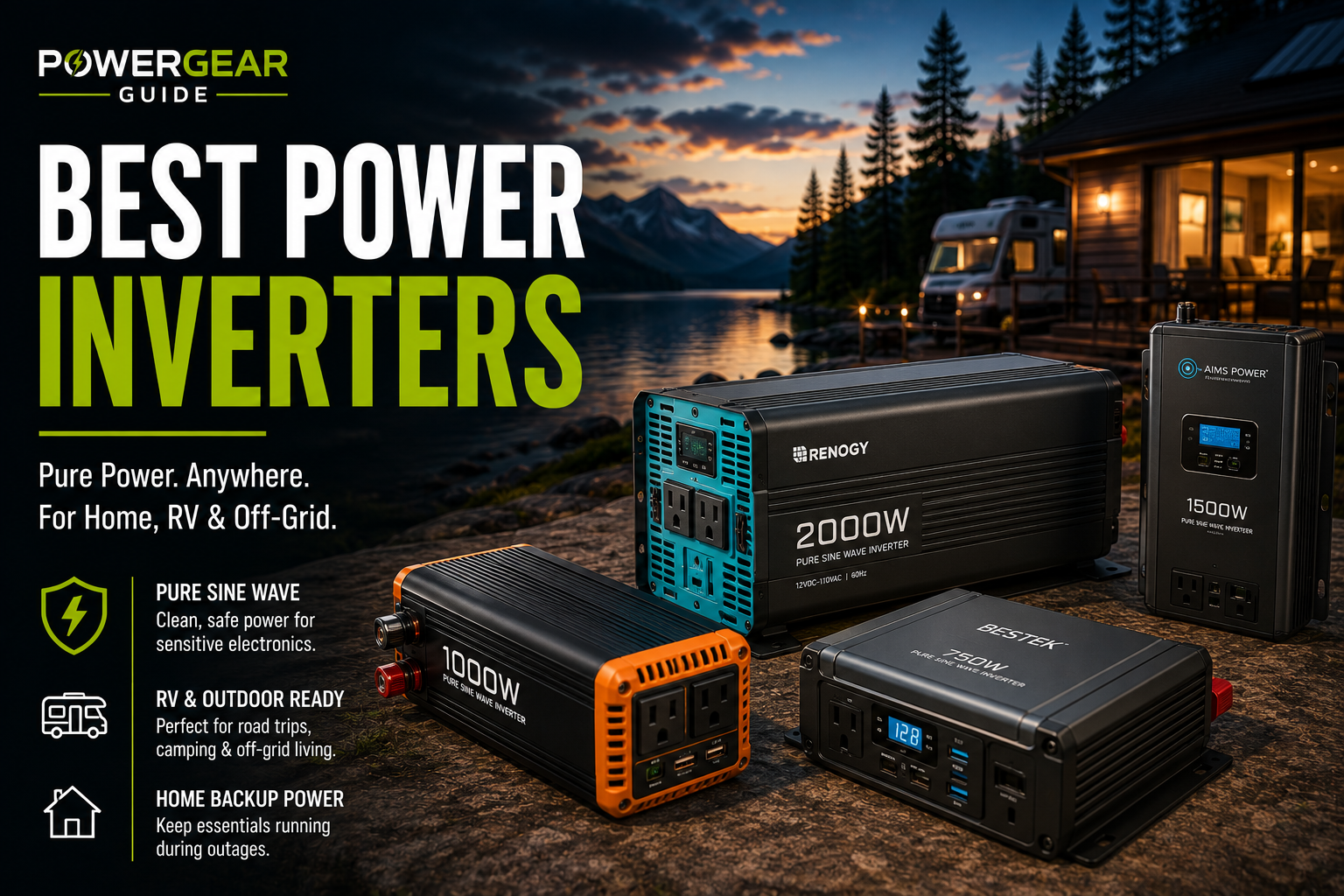
A power inverter converts direct-current battery energy into alternating-current electricity for household devices.
Inverters are central to RV, vehicle, solar and backup systems because batteries store DC while most appliances use AC.
They range from 150W car adapters to multi-kilowatt inverter-chargers.
It Converts DC Battery Power Into AC Power
The inverter must match battery voltage, appliance watts, startup surge and waveform requirements.
Who Needs One
Buy an inverter when you already have a battery system and need AC outlets. Choose pure sine wave for broad compatibility.
Definition
A power inverter is an electronic device that changes DC electricity from batteries or solar storage into AC electricity.
How It Works
DC Input
Receives battery voltage.
Switching Stage
Rapidly switches DC through power electronics.
Transformer or Conversion Stage
Raises or manages voltage.
Output Filter
Shapes the AC waveform.
Protection Circuit
Monitors heat, overload and voltage.
AC Output
Supplies outlets or circuits.
Main Types
| Type | Main Feature | Best Use |
|---|---|---|
| Plug-in car inverter | Low power and simple | Electronics |
| Hardwired inverter | High output | RV, truck, cabin |
| Inverter-charger | Adds charging and transfer | Integrated systems |
| Hybrid inverter | Adds solar/grid management | Home and off-grid systems |
Waveform
Pure sine wave closely matches utility power. Modified sine wave is cheaper but can cause noise, heat or malfunction in some devices.
Sizing
Choose continuous watts from simultaneous loads and surge watts from the largest startup demand.
Common Uses
Cars
Laptops and chargers.
Trucks
Tools and mobile work.
RVs
Kitchen and comfort loads.
Off-Grid Cabins
Household AC devices.
Solar Systems
Battery-to-AC conversion.
Backup Power
Critical loads during outages.
Limitations
Inverters cannot exceed battery energy or discharge limits. Large loads require large batteries, heavy cables and strong charging systems.
Practical System Planning
Electrical sizing works best when the entire system is considered together. Load watts, startup surge, battery energy, wiring, charging capability and protective devices all interact; optimizing one number while ignoring the others can create an unreliable setup.
Use manufacturer instructions as the controlling reference for installation, connection and service. Generic calculations are useful for understanding the design, but model-specific voltage limits, cable requirements, grounding instructions and safety procedures take priority.
Leave operating margin. Equipment that spends its life at maximum output has less room for startup events, temperature changes and unexpected loads. Sensible headroom generally improves reliability and makes future changes easier to accommodate.
For backup systems, test before the emergency. Verify the intended loads, charging method, cables and accessories while utility power and replacement parts are available. A documented, practiced setup is far more useful than a theoretically capable system that has never been assembled.
A Useful Design Margin
Avoid sizing a power system to the exact edge of a published rating. Real loads vary, batteries age, wiring introduces voltage drop and environmental conditions change. Leaving headroom in both power and energy capacity makes the system more tolerant of those differences.
For critical backup use, separate essential loads from optional ones. Reducing simultaneous demand can often improve reliability and runtime more effectively than simply buying the largest inverter or battery available.
Where an Inverter Fits in the System
A power inverter does not create energy; it converts DC electricity from a battery or other DC source into AC electricity suitable for compatible loads. The battery determines how much energy is available, while the inverter determines how much AC power can be delivered and what electrical waveform and protections are provided.
Pure sine-wave output is generally the safer choice for sensitive electronics, motor-driven equipment and devices whose manufacturers require utility-like AC power. Modified-wave inverters can be cheaper but are not appropriate for every load and may cause noise, heat or poor operation in some equipment.
Efficiency matters because conversion consumes some of the battery's stored energy. Inverter idle draw can also become significant when a small load runs for many hours, which is why direct DC or USB power can sometimes be more efficient when the device supports it.
Additional Real-World Consideration
Inverters are also rated by input voltage, commonly 12V, 24V or 48V in battery systems. The inverter must match the battery-bank voltage; these ratings are not interchangeable. Higher-voltage systems can deliver the same power with lower DC current, which can reduce cable-current demands in larger installations. Some inverters also include battery charging and automatic transfer functions, in which case they are often described as inverter/chargers rather than simple standalone inverters.
Frequently Asked Questions
Does an inverter make electricity?
No, it converts stored DC electricity.
Does it charge batteries?
Only an inverter-charger does.
What is pure sine wave?
A smooth AC waveform similar to utility power.
Can it run a refrigerator?
Yes with adequate continuous and surge power.
What determines runtime?
Battery watt-hours and load.
Why do large inverters need heavy cables?
Because low-voltage DC current is very high.