
Best 2000W Power Inverters: Pure Sine Wave Models Compared
A 2,000-watt inverter can run many everyday 120V appliances from a properly sized battery bank. But choosing one involves more than the wattage on the box: battery voltage, surge duration, charging features and safe installation can make or break the system.
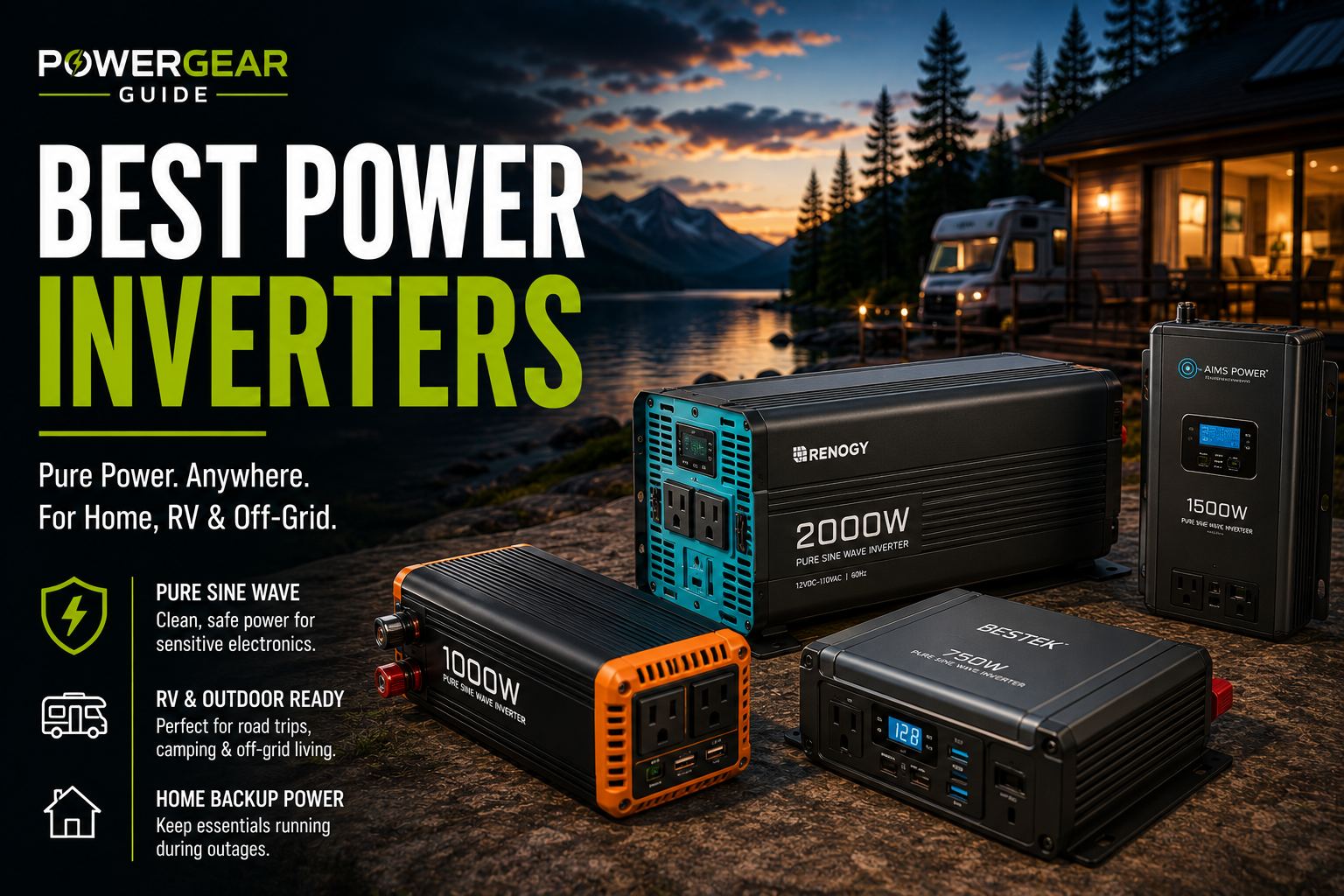
Our top recommendation for a straightforward 12V installation is the Renogy 2000W Pure Sine Wave Inverter. It provides 2,000W continuous AC output, a manufacturer-rated 4,000W peak and a conventional inverter-only design. For buyers who also need shore-power charging, the Renogy 2000W HF Inverter Charger is a more integrated alternative. If your battery bank is 24V, choose a genuine 24V model rather than trying to adapt a 12V inverter.
These recommendations are based on manufacturer-published specifications and installation requirements, not claimed hands-on testing. We also explain why a 3,000VA inverter-charger is not automatically a 3,000W replacement and why 1,000W or 3,000W products should not be treated as equivalent 2,000W picks.
Editor's Verdict
Best straightforward 12V inverter: Renogy 2000W 12V Pure Sine Wave Inverter (RNG-INVT-2000-12V-P2-US). It offers the expected 2,000W continuous rating and 4,000W peak without requiring an integrated charger.
Best 12V inverter with transfer functionality: Renogy 2000W Pure Sine Wave Inverter with UPS Transfer Switch and Bluetooth (RIV1220PU-126). It is suited to buyers who specifically want a built-in transfer feature but do not need a full battery charger.
Best inverter-charger option: Renogy 2000W 12V High-Frequency Inverter Charger (RIV1220ECH-1SS-US). It combines inversion, charging and transfer functionality, with a more complex installation and model-specific transfer limitations.
Best direction for 24V systems: Renogy 24V 2000W Pure Sine Wave Inverter (RIV2420P2-12S). A 24V battery system substantially reduces current for the same output power compared with a 12V system.
Top 2000W Power Inverters
Renogy 2000W Pure Sine Wave Inverter
12V DC input · 120V AC output
Traditional inverter-only configuration with remote control, AC outlets and a published pure sine wave specification.
Choose it for: RVs, vans and battery systems that already have a separate charging solution.
Check PriceRenogy 2000W UPS Transfer Inverter
Model RIV1220PU-126 · 12V DC
Combines pure sine output with a transfer switch and Bluetooth capability. It is not the same product as a full inverter-charger.
Choose it for: Systems requiring its documented AC transfer function.
Check PriceRenogy 2000W HF Inverter Charger
Model RIV1220ECH-1SS-US · 12V DC
Includes battery charging and AC transfer functions, making it relevant to installations that alternate between shore power and battery operation.
Choose it for: Integrated RV or cabin electrical systems.
Check PriceRenogy 24V 2000W Pure Sine Wave Inverter
Model RIV2420P2-12S · 24V DC
Delivers the same continuous power class at a higher battery voltage, reducing DC current demands compared with a 12V equivalent.
Choose it for: Properly designed 24V battery systems.
Check Price2000W Inverter Comparison Table
The four products below share a 2,000W output class, but they do not perform identical jobs. In particular, an inverter with AC transfer functionality is not necessarily a battery charger.
| Model | Battery Input | Continuous AC | Surge | Charging / Transfer | Best Application |
|---|---|---|---|---|---|
| Renogy RNG-INVT-2000-12V-P2-US | 12V | 2,000W | 4,000W peak | No integrated battery charger | Simple inverter-only installation |
| Renogy RIV1220PU-126 | 12V | 2,000W | 4,000W for 2 seconds | Built-in AC transfer; no integrated charger | AC transfer with battery inversion |
| Renogy RIV1220ECH-1SS-US | 12V | 2,000W at stated reference temperature | 4,000W for 100ms; 3,000W for 3 seconds | Integrated charger and transfer | RV and cabin shore-power systems |
| Renogy RIV2420P2-12S | 24V | 2,000W | 4,000W for 2 seconds | Inverter-only | 24V battery installations |
Why the surge duration matters: A 4,000W rating lasting 100 milliseconds is not equivalent to 4,000W for two seconds. Motor starting compatibility depends on both the peak and how long the inverter can sustain it.
Detailed Model Evaluations
Renogy 2000W 12V Pure Sine Wave Inverter
The Renogy RNG-INVT-2000-12V-P2-US is a sensible benchmark for a traditional 12V inverter installation. Renogy specifies 2,000W continuous output, 4,000W peak output, 120V AC, three AC sockets and a remote control.
It is most useful when your electrical system already includes battery charging equipment—such as an appropriately configured solar charge controller, DC-DC charger or shore-power battery charger.
- True 2,000W continuous rating.
- Pure sine wave output.
- 4,000W manufacturer-listed peak.
- Remote control and AC outlets.
- No unnecessary integrated charging complexity.
- Requires a suitable external battery charger.
- High DC current at full load.
- 12V battery system only.
- Manufacturer's official storefront may show limited availability.
Best for: A properly sized 12V RV, van or off-grid battery bank with separate charging components.
Avoid if: You expect shore-power transfer and battery charging from the same device, or your existing battery bank is 24V.
Renogy 2000W Pure Sine Wave Inverter with UPS Transfer
Model RIV1220PU-126 combines 2,000W continuous output with a built-in transfer switch, Bluetooth capability and a manufacturer-rated 4,000W surge lasting two seconds.
Renogy lists a 20A transfer-switch rating, two AC sockets plus a terminal block, and a 12V nominal battery input. The manufacturer also specifies a maximum continuous battery current of 210A.
That 210A figure highlights why installation design matters. The inverter may look compact, but the battery circuit must support very high current safely.
- Built-in transfer function.
- Bluetooth monitoring features.
- 2,000W continuous output.
- Documented two-second surge rating.
- Not a complete battery charger.
- Transfer functionality is not a universal no-break UPS guarantee.
- Requires careful AC wiring and protection.
- 12V battery input only.
Best for: Installations that need manufacturer-supported AC transfer between an external source and battery-powered inversion.
Avoid if: You need a combined battery charger or require guaranteed uninterrupted operation for critical electronics.
Renogy 2000W 12V High-Frequency Inverter Charger
The Renogy RIV1220ECH-1SS-US integrates pure sine wave inversion, battery charging and AC transfer. This makes it a more complete solution for an RV or cabin that regularly connects to shore power.
Renogy specifies 2,000W rated output at its stated reference temperature. Its surge specifications are unusually important: up to 4,000W for 100 milliseconds, 3,000W for three seconds and 2,400W for approximately 30 seconds in the manufacturer's documentation.
Those figures illustrate why simply reading "4,000W surge" can be misleading. A motor that takes several seconds to accelerate may need a different overload profile than a brief electronic inrush.
- Battery charging and inversion in one chassis.
- AC transfer functionality.
- Published overload ratings at several durations.
- Remote control and monitoring options.
- More complex AC and DC installation.
- Higher system integration demands.
- Transfer timing must be checked against connected equipment.
- Requires battery settings appropriate to the chemistry and BMS.
Best for: A professionally planned 12V system that needs battery charging from AC power and inverter operation from the same unit.
Avoid if: You only need a simple inverter for occasional plug-in loads or already have a well-functioning charging system.
Renogy 24V 2000W Pure Sine Wave Inverter
The RIV2420P2-12S is a 24V alternative for battery systems built around a higher nominal voltage. Renogy's manual specifies 2,000W continuous output, 4,000W surge for two seconds, 120V AC output and a maximum continuous battery current of 106A.
That maximum current is approximately half the 210A figure listed for Renogy's 12V transfer-equipped inverter. The exact difference depends on efficiency and operating voltage, but the principle is consistent: higher battery voltage reduces current for the same power.
- Suitable for a 24V battery architecture.
- Lower DC current than a comparable 12V system.
- Pure sine wave output.
- Documented two-second surge capability.
- Cannot be connected directly to a 12V battery bank.
- Requires 24V-compatible charging equipment.
- Still needs correctly sized cables and protection.
- Not an integrated inverter charger.
Best for: Cabins, vans and off-grid systems designed from the outset around a 24V battery bank.
Avoid if: Your system is already built around 12V and you do not intend to redesign its battery and charging architecture.
How Much Battery Does a 2000W Inverter Need?
A 2,000W inverter rating tells you how much AC power it can deliver, not how long it can deliver that power. Runtime depends on usable battery energy, load and conversion losses.
At 2,000W AC output and an assumed 90% conversion efficiency:
| Nominal Battery Voltage | Estimated DC Current | Design Implication |
|---|---|---|
| 12V | Approximately 185A | Very high current; short, appropriately sized cables and robust protection are essential |
| 24V | Approximately 93A | Lower current for the same AC power, but still a substantial electrical load |
| 48V | Approximately 46A | Lower current again; requires a compatible 48V inverter and complete system design |
These are nominal-voltage examples. At a lower actual battery voltage, current increases. Inverter efficiency also changes with load, so the figures are for planning rather than cable or fuse selection.
Why a Single 100Ah Lithium Battery May Not Be Enough
A nominal 12.8V, 100Ah LiFePO4 battery contains approximately 1,280Wh before accounting for usable capacity limits and conversion losses.
But capacity is only half the question. If its battery management system allows a maximum continuous discharge of 100A, it cannot necessarily support a 2,000W inverter at full output. Two batteries with the same Ah rating may have different discharge limits.
For a 12V 2,000W system, verify the battery bank's combined continuous discharge rating, short-duration surge capability, low-voltage behavior and the manufacturer's approved parallel configuration.
Illustrative Runtime Estimates
Assume a nominal 12.8V 200Ah battery bank (2,560Wh), 90% inverter efficiency and that the entire nominal energy is accessible. Real usable energy may be lower.
| Constant AC Load | Estimated Runtime | Typical Interpretation |
|---|---|---|
| 100W | About 23 hours | Light electronics; inverter idle consumption may materially reduce runtime |
| 300W | About 7.7 hours | Moderate combined load |
| 800W | About 2.9 hours | Higher sustained appliance demand |
| 2,000W | About 1.15 hours | Full output, only if the battery bank supports the required discharge current |
Actual runtime is affected by the battery's usable capacity, discharge-rate limits, inverter self-consumption, cable losses and temperature. The estimates are not product test results.
What Can a 2000W Power Inverter Run?
A 2,000W inverter can run a compatible appliance—or several appliances—when their combined continuous demand stays within the inverter's rated output and any startup surge remains within its documented limits.
| Appliance | What to Check | 2000W Inverter Suitability |
|---|---|---|
| Phone and laptop chargers | Combined input wattage | Usually well within output capacity |
| Television and networking equipment | Combined continuous consumption | Generally suitable if the electrical specifications match |
| Microwave | Electrical input watts, not advertised cooking watts | Model-dependent; some exceed the practical load budget |
| Coffee maker or kettle | Heating-element input watts | Possible when rated input is within capacity and battery current is sufficient |
| Refrigerator | Compressor starting demand and daily energy use | Often possible, but requires appliance-specific verification |
| Air conditioner | Running watts, compressor startup, voltage and duty cycle | Highly model-dependent; do not assume compatibility |
| Electric space heater | Continuous heating watts and battery runtime | May be within output rating, but can drain a battery bank quickly |
Example: A Microwave and Refrigerator Together
Suppose a microwave draws 1,450W from the wall and a refrigerator draws 180W while its compressor runs. The combined steady load is 1,630W, below 2,000W.
However, if the refrigerator compressor starts while the microwave is operating, its startup surge may push the instantaneous demand above what the inverter can sustain. That is why appliance startup sequencing and surge specifications matter.
These figures are an illustrative scenario, not a promise that a particular microwave or refrigerator will work.
Installation: The Most Important Part of a 2000W Inverter System
A 2,000W inverter is a high-current electrical device. At 12V, its DC side can draw well over 150A during heavy operation. A poorly designed installation can cause voltage drop, nuisance shutdowns, overheated conductors or fire.
Battery-Side Requirements
- Correct nominal battery voltage.
- Adequate continuous and surge discharge capability.
- Manufacturer-approved DC cable size and length.
- Properly rated overcurrent protection near the battery.
- Suitable disconnects, terminals and connection torque.
AC-Side Requirements
- Correct outlet and branch-circuit ratings.
- Appropriate grounding and neutral configuration.
- Manufacturer-approved transfer arrangements.
- Compatible protection for connected loads.
- Professional installation for fixed building or RV wiring where applicable.
Why We Do Not Give One Universal Cable or Fuse Size
There is no single safe cable gauge or fuse value for every 2,000W inverter. Requirements depend on the inverter's maximum input current, conductor material, insulation temperature rating, cable length, installation method, battery voltage, protective-device characteristics and applicable electrical codes.
Even if a manufacturer includes cables, that does not mean those cables are suitable for a longer installation run or every mounting environment. Use the exact model manual and have the installation reviewed by a qualified professional.
12V vs 24V: Which Is Better?
If you already have a correctly designed 12V RV system, a 12V inverter may be the least disruptive choice. If you are building a larger battery system from scratch, 24V can reduce DC current and related conductor demands at the same power.
Changing to 24V is not as simple as connecting batteries differently. Chargers, solar controllers, DC loads, converters and battery-management settings must all be compatible with the new system voltage.
Grounding, Neutral Bonding and Transfer Switches
Inverter output grounding and neutral behavior vary by product and operating mode. A device with a built-in transfer switch may have different bonding requirements from a standalone inverter.
Do not improvise a neutral-to-ground bond or connect inverter output to a household panel without an approved transfer arrangement. Follow the specific installation manual and applicable codes. Use a licensed electrician for fixed wiring and system integration.
Should You Buy a 1000W, 2000W or 3000W Inverter?
The original article included 1,000W and 3,000W models alongside 2,000W choices. They are useful alternatives, but not direct substitutes in a ranking of 2,000W inverters.
| Inverter Class | When It Makes Sense | Main Trade-Off |
|---|---|---|
| 1,000W | Small electronics, modest appliance loads and lower battery current | Less headroom for heating appliances and motor startup |
| 2,000W | Many RV, van and small off-grid appliance combinations | High DC current at 12V and substantial battery demand |
| 3,000W | Larger combined loads and applications needing additional output headroom | Greater potential battery, cabling and protection requirements |
What About Victron MultiPlus 3000VA?
Victron MultiPlus is an important premium inverter-charger family, but its model naming uses volt-amperes (VA), and the real-power output rating depends on the exact model and temperature. A 3,000VA model should not be described automatically as either a 2,000W or 3,000W inverter.
It is worth evaluating for a professionally designed integrated system requiring charging, transfer and Victron ecosystem features. Compare the precise 12V, 24V or 48V variant and its continuous watt rating against your actual load before choosing it over a conventional 2,000W inverter.
For a broader comparison of inverter sizes and architectures, see our Best Power Inverters guide and inverter sizing guide.
Frequently Asked Questions
Can a 2000W inverter run a microwave?
Possibly. Check the microwave's electrical input wattage, not just its cooking-power rating. Some microwaves draw more than their advertised cooking watts, and the inverter must have adequate continuous output and battery support.
Can I run a 2000W inverter from a car cigarette-lighter socket?
No. A 2,000W inverter requires a properly designed high-current battery connection. Typical vehicle accessory sockets are rated for a small fraction of that power. Do not attempt to operate a full-size inverter through an accessory plug.
Will a 100Ah lithium battery run a 2000W inverter?
It depends on the battery's continuous discharge rating, BMS limits, voltage and the actual load. A 100Ah capacity label alone does not establish that the battery can safely deliver the current required at full inverter output.
Is pure sine wave worth it?
Pure sine wave is the sensible default for a general-purpose inverter powering mixed household electronics, motor-driven appliances and equipment whose compatibility with modified sine wave is uncertain. It does not remove the need to check individual device requirements.
Does a 2000W inverter use 2000W all the time?
No. A 2,000W rating describes maximum continuous output under specified conditions. Actual power consumption depends on the connected loads plus the inverter's conversion losses and idle draw.
Is an inverter charger better than an inverter?
An inverter charger is better when you need its integrated charging and transfer functions. If you already have suitable charging equipment and only need DC-to-AC conversion, a standalone inverter may be simpler and more economical.
Can a 2000W inverter power an entire house?
It is generally more appropriate for selected loads than whole-house operation. Many households have simultaneous loads and 240V equipment that exceed the capabilities of a typical 120V, 2,000W inverter. Home-circuit connections also require approved electrical integration.
Sources and Editorial Methodology
This guide evaluates documented inverter specifications, use-case fit, battery-system compatibility and installation considerations. Product claims come from manufacturer specifications and manuals; calculated battery currents and runtimes are illustrative engineering estimates. We did not conduct or claim hands-on product testing.
- Renogy — 2000W 12V Pure Sine Wave Inverter Specifications
- Renogy — 2000W Inverter with UPS Transfer Switch and Bluetooth
- Renogy — 2000W High-Frequency Inverter Charger
- Renogy — 24V 2000W Pure Sine Wave Inverter User Manual (PDF)
- Victron Energy — MultiPlus Inverter/Charger Product Family
Selection method: We prioritize genuine 2,000W continuous-output models, distinguish inverter-only units from transfer-equipped models and inverter chargers, and consider both 12V and 24V architectures. We do not award invented numerical scores or assume that surge wattage represents continuous power.
Before purchasing: Confirm the exact model number, AC output voltage, battery input range, surge duration, battery compatibility, installation manual, current seller and warranty terms.
Final Recommendation: Match the Inverter to Your Electrical System
For a conventional 12V battery bank with separate charging equipment, the Renogy 2000W Pure Sine Wave Inverter is a strong starting point. It provides a clear 2,000W continuous specification without adding transfer and charging features you may not need.
Choose the Renogy transfer-equipped model if its documented AC transfer functionality fits your system. Choose the Renogy HF Inverter Charger when integrated battery charging is part of the installation. For a 24V battery bank, start with a dedicated 24V 2000W inverter instead.
Above all, verify the battery bank, current capacity, surge requirements and protective wiring before buying. A properly installed 2,000W inverter is far more valuable than a higher-rated unit attached to an undersized electrical system.
Compare Current Options