
Anker SOLIX Brand Guide: Power Stations, Solar Generators & Home Backup
Explore the Anker SOLIX ecosystem, compare its portable power stations, and learn which battery systems make sense for camping, RV travel, emergency backup, and larger residential power needs.
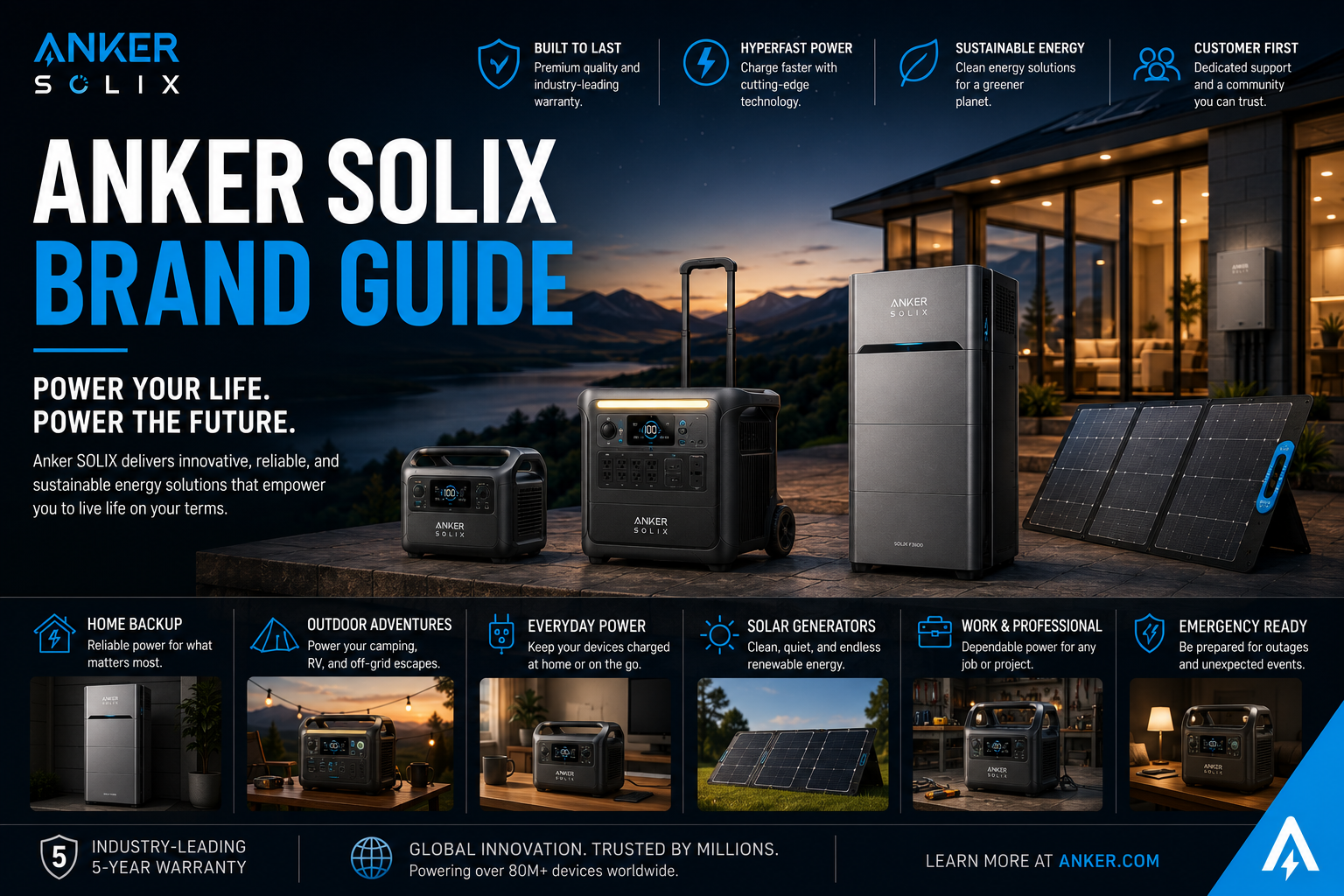
Is Anker SOLIX a Good Brand?
Anker SOLIX is a credible choice for portable battery power and expandable backup, especially for buyers interested in lithium iron phosphate batteries, multiple charging options, app monitoring, and a lineup that extends from compact travel stations to large 120/240V systems.
But SOLIX is not one interchangeable product family. A C300 cannot replace an F3800, and an F3800 does not automatically constitute a complete installed home-backup system. Capacity, inverter output, solar limits, expansion hardware, and installation requirements vary substantially.
Our recommendation: Choose by your electrical load, required runtime, and total system cost—not by the largest advertised peak-watt number.
Understanding the Anker SOLIX Product Lineup
The easiest way to understand SOLIX is to separate compact portable stations, higher-capacity power stations, expandable backup platforms, and permanently installed residential systems.
SOLIX C Series
Smaller stations for electronics, camping, portable refrigerators, remote work, and limited outage needs. Models differ in capacity, AC output, and charging features.
Key question: Do you need USB/DC charging only, or enough 120V AC output for household appliances?
SOLIX F Series
Larger stations for more demanding loads, longer runtimes, RV use, and emergency backup. Expansion capability depends on the specific model.
Key question: Does the system provide the correct voltage, outlet type, and sustained output?
SOLIX F3800 Platform
A large battery platform with US 120/240V capability, high AC output, and compatible expansion batteries. Household integration requires additional planning.
Key question: Which circuits, transfer equipment, and battery capacity do you actually need?
Installed SOLIX Systems
Permanent residential energy systems are a separate category involving compatible storage, inverters, electrical equipment, and professional installation.
Key question: Are you buying portable emergency power or a permanently integrated home-energy system?
Anker SOLIX Comparison: Capacity, Output & Purchase Options
These four established models represent different capacity classes. The original C1000 and later C1000 generations are not interchangeable; specifications below refer to the exact identified configurations.
| Model | Capacity | Rated AC Output | Max Solar Input | Best For | Purchase Options |
|---|---|---|---|---|---|
| C300 AC (A1722) | 288Wh | 300W | 100W | Small electronics and light camping | Check Price |
| C1000 (A1761) | 1,056Wh | 1,800W | 600W | Portable appliances and short outages | Check Price |
| F2000 / PowerHouse 767 | 2,048Wh | 2,400W | 1,000W | RV use and longer appliance runtime | Check Price |
| F3800 (US) | 3,840Wh | 6,000W, 120/240V | 2,400W | Large-load and expandable backup | Check Price |
Which Anker SOLIX Power Station Should You Choose?
C300 AC
Choose this size for phones, laptops, modest accessories, and light travel use when 300W AC output is sufficient.
Check Price Read Model Review →Original C1000
A better fit when a compact 300W station cannot run your appliances and you need approximately 1kWh of storage.
Check Price Read Model Review →F2000
Consider this model when additional battery capacity and 2,400W AC output matter more than easy carrying.
Check Price Read Model Review →F3800
Relevant when you need higher output, US 120/240V capability, and a compatible expandable battery system.
Check Price Read Model Review →Home Energy System
If your goal is automatic household backup or ongoing solar-energy management, evaluate a complete installed system rather than assuming a portable station provides every required feature.
Compare Total Cost
Include compatible solar panels, adapters, extra batteries, transfer equipment, and installation. The least expensive base station is not always the lowest-cost complete solution.
Anker SOLIX Model Reviews
1. Anker SOLIX C300 AC
The C300 AC is designed around portability. Anker's A1722 version has a 288Wh LiFePO4 battery, 300W rated AC output, and a 100W maximum solar input. It suits electronics charging, modest accessories, and limited backup power.
SurgePad marketing should not be interpreted as a higher conventional continuous inverter rating. Check your appliance's running and starting requirements against the 300W specification.
- Compact and relatively lightweight
- AC and USB charging options
- Solar charging support
- App monitoring
- Limited stored energy
- 300W rated inverter ceiling
- Not intended for large appliances
- AC and DC variants differ
Best for: camping, mobile electronics, and light backup. Skip if: your appliance requires more than 300W continuous AC power.
Check Price & Availability Official Specifications2. Anker SOLIX C1000 — Original A1761
The original C1000 provides 1,056Wh capacity, 1,800W rated AC output, and 600W maximum solar input. That makes it more capable than the C300 for selected household appliances and short emergency-backup scenarios.
Anker also documents compatible expansion for this original generation. However, newer C1000 versions have different specifications and should be evaluated separately. Do not assume similarly named units use identical batteries or accessories.
- More versatile inverter than C300
- Useful approximately 1kWh capacity
- Fast AC charging capability
- Supported expansion configuration
- Heavy loads reduce runtime quickly
- Not a 240V home-backup platform
- Generation-specific compatibility
- May be superseded by newer retail models
Best for: portable appliances, camping, and short outages. Skip if: you require sustained 240V output or extensive home-circuit backup.
Check Price & Availability Official Specifications3. Anker SOLIX F2000 / PowerHouse 767
The F2000 steps up to 2,048Wh battery capacity, 2,400W AC output, and 1,000W maximum solar input on the documented US configuration.
Its TT-30R RV outlet is useful, but the outlet's physical format does not increase the station's overall output. Anker documents compatible expansion to 4,096Wh with the supported additional battery.
- Greater energy storage
- Substantial 120V AC output
- Compatible expansion battery
- RV-oriented connection
- Heavier than compact stations
- 120V output on documented US model
- Expansion increases cost
- Not a complete installed home system
Best for: RV use and extended appliance runtime. Skip if: you need US 240V output for large household loads.
Check Price & Availability Official User Manual4. Anker SOLIX F3800
The F3800 is a large-capacity backup platform with 3,840Wh battery storage, 6,000W AC output, and 120/240V capability on the US model. Its maximum documented solar input is 2,400W.
Compatible expansion batteries can increase storage capacity significantly. Anker documents a single-unit expansion configuration reaching 26,880Wh, while larger configurations require additional compatible equipment.
At approximately 132 pounds, the F3800 is not a casual carry-anywhere station. Its value comes from high output, voltage flexibility, and system expandability.
- High AC output
- US 120/240V capability
- Expandable battery storage
- Solar charging and app monitoring
- Home-backup integration possibilities
- Very heavy
- Higher total system cost
- Home integration requires compatible equipment
- Base unit is not unlimited whole-home backup
- Not waterproof
Best for: larger loads and expandable home backup. Skip if: you only need small electronics and occasional camping power.
Check Price & Availability Official SpecificationsBattery Capacity, Output, and LiFePO4 Technology
The documented models use lithium iron phosphate (LiFePO4 or LFP) batteries. This chemistry is valued for long cycle-life potential and favorable thermal stability, but chemistry alone does not establish a guaranteed lifespan.
Capacity: Watt-Hours
Watt-hours measure stored energy. A 1,000Wh battery cannot be assumed to provide 1,000W for exactly one hour because inverter losses, standby power, temperature, and load behavior affect runtime.
Output: Watts
Watts describe the power available at one time. Even a large battery cannot run an appliance whose requirements exceed the inverter's continuous rating or the outlet's limit.
Cycle Life
Cycle-life claims must be interpreted with the manufacturer's test conditions and remaining-capacity threshold. Thousands of cycles do not mean zero battery degradation.
Expandability
Expansion batteries are model-specific. Check compatible battery modules, connection cables, firmware, and maximum supported quantities before buying.
Illustrative Runtime Calculation
A practical planning formula is estimated runtime = battery Wh × assumed usable fraction ÷ load W.
Example: Original C1000 capacity = 1,056Wh. Assume 85% reaches a constant 100W AC load.
1,056 × 0.85 ÷ 100 = 8.98 hours.
That is roughly nine hours under the stated assumptions—not a measured or guaranteed C1000 result.
At 500W under the same assumptions, runtime is approximately 1.8 hours. Actual performance depends on the load and operating conditions.
Solar Charging With Anker SOLIX
A SOLIX station becomes a solar-generator setup when paired with compatible solar panels. The panels generate electricity while the power station controls charging and stores energy for later use.
Match Voltage
Panel operating voltage and open-circuit voltage must stay within the power station's supported limits, including in cold weather.
Match Current
Maximum solar wattage is only part of the specification. Input-current limits and supported connections also matter.
Plan for Real Conditions
Clouds, shade, temperature, orientation, and daylight hours affect production. Panel nameplate wattage is not guaranteed continuous output.
Can Anker SOLIX Power a House?
Some SOLIX systems can support household appliances and properly configured backup circuits. That does not mean every station can power an entire home or that a portable unit can connect directly to household wiring without approved equipment.
Plug-In Appliance Backup
Portable stations can power compatible appliances directly through their outlets, provided startup power, running watts, voltage, and runtime fit the station's limits.
Household Circuit Backup
Supporting home circuits requires suitable transfer equipment or an approved integration system, correct wiring, and qualified installation. The F3800's 120/240V capability is relevant but does not establish compatibility by itself.
Home Electrical Safety
Never backfeed household wiring through a standard wall outlet. Have a qualified electrician evaluate transfer equipment, grounding and bonding, circuit ratings, and applicable electrical codes.
Do not assume an EPS or UPS feature guarantees uninterrupted operation of medical equipment or other sensitive devices. Check the published transfer time and the equipment's requirements.
Anker SOLIX Strengths and Limitations
Where SOLIX Makes Sense
- Broad range of portable and backup products
- LFP batteries on the documented models
- Multiple charging options
- App monitoring on supported products
- Expandable storage on selected systems
- US 120/240V support on F3800
Where Buyers Should Be Careful
- Model generations can differ substantially
- Expansion accessories are not universal
- Large systems are heavy
- Solar electrical compatibility matters
- Home integration may require professional work
- Total cost rises with expansion batteries
How SOLIX Compares With Other Brands
Anker SOLIX competes with EcoFlow, BLUETTI, and Jackery across overlapping portable-power and backup categories. Compare exact products by usable capacity, rated AC output, voltage, solar limits, battery expansion, warranty terms, and total system cost rather than assuming one brand is always superior.
| Brand | Product Focus | Key Comparison Points |
|---|---|---|
| Anker SOLIX | Portable stations and expandable backup | Model generation, 120/240V capability, expansion |
| EcoFlow | Portable power and modular energy systems | Charging, inverter output, ecosystem compatibility |
| BLUETTI | Portable and expandable battery systems | Capacity, inverter output, supported batteries |
| Jackery | Portable stations and solar-generator bundles | Portability, solar charging, capacity, output |
What to Check Before Buying Anker SOLIX
Exact Model Generation
Check the model identifier, not only the retail name. Older and newer versions may differ in capacity, inverter rating, outlets, charging limits, and accessories.
Appliance Compatibility
Compare running watts, starting watts, voltage, frequency, and individual outlet limits. A large battery cannot overcome an undersized inverter.
Expansion Requirements
Verify supported battery modules, quantity, cables, and any required integration equipment. Include them in total cost.
Warranty and Seller
Read warranty terms for the specific product, region, and seller. Do not assume one warranty period covers every SOLIX product.
Ready to Compare Current SOLIX Listings?
Choose the capacity class that matches your needs. Each button opens search results for the named model; confirm the exact configuration before purchasing.
C300 — Check Price C1000 — Check Price F2000 — Check Price F3800 — Check PriceFrequently Asked Questions About Anker SOLIX
Is Anker SOLIX the same as Anker?
SOLIX is Anker's portable-energy and energy-storage brand. These products are distinct from Anker's smaller consumer charging accessories.
Is the original Anker SOLIX C1000 still worth considering?
It has documented 1,056Wh capacity and 1,800W rated AC output. It may suit some buyers, but newer generations should be compared by exact specifications and current purchase terms.
Can Anker SOLIX run a refrigerator?
Some models can run compatible refrigerators, but startup watts, running consumption, voltage, and required runtime must all be considered.
Does Anker SOLIX support solar panels?
Many models do. Voltage, current, connectors, and maximum input differ by model.
Can I use any Anker expansion battery with any SOLIX station?
No. Expansion batteries are model-specific. Verify the exact compatible accessory.
Can an F3800 run 240V appliances?
The US F3800 supports 120/240V output. Appliance compatibility still depends on current, startup demand, connections, and the complete electrical setup.
Is the F3800 waterproof?
No. Anker identifies the F3800 as not waterproof. Follow the manufacturer's environmental and ventilation requirements.
Final Verdict: Which Anker SOLIX Is Worth Buying?
For light portable use, the C300 AC is a sensible starting point. For appliances requiring more AC output, consider the original C1000 or compare it with newer generations. The F2000 provides greater stored energy and 120V appliance capacity, while the F3800 is relevant for higher-output 120/240V backup and expansion.
The strongest purchase is the smallest compatible system that meets your actual electrical load, runtime, charging, and expansion requirements.
Compare All Four Models & PricesResearch Sources and Editorial Method
This guide evaluates manufacturer-documented specifications, compatibility, system expansion, and practical ownership trade-offs. It does not claim hands-on testing or independent laboratory results.
- Anker C300 AC A1722 — 120V User Guide
- Anker C1000 — Official Product Introduction
- Anker F2000 / PowerHouse 767 — User Manual
- Anker F3800 — US Technical Specifications
Editorial attribution: PowerGearGuide Editorial Team. Specifications are model- and region-specific and should be checked before purchasing. This is an independent brand guide, not an endorsement issued by Anker.