
BLUETTI Brand Guide: Portable Power Stations, Solar Generators & Home Backup
Understand BLUETTI's current power station lineup, compare battery sizes and inverter output, and find the right starting point for camping, RV travel, emergency power or a larger backup system.
Compare Current Options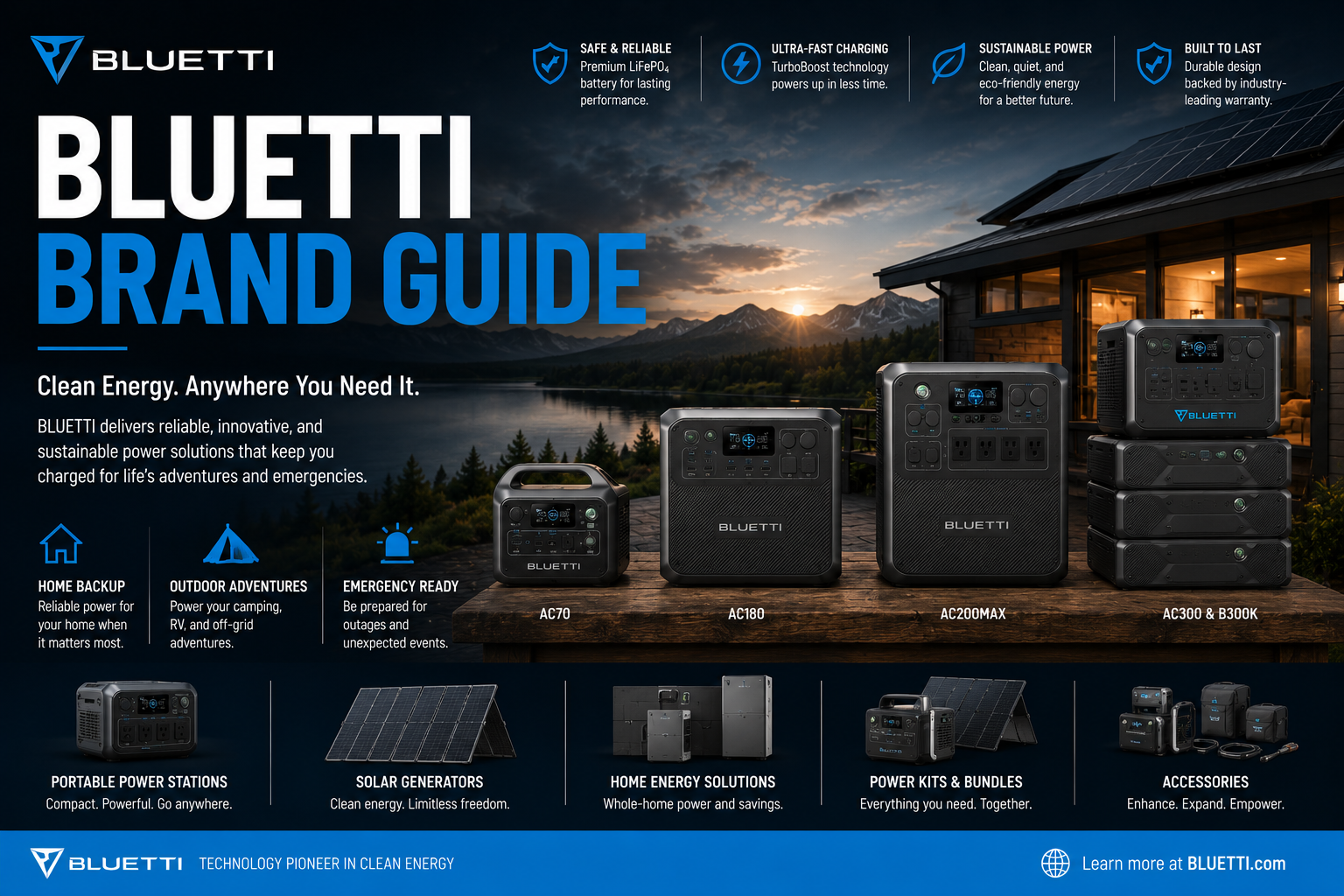
BLUETTI makes battery-powered stations for a wide range of uses, from charging small electronics at a campsite to powering selected household circuits through properly designed backup equipment. The important question is not simply whether BLUETTI is a good brand. It is which product family fits your electrical loads, required runtime, portability needs and installation plans.
BLUETTI at a Glance
Best starting point for general portable power: The Elite 100 V2 combines 1,024Wh of rated capacity with 1,800W continuous AC output.
For longer portable backup: The Elite 200 V2 increases rated capacity to 2,073.6Wh and continuous AC output to 2,600W.
For expandable systems: The AC200L and Apex 300 deserve separate consideration. The Apex 300 supports 120V/240V applications when installed and configured according to the manufacturer's requirements.
Important: BLUETTI models are not interchangeable. Battery capacity, output voltage, solar input limits, expandability and transfer behavior differ substantially between product families.
What Is BLUETTI Known For?
BLUETTI's product range centers on rechargeable battery systems that store electricity and provide power through AC outlets, USB connections and other outputs, depending on the model. Many of its current portable products use lithium iron phosphate (LiFePO4 or LFP) batteries.
The brand's lineup covers three distinct needs: compact portable charging, higher-capacity mobile power, and expandable backup systems. Those categories overlap in marketing, but they have different practical limitations.
BLUETTI competes with brands such as EcoFlow, Jackery and Anker SOLIX. A useful comparison focuses on the exact models rather than assuming one manufacturer is superior in every capacity range.
Understanding the BLUETTI Product Lineup
The following models illustrate how BLUETTI's range changes as capacity and output increase. They are not a complete catalog, and model availability may change.
Elite 30 V2
A smaller-capacity option for electronics, lighting and modest appliances. Its 600W rated AC output makes load checking especially important.
Elite 100 V2
A practical middle ground for camping, mobile workstations and limited emergency backup. Its 1,800W output supports more demanding loads than many small stations.
Elite 200 V2
Offers approximately twice the stored energy of the Elite 100 V2 and a higher normal inverter rating. A strong candidate when portability still matters but runtime needs increase.
BLUETTI AC200L
The AC200L has 2,048Wh of rated capacity and 2,400W continuous AC output. Its defining advantage over a typical fixed-capacity 2kWh station is compatibility with specified expansion batteries.
It also has a manufacturer-published maximum solar input of 1,200W, compared with 1,000W for the Elite 200 V2. But higher solar input alone does not guarantee faster charging in typical weather.
- Expandable energy storage with compatible batteries.
- 2,400W rated AC output.
- Higher published maximum solar input than Elite 200 V2.
- Expansion batteries add cost and weight.
- Not equivalent to a native 240V home-backup system.
- Compatibility must be checked by battery model.
BLUETTI Apex 300
The Apex 300 is a different class of system. BLUETTI lists 2,764.8Wh of base capacity, 3,840W rated output and 120V/240V capability. Compatible expansion batteries can increase total energy storage for longer backup requirements.
This makes it more relevant than a conventional 120V-only portable station for certain home and RV applications. However, 240V capability does not mean the station can be connected directly to household wiring without suitable approved equipment and installation.
BLUETTI Power Station Comparison Chart
Battery capacity and continuous inverter output answer different questions. Compare both before looking at extra features.
| Model | Battery Capacity | Rated AC Output | Primary Role | Key Consideration |
|---|---|---|---|---|
| Elite 30 V2 | 288Wh | 600W | Compact electronics | Limited energy and appliance output |
| Elite 100 V2 | 1,024Wh | 1,800W | Camping and general portable power | Good output-to-capacity balance |
| AC180 | 1,152Wh | 1,800W | General portable power | Compare generation, size and solar input with Elite 100 V2 |
| Elite 200 V2 | 2,073.6Wh | 2,600W | Higher-demand portable loads | Fixed-capacity design |
| AC200L | 2,048Wh | 2,400W | Expandable backup | External battery compatibility |
| Elite 300 | 3,014Wh | 2,400W | Longer-duration backup | More energy, not more output than AC200L |
| Elite 400 | 3,840Wh | 2,600W | High-capacity portable backup | Greater storage increases size and weight |
| Apex 300 | 2,764.8Wh | 3,840W | Expandable home and RV systems | 120V/240V and installation requirements |
Figures are manufacturer-published nominal ratings for the referenced U.S. product lineup. This table does not imply that every model is equally available, expandable or suitable for household circuit integration. Verify the regional product manual before purchasing.
Why the Biggest Battery Is Not Always the Best Choice
A 3,840Wh battery can supply more energy than a 1,024Wh battery, but that does not automatically make it the better camping station. It may be harder to carry, take longer to replenish from a small solar panel and cost more than your use case justifies.
Similarly, the Elite 300 has more nominal stored energy than the Apex 300's base unit, but the Apex 300 has a higher rated inverter output and a different voltage configuration. They solve different problems.
BLUETTI Battery Technology Explained
LiFePO4 Batteries
Many current BLUETTI stations use lithium iron phosphate battery cells. LFP chemistry is commonly selected for cycle-life characteristics and thermal stability compared with some other lithium-ion chemistries. That does not make a battery fireproof or eliminate the need to follow charging, ventilation and storage instructions.
Cycle-life claims require careful interpretation. A manufacturer's stated number of cycles typically refers to a defined test condition and a remaining-capacity threshold, not a guarantee that the product will operate for a particular number of calendar years.
Pure Sine Wave AC Output
Portable stations in these product families use inverter electronics to supply AC power. Check the manual for the precise output voltage, frequency and rated wattage. An inverter's normal continuous output rating is more useful for appliance selection than an advertised short-duration surge number.
Power-Lifting Modes
Some BLUETTI stations include power-lifting features intended for certain high-wattage resistive loads. These modes should not be interpreted as increasing normal continuous inverter output for every appliance. Equipment with motors, compressors or sensitive electronics may behave differently.
App Controls and Connectivity
Supported models can offer app-based monitoring, charging settings or power-management features. Connectivity differs by generation: for example, BLUETTI lists both Wi-Fi and Bluetooth for the Elite 100 V2. Do not assume that all older models have identical remote features.
Watts (W) measure the rate at which a device uses power. Watt-hours (Wh) measure stored energy. A 2,000Wh station does not necessarily support a 2,000W appliance; the inverter rating must also be sufficient.
How Long Can a BLUETTI Power Station Run Your Devices?
Runtime depends on the appliance's average consumption, usable battery energy and conversion losses. For a simple AC planning estimate:
Estimated runtime (hours) = rated capacity (Wh) × assumed usable fraction ÷ average appliance load (W).
The examples below use an illustrative 85% usable-energy assumption. This is not a measured efficiency rating for each BLUETTI model.
| Model | 60W Average Load | 150W Average Load | 500W Average Load |
|---|---|---|---|
| Elite 30 V2 | 4.1 hours | 1.6 hours | 0.5 hours |
| Elite 100 V2 | 14.5 hours | 5.8 hours | 1.7 hours |
| Elite 200 V2 | 29.4 hours | 11.8 hours | 3.5 hours |
| AC200L | 29.0 hours | 11.6 hours | 3.5 hours |
| Apex 300, base unit | 39.2 hours | 15.7 hours | 4.7 hours |
Calculated estimates rounded to one decimal. Real runtimes may be shorter because of inverter standby consumption, operating temperature, battery condition, appliance cycling and other losses. A load must also remain within the station's continuous and startup power limits.
Refrigerators Require More Than a Simple Wattage Estimate
A refrigerator compressor cycles on and off and may draw substantially more power at startup than while running. For realistic backup planning, measure energy consumption over a representative period and confirm that the station can handle startup demand.
For a more detailed estimate, use our power runtime calculator.
BLUETTI Solar Generators and Solar Charging
A BLUETTI solar generator is typically a power station paired with compatible solar panels. The battery supplies electricity when needed, while the panels can replenish it when sunlight and the station's input limits permit.
Solar Input Limits Are Model-Specific
The Elite 100 V2 is rated for up to 1,000W of solar input within its specified voltage and current range. The Elite 200 V2 also has a 1,000W published maximum, while the AC200L supports up to 1,200W.
Those maximums are not daily energy-production guarantees. A 200W panel rarely supplies exactly 200W continuously throughout the day. Weather, orientation, shading, temperature and charging-controller behavior affect the result.
Check More Than the Panel's Wattage
- Confirm the power station's allowable photovoltaic input voltage range.
- Check maximum input current and wattage.
- Verify connector type and cable polarity.
- Account for solar-panel open-circuit voltage, especially in cold conditions.
- Use the manufacturer's instructions before combining panels in series or parallel.
Choose the station based on the energy you need after sunset, not just the largest solar input number. Then size the solar array for the expected daily recharge requirement and local sunlight conditions.
Can BLUETTI Power a House During an Outage?
Some BLUETTI systems can support selected household loads, but the answer depends on the model, electrical configuration, circuit demand and how the system is connected.
Small Stations: Plug-In Backup for Essentials
An Elite 100 V2 or Elite 200 V2 can power compatible appliances connected directly to its outlets. Typical use cases include a router, lighting, laptop charging and certain refrigerators, provided startup and continuous loads are within limits.
These units should not be treated as replacements for a properly installed whole-home electrical backup system.
Expandable Systems: More Energy for Longer Outages
Products such as the AC200L can increase stored energy using compatible external batteries. Expansion is especially useful when the appliances already fit within the inverter's output rating but need to operate longer.
Adding battery capacity does not automatically increase the number of watts the inverter can continuously deliver.
Apex 300: A Different Electrical Category
BLUETTI publishes 120V/240V capability for the Apex 300, making it relevant to some applications that ordinary 120V-only stations cannot serve. However, 240V compatibility alone does not prove that a specific appliance, breaker panel or transfer setup is supported.
Home wiring connections require appropriate listed equipment, compliance with local electrical codes and qualified installation. Never backfeed a house through a receptacle or improvised cable.
Do not assume that a station's advertised UPS or EPS feature guarantees uninterrupted operation of every medical device, computer or other critical load. Check transfer time, waveform, grounding requirements, load compatibility and the equipment manufacturer's guidance. Critical medical needs require a dependable, independently planned backup strategy.
Which BLUETTI Power Station Should You Choose?
Five Questions to Answer Before Buying
- What must run? List every essential appliance and its normal and startup power requirements.
- For how long? Estimate the total watt-hours needed, including realistic losses and reserve capacity.
- How will you recharge? Compare AC charging, solar input, car charging and accessory compatibility.
- Will you carry it? Check the complete system's weight and dimensions, not only the battery capacity.
- Do you need expansion or home integration? Confirm compatible batteries, electrical voltage and approved connection equipment.
For a broader comparison across manufacturers, see our best portable power stations guide and portable power station buying guide.
BLUETTI vs EcoFlow, Jackery and Anker SOLIX
There is no reliable brand-wide winner across every capacity range. A better comparison pairs products with similar stored energy, continuous output and intended use.
Browse our EcoFlow brand guide, Jackery brand guide and Anker SOLIX brand guide for more context.
Common BLUETTI Buying Mistakes
- Assuming every BLUETTI unit is expandable. Check the exact model and compatible expansion batteries.
- Comparing only battery capacity. A large battery may still have insufficient inverter output for a particular appliance.
- Confusing power-lifting with continuous output. Special modes have operating limitations.
- Assuming solar panels are included. Verify the exact package contents.
- Ignoring voltage. Most portable 120V stations cannot directly operate a 240V-only appliance.
- Assuming UPS means zero interruption. Check the model's transfer behavior and the connected equipment's tolerance.
- Buying expansion batteries without compatibility checks. Similar-looking connectors or product-family names do not prove compatibility.
- Ignoring the total system cost. Panels, expansion batteries, adapters and home integration equipment can materially change the budget.
Frequently Asked Questions About BLUETTI
Is BLUETTI a good portable power station brand?
BLUETTI offers a broad range of portable and expandable battery systems with documented technical specifications. Whether a particular model is a good purchase depends on its electrical fit, product support, price and available alternatives. This guide is based on published specifications rather than firsthand product testing.
What is the difference between BLUETTI Elite and AC models?
Elite and AC are product-family names, not universal technical categories. Some Elite models emphasize compact, self-contained power, while products such as the AC200L support expansion. Always compare the exact models because capabilities vary within each family.
Can BLUETTI power a refrigerator?
Many BLUETTI stations can power compatible refrigerators when both running consumption and compressor startup demand remain within the station's limits. Actual runtime depends on the refrigerator's duty cycle and energy use.
Can I use third-party solar panels with BLUETTI?
Some models support appropriately specified third-party panels, but you must confirm voltage, current, connector polarity and other requirements in the exact model manual. Never assume a panel is compatible merely because its advertised wattage is below the station's maximum.
Can BLUETTI replace a home generator?
For some limited loads, a battery station can provide quiet, fuel-free-at-the-point-of-use backup power. It cannot automatically replace the runtime, refueling flexibility or electrical integration of every generator installation. Compare required energy, inverter output, charging opportunities and installation requirements.
Do BLUETTI power stations require maintenance?
They do not require engine maintenance, but battery care still matters. Follow the manufacturer's storage-charge, temperature, cleaning, ventilation and periodic-check recommendations for the exact model.
Can a BLUETTI power station run while charging?
Some models support simultaneous charging and discharging, but operating limits and backup-transfer behavior vary. Confirm the model manual and do not assume that pass-through operation is suitable for every connected appliance.
Final Verdict: Start With Your Electrical Needs
BLUETTI is worth considering because its lineup spans compact battery stations, higher-output portable units and expandable backup platforms. But the brand name alone is not a reason to purchase.
For most general-purpose portable users, start by comparing the Elite 100 V2. For more demanding loads and longer runtime, investigate the Elite 200 V2. If expansion is essential, compare the AC200L and compatible battery options. If your application requires 120V/240V capability and planned home integration, the Apex 300 belongs in a separate evaluation.
The best purchase is the one whose output, usable energy, charging setup and electrical compatibility match your needs—with no unnecessary complexity or unsupported assumptions.
Compare Current OptionsResearch Sources and Editorial Method
This guide compares published manufacturer specifications and explains their practical implications. We have not represented specification-based research as hands-on testing. Model configurations, warranty conditions, bundle contents and availability may change.
- BLUETTI — Current Portable Power Station Lineup
- BLUETTI — Elite 100 V2 Product Specifications
- BLUETTI — Elite 200 V2 Product Specifications
- BLUETTI — Elite 200 V2 Support and Manuals
- BLUETTI — Current Product Families and Backup Systems
Research reviewed October 19, 2026. Manufacturer specifications are subject to regional and product-generation differences. Illustrative runtime calculations are not measured product test results.