
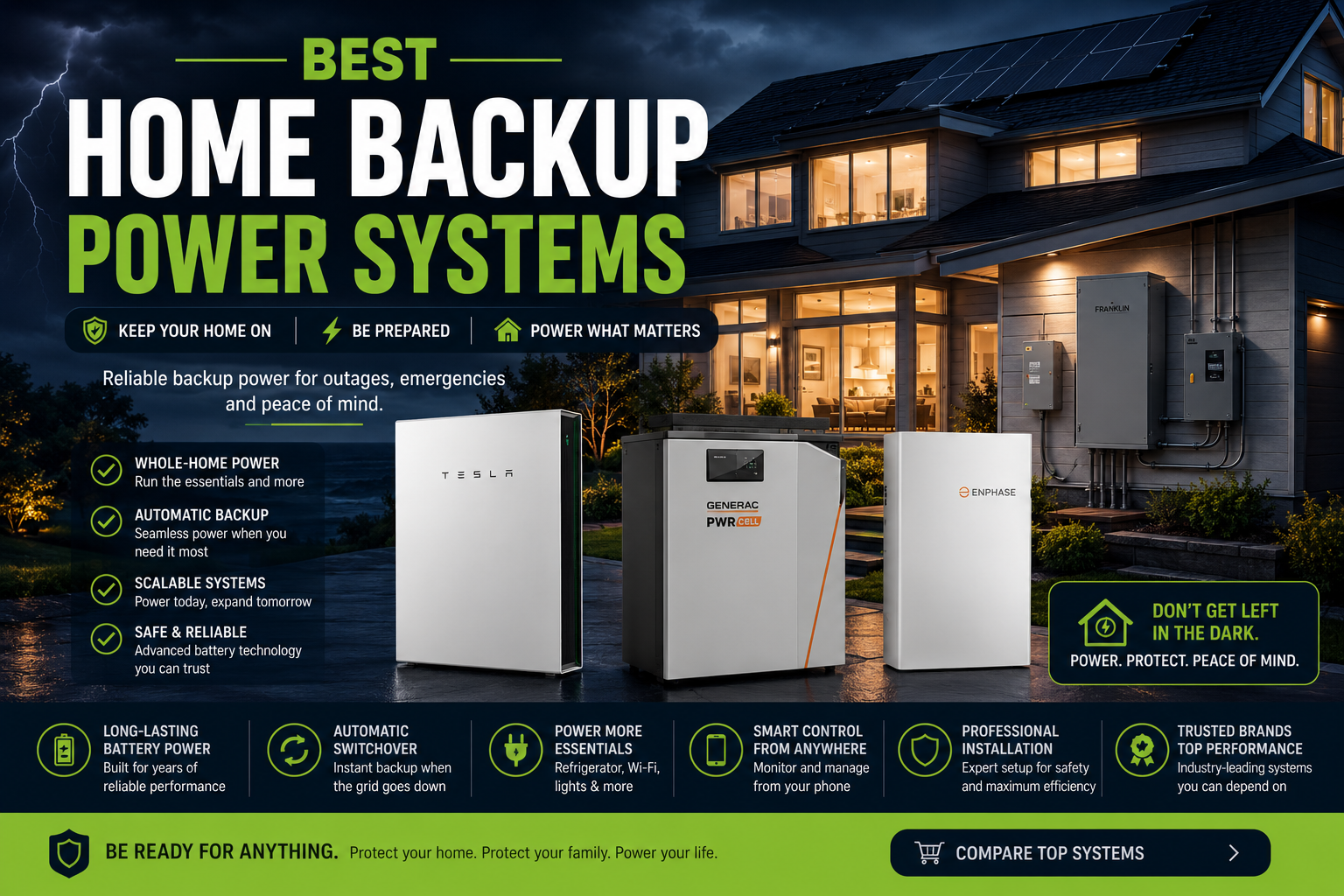
Best Home Backup Power Systems
Reliable Emergency Electricity for Outages and Whole-Home Backup
PowerGearGuide may earn a commission from qualifying purchases made through links on this page, at no extra cost to you.
Reliable Emergency Electricity for Outages and Whole-Home Backup
The best home backup power systems combine enough battery capacity for essential appliances, strong inverter output, dependable transfer performance and practical ways to recharge during a long outage. We compared expandable battery systems from EcoFlow, Anker SOLIX, BLUETTI and Jackery to identify the strongest options for whole-home circuits, refrigerators, medical equipment, apartments and emergency preparedness.
The Best Home Backup Power System for Most Homes
EcoFlow DELTA Pro Ultra is the best overall home backup system because its 6,144Wh starting capacity, 7,200W continuous output, 120V/240V support and extensive expansion options make it capable of supporting both essential circuits and larger household loads. Choose the Anker SOLIX F3800 Plus for flexible 240V backup and strong value, the BLUETTI Apex 300 for highly modular expansion, or the Jackery HomePower 3000 for a simpler compact emergency setup.
Best Home Backup Power Systems at a Glance
EcoFlow DELTA Pro Ultra
A high-output 120V/240V system with 6.1kWh starting capacity and exceptional whole-home expansion.
Anker SOLIX F3800 Plus
A flexible 3.84kWh system with 6,000W output, dual-voltage capability and strong solar input.
BLUETTI Apex 300
A scalable 120V/240V platform that can grow from compact backup to a large multi-battery installation.
Jackery HomePower 3000
A straightforward 3,072Wh system with 3,600W output for refrigerators, lights, internet and essentials.
Home Backup Power System Comparison
| System | Best For | Starting Capacity | Continuous Output | 120V/240V | Score | Shop |
|---|---|---|---|---|---|---|
| EcoFlow DELTA Pro Ultra | Whole-home capability | 6,144Wh | 7,200W | Yes | 9.7 | CHECK ECOFLOW DELTA PRO ULTRA PRICE |
| Anker SOLIX F3800 Plus | 240V value | 3,840Wh | 6,000W | Yes | 9.4 | CHECK ANKER SOLIX F3800 PLUS PRICE |
| BLUETTI Apex 300 | Modular expansion | 2,764.8Wh | 3,840W | Expandable system support | 9.2 | CHECK BLUETTI APEX 300 PRICE |
| Jackery HomePower 3000 | Compact essentials backup | 3,072Wh | 3,600W | Primarily 120V portable backup | 8.9 | CHECK JACKERY HOMEPOWER 3000 PRICE |
Specifications are based on manufacturer-published information and may vary by configuration, accessory, region or future product revision.
Best Home Battery Backup Systems Reviewed
EcoFlow DELTA Pro Ultra
The strongest all-around choice for serious whole-home battery backup.
Pros
- Highest starting capacity in this shortlist
- Strong 7,200W continuous output
- Native 120V and 240V capability
- Extensive capacity and output expansion
- LFP battery chemistry
- Suitable for smart-panel integration
Cons
- High initial system cost
- Heavy and less portable than compact systems
- Whole-home integration may require professional installation
- Expansion accessories add complexity
Anker SOLIX F3800 Plus
A powerful dual-voltage system with practical home integration and solar charging.
Pros
- Strong 6,000W output
- 120V and 240V support
- Expandable battery capacity
- High solar-input capability
- Home-panel options available
- Good balance of capability and value
Cons
- Lower starting capacity than DELTA Pro Ultra
- Heavy for frequent movement
- Full-home use requires additional hardware
- Large expansions become expensive
BLUETTI Apex 300
A flexible platform designed to scale from portable backup to large home storage.
Pros
- Highly scalable platform
- LiFePO4 battery chemistry
- Useful 3,840W base output
- Can support large multi-unit installations
- Suitable for home, RV and off-grid use
- Flexible expansion path
Cons
- Smaller base capacity than major competitors
- Large-system capability requires extra units
- Configuration choices can be complicated
- Total system cost rises quickly with expansion
Jackery HomePower 3000
A simple 3kWh-class emergency system for household essentials.
Pros
- Useful 3,072Wh capacity
- Strong 3,600W output for its size
- Fast backup transfer specification
- LiFePO4 battery chemistry
- Compact compared with larger modular systems
- Simple emergency-power role
Cons
- Less expandable than whole-home platforms
- Not the best option for large 240V loads
- Heavy despite compact footprint
- Shorter runtime under high appliance loads
Home Backup Power System Methodology
PowerGearGuide compared each system using manufacturer-published specifications, system architecture and practical emergency-use requirements. Scores reflect structured editorial evaluation rather than a claim that every system was physically laboratory-tested by PowerGearGuide. Prices change frequently and were not treated as fixed specifications.
Backup PerformanceContinuous output, surge capability, 120V/240V support and realistic appliance compatibility. Battery SystemStarting capacity, chemistry, expansion options and suitability for repeated emergency use. ChargingAC charging, solar-input capacity, generator compatibility and outage recovery flexibility. Home IntegrationTransfer behavior, panel compatibility, circuit backup options and installation complexity. UsabilityControls, portability, app support, modularity and ease of deploying the system during an outage. Overall ValueCapability, expandability and long-term usefulness relative to the system class.How to Choose a Home Backup Power System
List Essential Loads
Start with the appliances and circuits that must operate during an outage. Refrigerators, freezers, routers, lights, sump pumps, medical devices and selected outlets usually matter more than powering every room.
Separate Output From Capacity
Output in watts determines what the system can run at one time. Capacity in watt-hours determines how long it can run. A system can have enough output to start an appliance but insufficient capacity for long runtime.
Check 240V Requirements
Central air conditioners, well pumps, electric dryers and other large appliances may require 240V. Do not assume a powerful 120V station can operate them simply because its wattage appears high.
Plan for Expansion
A modular system lets you begin with essential-load coverage and add batteries later. Confirm the maximum supported battery count, whether multiple inverters can be combined and which accessories are required.
Consider Transfer Time
UPS or EPS performance matters for routers, computers and some medical equipment. Confirm the manufacturer’s transfer specification and verify that your connected device tolerates that switching time.
Size Solar Realistically
Large batteries require substantial solar arrays to recharge quickly. Panel wattage, weather, daylight hours and the system’s solar-input ceiling all affect recovery during an extended outage.
Plan Installation Early
Plug-in backup is simple, but automatic circuit backup or whole-home integration may require a transfer switch, smart panel, permits and a licensed electrician.
Prefer Long-Life Chemistry
LiFePO4 batteries are well suited to stationary backup because they generally provide long cycle life and strong thermal stability. Storage temperature and charging habits still affect long-term performance.
How Much Battery Capacity Does a Home Need?
1–2kWhPhones, internet, lights, laptops and limited small-appliance backup. 3–4kWhRefrigerator, freezer, internet, lighting, electronics and selected kitchen loads. 6–10kWhLonger essential-circuit runtime and more flexibility for pumps or intermittent heavy loads. 10kWh+Extended outages, broader circuit coverage and selected whole-home applications.Actual runtime depends on appliance efficiency, duty cycle, inverter losses and how carefully loads are managed. Electric resistance heating, water heaters, ovens and central air conditioning can consume battery energy rapidly.
Portable Backup vs Home-Panel Integration
Portable Plug-In Backup
- Lower setup complexity
- No permanent electrical modification
- Useful for renters and apartments
- Easy to move between rooms or locations
- Best for extension-cord-powered essentials
Panel-Integrated Backup
- Can support selected household circuits
- Cleaner outage operation
- May provide automatic transfer
- Often supports larger 240V loads
- Usually requires professional installation
Which Home Backup Power System Should You Buy?
EcoFlow DELTA Pro Ultra is the best overall choice for homeowners who want a powerful 120V/240V battery platform with enough capacity and expansion potential for serious whole-home backup. Anker SOLIX F3800 Plus is the strongest value-focused alternative for dual-voltage backup, while BLUETTI Apex 300 offers the most flexible gradual expansion path.
For simpler emergency coverage, Jackery HomePower 3000 provides a practical combination of capacity, output and compact size for refrigerators, lights, internet and other essential devices. The correct system is the one sized around your real loads, desired runtime and installation plan—not simply the model with the largest headline number.
Home Backup Power System FAQ
What is the best home backup power system?
EcoFlow DELTA Pro Ultra is the best overall option in this comparison because it combines 6,144Wh of starting capacity, 7,200W continuous output, 120V/240V support and extensive expansion capability. Smaller homes may be better served by a more compact 3–4kWh system.
How large should a home backup battery be?
A 3–4kWh battery can cover refrigerators, internet, lights and electronics for a useful period when loads are managed carefully. Larger 6–10kWh systems provide more flexibility, while whole-home backup may require 10kWh or substantially more.
Can a battery backup run central air conditioning?
Some high-output 120V/240V systems can run selected central air conditioners, but starting surge, compressor size, soft-start equipment, battery capacity and system configuration all matter. Confirm compatibility with the HVAC manufacturer and backup-system provider.
Can a home battery run a refrigerator overnight?
Yes. Most 2–4kWh-class systems can run an efficient refrigerator overnight, although actual runtime depends on compressor cycling, room temperature, refrigerator age and other connected loads.
Do home backup batteries need solar panels?
No. Most systems can recharge from household AC power. Solar panels become valuable during long outages because they can replenish the battery when grid power remains unavailable.
Is a home battery safer than a gas generator?
A battery system produces no combustion exhaust while operating, so it can be used indoors according to manufacturer instructions. Gas generators produce carbon monoxide and must always operate outdoors in a safe location.
Do I need an electrician to install home battery backup?
Portable plug-in use generally does not require an electrician. Connecting a battery system to household circuits, a transfer switch or a smart home panel usually requires professional installation and may require permits.
How long do LiFePO4 home batteries last?
Many LiFePO4 systems are rated for thousands of charge cycles before falling to a specified percentage of original capacity. Actual lifespan depends on temperature, depth of discharge, charging behavior and storage conditions.
Related PowerGearGuide Articles
PowerGearGuide researches portable power stations, solar generators, home batteries and emergency-power systems using manufacturer documentation, technical specifications and practical use-case analysis. We do not claim hands-on testing unless it actually occurred.