
Best Budget Portable Power Stations
A budget portable power station should be inexpensive, but it still needs a safe battery, useful inverter output and enough capacity for the devices you depend on. We compared affordable LFP models for phones, laptops, routers, lights, CPAP machines, refrigerators, camping and short emergency outages.
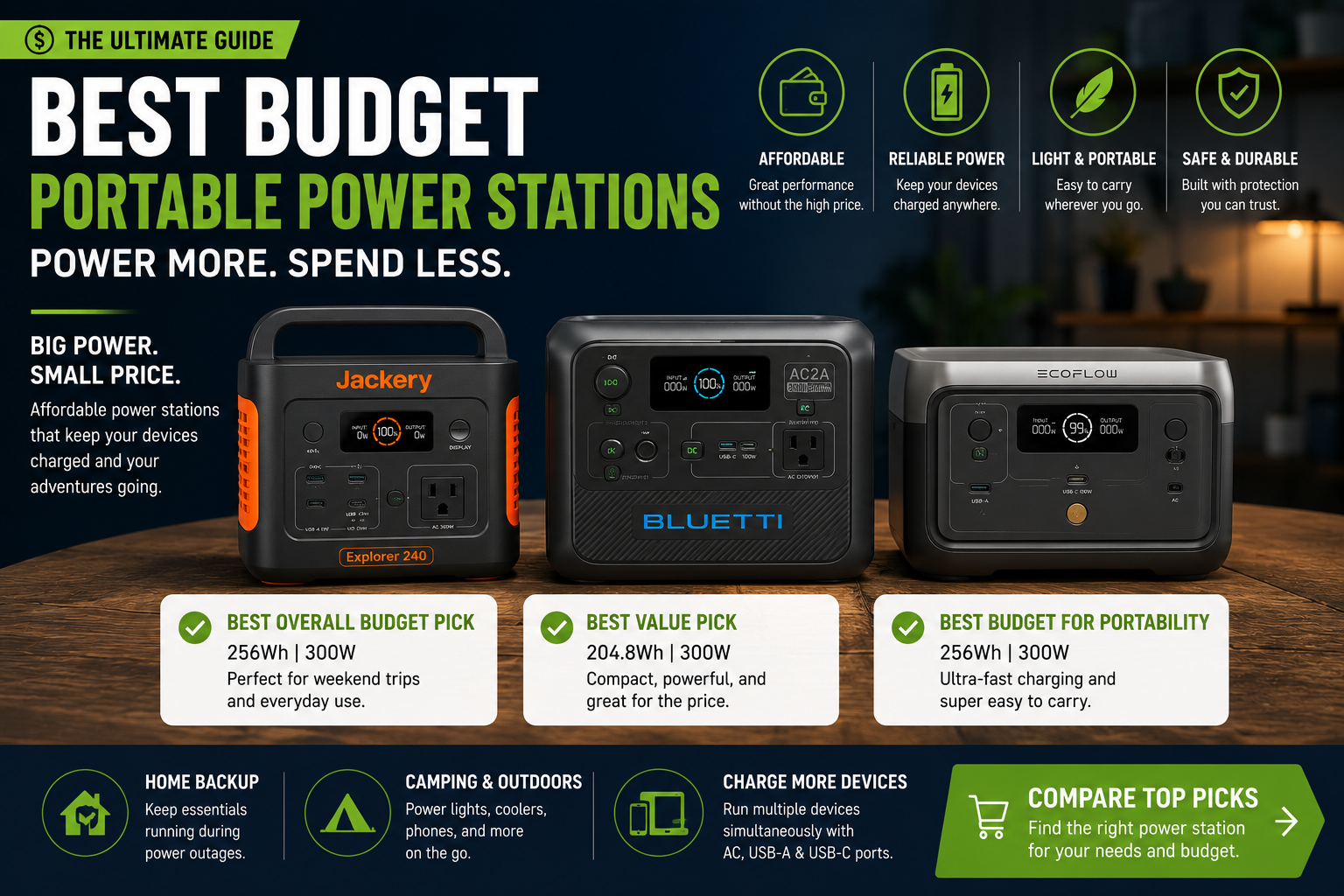
Affordable Backup Power Without Sacrificing Reliability
PowerGearGuide may earn a commission from qualifying purchases made through links on this page, at no extra cost to you.
A budget portable power station should be inexpensive, but it still needs a safe battery, useful inverter output and enough capacity for the devices you depend on. We compared affordable LFP models for phones, laptops, routers, lights, CPAP machines, refrigerators, camping and short emergency outages.
The Best Budget Portable Power Station
EcoFlow RIVER 3 Plus is the best overall budget pick because its 286Wh battery, 600W output, low weight and fast charging cover more real-world uses than most compact competitors. Choose the Jackery Explorer 600 Plus for more runtime, the BLUETTI AC70 for larger appliances, or the Anker SOLIX C300 DC for ultra-portable USB-C power.
CHECK CURRENT PRICESBest Affordable Power Stations at a Glance
EcoFlow RIVER 3 Plus
A compact 286Wh station with 600W output, fast charging and excellent everyday portability.
9.5PowerGear ScoreRead review →Anker SOLIX C300
A 288Wh portable station with dual 140W USB-C ports and fast multi-source charging.
9.3PowerGear ScoreRead review →Jackery Explorer 600 Plus
A 632Wh LFP station with 800W output and a light 16.1-pound design.
9.4PowerGear ScoreRead review →BLUETTI AC70
A 768Wh station with 1,000W output for refrigerators, tools and larger emergency loads.
9.3PowerGear ScoreRead review →EcoFlow RIVER 2
A simple 256Wh, 300W station for phones, laptops, routers, lights and emergency essentials.
9.1PowerGear ScoreRead review →Anker SOLIX C300 DC
A six-pound DC-focused battery with 288Wh capacity and 300W USB-C output.
9.0PowerGear ScoreRead review →Budget Portable Power Station Comparison
| Product | Best For | Capacity / Output | Score | Price |
|---|---|---|---|---|
| EcoFlow RIVER 3 Plus | Overall Budget Pick | 286Wh / 600W | 9.5 | CHECK ECOFLOW RIVER 3 PLUS PRICE |
| Anker SOLIX C300 | for USB-C Devices | 288Wh / 300W | 9.3 | CHECK ANKER SOLIX C300 PRICE |
| Jackery Explorer 600 Plus | Mid-Capacity Value | 632Wh / 800W | 9.4 | CHECK JACKERY EXPLORER 600 PLUS PRICE |
| BLUETTI AC70 | Budget Backup Power | 768Wh / 1,000W | 9.3 | CHECK BLUETTI AC70 PRICE |
| EcoFlow RIVER 2 | Entry-Level Choice | 256Wh / 300W | 9.1 | CHECK ECOFLOW RIVER 2 PRICE |
| Anker SOLIX C300 DC | Ultra-Portable | 288Wh / 300W DC | 9.0 | CHECK ANKER SOLIX C300 DC PRICE |
Best Budget Portable Power Stations Reviewed
EcoFlow RIVER 3 Plus
The EcoFlow RIVER 3 Plus is the best budget portable power station for most buyers because it combines strong output, compact size and useful backup features at a relatively accessible price. Its 600W inverter is enough for laptops, routers, lights, televisions, fans, camera gear and many small appliances.
The 286Wh battery is not designed for long refrigerator runtime, but it is ideal for short outages, camping and everyday emergency charging. Fast AC charging, app control and UPS-style transfer add value that many inexpensive competitors omit.
Pros
- Strong 600W output for its size
- Lightweight and easy to store
- Fast AC and solar charging
- Useful UPS and app features
Cons
- Limited runtime for large appliances
- Not suitable for high-draw cooking or heating equipment
Anker SOLIX C300
The Anker SOLIX C300 is the best budget choice for laptops, tablets, phones and other USB-C equipment. Its dual 140W USB-C ports can directly power or recharge demanding devices without relying on the AC inverter.
The 300W AC output is lower than the EcoFlow, but the station remains highly practical for travel, remote work and basic emergency charging. It can recharge from AC, solar, a vehicle or USB-C.
Pros
- Dual high-power 140W USB-C ports
- Compact and travel friendly
- Multiple charging methods
- Fast recharge time
Cons
- Only 300W AC output
- 100W solar ceiling is modest
Jackery Explorer 600 Plus
The Jackery Explorer 600 Plus is the best budget step-up for buyers who need more runtime than a 300Wh station can provide. Its 632Wh battery and 800W inverter can handle portable refrigerators, televisions, CPAP machines, laptops, lights and many modest appliances.
At roughly 16 pounds, it is unusually easy to carry for its capacity class. It also offers fast AC charging and long-life LFP cells, making it a practical middle ground between tiny entry-level units and heavier 1kWh models.
Pros
- Excellent capacity-to-weight ratio
- 800W output covers many essential loads
- Long-life LFP battery
- Fast recharge capability
Cons
- Costs more than compact 300Wh units
- Solar input is lower than some competitors
BLUETTI AC70
The BLUETTI AC70 offers the strongest appliance capability in this budget-focused lineup. Its 1,000W inverter and 768Wh battery can support refrigerators, fans, televisions, small power tools and selected kitchen appliances that exceed the limits of compact stations.
It also supports fast AC charging and substantially more solar input than most low-cost competitors. The tradeoff is size and price, but it remains a strong value for buyers who want genuine emergency-backup capability.
Pros
- 1,000W output supports larger appliances
- 768Wh capacity provides useful runtime
- Fast AC and strong solar charging
- Five-year warranty
Cons
- Heavier than compact budget models
- May exceed an entry-level budget when not discounted
EcoFlow RIVER 2
The EcoFlow RIVER 2 remains one of the easiest entry-level power stations to recommend. It is light, straightforward and fast to recharge, while the 256Wh LFP battery provides enough energy for phones, laptops, Wi-Fi equipment, lights and other low-power essentials.
Its 300W output is restrictive for appliances, but that limitation is reasonable for a small station intended primarily for electronics and short emergency use.
Pros
- Very lightweight
- Fast recharge time
- LFP battery and long warranty
- Simple and affordable
Cons
- Only 300W continuous output
- Small battery limits runtime
Anker SOLIX C300 DC
The Anker SOLIX C300 DC is the best ultra-portable budget option when AC outlets are unnecessary. It weighs just over six pounds and provides multiple USB-C and DC outputs for phones, tablets, laptops, cameras and other modern electronics.
Because it does not include a conventional AC inverter, it is more efficient and lighter for DC devices. Buyers needing household AC outlets should choose the standard C300 or EcoFlow RIVER 3 Plus instead.
Pros
- Extremely lightweight
- Dual high-power USB-C capability
- Efficient for modern electronics
- Easy to carry in a backpack or vehicle
Cons
- No standard AC outlets
- Not suitable for household appliances
How We Chose These Budget Models
We compared manufacturer-published battery capacity, inverter output, battery chemistry, weight, charging speed, solar input, outlet selection, warranty coverage and practical usefulness. Scores reflect a structured editorial comparison rather than a claim that every unit was laboratory-tested by PowerGearGuide.
Real UsabilityWhether the station can power useful electronics and appliances rather than only phones.Battery ValueCapacity, LFP chemistry and cycle-life expectations relative to price class.PortabilityWeight, size and ease of carrying or storing the unit.ChargingAC speed, solar capability, USB-C and vehicle charging options.What You Get at Different Budget Levels
Entry-Level Compact
Best for phones, laptops, routers and lights. Expect roughly 250–300Wh and 300–600W output.
Mid-Capacity Value
Models around 500–700Wh provide more useful runtime for CPAP machines, televisions and portable refrigerators.
Budget Backup
Stations near 700–800Wh with 1,000W output can support refrigerators, tools and selected household appliances.
Watch for Discounts
Portable power pricing changes frequently. A higher-capacity model on sale can be a better value than the cheapest regular-price option.
How to Choose an Affordable Power Station
Buy Enough Output
Check continuous and surge watts before buying. A large battery is not useful when the inverter cannot start your appliance.
Prioritize LFP Chemistry
LFP batteries usually provide better long-term value because they support more charge cycles than older battery chemistries.
Compare Watt-Hours
Battery capacity determines runtime. Avoid comparing models only by outlet count or peak-watt marketing claims.
Check USB-C Output
High-power USB-C can recharge modern laptops directly and efficiently without using the AC inverter.
Consider Solar Limits
Budget models often accept less solar input. Confirm panel voltage, connector type and maximum charging wattage.
Do Not Ignore Warranty
A longer manufacturer warranty can be more valuable than a small upfront saving from an unknown brand.
Which Budget Power Station Should You Buy?
The EcoFlow RIVER 3 Plus is the best overall affordable option for most buyers. The Anker SOLIX C300 is better for USB-C-heavy setups, while the Jackery Explorer 600 Plus adds meaningful runtime without becoming heavy. Choose the BLUETTI AC70 when appliance power matters most, the EcoFlow RIVER 2 for a simple entry-level station, or the Anker SOLIX C300 DC when maximum portability is the priority.
CHECK CURRENT PRICESFrequently Asked Questions
What is the best inexpensive portable power station?
The EcoFlow RIVER 3 Plus is the strongest overall budget choice for most buyers because it combines 286Wh capacity, 600W output, fast charging and a compact design.
How much should I spend on a budget power station?
Basic 250–300Wh models commonly target light electronics and short outages, while 500–800Wh units cost more but provide far better refrigerator, CPAP and appliance runtime.
Can a cheap portable power station run a refrigerator?
Some can. Compact 300Wh models may power a refrigerator briefly, but a 600–800Wh station with adequate surge output is a safer minimum for practical emergency use.
Are budget power stations safe?
Reputable LFP models with battery-management systems are generally designed with protections for overcurrent, temperature and voltage. Buyers should still follow charging, ventilation and storage instructions.
Is LiFePO4 worth it in a budget power station?
Yes. LFP batteries generally provide longer cycle life and strong thermal stability, making them preferable for frequent use and emergency storage.
Should I buy a 300Wh or 700Wh power station?
Choose 300Wh for phones, laptops, routers and lights. Choose roughly 700Wh when you need longer runtime, a refrigerator, CPAP equipment or larger appliances.
Related Portable Power Guides
We compare portable power systems, backup equipment and charging technology to help readers choose the right products for outages, travel and off-grid use.