
Best Portable Power Stations for Home Backup, Camping & Emergencies
Compare six portable power stations by battery capacity, continuous AC output, portability, charging flexibility, and the trade-offs that matter before buying.
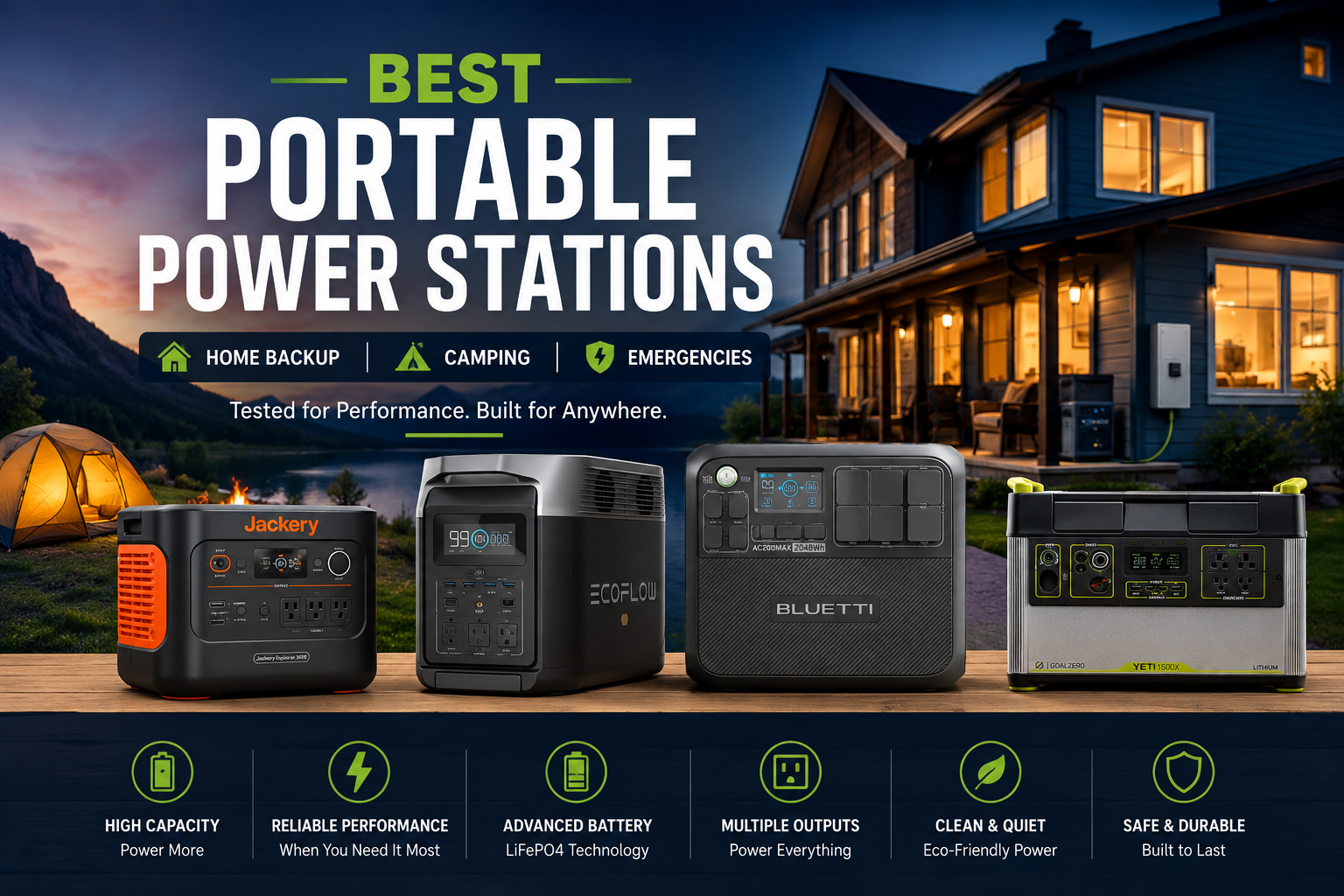
A portable power station can keep your router, laptop, lights, and other essential electronics running during an outage. It can also provide convenient battery power at a campsite or mobile workstation. But choosing the right model requires more than comparing the biggest wattage numbers.
A 1,024Wh station can be a practical portable backup for modest loads. A 4,096Wh system stores four times as much nominal energy, but brings substantially more weight, expense, and installation considerations. Neither capacity alone nor inverter wattage tells you which station is best for your needs.
Quick Answer: Which Portable Power Station Is Best?
EcoFlow DELTA 3 Plus is a versatile starting point for general portable backup. BLUETTI Elite 100 V2 is worth comparing when portability matters, while Anker SOLIX C1000 Gen 2 offers a higher continuous-output rating in the same nominal capacity class.
DJI Power 1000 V2 is particularly interesting for high-output portable applications. For larger energy reserves, consider the Jackery Explorer 2000 Plus and EcoFlow DELTA Pro 3.
These recommendations are based on published specifications and intended use cases, not independent hands-on testing. The best choice depends on your actual loads, portability requirements, and total system cost.
Best Portable Power Stations: Top Picks
Each recommendation is intended for a different type of buyer. We prioritize suitable battery capacity, continuous power, portability, expansion, and ownership limitations instead of assigning unsupported numerical scores.
EcoFlow DELTA 3 Plus
Balanced portable power for everyday backup, travel, and camping.
BLUETTI Elite 100 V2
A compact 1kWh-class station for portable work and camping.
Anker SOLIX C1000 Gen 2
Higher continuous AC output without moving to a larger battery class.
DJI Power 1000 V2
Substantial inverter output in a nominal 1,024Wh battery class.
Jackery Explorer 2000 Plus
Greater stored energy and an expandable battery platform.
EcoFlow DELTA Pro 3
High-capacity expandable power for larger household backup needs.
The buttons above open Amazon search results for the named model. Verify the exact generation, seller, specifications, included accessories, and current price before ordering.
Portable Power Station Comparison Table
Battery capacity describes nominal stored energy. Continuous AC output describes how much power a station can supply at once. A high-output model does not necessarily have longer runtime.
| Model | Capacity | AC Output | Battery | Best Fit |
|---|---|---|---|---|
| EcoFlow DELTA 3 Plus | 1,024Wh | 1,800W | LFP | Versatile portable backup |
| BLUETTI Elite 100 V2 | 1,024Wh | 1,800W | LFP | Compact transport |
| Anker SOLIX C1000 Gen 2 | 1,024Wh | 2,000W | LFP | Higher-output compact use |
| DJI Power 1000 V2 | 1,024Wh | 2,600W | LFP | Higher-power portable equipment |
| Jackery Explorer 2000 Plus | 2,042.8Wh | 3,000W | LFP | Expandable backup |
| EcoFlow DELTA Pro 3 | 4,096Wh | 4,000W | LFP | Larger home backup |
Figures are nominal manufacturer ratings, not independent measurements. Output and charging specifications can vary by region, operating conditions, and exact model variant.
Detailed Portable Power Station Reviews
1. EcoFlow DELTA 3 Plus
The EcoFlow DELTA 3 Plus is a sensible starting point for buyers who want one station for several purposes. Its 1,024Wh nominal battery and 1,800W rated continuous AC output provide a practical balance for laptops, routers, lights, small electronics, and selected household appliances.
The attraction is versatility rather than maximum energy storage. A compact 1kWh-class unit is easier to move and store than a large household backup system. That makes it relevant for weekend trips, home office continuity, and shorter outages.
The limitation is runtime under sustained heavy loads. Even when a station can run an appliance, the battery may be exhausted quickly if that appliance draws several hundred watts continuously. Check the appliance's startup requirements and the station's charging limits before deciding.
- Balanced capacity and output
- LFP battery chemistry
- Useful for several portable applications
- More manageable than large backup systems
- Limited runtime for high loads
- Not a whole-home solution
- Extra charging accessories add cost
Best for: General portable backup, camping, home office equipment, and short outages.
Check Price2. BLUETTI Elite 100 V2
The BLUETTI Elite 100 V2 competes in the 1kWh portable category with a published 1,024Wh battery and 1,800W continuous output. It is worth comparing directly against the DELTA 3 Plus if carrying convenience, physical dimensions, and charging flexibility are important.
Two stations can have the same capacity and output ratings yet differ substantially in weight, outlet arrangement, solar charging limits, noise, controls, and warranty terms. Those practical differences may matter more than a small difference in advertised specifications.
The Elite 100 V2 is not the right choice simply because its inverter can support a particular appliance. Buyers expecting extended refrigerator, heating, or other high-consumption backup should calculate their energy needs first.
- Compact 1kWh-class design
- 1,800W rated output
- LFP battery chemistry
- Relevant for camping and portable work
- Limited extended runtime
- Accessory compatibility must be checked
- Not intended for whole-home backup
Best for: Buyers prioritizing compact transport and general portable electricity.
Check Price3. Anker SOLIX C1000 Gen 2
The Anker SOLIX C1000 Gen 2 combines a nominal 1,024Wh battery with a published 2,000W continuous AC output rating. That makes it an interesting alternative when your equipment needs more continuous power than a typical 1,800W compact station provides.
The key distinction is power capability, not stored energy. For example, a high-wattage kitchen appliance may be within the station's output rating, but its energy demand can still deplete the battery rapidly. Motor-driven appliances also require separate attention to startup power.
Before purchasing, confirm that the listing is specifically for the Gen 2 model. Anker has sold multiple SOLIX C1000 variants, and similarly named products should not be assumed to share every specification or feature.
- 2,000W continuous AC rating
- Compact nominal battery class
- LFP battery chemistry
- Useful for moderately demanding equipment
- Higher output does not increase capacity
- High-wattage loads reduce runtime
- Exact model generation matters
Best for: Buyers needing higher continuous output from a portable 1kWh-class station.
Check Price4. DJI Power 1000 V2
The DJI Power 1000 V2 stands out for its published 2,600W continuous AC output paired with a nominal 1,024Wh battery. It is worth considering when the ability to operate higher-power equipment matters more than maximizing runtime.
This distinction is particularly important because DJI's original Power 1000 is a different product. Its manufacturer documentation distinguishes continuous output from higher short-duration output figures. Do not use the original model's ratings to evaluate the V2 or assume listings are interchangeable.
For camera equipment, mobile work, and portable appliances, examine the available outputs and compatible charging accessories. For home backup, calculate expected runtime before being persuaded by the high inverter rating.
- High published continuous-output rating
- 1,024Wh nominal capacity
- LFP battery chemistry
- Relevant for higher-power portable loads
- High loads exhaust 1kWh quickly
- Charging accessories vary by use case
- Original and V2 models must not be confused
Best for: Portable equipment with higher continuous power requirements, provided startup demands are compatible.
Check Price5. Jackery Explorer 2000 Plus
The Jackery Explorer 2000 Plus offers approximately twice the nominal stored energy of the 1,024Wh models in this comparison. Its published specifications include 2,042.8Wh capacity, 3,000W continuous AC output, and an expandable battery platform.
That makes it more suitable for buyers who want longer backup periods or the possibility of adding storage later. Jackery's published specifications also list a weight of approximately 61.5 pounds, a meaningful difference from compact portable stations.
Expansion is useful only if the added batteries are compatible and the complete system makes financial sense. Compare the base station, extra battery modules, solar panels, cables, and other accessories as one purchase—not as isolated prices.
Jackery now markets newer products in adjacent capacity categories, so compare the Explorer 2000 Plus with current alternatives before choosing it. The Explorer 2000 Plus should not be confused with other Jackery 2000-series models.
- More than 2kWh nominal capacity
- 3,000W continuous AC output
- Expandable battery platform
- Better suited to longer backup needs
- Substantially heavier than 1kWh models
- Expansion increases total cost
- Accessories are model-specific
Best for: Buyers who need greater stored energy and may expand their backup system.
Check Price6. EcoFlow DELTA Pro 3
The EcoFlow DELTA Pro 3 moves into a substantially larger backup category. Its nominal 4,096Wh battery and 4,000W continuous output make it relevant for households seeking to maintain selected essential appliances during outages.
Its advantage is the combination of more stored energy, substantial inverter capacity, and expansion potential. That can be useful when backup plans include refrigeration, internet equipment, lighting, and other important loads over a longer period.
However, a large power station is not automatically a whole-home generator replacement. The electrical requirements of connected appliances, total usable energy, charging opportunities, and installation method all matter. A high-capacity battery can still be exhausted quickly by sustained heating or cooling loads.
Connecting a portable battery system to household circuits requires suitable equipment and appropriate installation. Never attempt to energize household wiring through an improvised backfeed connection.
- 4,096Wh nominal capacity
- 4,000W continuous AC output
- Expandable backup potential
- More appropriate for larger household needs
- Large and heavy
- Higher overall system cost
- Home integration requires careful planning
Best for: Larger emergency backup requirements and expandable household systems.
Check PriceHow Long Will a Portable Power Station Last?
Runtime depends primarily on available battery energy and the average power drawn by connected devices. Continuous inverter output determines whether the station can support a load; battery capacity helps determine how long it can run.
Runtime (hours) = Battery capacity (Wh) × assumed usable-energy fraction ÷ average load (W)
The estimates below assume 85% of nominal battery capacity is available to the connected load. This is a planning assumption, not a measured efficiency result for any particular station. Real performance varies with load, inverter losses, temperature, standby consumption, and battery condition.
| Battery Capacity | 50W Load | 100W Load | 200W Load | 500W Load |
|---|---|---|---|---|
| 1,024Wh | 17.4 hours | 8.7 hours | 4.4 hours | 1.7 hours |
| 2,042.8Wh | 34.7 hours | 17.4 hours | 8.7 hours | 3.5 hours |
| 4,096Wh | 69.6 hours | 34.8 hours | 17.4 hours | 7.0 hours |
Rounded illustrative estimates assume constant average loads. Low-load inverter overhead and other real-world losses can make actual results shorter, especially for small loads.
Can a Portable Power Station Run a Refrigerator?
Many portable stations can operate compatible refrigerators, but two different requirements matter: compressor startup power and average energy consumption.
If a refrigerator averages 75W over time, a 1,024Wh battery would provide approximately 11.6 hours under the illustrative 85% assumption. Actual results depend on refrigerator efficiency, ambient temperature, compressor cycling, door openings, and other factors.
Do not size a refrigerator backup system using average watts alone. Check the refrigerator's startup demand and the station's supported surge behavior.
What About a 1,500W Appliance?
A continuous 1,500W load would use the illustrative 870Wh available from a 1,024Wh station in approximately 35 minutes. The station must also be capable of supplying the appliance's running and startup power.
This is why a higher inverter rating does not necessarily make a 1kWh battery a good choice for prolonged electric heating or cooking.
For more detailed estimates, use our power runtime calculator.
How to Choose a Portable Power Station
1. Calculate Your Energy Needs
List the equipment you want to power, its average running wattage, and how many hours it needs to operate. Multiply watts by hours to estimate energy consumption in watt-hours. Add a reasonable allowance for conversion losses and uncertainty.
2. Understand Watts vs. Watt-Hours
Watts (W) describe the rate of power consumption or delivery. Watt-hours (Wh) describe stored or consumed energy. You need sufficient inverter output to operate your equipment and sufficient battery capacity to run it for the desired duration.
3. Check Startup Power
Refrigerators, pumps, compressors, and other motor-driven appliances may draw substantially more power when starting than during normal operation. Check the station's continuous and surge specifications and the appliance's requirements.
4. Compare Battery Chemistry and Longevity
All six models discussed here use lithium iron phosphate (LFP) battery chemistry. Battery longevity still depends on charging behavior, temperature, cycle use, battery management, and manufacturer operating limits.
5. Evaluate Charging Speed
Compare supported AC charging input and the conditions under which advertised recharge times apply. Some fast-charging claims depend on specific settings, battery temperature, or operating modes.
6. Check Solar Charging Compatibility
Solar compatibility depends on input voltage, current, maximum supported power, connectors, and charging-controller limits. Panel nameplate wattage is not a guarantee of real charging output.
7. Consider Weight and Dimensions
A power station that works well in a garage may be awkward at a campsite. Check actual dimensions, carrying handles, weight, and where you plan to store and charge it.
8. Decide Whether Expansion Matters
Expansion batteries can increase stored energy, but compatibility is usually specific to the model or product family. Compare the cost of the complete system against purchasing a larger station from the beginning.
9. Review Warranty and Support
Check warranty duration, exclusions, seller requirements, registration rules, replacement arrangements, and customer support. A warranty advertised for one sales channel may not apply identically to every third-party listing.
10. Understand UPS and EPS Functions
Some portable stations provide automatic transfer to battery power during a grid outage. Transfer times and operating behavior vary. Do not assume every computer, server, or medical device can tolerate the interruption. Verify compatibility and use purpose-built equipment where uninterrupted power is critical.
11. Plan Safe Home Integration
Plugging equipment directly into a station is different from connecting a backup source to household circuits. Electrical integration requires suitable equipment, appropriate protection, and qualified installation. Never connect a station to home wiring through an improvised backfeed arrangement.
For additional help, see our portable power station buying guide and power station sizing calculator.
Which Power Station Fits Your Situation?
Portable Power Station vs. Gas Generator
Battery power stations and fuel-powered generators serve different needs. A battery station provides electricity without producing combustion exhaust during normal operation, making it convenient for indoor electronics backup when used according to the manufacturer's instructions.
Fuel generators can provide extended electricity while suitable fuel is available, but require safe outdoor placement, maintenance, and appropriate electrical connections.
Never operate a fuel-burning generator indoors, inside a garage, or in an enclosed or partially enclosed space. Carbon monoxide exposure can be fatal. Never backfeed household wiring through an improvised connection.
Read our portable power station vs. generator comparison for a more detailed breakdown.
Before You Buy: Confirm the Exact Model
Portable power station product names can be confusing. Different generations and similarly named products may have different inverter ratings, charging features, battery capacities, and accessory compatibility.
The Check Price buttons in this guide open Amazon search results for the named products. They are not verified links to individual product listings. Before purchasing, confirm the exact model and generation, seller, warranty eligibility, included accessories, and current price.
Pay particular attention to DJI Power 1000 vs. Power 1000 V2, Anker SOLIX C1000 vs. C1000 Gen 2, and the different products in Jackery's 2000-series lineup.
Frequently Asked Questions
What is the best portable power station overall?
There is no universal winner. The EcoFlow DELTA 3 Plus is a versatile compact option, but buyers needing higher output, greater portability, or longer backup may prefer another model.
Is 1,000Wh enough for home backup?
A 1,000Wh-class station may support selected essentials for a limited time. It is generally not enough for sustained whole-home electricity.
Can a portable power station run a refrigerator?
Many can run compatible refrigerators. Check compressor startup requirements and actual energy consumption, not just the refrigerator's average wattage.
How many watts do I need for camping?
It depends on your equipment. Phones, laptops, and lights generally require much less power than electric cooking, heating, or air conditioning. Calculate both peak power and total watt-hours.
Can I recharge a portable power station with solar panels?
Many models support compatible solar charging. Check voltage, current, connectors, and maximum input limits before connecting panels.
Are battery power stations safe indoors?
Battery stations do not produce combustion exhaust during normal operation, but must still be used according to the manufacturer's ventilation, charging, temperature, and electrical safety instructions.
Can a portable power station replace a UPS?
Only when its transfer time, output behavior, and other specifications are compatible with the connected equipment. Critical devices may require a purpose-built UPS.
Does higher inverter output mean longer runtime?
No. Inverter output determines how much power the station can supply at once. Battery capacity and the connected load determine approximate runtime.
Are expandable power stations worth buying?
They can be useful if backup requirements may grow, but compare compatible expansion batteries and total system cost before purchasing.
How We Evaluate Portable Power Stations
Power Gear Guide evaluates portable power equipment using published manufacturer specifications, technical documentation, feature comparisons, and practical use-case analysis.
Our criteria include nominal battery capacity, continuous AC output, charging flexibility, portability, expansion options, warranty considerations, and meaningful limitations. We do not present manufacturer specifications as independent measurements or claim hands-on testing that has not been performed.
Product specifications, generations, accessories, and availability can change. Verify the exact product details before purchasing.
Manufacturer Research Resources
Use the following manufacturer websites to confirm the current documentation and exact model variant:
Related Portable Power Guides
Continue with a guide focused on your particular backup requirements, camping setup, or sizing questions.
Final Verdict
For versatile portable backup, start by comparing the EcoFlow DELTA 3 Plus, BLUETTI Elite 100 V2, and Anker SOLIX C1000 Gen 2. They occupy a similar nominal capacity class, but their output ratings and practical features differ.
The DJI Power 1000 V2 is worth considering when higher continuous AC output is important. For more stored energy, compare the Jackery Explorer 2000 Plus and EcoFlow DELTA Pro 3.
The right purchase is the station that safely supports your equipment, provides enough usable energy for the intended duration, fits your transportation and storage needs, and makes sense at its total system cost.