
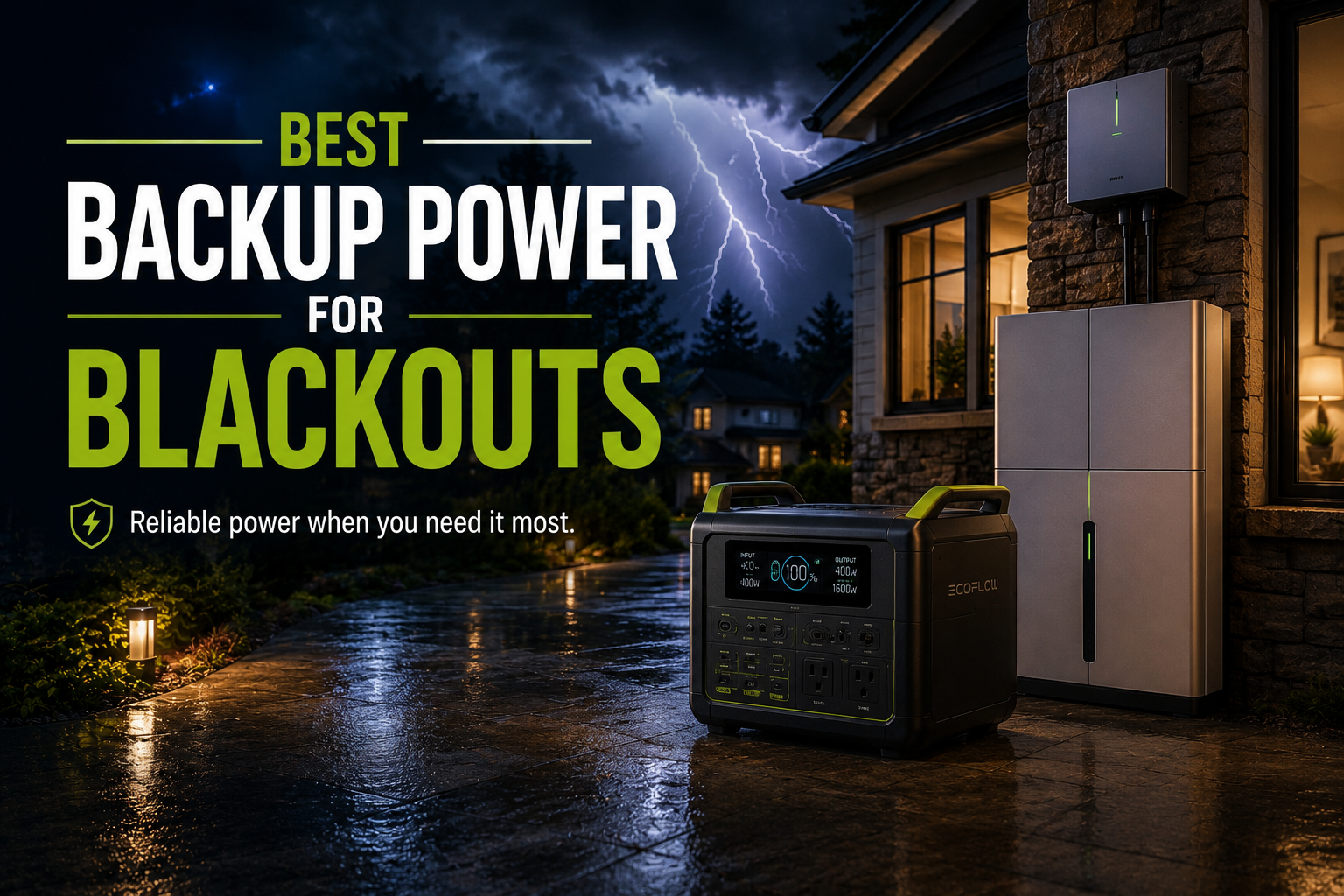
Best Backup Power for Blackouts
The right blackout backup system depends on what must stay powered, how long outages usually last and whether you want silent battery operation, fuel-supported runtime or automatic whole-home protection.
A short outage may only require enough power for a refrigerator, Wi-Fi equipment, lights and phone charging. A multi-day emergency can demand central HVAC, pumps, medical equipment and a dependable way to replenish energy after the initial battery or fuel supply is used.
This guide compares five distinct backup approaches, from expandable whole-home batteries and automatic standby generators to portable indoor-safe power stations and compact gasoline inverter generators.
EcoFlow DELTA Pro Ultra Is Our Best Overall Blackout Backup System
It starts with 6.1 kWh of LFP storage and 7.2 kW of 120/240V output, then scales to as much as 90 kWh and 21.6 kW. Tesla Powerwall 3 is the best permanent home battery, while Generac Guardian 26kW is the stronger option for long fuel-supported outages.
Editor's Verdict
Choose EcoFlow DELTA Pro Ultra for the most flexible path from essential-load backup to broader whole-home power. Choose Tesla Powerwall 3 for seamless permanent battery integration, Generac Guardian 26kW for extended whole-home runtime, EcoFlow DELTA 2 Max for portable indoor backup and Honda EU2200i for compact fuel-powered essentials.
Editor's Shortlist
EcoFlow DELTA Pro Ultra
Expandable 120/240V battery platform for essential or whole-home backup.
Tesla Powerwall 3
Automatic home battery with integrated solar inverter and strong software.
Generac Guardian 26kW
High-output automatic generator for multi-day whole-home outages.
EcoFlow DELTA 2 Max
Indoor-safe 2-kWh LFP backup for refrigerators and essential electronics.
Honda EU2200i
Compact inverter generator with dependable fuel-supported runtime.
Backup Power Comparison
| System | Capacity or Fuel | Continuous Output | Automatic Backup | Indoor Operation | Best For |
|---|---|---|---|---|---|
| EcoFlow DELTA Pro Ultra | 6.1–90 kWh | 7.2–21.6 kW | With Smart Home Panel 2 | Yes | Best Overall |
| Tesla Powerwall 3 | 13.5 kWh per unit | Up to 11.5 kW | Yes | Yes | Permanent home battery |
| Generac Guardian 26kW | Natural gas or propane | 26 kW | Yes | No | Long whole-home outages |
| EcoFlow DELTA 2 Max | 2,048 Wh | 2,400 W | Limited/optional integration | Yes | Portable indoor essentials |
| Honda EU2200i | 0.95-gallon gasoline tank | 1,800 W rated | No | No | Portable fuel-powered backup |
What We Looked for in Blackout Backup Power
Essential-Load Capability
Enough output for refrigeration, communications, lighting, medical devices and pumps.
Runtime Strategy
Practical stored energy, fuel supply or recharging options for realistic outage durations.
Startup Surge
Ability to handle compressors, pumps and other motor-driven equipment.
Automatic Operation
Fast transfer and reliable startup when nobody is available to connect equipment.
Expansion Path
Options to add battery capacity, inverter output or parallel generation later.
Safety and Installation
Indoor suitability, exhaust requirements, transfer equipment and code-compliant integration.
1. EcoFlow DELTA Pro Ultra
A scalable LFP platform that bridges portable backup and whole-home integration.
DELTA Pro Ultra earns the top position because it can begin as a powerful standalone backup source and expand into a substantially larger home-energy system. One inverter and battery provide 6.1 kWh of storage and 7.2 kW of output, while larger configurations can reach 90 kWh and 21.6 kW.
With Smart Home Panel 2, the system can provide circuit-level backup and automatic transfer. It also supports solar and generator-assisted charging, which improves resilience during longer outages.
Why It Stands Out
- 6.1-to-90-kWh expansion range
- 7.2-to-21.6-kW output range
- 120/240V operation
- LFP battery chemistry
- Solar and generator charging support
- Smart Home Panel integration
What to Consider
- Premium initial price
- Large systems require significant space
- Whole-home integration needs electrical work
- Five-year warranty is shorter than some fixed batteries
Best for: homeowners wanting a flexible system that can grow from appliance backup to broader home coverage.
2. Tesla Powerwall 3
A permanent 13.5-kWh home battery with automatic backup and an integrated solar inverter.
Powerwall 3 is the strongest choice for homeowners who want a permanently installed battery that transitions automatically during a utility outage. Its integrated solar inverter can simplify many new solar-plus-storage projects, while the Tesla app provides clear energy and backup monitoring.
Each unit stores 13.5 kWh, and approved U.S. configurations offer nominal AC output settings up to 11.5 kW. Expansion units add another 13.5 kWh each when longer backup duration is required.
Why It Stands Out
- Automatic outage transfer
- Integrated solar inverter
- Strong app monitoring
- Expandable energy storage
- Quiet operation
- Established residential ecosystem
What to Consider
- Professional installation required
- Installed cost varies by property
- One unit may not cover high-demand homes
- Best value often comes with solar
Best for: seamless automatic backup, solar integration and homeowners who want a permanent battery system.
3. Generac Guardian 26kW
A permanently installed automatic generator for high-demand and multi-day outages.
The Guardian 26kW is the best choice for extended outages when the goal is to keep a large portion of the home operating for as long as fuel remains available. With an automatic transfer switch, it detects the outage, starts itself and supplies the selected circuits without manual cable changes.
Its 26-kW output can support demanding household loads when the system is correctly sized. Actual coverage depends on fuel type, simultaneous demand, electrical service and the installation design.
Why It Stands Out
- High whole-home output
- Automatic outage startup
- Extended fuel-supported runtime
- Natural-gas and propane compatibility
- Suitable for HVAC and pumps
- Established installer network
What to Consider
- Outdoor installation only
- Produces noise and exhaust
- Needs regular maintenance
- Fuel use rises with load
- Installed cost can be substantial
Best for: large homes, multi-day outages, central HVAC, well pumps and continuous fuel-supported operation.
4. EcoFlow DELTA 2 Max
A 2,048-Wh LFP power station with 2,400W output and expandable storage.
DELTA 2 Max is the most practical option for renters, apartments and households that want indoor-safe backup without permanent installation. It can support refrigeration, Wi-Fi, lighting, televisions, laptops and many small appliances from built-in outlets.
The 2,400W inverter handles a broad range of emergency loads, while compatible extra batteries extend runtime. Heavy heating and cooling loads will still deplete the battery quickly.
Why It Stands Out
- Indoor-safe operation
- 2,400W continuous output
- Long-life LFP chemistry
- Expandable capacity
- Fast wall and solar charging
- Useful app controls
What to Consider
- Base battery is limited for long outages
- No native 240V output
- Electric heaters drain it quickly
- Not a complete whole-home solution
Best for: refrigeration, communications, medical devices and essential indoor backup without permanent installation.
5. Honda EU2200i
A compact inverter generator known for dependable essential-load power and low operating noise.
The EU2200i is a trusted portable inverter generator for refrigerators, freezers, lights, internet equipment and selected small appliances. Its inverter output is suitable for sensitive electronics, while Eco Throttle improves efficiency under lighter loads.
It is not a whole-home generator, but it is compact, relatively quiet and effective when emergency loads are carefully managed. A compatible companion unit can be added for parallel operation.
Why It Stands Out
- Strong reliability reputation
- Quiet inverter design
- Stable power for electronics
- Fuel-efficient operation
- Compact and portable
- Parallel capability
What to Consider
- Must operate outdoors
- Requires gasoline storage
- Limited 1,800W rated output
- No direct 240V support
- Manual startup and maintenance
Best for: compact fuel-powered backup for refrigeration, electronics and essential 120V loads.
How to Choose the Best Backup Power for Blackouts
The best system depends on the equipment you must keep operating, the duration of likely outages and whether you prefer permanent automatic protection or a portable solution.
1. List Critical Loads
Prioritize refrigeration, communications, medical equipment, lighting, pumps and essential heating or cooling.
2. Add Running Wattage
Total the normal wattage of everything that may operate at the same time.
3. Include Startup Surge
Compressors, pumps and motors may need several times their running power for a few seconds.
4. Estimate Outage Duration
Batteries are excellent for quiet short-to-moderate outages; generators are stronger for extended emergencies.
5. Plan Recharging or Fuel
Confirm solar input, generator charging, gasoline storage, propane capacity or natural-gas availability.
6. Consider Expansion
Future HVAC, EV charging or larger homes can increase both energy and output needs.
Battery Backup vs Generator During Blackouts
| Feature | Battery Backup | Generator |
|---|---|---|
| Noise | Nearly silent | Engine noise |
| Fuel | No fuel during discharge | Gasoline, propane or natural gas |
| Indoor operation | Yes | No |
| Maintenance | Low | Regular engine service |
| Long outages | Limited by stored energy | Runs while fuel is available |
| Solar charging | Often supported | Not directly |
How Much Backup Power Do You Need?
| Appliance | Typical Running Watts | Possible Starting Surge |
|---|---|---|
| Refrigerator | 150–800 W | 1,200–2,200 W |
| Wi-Fi and modem | 20–60 W | Minimal |
| Sump pump | 800–1,500 W | 2,000–4,000 W |
| Well pump | 1,000–2,000 W | 3,000–6,000 W |
| Portable air conditioner | 900–1,500 W | 2,000–3,000 W |
| Central air conditioner | 3,000–6,000 W | 6,000–10,000+ W |
Common Backup Power Buying Mistakes
Buying Capacity Without Output
A large battery can still fail to start a pump or air conditioner if inverter output is too low.
Ignoring Surge Loads
Motor startup demand can exceed running wattage by several times.
Using a Generator Indoors
Portable generators must remain outside and away from doors, windows and vents.
Skipping Transfer Equipment
Household circuits require approved transfer equipment and code-compliant installation.
Underestimating Fuel Needs
Long outages can consume more gasoline or propane than expected.
Planning Only for Today
Future electric appliances and HVAC upgrades can increase backup demand.
Final Recommendation
EcoFlow DELTA Pro Ultra is the strongest overall option because it combines 120/240V output, substantial expansion and multiple charging paths. Generac Guardian 26kW is better for long fuel-supported whole-home outages, while Tesla Powerwall 3 is the best permanent battery for automatic solar-integrated backup.
Frequently Asked Questions
What is the best backup power source for blackouts?
EcoFlow DELTA Pro Ultra is our best overall choice because it combines strong 120/240V output, modular LFP storage and an expansion path from 6.1 to 90 kWh.
Are batteries better than generators?
Batteries are quieter, indoor-safe and low maintenance. Generators are stronger for long outages because they continue operating while fuel remains available.
Can a battery power an entire house?
Large systems can support much of a home, but capability depends on inverter output, battery capacity, startup surges and load management.
How long will a home battery last?
Runtime equals usable capacity divided by average load, after allowing for conversion losses, reserves and changing appliance demand.
Can solar panels recharge batteries during an outage?
Yes, when the solar, inverter, battery and control equipment support islanded backup operation.
Can I use a portable generator indoors?
No. Portable generators produce carbon monoxide and must operate outside, well away from doors, windows and vents.
Which backup system is best for apartments?
A portable battery power station is generally the safest and most practical choice because it requires no combustion fuel and can operate indoors.
What should I power first during an outage?
Prioritize refrigeration, communications, medical devices, lighting and essential heating or cooling.
Do standby generators require maintenance?
Yes. They require scheduled testing, oil and filter service, battery inspection and fuel-system maintenance.
Is a hybrid battery-generator system worthwhile?
It can be. The battery provides silent overnight operation while the generator supplies heavy loads or recharges the battery during a prolonged outage.