
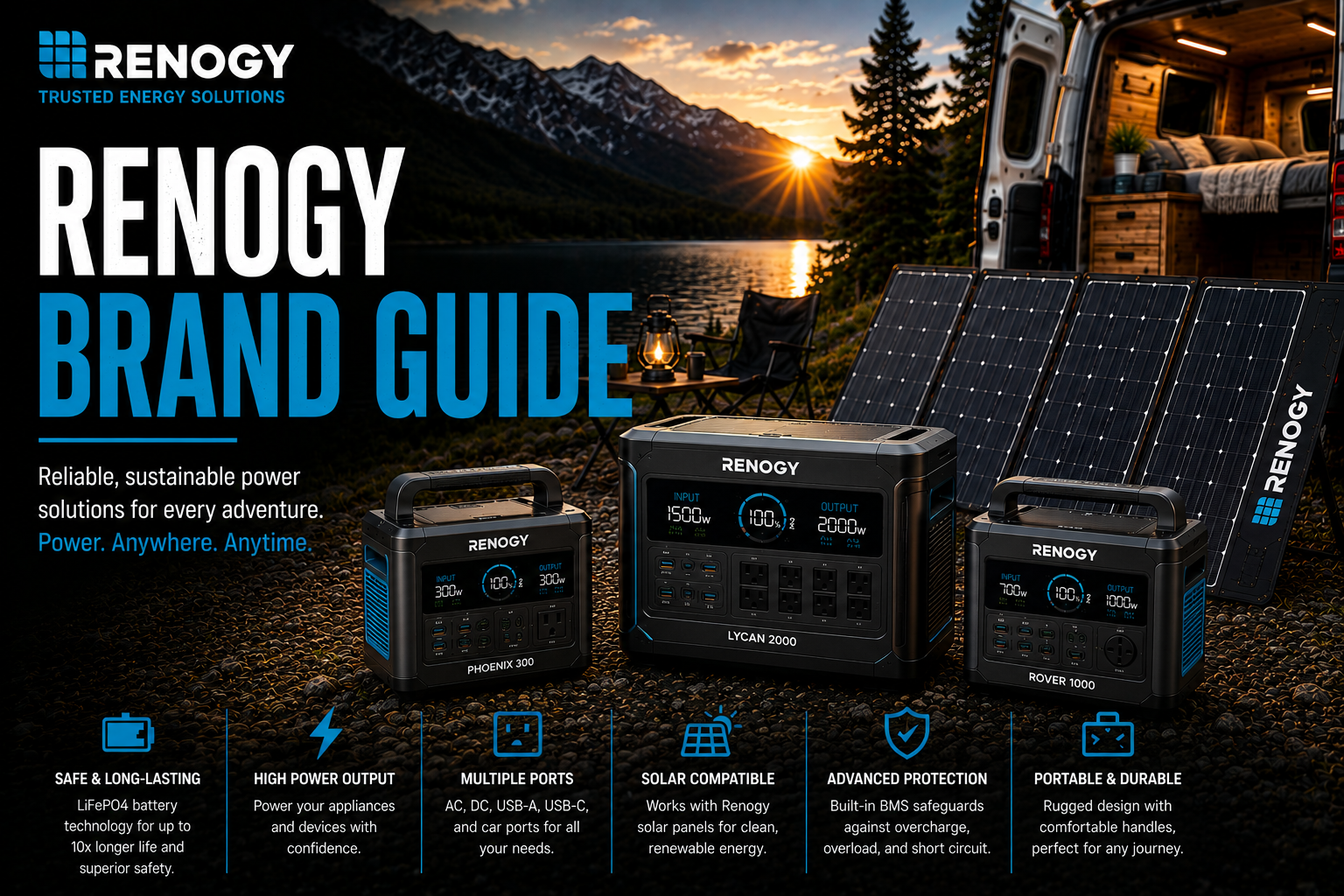
Are Renogy Products Worth It?
Renogy is worth considering for RV, solar and off-grid buyers who value a broad component ecosystem, while portable-station buyers should compare availability and expansion limitations.
Renogy’s value is strongest when multiple parts of the ecosystem are used together.
The brand is less compelling when a simple consumer expansion platform is the only goal.
Worth It for RV and Solar System Builders
PowerStation 2000 is the strongest current all-in-one value; REGO is valuable only for buyers ready to design a permanent system.
Editor's Verdict
Renogy is worth buying when solar, RV and DIY integration matter more than a single polished portable ecosystem.
Why Renogy Can Be Worth It
Broad Solar Catalog
Panels, controllers and batteries.
RV Integration
TT-30 and REGO.
LFP Flagships
PowerStation 2000 and PHOENIX 1000.
DIY Flexibility
Build custom systems.
App Monitoring
Selected products.
Current 2kWh Value
PowerStation 2000 pricing is competitive.
Reasons to Consider Alternatives
Fragmented Product Types
Portable vs REGO vs DIY.
Variable Availability
Older PHOENIX models.
No Simple Expansion Packs
For current stations.
Technical Complexity
DIY systems need expertise.
No Native Portable 240V
Limits large loads.
Support Experience Varies
Complex catalog.
Best Buyers
RV Owners
Use TT-30 or REGO.
Solar DIY Users
Broad component choice.
Campers
PHOENIX line.
Home Backup Buyers
PowerStation 2000.
System Builders
Batteries and inverters.
Not App-Only Buyers
EcoFlow may be simpler.
Frequently Asked Questions
Who should buy Renogy products?
Buy it when Renogy’s solar, RV and battery ecosystem matches the way you intend to build or recharge the system.
Who should skip Renogy products?
Skip it when you need the simplest consumer ecosystem, native 240V or a broad plug-in expansion-battery family.
How should Renogy runtime be estimated?
Multiply rated watt-hours by roughly 0.80 to 0.90 for usable AC energy, then divide by average load watts.
Can Renogy run a refrigerator?
PHOENIX 1000 and PowerStation 2000 can generally run common refrigerators when startup remains within inverter limits.
Can third-party solar panels be used?
Yes, when voltage, current, polarity and connectors match the exact station or charge controller.
Is REGO a portable power station?
No. REGO is a modular 12V RV and off-grid electrical system.
Are Renogy portable stations expandable?
The current portable stations do not use a broad consumer plug-in battery ecosystem comparable with some rivals.
Does Renogy offer app control?
PowerStation 2000 and selected PHOENIX/REGO devices support Renogy app monitoring or Bluetooth-connected components.
How should Renogy equipment be stored?
Keep it cool, dry and ventilated and follow the exact battery or station storage schedule.
What is the biggest Renogy buying mistake?
Confusing a portable station with a modular REGO or DIY battery system and assuming the components are interchangeable.
Is Renogy good for beginners?
Portable stations are beginner-friendly; REGO and DIY systems require more knowledge.
Is PowerStation 2000 good value?
Its 2,048Wh/2,400W specification and TT-30 outlet are competitive when available.