
Renogy Portable Power Station Buying Guide
Choose Renogy by architecture first: portable all-in-one station, compact camping battery or permanent REGO RV system.
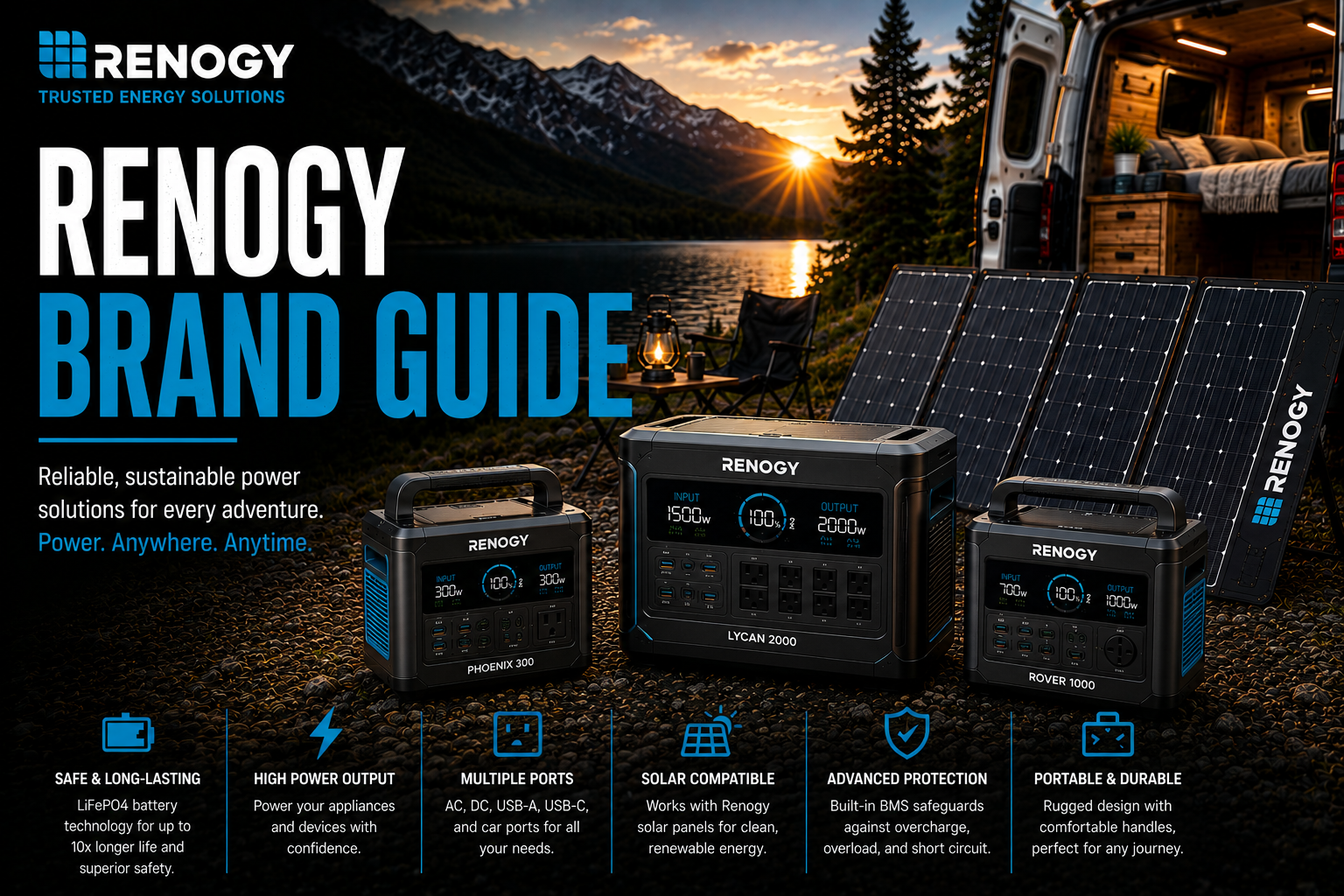
Choose Renogy by architecture first: portable all-in-one station, compact camping battery or permanent REGO RV system.
Renogy offers more system flexibility than most brands, but that makes product selection more technical.
This guide explains capacity, charging, solar and installation tradeoffs.
Choose Portable for Simplicity and REGO for Customization
PowerStation 2000 is the safest general purchase; REGO is best only when a permanent system is the goal.
Buying Guidance
Match the product architecture to the project before comparing watt-hours.
Choose the Architecture First
| Need | Best Renogy Option | Why |
|---|---|---|
| Plug-and-play 2kWh | PowerStation 2000 | All-in-one with TT-30 |
| Portable 1kWh | PHOENIX 1000 | High output LFP |
| Compact camping | PHOENIX 500 | 800W mid-size |
| Electronics only | Power Station 200 | Very light |
| Permanent RV | REGO | Modular and serviceable |
Solar and Charging
PowerStation 2000 accepts up to 1,200W DC input. PHOENIX products pair with E.FLEX 120W/220W panels. REGO systems can combine dedicated MPPT and alternator charging.
REGO Installation
REGO systems require correct cable sizing, fusing, disconnects, ventilation, grounding/bonding decisions and manufacturer-approved communication wiring. Permanent installation should follow ABYC, RVIA, NEC and local requirements as applicable.
Common Buying Mistakes
Confusing REGO with a Station
Different architectures.
Ignoring Solar Voltage
Match input limits.
Assuming Expansion
Portable stations are mostly fixed.
Buying Older Chemistry
PHOENIX 500 is lithium-ion.
Skipping RV Load Planning
TT-30 is limited to station output.
DIY Wiring Without Protection
Use fuses and disconnects.
Frequently Asked Questions
Who should buy a Renogy system?
Buy it when Renogy’s solar, RV and battery ecosystem matches the way you intend to build or recharge the system.
Who should skip a Renogy system?
Skip it when you need the simplest consumer ecosystem, native 240V or a broad plug-in expansion-battery family.
How should Renogy runtime be estimated?
Multiply rated watt-hours by roughly 0.80 to 0.90 for usable AC energy, then divide by average load watts.
Can Renogy run a refrigerator?
PHOENIX 1000 and PowerStation 2000 can generally run common refrigerators when startup remains within inverter limits.
Can third-party solar panels be used?
Yes, when voltage, current, polarity and connectors match the exact station or charge controller.
Is REGO a portable power station?
No. REGO is a modular 12V RV and off-grid electrical system.
Are Renogy portable stations expandable?
The current portable stations do not use a broad consumer plug-in battery ecosystem comparable with some rivals.
Does Renogy offer app control?
PowerStation 2000 and selected PHOENIX/REGO devices support Renogy app monitoring or Bluetooth-connected components.
How should Renogy equipment be stored?
Keep it cool, dry and ventilated and follow the exact battery or station storage schedule.
What is the biggest Renogy buying mistake?
Confusing a portable station with a modular REGO or DIY battery system and assuming the components are interchangeable.
Which station has a TT-30 outlet?
PowerStation 2000.
Which Renogy system charges from an alternator?
REGO can use compatible DC-DC charging components.