
Renogy Portable Power Stations for Backup Power: Which Size Fits Your Outage Plan?
Compare three very different Renogy options by their actual backup role: small-device charging, legacy mid-size equipment, and a documented 2,048Wh household-essentials station.
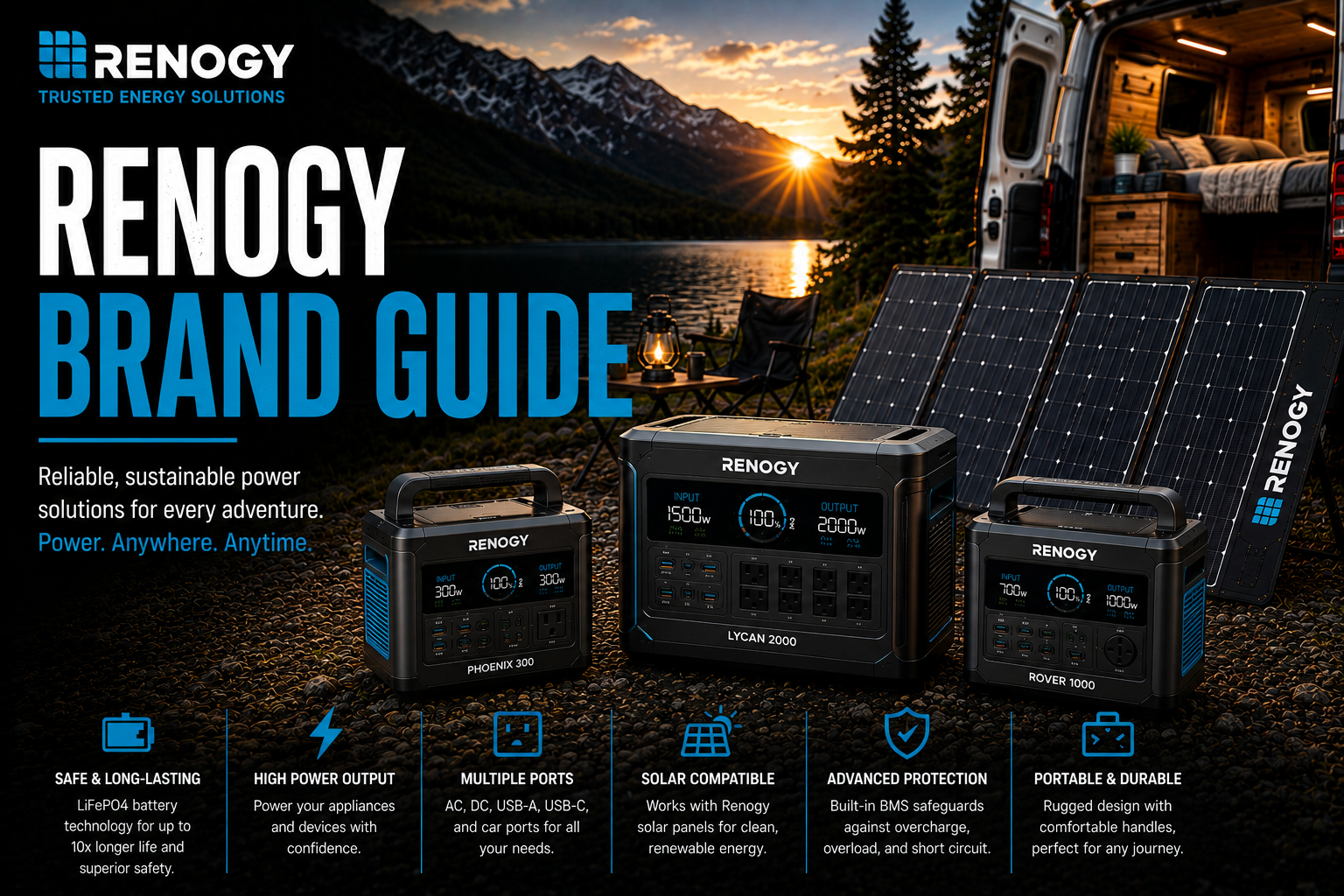
We checked Renogy product pages, manuals and support references. Numerical specifications are quoted only where a model-specific manufacturer source supports them. The PHOENIX 1000 family is treated cautiously because its exact variant specifications were not independently resolved.
Choose by Outage Load, Not by Model Name
For phones and lights: a small station can be sufficient. For refrigerator and essential-home backup: prioritize a documented high-output inverter and a larger battery. For older PHOENIX models: verify the exact SKU, output waveform, battery condition and manual before buying.
Renogy Backup Power: Quick Picks by Use Case
Renogy PHOENIX 200
The older PHOENIX 200 is a compact charging and low-power device option, not a refrigerator or household-appliance backup system. Its 200W modified-sine-wave AC output is a major compatibility limitation f.
Battery: 189Wh · Role: Phones, radios, low-wattage lights
Renogy PHOENIX 1000
PHOENIX 1000 is a model-family name that appears in Renogy support material. Do not assume every marketplace listing represents the same generation, battery chemistry, inverter rating or connector set. For.
Battery: Verify SKU · Role: Select medium-draw appliances
Renogy PowerStation 2000
The current PowerStation 2000 offers a materially different backup proposition: Renogy lists a 2,048Wh lithium-iron-phosphate battery, 2,400W continuous AC output, 3,600W surge rating and a TT-30 RV outlet.
Battery: 2,048Wh · Role: Fridge, router, lighting and RV essentials
Renogy Power Station Specifications Compared
| Model | Published battery capacity | Continuous AC output | Battery / waveform | Practical use |
|---|---|---|---|---|
| PHOENIX 200 | 189Wh | 200W | Lithium-ion / modified sine wave | Phones and small devices |
| PHOENIX 1000 | Exact SKU verification required | Exact SKU verification required | Generation-dependent; verify | Conditional mid-size option |
| PowerStation 2000 | 2,048Wh | 2,400W (3,600W surge) | LiFePO4 / verify connected equipment | Household essentials and RV |
Detailed Renogy Backup Power Reviews
Renogy PHOENIX 200
Phones, radios, low-wattage lights: a specific role in a tiered outage strategy.
The older PHOENIX 200 is a compact charging and low-power device option, not a refrigerator or household-appliance backup system. Its 200W modified-sine-wave AC output is a major compatibility limitation for sensitive electronics and motor loads.
What this means during an outage: A useful power station must satisfy two separate requirements: enough continuous inverter watts for every simultaneous appliance, and enough usable watt-hours for the duration. Before connecting anything critical, check the appliance label, surge behavior and power-station manual. Reserve energy for communications and lighting rather than spending the entire battery on a short high-wattage task.
How to choose this model: Charging phones, small lights and selected low-power equipment after verifying device compatibility. It is not a substitute for a tested, code-compliant home transfer arrangement. Check the seller's exact model number and warranty before ordering.
- 189Wh is enough for targeted low-draw essentials such as phones and LED lighting.
- Compact format is easier to keep ready in an emergency bag.
- Renogy publishes a detailed manual with operating limits and charging precautions.
- 200W continuous AC cannot run typical refrigerators, microwaves or kettles.
- Modified-sine-wave output is less versatile than pure sine wave for some equipment.
- Renogy warns that AC output is unavailable while this model is charging.
Best for: Charging phones, small lights and selected low-power equipment after verifying device compatibility.
Not ideal for: Whole-room backup, CPAP without careful manufacturer approval, fridges or any high-wattage appliance.
See Prices on AmazonRenogy PHOENIX 1000
Select medium-draw appliances: a specific role in a tiered outage strategy.
PHOENIX 1000 is a model-family name that appears in Renogy support material. Do not assume every marketplace listing represents the same generation, battery chemistry, inverter rating or connector set. For outage planning, insist on a legible rear label and the exact matching Renogy manual before purchase.
What this means during an outage: A useful power station must satisfy two separate requirements: enough continuous inverter watts for every simultaneous appliance, and enough usable watt-hours for the duration. Before connecting anything critical, check the appliance label, surge behavior and power-station manual. Reserve energy for communications and lighting rather than spending the entire battery on a short high-wattage task.
How to choose this model: Buyers who can verify an exact PHOENIX 1000 SKU, condition and documented output rating. It is not a substitute for a tested, code-compliant home transfer arrangement. Check the seller's exact model number and warranty before ordering.
- Potentially more practical than a pocket-sized station for essential home loads.
- Renogy maintains a support/manual page for the PHOENIX 1000 family.
- A used or older unit can be evaluated using its actual model number rather than advertising claims.
- Current model-specific numerical specifications were not sufficiently corroborated for this article.
- Battery aging can substantially reduce usable energy on secondhand units.
- Do not assume UPS, pure sine wave or solar-input support without the exact manual.
Best for: Buyers who can verify an exact PHOENIX 1000 SKU, condition and documented output rating.
Not ideal for: Buyers needing a clearly documented new high-capacity backup system without model ambiguity.
See Prices on AmazonRenogy PowerStation 2000
Fridge, router, lighting and RV essentials: a specific role in a tiered outage strategy.
The current PowerStation 2000 offers a materially different backup proposition: Renogy lists a 2,048Wh lithium-iron-phosphate battery, 2,400W continuous AC output, 3,600W surge rating and a TT-30 RV outlet. That gives more room for motor startup and mixed essential loads, but it is still a finite battery rather than a whole-home generator.
What this means during an outage: A useful power station must satisfy two separate requirements: enough continuous inverter watts for every simultaneous appliance, and enough usable watt-hours for the duration. Before connecting anything critical, check the appliance label, surge behavior and power-station manual. Reserve energy for communications and lighting rather than spending the entire battery on a short high-wattage task.
How to choose this model: A prioritized outage kit for refrigerator cycles, communications, selected kitchen use and RV essentials. It is not a substitute for a tested, code-compliant home transfer arrangement. Check the seller's exact model number and warranty before ordering.
- 2,048Wh battery gives meaningful energy for several essential devices when loads are managed.
- 2,400W continuous and 3,600W surge figures are published by Renogy.
- TT-30 outlet and manufacturer-described transfer behavior may help specific RV and backup arrangements.
- A 2,400W inverter cannot support simultaneous high-draw appliances beyond its total limit.
- At approximately 51.8 lb, it is a moveable unit rather than a lightweight carry-along.
- A stated ≤20ms transfer is not a guarantee for every sensitive device; test critical equipment.
Best for: A prioritized outage kit for refrigerator cycles, communications, selected kitchen use and RV essentials.
Not ideal for: Automatic whole-house backup, permanently hardwired transfer without professional design, or multi-day high-draw operation.
See Prices on AmazonBuild an Essential-Load Plan Before Buying
A backup plan starts with a short list of devices that matter during a power cut. Separate loads that must run continuously, such as a router, from intermittent appliances such as a refrigerator compressor. Use measured running power when possible and allow for motor starting surge. Do not assume a 2,400W inverter can run a kettle, microwave and fridge at once.
| Essential device | Illustrative running draw | Usage assumption | Energy over 12 hours |
|---|---|---|---|
| Internet router | 15W | Continuous | 180Wh |
| Four LED bulbs | 32W total | 6 hours | 192Wh |
| Small fan | 40W | 8 hours | 320Wh |
| Refrigerator | 120W while compressor runs | 40% duty cycle | 576Wh |
| Phone charging | 15W | 2 hours | 30Wh |
| Total illustrative energy | - | Not including inverter losses | 1,298Wh |
The example uses hypothetical loads, not appliance test results. A refrigerator may use more or less depending on ambient temperature, insulation, door openings and defrost cycles. The total 1,298Wh load would require approximately 1,527Wh of battery energy at a hypothetical 85% conversion fraction, leaving limited reserve in a 2,048Wh station.
Estimate Battery Runtime with a Transparent Formula
Use estimated AC runtime (hours) = nominal battery Wh × assumed delivered fraction ÷ average appliance watts. The 85% fraction below is a planning assumption, not a tested Renogy efficiency specification. Actual inverter idle draw and load variation may materially change the outcome.
| Average AC load | Illustrative 2,048Wh station runtime | What this means |
|---|---|---|
| 25W | 69.6 hours | Communications and very light loads |
| 75W | 23.2 hours | Router plus lights and a small fan |
| 150W | 11.6 hours | Mixed modest loads |
| 300W | 5.8 hours | Heavier combined essentials |
| 600W | 2.9 hours | Short high-demand windows |
Do not extrapolate a single steady-wattage runtime to a refrigerator without accounting for cycling and startup. Keep a reserve for emergencies and recharge opportunities. For solar charging, check actual panel open-circuit voltage, controller input range and weather; advertised panel watts are laboratory ratings, not all-day output.
Backup-Power Safety and Installation Checklist
Match nameplate power and compressor startup requirements to the exact station model.
Sum actual watt-hours for essential loads and allow for conversion losses.
Never backfeed household wiring; consult a licensed electrician for transfer equipment.
- Test your outage setup under supervised normal conditions before you need it.
- Keep AC connections dry, ventilated and away from flammable materials.
- Record exact appliance watts, station model number and recharge settings.
- Never feed a household outlet with a male-to-male extension cable.
- Do not exceed inverter or circuit ratings or ignore startup surge.
- Do not assume a station is approved for life-sustaining medical equipment.
Final Verdict: Start with the Loads You Cannot Lose
The Renogy PHOENIX 200 is a small-device charging tool, not a refrigerator backup. The PHOENIX 1000 family deserves SKU-specific verification rather than assumed specifications. For a documented household-essentials option, the PowerStation 2000 offers 2,048Wh and 2,400W continuous AC output, but realistic runtime still depends on what is plugged in and how long it runs.
Build a measured load list, check starting surge, protect critical devices and use a safe connection method. If your goal is model selection rather than backup-system planning, read our Renogy portable power station buying guide.
Frequently Asked Questions
Can a Renogy power station run a refrigerator?
A refrigerator requires adequate running watts and startup surge capacity. The 200W PHOENIX 200 is not suitable for typical household refrigerators; the 2,400W PowerStation 2000 is a more plausible candidate, but confirm the specific fridge nameplate and starting demand.
How long will the PowerStation 2000 keep a router online?
At an illustrative steady 15W draw and an assumed 85% AC-delivered energy fraction, 2,048 × 0.85 ÷ 15 ≈ 116 hours. Real results vary with idle inverter consumption, battery conditions and equipment draw.
Is a 2,048Wh battery the same as 2,048W of output?
No. Watt-hours measure stored energy; watts measure power at a moment. The PowerStation 2000 is listed at 2,048Wh capacity and 2,400W continuous AC output.
Can I connect a Renogy station to a home wall outlet to power the house?
No. Never backfeed a wall outlet. A licensed electrician must specify and install a code-compliant transfer solution if you intend to supply household circuits.
Does a 20ms transfer rating make a station a medical-grade UPS?
No. A manufacturer-described transfer time does not guarantee uninterrupted operation for every computer, medical device or other critical load. Use the device maker's approved backup arrangement.
Will a 200W solar panel recharge a 2,048Wh station in one day?
Not reliably. Theoretical 2,048 ÷ 200 is 10.24 peak-sun hours before charging losses. Actual daily yield depends on weather, panel orientation, temperature and controller limits.
Should I buy an older PHOENIX 1000 or the current PowerStation 2000?
For backup planning, favor the option whose exact specifications, warranty and condition can be documented. PHOENIX 1000 specifications must be verified by SKU; the PowerStation 2000 has published 2,048Wh and 2,400W figures.
Sources and Editorial Methodology
Manufacturer documents were used for product-specific specifications. Runtime figures and load scenarios are illustrative calculations, not hands-on measurements. Product generations, stock and listing accuracy may change; verify the exact SKU before purchase.