
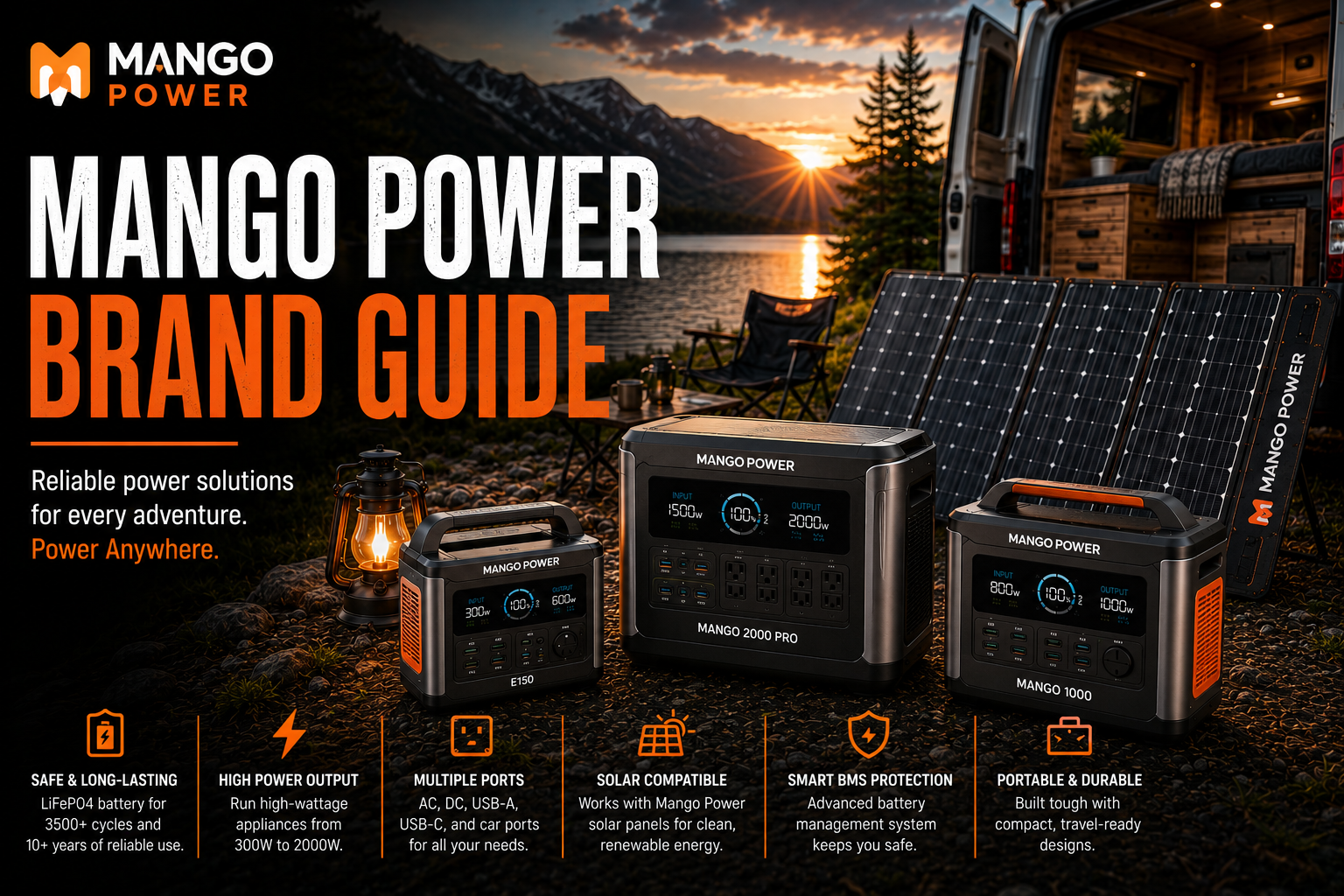
Mango Power Series Comparison
Power E is the portable platform, dual Power E creates 240V backup, mPanel Pro integrates circuits and Power M is the installed 15–20kWh system.
Mango Power does not offer a conventional small-to-large portable lineup; it offers different architectures for different levels of home integration.
This comparison clarifies those architectures.
Power E Is Portable; Power M Is Permanent
The correct system depends on whether you need outlets and wheels or professional whole-home integration.
Series Verdict
Power E is the flexible entry point, but Power M is the cleaner choice for a permanent solar-storage project.
Mango Power Series Comparison
| System | Capacity | Output | Portable | Expansion | Best Use |
|---|---|---|---|---|---|
| Power E | 3,533Wh | 3,000W | Wheeled | 7,066Wh per unit | Portable backup |
| Dual Power E | 7,066Wh base pair | 6,000W | Semi-portable | Up to 14kWh | 240V backup |
| Power E + mPanel | 3.5–14kWh | System-dependent | Semi-stationary | Yes | Home circuits |
| Power M | 15–20kWh | Installed-system class | No | Modular batteries | Whole-home |
Portable vs Installed
Power E includes outlets, wheels, a screen and direct appliance connections. Power M is built around permanently installed battery modules and home-energy controls.
Expansion Paths
One E battery doubles one Power E to 7,066Wh. Two expanded Power E bundles can create approximately 14kWh and 6,000W through the approved split-phase system.
Best System by Buyer
RV Owner
Power E.
Long-Outage Buyer
Power E + battery.
Well-Pump Backup
Dual E + mSocket.
Selected Home Circuits
mPanel Pro.
Solar Home
Power M.
Apartment User
Consider a smaller station.
Frequently Asked Questions
Who should buy the Mango Power series?
Buy it when large battery capacity, 240V expansion, home integration and high solar input match your backup plan.
Who should skip the Mango Power series?
Skip it when low weight, simple plug-and-play ownership or a broad retail service network matters more.
How should Mango Power runtime be estimated?
Multiply rated watt-hours by roughly 0.80 to 0.90 for usable AC energy, then divide by the appliance’s average watts.
Can Mango Power E run a refrigerator?
Yes. Its 3,000W inverter and 3,533Wh battery are sufficient for most refrigerators when startup remains within inverter limits.
Can third-party solar panels be used?
Yes, when array open-circuit voltage stays within the 60–150V input window and current, polarity and connectors are correct.
Does Mango Power support UPS use?
Power E and installed Mango systems include backup modes, but transfer behavior should be verified for sensitive medical or server equipment.
How long does the battery last?
Power E uses CATL LiFePO4 cells rated by Mango Power for 6,000 cycles to 70% capacity under stated conditions.
Can one Power E produce 240V?
No. The documented 240V configuration uses two compatible Power E systems and mSocket Pro.
Does Mango Power E require professional installation?
Not for ordinary portable use, but mPanel Pro, transfer equipment and permanent home wiring require qualified installation and local code compliance.
What is the biggest Mango Power buying mistake?
Buying the base station without budgeting for the expansion battery, mSocket, panel integration or solar hardware needed for the intended system.
Does Mango Power have a small camping model?
Its main current consumer focus is the much larger Power E platform.
Which system has the largest installed capacity?
Power M at roughly 15–20kWh.