
Are Mango Power Systems Worth It?
Mango Power can be worth buying for large-capacity solar and home backup, especially when Power E is heavily discounted and its expansion path fits the project.
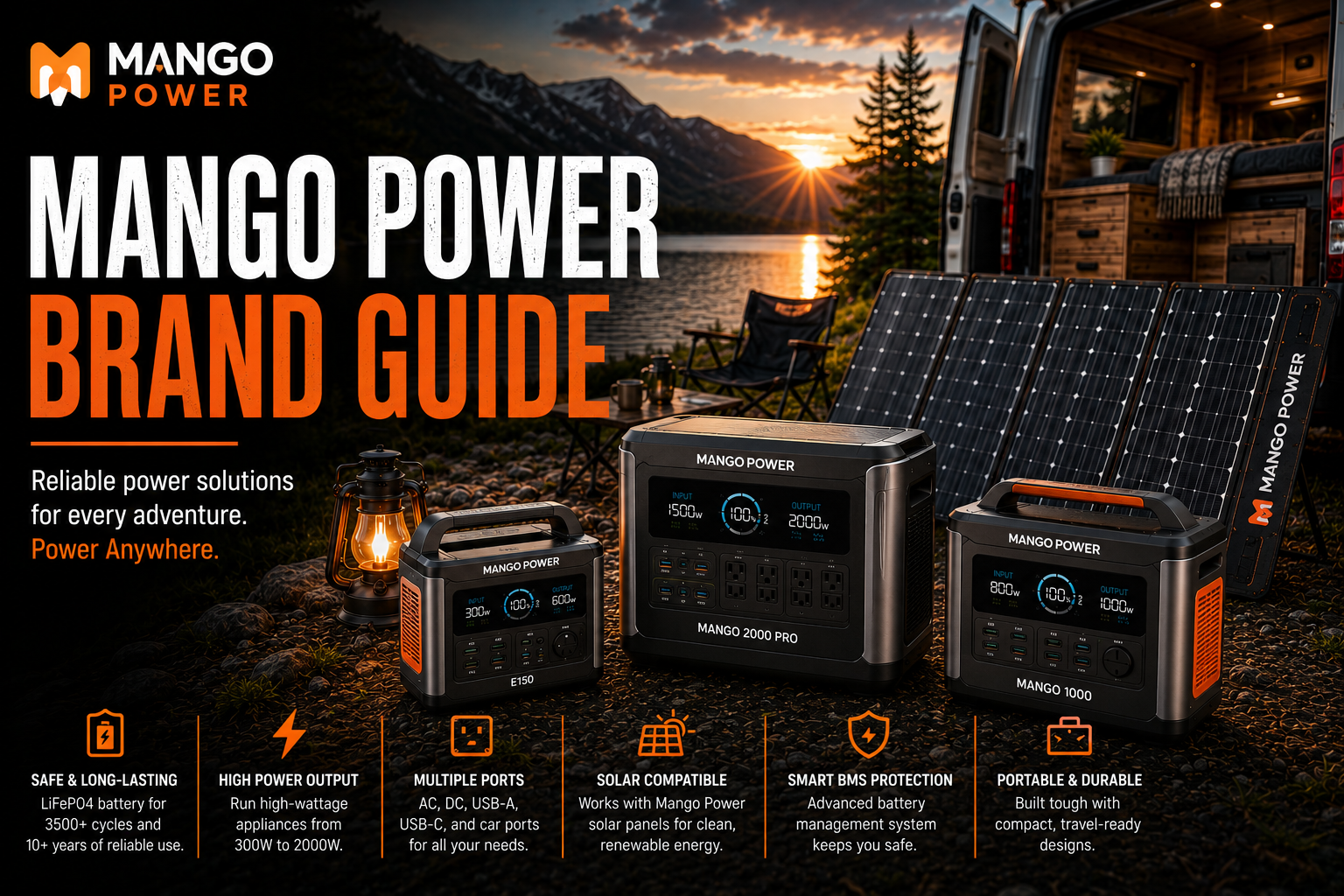
Mango Power can be worth buying for large-capacity solar and home backup, especially when Power E is heavily discounted and its expansion path fits the project.
Mango Power offers impressive battery longevity and solar input, but complete-system value depends on how many proprietary accessories are required.
This guide separates the value of Power E as a standalone station from the cost of building a 240V or panel-integrated system.
Worth It as a Discounted 3.5kWh Station; More Complex as a Whole-Home System
Power E is compelling at current sale prices. A full dual-unit system should be compared against newer native-240V platforms.
Editor's Verdict
Mango Power is worth considering for CATL battery longevity, high solar input and discounted capacity. It is less compelling when broad ecosystem support matters most.
Why Mango Power Can Be Worth It
Large Base Capacity
3.533kWh in one unit.
CATL LiFePO4
6,000-cycle claim.
2,000W Solar Input
Strong PV recovery.
240V Upgrade Path
Two units plus mSocket.
Home Panel Integration
mPanel Pro.
Deep Discount Pricing
Power E is often heavily reduced.
Reasons to Consider Alternatives
Very Heavy
Power E is around 100 lb.
Accessory Dependence
240V and panel use require add-ons.
Smaller Ecosystem
Fewer current products than major rivals.
No Native Single-Unit 240V
Two stations required.
Installation Complexity
Panel work needs an electrician.
Stock Variability
Panels and accessories may be backordered.
When Mango Power Delivers Value
Mango Power delivers its strongest value when Power E is purchased at a large discount and used as a high-capacity standalone 120V station. The value becomes less obvious when two units, expansion batteries, mSocket Pro and professional panel work are all required.
Best Buyers
RV Owners
Use the 30A RV outlet.
Solar Users
Exploit 2,000W PV input.
Long-Outage Planners
Add the E battery.
240V Buyers
Build a dual-unit system.
Homeowners
Use mPanel Pro professionally.
Not Frequent Movers
The station is very heavy.
What Matters in Real-World Use
The useful way to decide whether are mango power systems worth it are worth buying is to compare the full system against the actual backup, camping or off-grid job. Start with simultaneous watts, startup surges and the runtime you need. A feature-rich station can still be poor value if its strengths do not solve the loads you actually have.
Price the complete configuration, not only the base unit. Expansion batteries, panels, proprietary cables, adapters and faster charging accessories can materially change ownership cost. A lower entry price is not automatically cheaper once the system is configured for the same runtime and recharge target.
Recharge speed has the most value when the unit will be cycled repeatedly. For frequent outages, travel or solar use, quicker turnaround can materially improve usability. For a station that spends most of the year stored for emergencies, paying a large premium for recharge speed may produce little practical return.
With smaller or less established power-station brands, support and accessory availability deserve extra weight. Warranty handling, replacement cables, battery expansion compatibility and long-term ecosystem continuity can matter more over several years than a modest advantage in one headline specification.
A Better Way to Decide
1. Define simultaneous loads
List the devices that must run together, their continuous wattage and any motor or compressor startup surge.
2. Set the runtime requirement
Estimate watt-hours from the actual operating hours you need, then leave reserve for inverter losses and changing loads.
3. Compare the complete system
Include panels, expansion batteries, adapters, proprietary cables and other hardware required for the intended setup.
4. Weight long-term ownership
Portability, recharge time, noise, accessory availability and warranty support can outweigh modest specification differences.
Common Buying Mistakes to Avoid
Frequently Asked Questions
Who should buy a Mango Power system?
Buy it when large battery capacity, 240V expansion, home integration and high solar input match your backup plan.
Who should skip a Mango Power system?
Skip it when low weight, simple plug-and-play ownership or a broad retail service network matters more.
How should Mango Power runtime be estimated?
Multiply rated watt-hours by roughly 0.80 to 0.90 for usable AC energy, then divide by the appliance’s average watts.
Can Mango Power E run a refrigerator?
Yes. Its 3,000W inverter and 3,533Wh battery are sufficient for most refrigerators when startup remains within inverter limits.
Can third-party solar panels be used?
Yes, when array open-circuit voltage stays within the 60–150V input window and current, polarity and connectors are correct.
Does Mango Power support UPS use?
Power E and installed Mango systems include backup modes, but transfer behavior should be verified for sensitive medical or server equipment.
How long does the battery last?
Power E uses CATL LiFePO4 cells rated by Mango Power for 6,000 cycles to 70% capacity under stated conditions.
Can one Power E produce 240V?
No. The documented 240V configuration uses two compatible Power E systems and mSocket Pro.
Does Mango Power E require professional installation?
Not for ordinary portable use, but mPanel Pro, transfer equipment and permanent home wiring require qualified installation and local code compliance.
What is the biggest Mango Power buying mistake?
Buying the base station without budgeting for the expansion battery, mSocket, panel integration or solar hardware needed for the intended system.
Is Mango Power E good value at full list price?
Its value is more competitive at current promotional pricing than at the original list price.
Should I buy the expansion battery immediately?
Only when runtime calculations show the base 3,533Wh is insufficient.