
Best Mango Power Systems
Power E is best overall, the E Expansion Battery is best for runtime, mSocket Pro is best for 240V, mPanel Pro is best for circuit integration and Power M is best for permanent storage.
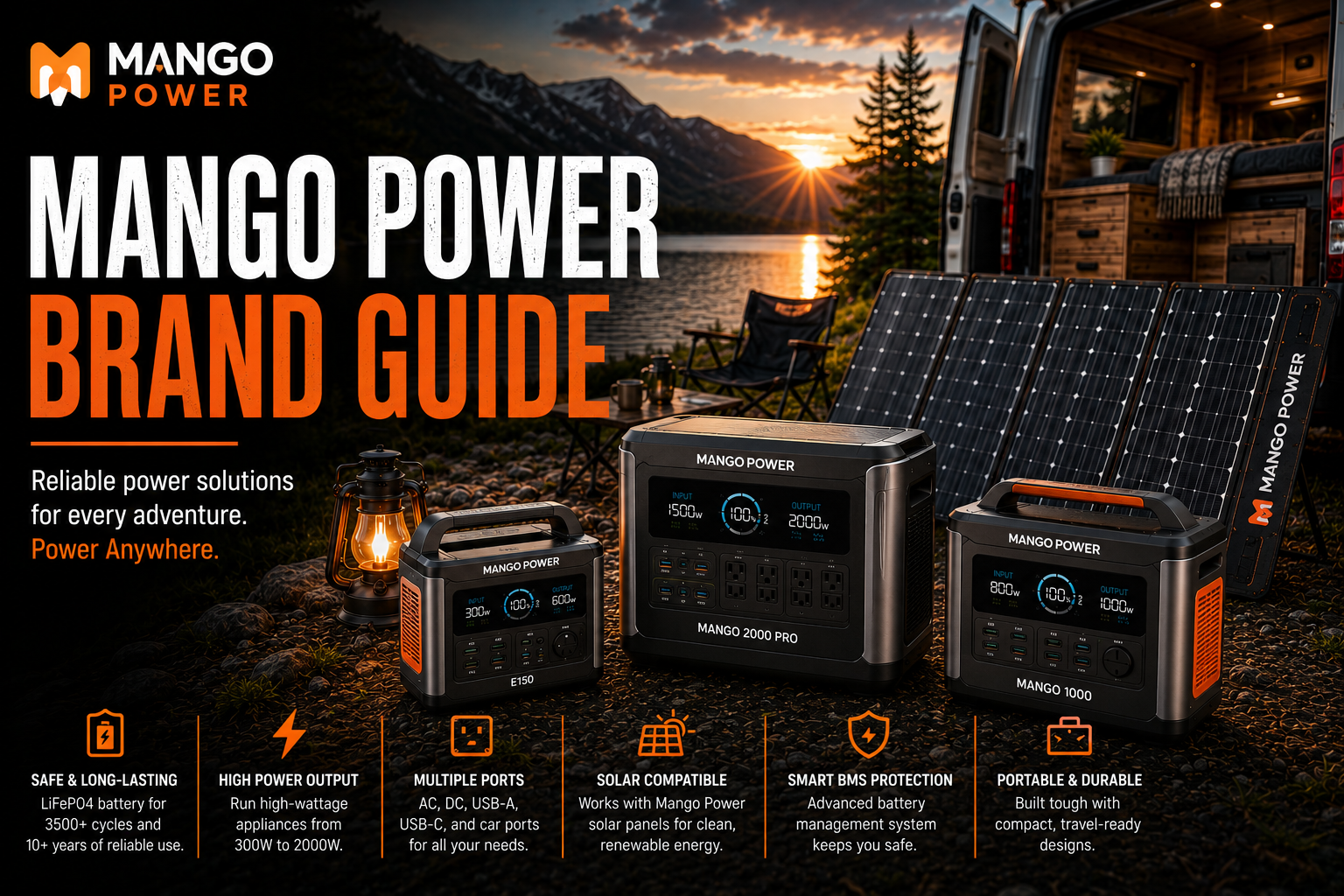
Power E is best overall, the E Expansion Battery is best for runtime, mSocket Pro is best for 240V, mPanel Pro is best for circuit integration and Power M is best for permanent storage.
Mango Power’s products are better understood as system components than as a long list of stand-alone stations.
This ranking matches each component to a specific backup role.
Best Overall: Mango Power E
Power E provides the most flexibility because it works alone, with an expansion battery, with mPanel Pro or as one half of a 240V system.
Editor's Verdict
Start with Power E only when its 3.5kWh capacity and future integration options justify its weight and accessory cost.
Top Mango Power Systems
Mango Power E
3,533Wh CATL LiFePO4 station with 3,000W output, 2,000W solar input and 7kWh expansion.
Mango Power E Expansion Battery
3,533Wh add-on battery that doubles one Power E system to 7,066Wh.
Mango Power mSocket Pro
Split-phase accessory that combines two compatible Power E systems for 240V and up to 6,000W output.
Mango Power mPanel Pro
Smart panel accessory for connecting Power E systems to selected household circuits.
Mango Power M
Installed whole-home platform scaling from roughly 15kWh to 20kWh with CATL LiFePO4 batteries.
System Comparison
| System | Capacity | Output | Best For |
|---|---|---|---|
| Power E | 3,533Wh | 3,000W | Portable backup |
| Power E + Battery | 7,066Wh | 3,000W | Long runtime |
| Dual E + mSocket | 7–14kWh | 6,000W, 240V | Heavy loads |
| Power E + mPanel | 3.5–14kWh | System-dependent | Circuit backup |
| Power M | 15–20kWh | Installed-system class | Whole-home storage |
Mango Power E
3,533Wh CATL LiFePO4 station with 3,000W output, 2,000W solar input and 7kWh expansion.
Mango Power E is the core product in the brand’s ecosystem. It combines a large CATL LiFePO4 battery, 16 output ports, a 30A RV outlet, app control, fast charging and a wheeled chassis.
Why It Stands Out
- Large 3.5kWh base
- 3,000W pure sine output
- 2,000W solar input
- 6,000-cycle claim
- Expandable and split-phase capable
What to Consider
- About 100 lb
- Premium accessory costs
- 240V needs a second unit and hardware
- Not practical for frequent lifting
Best for: home essentials, RVs, workshops and multi-day outages.
Mango Power E Expansion Battery
3,533Wh add-on battery that doubles one Power E system to 7,066Wh.
The E Expansion Battery is the simplest way to double runtime without adding another inverter. It is proprietary to Power E and includes the required E+ connection cable.
Why It Stands Out
- Doubles capacity
- Shared display and BMS
- No duplicate inverter cost
- Maintains 3,000W output
- Useful for stationary backup
What to Consider
- No standalone AC output
- Heavy
- Power E only
- Large upfront cost
Best for: refrigerators, pumps, networking and extended household backup.
Mango Power mSocket Pro
Split-phase accessory that combines two compatible Power E systems for 240V and up to 6,000W output.
mSocket Pro creates a 240V split-phase system from two Power E units. It is the key accessory for larger pumps, heaters and selected high-voltage household equipment.
Why It Stands Out
- 240V output
- 6,000W system power
- 7–14kWh system capacity
- Portable compared with installed battery walls
- Supports heavy loads
What to Consider
- Requires two stations
- Expensive complete system
- Complex cable management
- Still needs load planning
Best for: well pumps, larger workshop loads and selected 240V backup.
Mango Power mPanel Pro
Smart panel accessory for connecting Power E systems to selected household circuits.
mPanel Pro moves Mango Power E from extension-cord backup toward circuit-level home integration. It requires correct electrical design and qualified installation.
Why It Stands Out
- Circuit-level backup
- Automatic operation
- Energy monitoring
- Time-based controls
- Cleaner home integration
What to Consider
- Installation required
- Additional cost
- Panel compatibility matters
- Local permits may apply
Best for: homeowners who want selected circuits backed up automatically.
Mango Power M
Installed whole-home platform scaling from roughly 15kWh to 20kWh with CATL LiFePO4 batteries.
Mango Power M is not a portable station. It is a professionally installed home-energy system using stacked 5kWh battery modules, high charging rates and integrated home backup controls.
Why It Stands Out
- Whole-home scale
- High roundtrip efficiency
- Large installed capacity
- Fast battery charging
- Professional integration
What to Consider
- Requires installation
- Not portable
- Higher project cost
- Local permitting and code apply
Best for: permanent solar storage and automatic whole-home backup.
How to Choose
Need Portability
Power E.
Need Longer Runtime
E Expansion Battery.
Need 240V
Dual E plus mSocket.
Need Automatic Circuits
mPanel Pro.
Need Whole-Home Solar Storage
Power M.
Need Low Weight
Choose a smaller rival platform.
Frequently Asked Questions
Who should buy a Mango Power system?
Buy it when large battery capacity, 240V expansion, home integration and high solar input match your backup plan.
Who should skip a Mango Power system?
Skip it when low weight, simple plug-and-play ownership or a broad retail service network matters more.
How should Mango Power runtime be estimated?
Multiply rated watt-hours by roughly 0.80 to 0.90 for usable AC energy, then divide by the appliance’s average watts.
Can Mango Power E run a refrigerator?
Yes. Its 3,000W inverter and 3,533Wh battery are sufficient for most refrigerators when startup remains within inverter limits.
Can third-party solar panels be used?
Yes, when array open-circuit voltage stays within the 60–150V input window and current, polarity and connectors are correct.
Does Mango Power support UPS use?
Power E and installed Mango systems include backup modes, but transfer behavior should be verified for sensitive medical or server equipment.
How long does the battery last?
Power E uses CATL LiFePO4 cells rated by Mango Power for 6,000 cycles to 70% capacity under stated conditions.
Can one Power E produce 240V?
No. The documented 240V configuration uses two compatible Power E systems and mSocket Pro.
Does Mango Power E require professional installation?
Not for ordinary portable use, but mPanel Pro, transfer equipment and permanent home wiring require qualified installation and local code compliance.
What is the biggest Mango Power buying mistake?
Buying the base station without budgeting for the expansion battery, mSocket, panel integration or solar hardware needed for the intended system.
Which system is best for an RV?
Power E because it includes a 30A RV outlet.
Which system supports 240V?
Two Power E systems with mSocket Pro.