
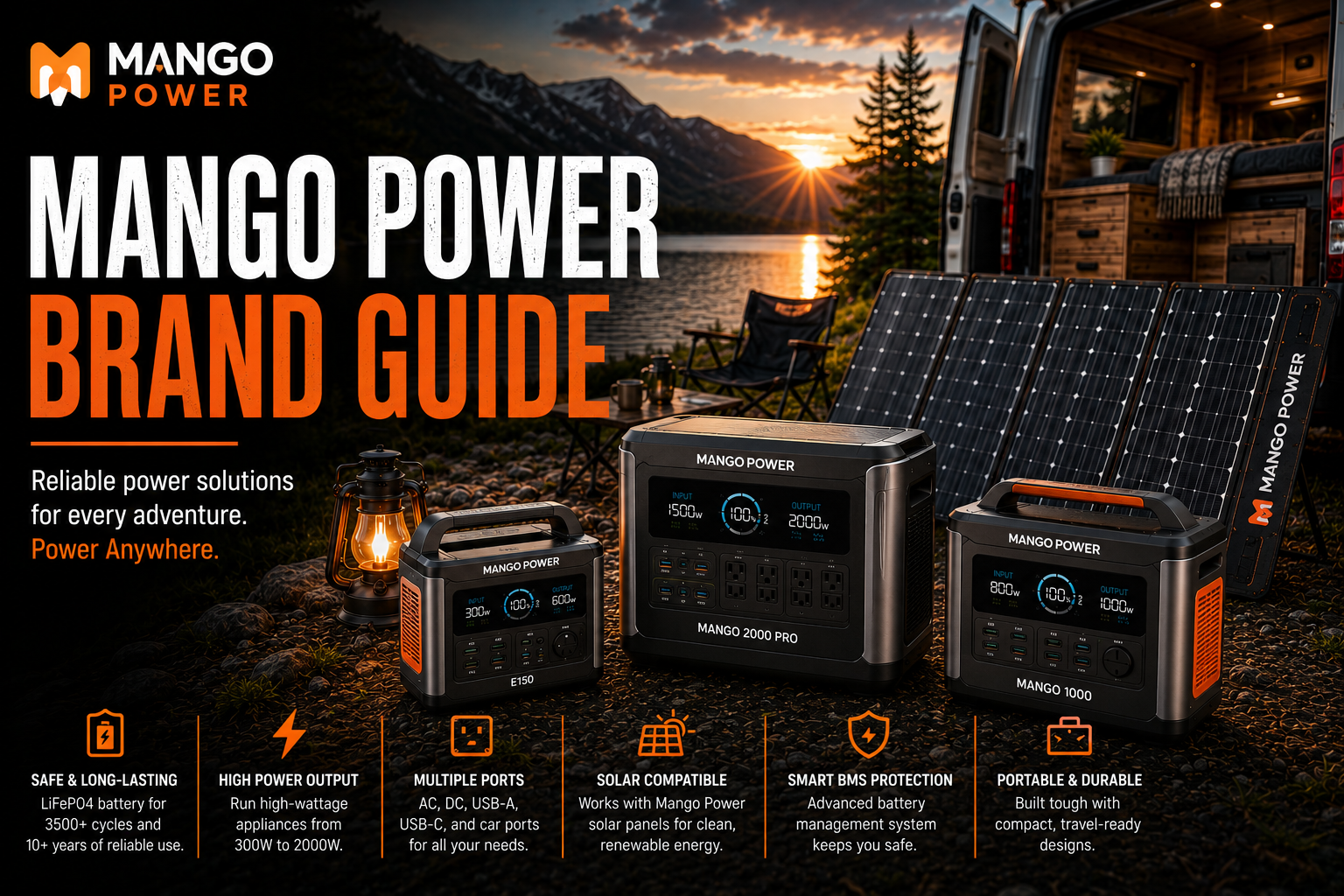
Mango Power Portable Power Station Buying Guide
Choose Mango Power by architecture first: portable 120V, expanded runtime, dual-unit 240V, circuit integration or permanent whole-home storage.
Mango Power purchases are system-design decisions, not simple battery-size choices.
This guide explains capacity, solar, split phase, panel integration and ownership cost.
Choose the Final System Before Buying the Base Unit
A Power E purchased for camping is different from a Power E purchased as the first half of a 14kWh split-phase home system.
Buying Guidance
Power E is versatile but heavy. Buy it when you genuinely need its 3.5kWh base and expansion path.
Start With Architecture
| Need | Recommended Architecture | Why |
|---|---|---|
| Movable backup | One Power E | 3.533kWh and 3,000W |
| Longer 120V runtime | Power E + battery | 7.066kWh |
| 240V loads | Two Power E + mSocket | Split phase, 6,000W |
| Automatic circuit backup | Power E + mPanel Pro | Panel integration |
| Permanent solar storage | Power M | 15–20kWh installed system |
Capacity and Runtime
Power E provides roughly three times the stored energy of a typical 1kWh station. At a 500W average load, practical AC runtime is often around six hours before reserve and conversion losses; adding the E battery can roughly double that duration.
Solar and Charging
Power E accepts up to 2,000W of solar through a 60–150V input window. Array design must respect open-circuit voltage in the coldest expected conditions, not only the panel’s rated operating voltage.
Home Integration
mPanel Pro, transfer equipment and 240V circuits are not DIY extension-cord tasks. A qualified electrician must verify neutral/ground configuration, overcurrent protection, conductor sizing, backfeed prevention and local permits.
Common Buying Mistakes
Ignoring Weight
Power E is around 100 lb.
Buying by Base Price
Accessories define the final system.
Assuming One Unit Makes 240V
Two units are required.
Oversizing Solar Voltage
Respect the 150V maximum.
Skipping Panel Compatibility
mPanel installation must be designed.
Confusing Power E and Power M
One is portable; one is installed.
Frequently Asked Questions
Who should buy a Mango Power system?
Buy it when large battery capacity, 240V expansion, home integration and high solar input match your backup plan.
Who should skip a Mango Power system?
Skip it when low weight, simple plug-and-play ownership or a broad retail service network matters more.
How should Mango Power runtime be estimated?
Multiply rated watt-hours by roughly 0.80 to 0.90 for usable AC energy, then divide by the appliance’s average watts.
Can Mango Power E run a refrigerator?
Yes. Its 3,000W inverter and 3,533Wh battery are sufficient for most refrigerators when startup remains within inverter limits.
Can third-party solar panels be used?
Yes, when array open-circuit voltage stays within the 60–150V input window and current, polarity and connectors are correct.
Does Mango Power support UPS use?
Power E and installed Mango systems include backup modes, but transfer behavior should be verified for sensitive medical or server equipment.
How long does the battery last?
Power E uses CATL LiFePO4 cells rated by Mango Power for 6,000 cycles to 70% capacity under stated conditions.
Can one Power E produce 240V?
No. The documented 240V configuration uses two compatible Power E systems and mSocket Pro.
Does Mango Power E require professional installation?
Not for ordinary portable use, but mPanel Pro, transfer equipment and permanent home wiring require qualified installation and local code compliance.
What is the biggest Mango Power buying mistake?
Buying the base station without budgeting for the expansion battery, mSocket, panel integration or solar hardware needed for the intended system.
How much solar can Power E accept?
Up to 2,000W within the documented 60–150V input range.
Can I connect Power E directly to a home panel?
Only through approved equipment and qualified installation.