
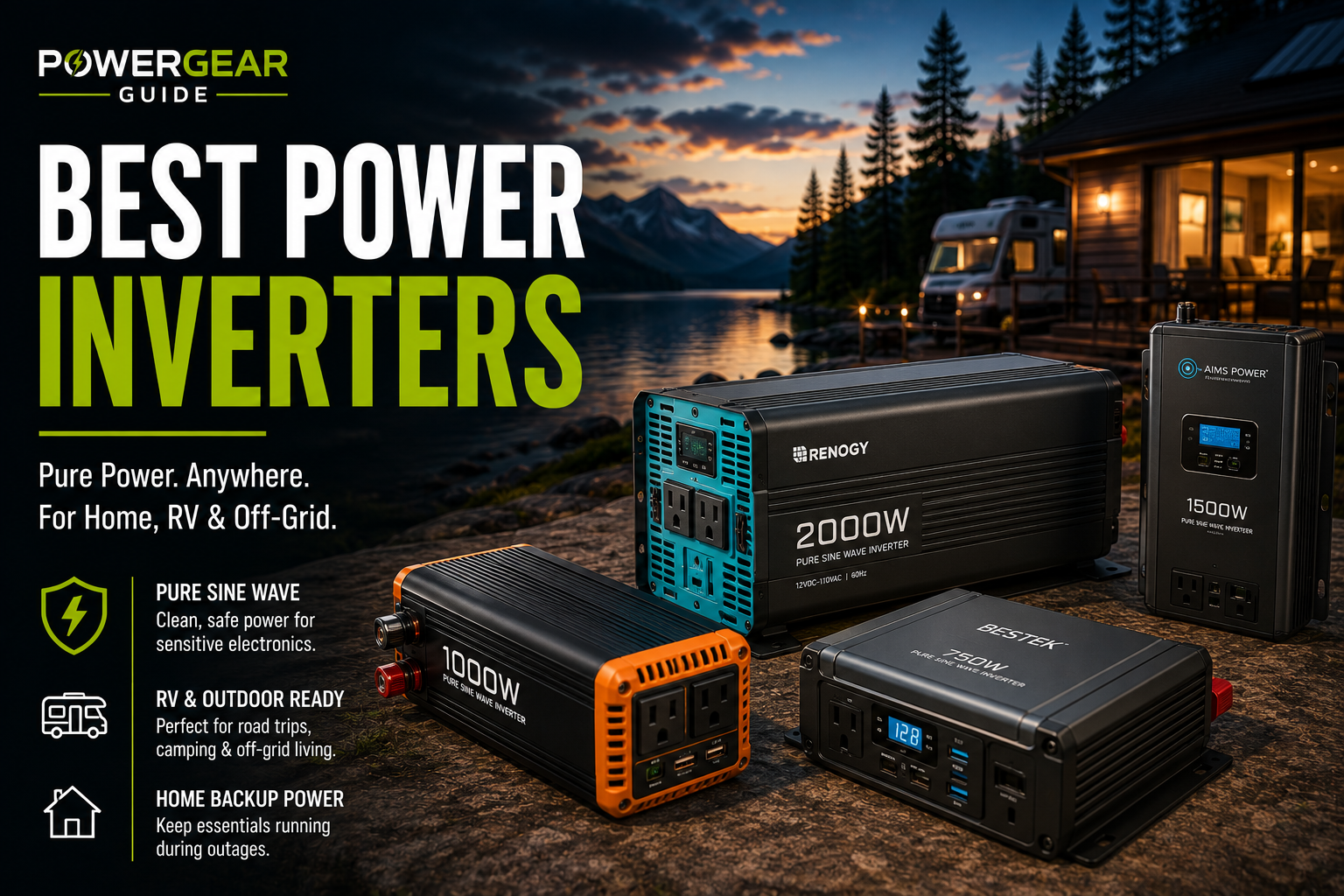
Power Inverter Buying Guide
Choose an inverter by continuous watts, startup surge, waveform, battery voltage, cable current and the type of loads you plan to run.
The inverter must match both the appliances on the AC side and the battery system on the DC side.
This guide explains the major decisions before buying a vehicle, RV or off-grid inverter.
Choose Pure Sine Wave and Size the DC Side Carefully
Add simultaneous AC loads and surge, then verify battery voltage, discharge current, cable size, fuse and runtime.
Buying Priority
Pure sine wave is the best default. Above roughly 2,000W, consider 24V or 48V systems to reduce extreme DC current.
Choose the Right Wattage
| Inverter Class | Typical Uses | Battery-System Note |
|---|---|---|
| 150–300W | Laptops, cameras and small electronics | Vehicle socket may limit power |
| 500–1,000W | TVs, tools and small appliances | Direct battery connection common |
| 1,500–2,000W | Microwave, coffee maker and RV loads | Heavy cables and large battery needed |
| 3,000W+ | Large appliances and off-grid systems | 24V or 48V often more practical |
Pure Sine vs Modified Sine
Pure sine wave is the safer general-purpose choice. Modified sine wave may work for simple resistive loads but can cause noise, heat or poor performance in motors, chargers and sensitive electronics.
Battery Voltage
12V
Common for vehicles and smaller systems but high current above 2kW.
24V
Cuts current roughly in half versus 12V.
48V
Preferred for larger off-grid systems.
Never Mix Ratings
The inverter input voltage must match the bank.
Check BMS Current
Lithium battery discharge limits matter.
Allow Low-Voltage Margin
Cable loss can trigger shutdown.
Cable, Fuse and Installation
Large inverters require short, heavy DC cables and a properly sized fuse or breaker close to the battery. Follow the manufacturer’s exact recommendations rather than generic charts alone.
Inverter vs Inverter-Charger
An inverter-only model converts battery DC to AC. An inverter-charger also charges the bank from shore or generator power and usually includes an automatic transfer function.
Buying Process
List AC Loads
Add simultaneous watts.
Find Startup Surge
Include motors and compressors.
Choose System Voltage
Higher voltage reduces current.
Select Waveform
Pure sine for general use.
Size Battery Capacity
Inverter output does not determine runtime.
Plan Ventilation
Inverters need airflow and dry installation.
Frequently Asked Questions
How many watts do I need?
Add simultaneous running loads and the largest startup surge.
Should I buy pure sine wave?
Yes for broad compatibility.
Is 12V suitable for 3000W?
It is possible but requires extremely high current; higher voltage is often better.
How do I size the fuse?
Use the inverter manufacturer’s instructions and cable ampacity.
What controls runtime?
Battery watt-hours, load and efficiency.
Does an inverter charge batteries?
Only an inverter-charger does.