
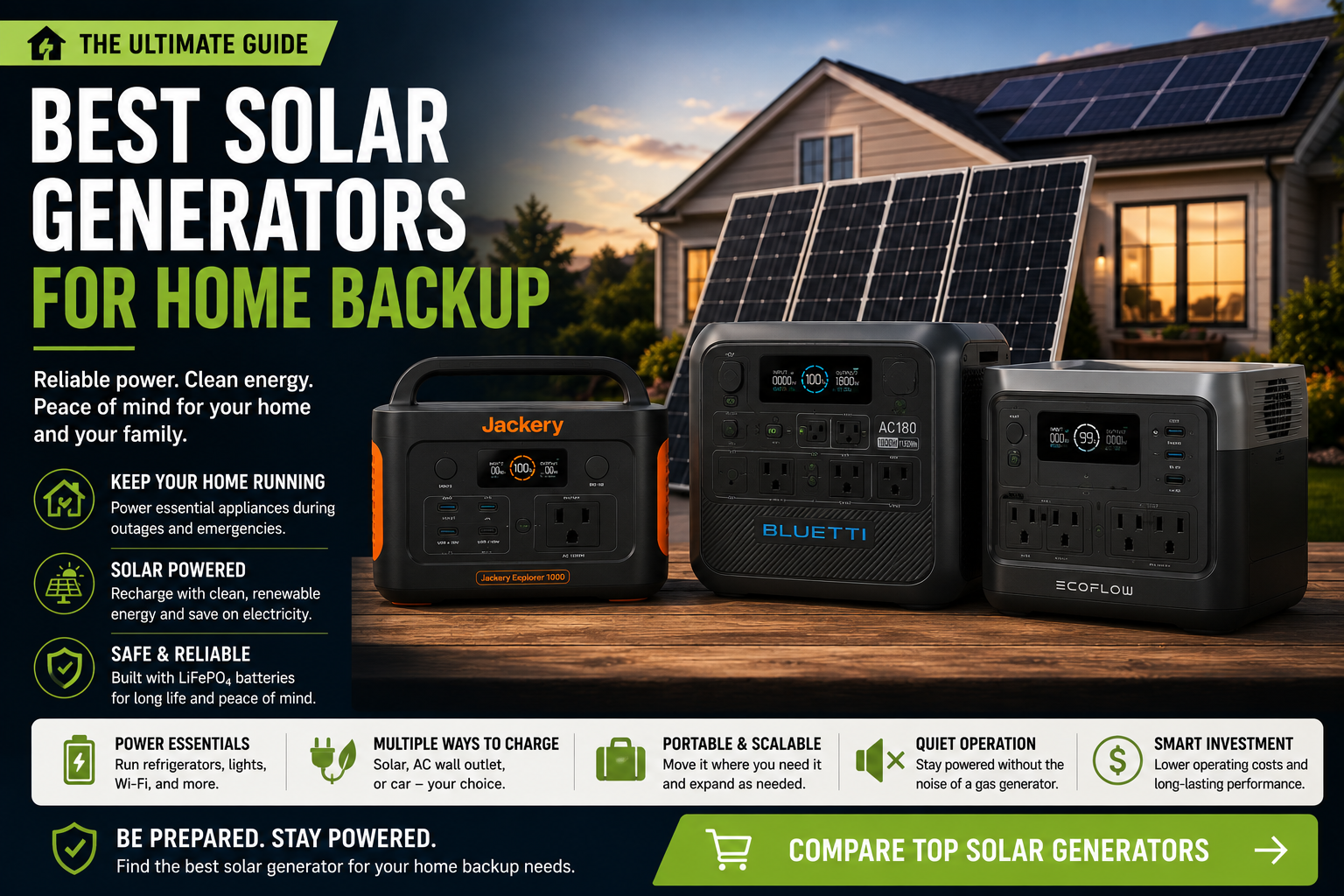
Best Solar Generators for Home Backup (Clean Emergency Power)
Compare dependable battery backup systems for refrigerators, essential appliances, extended outages, and scalable whole-home emergency power.
PowerGearGuide may earn a commission from qualifying purchases made through links on this page, at no extra cost to you.
Modern solar generators can keep refrigerators running, maintain internet access, recharge electronics, support medical equipment, and power selected household circuits without gasoline, exhaust, or engine noise.
The right system depends on battery capacity, inverter output, surge performance, charging speed, solar input, expansion options, and whether you need portable essential-load backup or a more permanent home-integration platform.
Our Top Home Backup Picks
The EcoFlow DELTA Pro Ultra is the strongest overall option for buyers who want premium scalability and whole-home integration. The Anker SOLIX F3800 offers excellent value for high-output backup, while the EcoFlow DELTA 2 Max and BLUETTI AC200L are more practical for essential appliances and smaller homes.
Editor's Shortlist
EcoFlow DELTA Pro Ultra
Premium whole-home capability, excellent expansion, and fast charging.
Anker SOLIX F3800
High output and strong home-backup features at a competitive system cost.
BLUETTI AC500 + B300S
Modular storage for larger homes, long outages, and off-grid use.
EcoFlow DELTA 2 Max
Excellent balance of output, portability, and expandable capacity.
BLUETTI AC200L
Dependable LiFePO4 backup for refrigerators and essential household loads.
Solar Generator Comparison Table
| Model | Capacity Class | Output Class | Expansion | Best For |
|---|---|---|---|---|
| EcoFlow DELTA Pro Ultra | Large modular | Very high | Extensive | Premium whole-home backup |
| Anker SOLIX F3800 | Large modular | Very high | Extensive | Best-value high-output backup |
| BLUETTI AC500 + B300S | Large modular | High | Extensive | Long outages and off-grid homes |
| EcoFlow DELTA Pro | Large portable | High | Yes | Proven residential backup |
| BLUETTI AC300 + B300 | Large modular | High | Yes | Flexible home backup |
| EcoFlow DELTA 2 Max | Mid-size | High | Yes | Apartments and essential loads |
| BLUETTI AC200L | Mid-size | Medium-high | Yes | Budget emergency backup |
How We Selected These Models
We evaluated manufacturer specifications, battery chemistry, inverter performance, expansion support, solar charging capability, AC recharge speed, software features, warranty coverage, home-integration options, and overall value. We do not claim hands-on testing unless it actually occurred.
Best Solar Generators for Home Backup
1. EcoFlow DELTA Pro Ultra
The DELTA Pro Ultra is a premium modular platform designed for serious residential backup. Its strongest advantages are high output, extensive battery expansion, fast multi-source charging, and compatibility with EcoFlow home-integration equipment.
Pros
- Excellent scalability
- Very high inverter output
- Strong solar and AC charging
- Premium app and ecosystem
- Home integration available
Cons
- Premium price
- Heavy
- Accessories raise total system cost
Bottom line: The strongest choice for buyers who want a long-term, expandable home-backup platform rather than a simple portable battery.
2. Anker SOLIX F3800
The SOLIX F3800 combines high output, expandable storage, LiFePO4 chemistry, and home-backup compatibility in a package that often undercuts similarly capable flagship systems.
Pros
- Strong price-to-performance ratio
- High-output inverter
- Expandable batteries
- Good mobile app
- Home integration support
Cons
- Heavy
- Expansion accessories add cost
- Large system requires planning
Bottom line: One of the best options for households that want serious emergency power without paying the highest flagship premium.
3. BLUETTI AC500 + B300S
This modular BLUETTI platform is built for large energy reserves, long outages, and buyers who want to grow their system over time. Its high-capacity charging and battery expansion make it especially attractive for off-grid or outage-prone homes.
Pros
- Extensive modular expansion
- Long-life LiFePO4 batteries
- Strong solar input
- High-output inverter
- Excellent off-grid potential
Cons
- High initial investment
- Heavy modules
- More complex than a single-box system
Bottom line: A strong choice for households prioritizing storage growth and long-duration backup.
4. EcoFlow DELTA Pro
The original DELTA Pro remains a dependable residential backup option thanks to its mature software, fast charging, expandable batteries, and broad accessory ecosystem.
Pros
- Proven platform
- Fast charging
- Strong app
- Expandable capacity
- Good accessory support
Cons
- Newer systems offer more expansion
- Heavy
- Premium accessories increase cost
Bottom line: A well-established, flexible option for medium-to-large essential-load backup.
5. BLUETTI AC300 + B300
The AC300 and B300 combination offers modular LiFePO4 storage, strong solar charging, and the flexibility to expand capacity as household requirements grow.
Pros
- Modular battery design
- Good solar capability
- Strong inverter performance
- Expandable storage
- Useful for cabins and off-grid applications
Cons
- Requires separate battery module
- Heavy system
- Less convenient for frequent transport
Bottom line: A capable modular alternative for buyers who prefer BLUETTI's ecosystem and expansion strategy.
6. EcoFlow DELTA 2 Max
The DELTA 2 Max offers enough output for refrigerators, routers, lights, televisions, laptops, CPAP machines, and many kitchen appliances while remaining much easier to move and store than whole-home systems.
Pros
- Excellent balance of size and power
- Fast charging
- Expandable batteries
- LiFePO4 chemistry
- Strong app
Cons
- Not intended for whole-home loads
- Lower total expansion than flagship systems
- Extra batteries add cost
Bottom line: One of the most practical choices for apartments, condos, and small homes that need essential-load protection.
7. BLUETTI AC200L
The AC200L brings LiFePO4 chemistry, respectable inverter output, fast charging, and expansion support to a more accessible price tier.
Pros
- Strong overall value
- LiFePO4 battery
- Expandable storage
- Good emergency performance
- Practical for essential appliances
Cons
- Not a whole-home system
- Less premium software experience
- Lower expansion ceiling than flagship platforms
Bottom line: A dependable budget-friendly option for refrigerators, freezers, electronics, lighting, and medical devices.
Home Backup Solar Generator Buying Guide
Start by deciding which appliances must remain powered during an outage. Most households should prioritize refrigeration, internet, lighting, phones, medical equipment, fans, and selected cooking appliances.
| Home Type | Suggested Capacity | Typical Goal |
|---|---|---|
| Apartment | 1–2kWh | Refrigerator, internet, lights, electronics |
| Small home | 2–4kWh | Multiple essentials and short outages |
| Average family home | 4–8kWh | Longer outages and more simultaneous loads |
| Large home | Expandable 8kWh+ | Multiple circuits and larger appliances |
| Whole-home platform | Modular system | Integrated backup with managed loads |
Runtime Planning
Battery capacity alone does not determine runtime. Appliance cycling, inverter losses, ambient temperature, battery age, and standby consumption all matter.
Reducing unnecessary devices during an outage can extend backup time dramatically. Refrigerators and freezers usually cycle rather than draw full power continuously.
Estimate daily energy use for each priority device, add the totals, then include reserve capacity for conversion losses and unexpected needs.
Transfer Switches and Home Integration
Premium systems may connect to selected household circuits through compatible transfer equipment or smart panels. This can eliminate extension cords and allow automatic or simplified outage switching.
Common Buying Mistakes
Compare Current Solar Generator Options
Review current pricing, available bundles, expansion batteries, and solar-panel packages before deciding which system best matches your home.
Frequently Asked Questions
What size solar generator do I need for home backup?
Choose a system based on the appliances you need during an outage. Small apartments often need 1–2kWh, while larger homes may benefit from expandable battery systems capable of supporting multiple circuits.
Can a solar generator power an entire house?
Some expandable systems paired with compatible transfer equipment or smart home panels can power large portions of a home. Most portable systems are designed for essential loads rather than every circuit at once.
Can a solar generator run a refrigerator?
Yes, provided the inverter can handle the refrigerator's startup surge and the battery has enough capacity for the desired runtime.
Are solar generators better than gas generators?
Solar generators are quieter, require little maintenance, produce no exhaust, and can be used indoors. Gas generators may offer longer continuous runtime when fuel is available and can support demanding loads.
How long do LiFePO4 solar generators last?
Many LiFePO4 systems are designed for thousands of charge cycles, though actual lifespan depends on temperature, charging habits, storage, and usage.
Should I buy expandable batteries?
Expandable batteries are useful when you expect your runtime needs to grow. They can be more economical than replacing the entire system later.
Can I recharge a solar generator without solar panels?
Yes. Most systems can recharge from household AC power, and many also support vehicle or fuel-generator charging.
Are solar generators worth it for emergency preparedness?
For many households, yes. They provide quiet, low-maintenance backup electricity without gasoline and can be recharged through multiple methods.
Choose the System That Matches Your Critical Loads
The EcoFlow DELTA Pro Ultra is our strongest overall recommendation for premium, scalable home backup. The Anker SOLIX F3800 offers excellent value, while the EcoFlow DELTA 2 Max and BLUETTI AC200L make more sense for smaller homes and essential-load protection.
The best system is not automatically the largest. Match battery capacity, inverter output, surge capability, charging speed, expansion, and integration features to the appliances you truly need during an outage.