
Renogy Portable Power Stations Compared: Which Model Fits Your Needs?
Renogy's portable power lineup stretches from compact electronics chargers to a 2,048Wh power station with a 2,400W inverter and dedicated RV outlet. Compare the differences that actually affect what you can power, how long it runs and how you recharge.
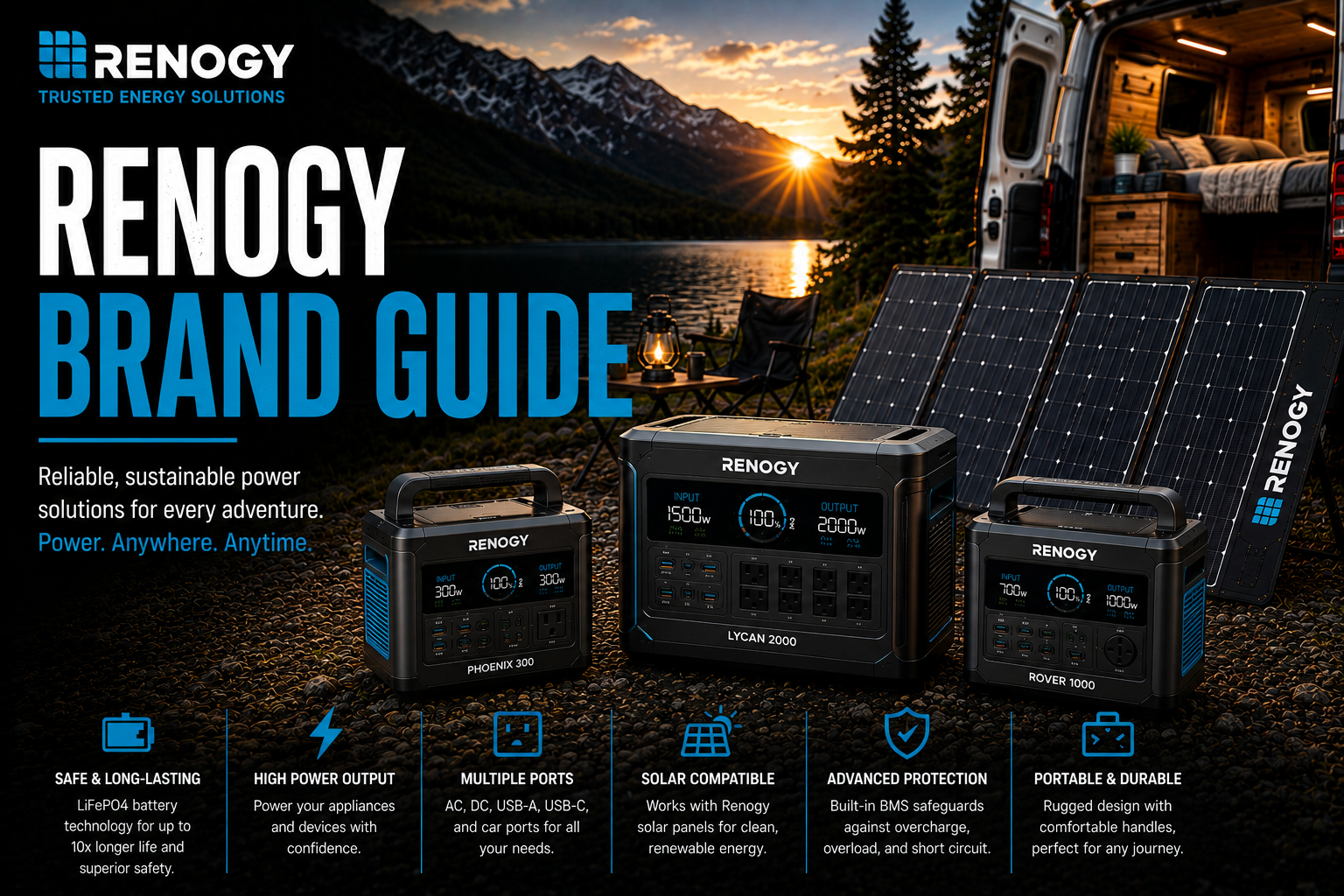
Quick answer: The Renogy PowerStation 2000 is the most capable all-in-one model in this comparison, with 2,048Wh of LiFePO4 storage, 2,400W continuous AC output and a TT-30 RV outlet. The PHOENIX 1000 is the more practical size for many campers, while the PHOENIX 500 and Power Station 200 serve lighter electrical needs.
The important distinction is that Renogy also sells batteries, inverters, solar controllers and modular RV equipment. Those components should not be confused with self-contained portable power stations.
Four Different Sizes, Four Different Jobs
Choosing the largest Renogy power station is not automatically the best decision. The right model depends on whether you need occasional USB charging, a portable camping battery or a larger source of AC power.
Best suited to higher-wattage appliances, longer backup requirements and RV owners who can use its TT-30 connection.
A balanced 1kWh-class option with 1,500W continuous AC output and LiFePO4 chemistry.
A smaller 495Wh station with an 800W pure-sine inverter, most relevant for camping and lighter loads.
A 222Wh compact option for phones, cameras, laptops and low-wattage essentials rather than household backup.
Renogy Portable Power Station Specifications Compared
Battery capacity determines how much energy a station stores. Continuous AC output determines the combined running wattage it can support. These are separate limits, and both matter.
| Specification | PowerStation 2000 | PHOENIX 1000 | PHOENIX 500 | Power Station 200 |
|---|---|---|---|---|
| Battery capacity | 2,048Wh | 998.4Wh | 495Wh | 222Wh |
| Battery chemistry | LiFePO4 | LiFePO4 | Older lithium-ion design | Lithium-ion |
| Continuous AC output | 2,400W | 1,500W | 800W | Compact 200W class |
| Advertised AC surge | 3,600W | 3,000W | Check model manual | Check model manual |
| Solar/DC input | Up to 1,200W, 12–60V | Up to 400W, 10–100V | Verify specific unit and connector | Verify specific unit and connector |
| Approximate weight | 51.8 lb | 41 lb | Smaller mid-size class | About 5.3 lb |
| Dedicated RV outlet | TT-30 | No TT-30 listed | No TT-30 listed | No TT-30 listed |
| Best fit | RV and larger backup loads | Camping appliances and mobile work | Light camping and electronics | USB devices and short trips |
Renogy Power Station Models: Strengths and Limitations
Renogy PowerStation 2000
The strongest model here for larger AC loads and plug-in RV use.
The PowerStation 2000 combines a 2kWh-class LiFePO4 battery with a 2,400W continuous pure-sine inverter. It includes five standard AC outlets, a TT-30 RV outlet and multiple USB and DC outputs.
Renogy also advertises a transfer time of 20 milliseconds or less, app monitoring and a 3,000-cycle battery rating under its stated testing conditions.
- Largest capacity in this comparison
- 2,400W continuous inverter
- Built-in TT-30 RV outlet
- High DC charging input
- LiFePO4 battery chemistry
- Approximately 52 lb
- Substantial size for short trips
- No confirmed plug-in expansion family
- Availability can vary
Choose it if: You need longer backup duration, substantial AC output or a dedicated RV connection.
Avoid it if: You primarily charge phones and laptops or need something easy to carry frequently.
Check PriceRenogy PHOENIX 1000
Strong appliance output without stepping up to a 2kWh station.
The PHOENIX 1000 is a useful middle ground for camping appliances, portable tools and temporary backup loads.
Its official manual specifies 998.4Wh of LiFePO4 storage, 1,500W rated AC output, 3,000W surge output and up to 400W DC input.
The same manual describes a proprietary parallel connection system for two compatible units. That is different from adding an expansion battery to a single station.
- 1,500W continuous AC output
- LiFePO4 chemistry
- High-voltage DC input range
- More manageable than a 2kWh unit
- Less than half the 2000's capacity
- Approximately 41 lb
- 400W maximum DC input
- Older product generation
Choose it if: You want an approximately 1kWh battery with enough inverter power for compatible medium-sized appliances.
Avoid it if: You need extended runtime without recharging or a built-in TT-30 RV outlet.
Check PriceRenogy PHOENIX 500
A smaller station for light appliance use and electronics.
The PHOENIX 500 occupies a practical middle ground between small electronics batteries and larger appliance-capable stations.
Its 495Wh battery and 800W pure-sine inverter suit compatible low-wattage cooking equipment, small TVs, laptops, lights and camping accessories.
It is an older lithium-ion design rather than one of Renogy's newer LiFePO4 platforms, so battery chemistry and product age deserve consideration.
- Smaller than the 1kWh class
- 800W continuous AC output
- Useful for lighter camping loads
- Potential value when discounted
- Limited energy storage
- Older battery chemistry
- Not ideal for larger appliances
- No broad expansion ecosystem
Choose it if: You want a smaller AC-capable station and can obtain it from a supported seller.
Avoid it if: Frequent battery cycling or long-term home backup is your main priority.
Check PriceRenogy Power Station 200
A grab-and-go power source for small electrical loads.
The Power Station 200 is for users who need portable charging more than substantial appliance power.
Its 222Wh battery is appropriate for phones, tablets, cameras, lighting and compatible low-wattage devices.
Do not confuse this model with older Renogy PHOENIX 200 versions, which can have different outlet waveforms, input limits and specifications.
- Easy to transport
- Useful for emergency communications
- Compact storage footprint
- More economical size for USB loads
- Very limited runtime for AC loads
- Not a refrigerator backup solution
- No practical expansion system
- Exact version must be checked
Choose it if: You mainly need portable electronics charging during trips or brief outages.
Avoid it if: You want to run household appliances, heaters or power-hungry tools.
Check PriceBattery Capacity: How Much Runtime Do You Really Gain?
The largest difference between these models is the amount of stored energy. A 2,048Wh battery holds roughly twice the nominal energy of a 998.4Wh battery and more than four times that of a 495Wh battery.
Capacity matters when running lights, networking equipment, televisions and other relatively steady loads for extended periods.
But capacity alone does not determine whether a device will work. You must also check the station's continuous output rating, voltage and startup power requirements.
AC Output: What Can Each Model Actually Power?
Continuous inverter output is the more useful number when determining whether a station can run an appliance.
| Electrical Need | Suitable Starting Point | Important Qualification |
|---|---|---|
| Phones, tablets and cameras | Power Station 200 | Confirm charging port and wattage requirements |
| Laptop and small electronics | Power Station 200 or larger | USB-C charging compatibility can improve efficiency |
| Small camping appliances | PHOENIX 500 or larger | Verify continuous draw and startup load |
| Medium-wattage AC appliances | PHOENIX 1000 or larger | 1,500W continuous limit on PHOENIX 1000 |
| Higher-wattage 120V loads | PowerStation 2000 | 2,400W total continuous AC output limit |
| 240V appliances | Neither automatically suitable | These 120V stations do not provide native 240V output |
Solar Charging: Which Renogy Station Makes the Most Sense?
Renogy's background in solar equipment makes solar compatibility an important buying factor. However, a station's solar input limits determine what can actually be connected.
Up to 1,200W DC Input
The manufacturer specifies a 12–60V DC input range, a 25A maximum and a 1,200W input ceiling.
This is the most capable solar/DC charging specification in the group, but panel configuration must remain within the input limits.
Up to 400W DC Input
The official PHOENIX 1000 manual specifies 10–100V DC, 10A and 400W maximum input.
It is a practical option for a smaller compatible solar array, although charging a nearly 1kWh battery will take longer at lower solar output.
Runtime Comparison: 100W and 500W Loads
To compare battery capacity fairly, the estimates below assume 85% of nominal battery energy is available for AC-powered devices.
| Model | 100W Constant Load | 500W Constant Load | Interpretation |
|---|---|---|---|
| PowerStation 2000 | 17.4 hours | 3.5 hours | Longest base runtime |
| PHOENIX 1000 | 8.5 hours | 1.7 hours | Useful mid-duration backup |
| PHOENIX 500 | 4.2 hours | 0.8 hours | Best for shorter loads |
| Power Station 200 | 1.9 hours | Not applicable | 500W exceeds compact model's AC class |
These are calculated estimates, not measured product results. They assume a constant load, no solar input and 85% usable AC energy. Actual runtime varies with inverter overhead, temperature, battery condition and load behavior.
For refrigerators and other cycling appliances, use measured average energy consumption over time rather than multiplying the compressor's instantaneous running wattage by 24 hours.
RV Use: PowerStation 2000 vs a Renogy REGO System
Renogy sells two fundamentally different approaches to RV electrical power: portable all-in-one stations and modular systems designed for permanent installation.
PowerStation 2000
The built-in TT-30 outlet is designed for compatible 120V RV connections. It offers a simpler approach for temporary or supplemental power.
However, a TT-30 connector does not make the station a 30A continuous power source. The station's 2,400W output limit still applies.
Air conditioners, water heaters and other RV loads may need to be managed carefully.
Renogy REGO 12V System
REGO is a modular system built around separate batteries, inverters, charging components and system monitoring.
It is better suited to a properly engineered RV or off-grid installation where battery capacity, alternator charging and solar hardware can be configured together.
It is not a portable power station and requires appropriate electrical design and installation.
Battery Chemistry and Long-Term Ownership
Battery chemistry is another meaningful difference between Renogy's newer and older portable stations.
LiFePO4 Models
PowerStation 2000 and PHOENIX 1000 use lithium iron phosphate battery chemistry. Their manufacturer-published cycle-life ratings are intended to describe battery longevity under specified test conditions.
Actual service life depends on temperature, depth of discharge, storage habits and charging behavior.
Older Lithium-Ion Models
PHOENIX 500 and Power Station 200 belong to older compact product families. They can still be useful, but shoppers should consider product age, support and warranty eligibility.
Do not assume an older station has the same cycle-life rating as a newer LiFePO4 model.
Which Renogy Power Station Should You Buy?
| Your Main Priority | Best Starting Point | Why |
|---|---|---|
| Longest runtime among these models | PowerStation 2000 | 2,048Wh battery |
| Highest continuous AC output | PowerStation 2000 | 2,400W rated inverter |
| Portable 1kWh-class battery | PHOENIX 1000 | 998.4Wh and 1,500W AC |
| Smaller camping power station | PHOENIX 500 | 495Wh and 800W AC |
| Phone, camera and laptop charging | Power Station 200 | Small and lightweight |
| Temporary 120V RV power | PowerStation 2000 | Built-in TT-30 connection |
| Permanent RV electrical installation | REGO / modular Renogy system | Configurable components and batteries |
Common Mistakes When Comparing Renogy Power Stations
1. Confusing Watts and Watt-Hours
Watts describe power. Watt-hours describe stored energy. You need enough of both to operate a device for the required time.
2. Using Peak Output as Continuous Power
Surge figures are temporary limits. Size sustained appliance loads against the continuous inverter rating.
3. Assuming Every Solar Panel Is Compatible
Renogy branding alone does not guarantee compatibility. Check voltage, current, polarity and connectors for the exact station.
4. Assuming an RV Outlet Means Unlimited RV Power
A TT-30 outlet does not override the station's 2,400W continuous output limit. Manage connected RV loads accordingly.
5. Ignoring Model Generation
Older PHOENIX products and newer Renogy stations may have different chemistry, input limits and electrical features.
6. Expecting Portable Stations to Be Modular
Renogy's REGO and DIY battery components are different from its portable all-in-one power stations.
Safety, Backup Power and UPS Limitations
UPS transfer: Renogy advertises a transfer time of 20 milliseconds or less for PowerStation 2000. That does not guarantee uninterrupted operation for every computer, server or medical device.
Home circuits: Never backfeed a wall outlet. Permanent home electrical connections require properly approved transfer equipment and qualified installation.
120V vs 240V: Do not assume these 120V portable stations can operate 240V household appliances.
Weather: Keep the units protected from rain and excessive moisture unless the exact model has an appropriate published environmental rating.
Medical equipment: Use only with manufacturer-confirmed compatibility and an appropriate independent backup plan for essential equipment.
Renogy Portable Power Station FAQs
Which Renogy power station has the largest battery?
Among the four models compared here, PowerStation 2000 has the largest battery at 2,048Wh.
Is PHOENIX 1000 a 2,100W AC power station?
No. Its continuous AC inverter rating is 1,500W. The 2,100W figure refers to advertised combined output, not continuous AC output from its outlets.
Which Renogy station is best for camping?
PHOENIX 1000 is a reasonable starting point when you need appliance-capable AC power. PHOENIX 500 suits lighter loads, while Power Station 200 is better for compact electronics charging.
Can a Renogy power station run a refrigerator?
A suitably sized station may run a compatible refrigerator, but you must verify the refrigerator's running demand, compressor startup requirements and expected energy consumption.
Can I use third-party solar panels?
Potentially, yes, when voltage, current, polarity and connector requirements match the exact station's specifications. Never assume compatibility from wattage alone.
Does PowerStation 2000 provide 30 amps through its RV outlet?
It has a TT-30 outlet, but the station's overall 2,400W continuous inverter limit still applies. Do not treat the connector as a promise of unrestricted 30A output.
Are Renogy portable power stations expandable?
These models do not offer a broad consumer plug-in expansion battery family. PHOENIX 1000 has a documented parallel connection feature for two compatible units using the approved kit. That is not the same as attaching a generic battery.
Is Renogy REGO a portable power station?
No. REGO is a modular electrical system for RV and off-grid installations. It uses separate components and requires proper system design.
Final Recommendation: Match the Renogy to the Job
PowerStation 2000 is the strongest choice here for buyers who need 2kWh-class energy, 2,400W continuous output or a TT-30 RV connection.
PHOENIX 1000 is a sensible middle ground for compatible appliances and mobile work. PHOENIX 500 serves lighter camping loads, while Power Station 200 is mainly an electronics charging solution.
If you want a permanently installed RV or off-grid electrical system, compare Renogy's modular batteries and REGO components instead of treating a portable station as a substitute.
Compare Current OptionsResearch Sources and Editorial Methodology
This comparison uses Renogy's published product specifications, official manuals and model documentation. The recommendations are based on electrical capabilities, battery size, portability and intended use. No firsthand testing is claimed.
- Renogy PowerStation 2000 — Official Specifications — capacity, inverter output, input limits, TT-30 connection and physical specifications.
- Renogy PHOENIX 1000 — Official Product Documentation — product documentation and manual access.
- Renogy PHOENIX 1000 — Official User Manual — 998.4Wh battery, 1,500W rated AC output, 400W DC input and parallel connection details.
- Renogy Product Manuals and Downloads — model-specific manuals for portable stations and electrical equipment.
- Renogy — Lithium Content in Portable Power Stations — product-family identification and battery information.
Related Power Gear Guide Articles
For a ranked product shortlist, see our Best Renogy Portable Power Stations . For a broader look at the brand's portable and modular backup systems, read Renogy Portable Power Stations and Backup Power .
Specifications, model availability, warranties and supported accessories can change. Confirm the exact model number and current manufacturer documentation before purchase.