
Pecron vs Jackery: Which Portable Power Station Brand Is Better?
Pecron often gives you more output, solar-input capability or expansion flexibility for the money. Jackery emphasizes portable designs, easy-to-understand product families and a broader consumer ecosystem. But the winner changes with the exact models you compare.
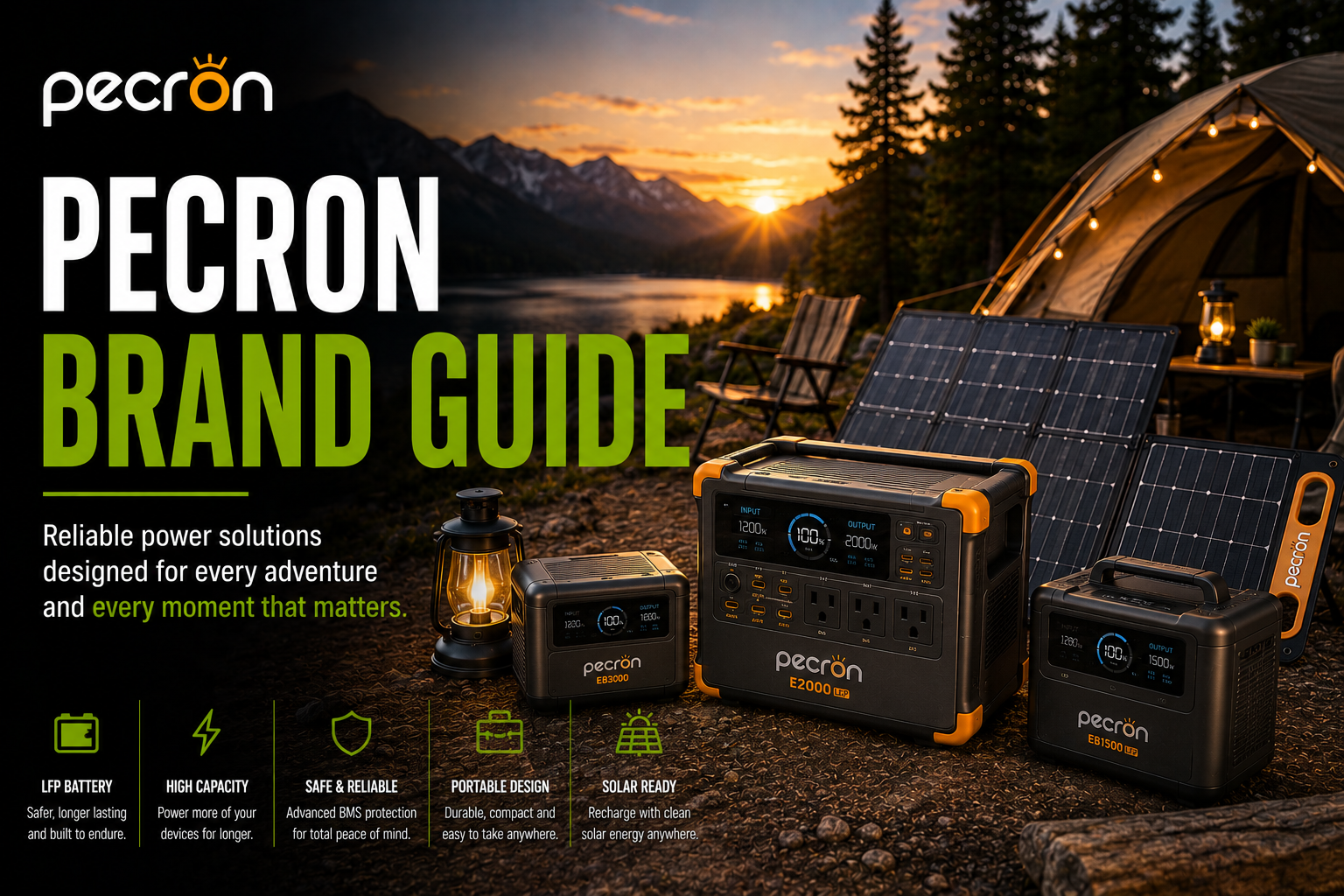
Quick verdict: Choose Pecron when you prioritize electrical capability, generous solar-input specifications and expansion options in a particular price class. Choose Jackery when lower weight, simpler purchasing and a well-established accessory ecosystem matter more. Neither brand wins every size category.
The key is to compare specific generations, not logos. A Jackery Explorer 1000 v2 is not the same product as an Explorer 1000 Plus, and a Pecron E1000LFP is not the same size or class as an E2400LFP. Older products, newer generations and regional versions can have very different specifications.
Pecron vs Jackery: The Short Answer
For roughly 1kWh of battery capacity: The Pecron E1000LFP offers 1,024Wh and 1,800W of rated AC output, compared with 1,070Wh and 1,500W for the Jackery Explorer 1000 v2. Pecron has more continuous inverter output; Jackery is lighter.
For expandable mid-size power: The Pecron E1500LFP offers 1,536Wh and 2,200W. The Jackery Explorer 1000 Plus offers approximately 1,265Wh and 2,000W, but has a particularly straightforward Jackery-branded battery-expansion path.
For approximately 2kWh of storage: The Pecron E2400LFP offers 2,048Wh and 2,400W. The Jackery Explorer 2000 Plus offers approximately 2,043Wh and 3,000W. Here Jackery has the higher rated AC output, while Pecron has a substantially lighter base unit.
Our editorial conclusion: Pecron is particularly compelling for specification-focused buyers. Jackery is especially attractive for people who want a mainstream portable-power ecosystem. The correct choice depends on the exact model and complete system cost.
You Want More Electrical Flexibility
Pecron's E-series models emphasize high-output DC ports, solar-input specifications and compatible expansion batteries. They appeal to owners who enjoy comparing technical details and configuring their systems.
Best fit: RV power, off-grid projects and capacity-focused backup setups.
Compare Current OptionsYou Value Portable Ownership
Jackery's Explorer line includes lightweight compact stations, branded SolarSaga charging accessories and clearly differentiated portable and expandable product families.
Best fit: Camping, occasional emergency backup and buyers who prefer an integrated accessory ecosystem.
Compare Current OptionsPecron vs Jackery: Side-by-Side Specifications
The following examples use named models rather than mixing product generations. Ratings are manufacturer-published specifications for the indicated model variants, not independent test results.
| Model | Battery Capacity | Rated AC Output | Weight | Battery Chemistry | Expandable? |
|---|---|---|---|---|---|
| Pecron E1000LFP | 1,024Wh | 1,800W | 29 lb | LiFePO4 | Yes, with compatible Pecron battery modules |
| Jackery Explorer 1000 v2 | 1,070Wh | 1,500W | 23.8 lb | LiFePO4 | No external battery expansion |
| Pecron E1500LFP | 1,536Wh | 2,200W | 38.4 lb | LiFePO4 | Yes |
| Jackery Explorer 1000 Plus | 1,264.6Wh | 2,000W | Approx. 32 lb | LiFePO4 | Yes, with compatible Jackery expansion batteries |
| Pecron E2400LFP | 2,048Wh | 2,400W | 45 lb | LiFePO4 | Yes |
| Jackery Explorer 2000 Plus | 2,042.8Wh | 3,000W | 61.5 lb | LiFePO4 | Yes |
Three Real-World Pecron vs Jackery Matchups
Pecron E1000LFP vs Jackery Explorer 1000 v2
These two products are among the clearest comparisons for camping, weekend use and small-scale emergency backup. Their batteries store similar amounts of energy, but the trade-offs are different.
The Pecron E1000LFP offers a higher continuous inverter rating, a 600W maximum solar input and a 12V/20A XT60 output. Those specifications can matter when you need more demanding AC appliances or higher-current 12V DC equipment.
The Jackery Explorer 1000 v2 is approximately 5.2 lb lighter. That difference matters if you repeatedly lift the station into a vehicle, carry it to a campsite or move it around your home.
Both use LiFePO4 battery chemistry. Jackery lists 4,000 cycles to at least 70% remaining capacity for the 1000 v2, while Pecron lists more than 3,500 cycles to 80% for the E1000LFP. These are different retention thresholds, so the headline cycle counts should not be treated as directly equivalent longevity tests.
- You want 1,800W rated AC output.
- You can use its 600W solar-input ceiling.
- You value its higher-current 12V DC output.
- You may use compatible expansion batteries.
- You want the lighter unit.
- 1,500W continuous output is sufficient.
- You do not need external battery expansion.
- You prefer a straightforward portable setup.
Pecron E1000LFP
Check PriceJackery Explorer 1000 v2
Check PriceOur pick: Pecron for higher inverter output and electrical flexibility; Jackery for lower weight and easy portability. The extra 46Wh of Jackery battery capacity is too small to decide the purchase by itself.
Pecron E1500LFP vs Jackery Explorer 1000 Plus
This matchup is more interesting for buyers who expect their backup system to grow. Both models support compatible expansion batteries, but they begin with different base capacities.
The E1500LFP offers about 271Wh more battery capacity before expansion and 200W more continuous AC output. It also has a manufacturer-published maximum solar input of 1,000W, with an 11–60V solar-input range and 20A limit on its XT60 input.
The Explorer 1000 Plus has a smaller base battery and lower continuous output, but Jackery provides a clearly defined branded expansion-battery system. It can be a more approachable choice for buyers who want to purchase the main station now and add matching batteries later.
Pecron's published expansion options can offer substantial additional capacity, but buyers must confirm the exact battery-module model, required cables and currently supported configuration. Do not assume any Pecron expansion battery will work with every Pecron station.
- You want more starting capacity.
- You need up to 2,200W continuous output.
- You can take advantage of its higher solar-input specification.
- You are comfortable verifying expansion compatibility.
- You prefer Jackery's branded expansion path.
- 2,000W output is enough.
- You want a lighter base station.
- You value a simpler accessory selection process.
Pecron E1500LFP
Check PriceJackery Explorer 1000 Plus
Check PriceOur pick: Pecron when higher starting capacity and solar input are priorities. Jackery when you want a familiar expansion ecosystem and less weight in the base unit.
Pecron E2400LFP vs Jackery Explorer 2000 Plus
At around 2kWh, the decision shifts. The two stations have nearly identical battery capacities, but Jackery offers more continuous AC output and Pecron is significantly lighter.
The E2400LFP weighs approximately 45 lb, compared with approximately 61.5 lb for the Explorer 2000 Plus. A difference of about 16.5 lb can matter when you need to move a larger station regularly.
Jackery's 3,000W continuous inverter provides more headroom for appliances with high running loads. However, you still need to check startup surge, receptacle ratings and the requirements of individual appliances.
Pecron lists an 800W combined maximum solar input for the E2400LFP, using two inputs with different voltage and power limits. That is not the same as one universal 800W solar port. Jackery's solar configuration likewise depends on the number of connected panels, approved adapters and exact product limits.
Both support compatible expansion batteries, but their battery modules and cables are proprietary to their respective systems. Never assume cross-brand or cross-generation battery compatibility.
- You want a lighter 2kWh-class base unit.
- 2,400W continuous AC output is enough.
- You need its high-current 12V DC output.
- You can verify the exact solar-input and expansion configuration.
- You need up to 3,000W continuous output.
- You plan to expand with Jackery battery packs.
- You prioritize inverter headroom over base-unit weight.
- You want an integrated Jackery accessory ecosystem.
Pecron E2400LFP
Check PriceJackery Explorer 2000 Plus
Check PriceOur pick: Jackery for greater continuous inverter output; Pecron for a lighter 2kWh-class unit. For large appliances, the 600W output difference is more consequential than the roughly 5Wh difference in rated battery capacity.
Solar Charging: Pecron vs Jackery
Solar charging is one of the biggest reasons to compare these brands carefully. Both offer solar-capable power stations, but the input limits and connector arrangements differ substantially between models.
| Model | Maximum Solar Input | Important Compatibility Detail |
|---|---|---|
| Pecron E1000LFP | 600W | XT60 input; 11–60V open-circuit voltage range, 20A maximum. |
| Pecron E1500LFP | 1,000W | XT60 input; 11–60V, 20A maximum. |
| Pecron E2400LFP | 800W combined | Separate 700W GX16MF and 100W DC5521 inputs with different voltage ranges. |
| Jackery Explorer 1000 Plus | 800W | Two DC inputs; check voltage, current and supported connectors. |
| Jackery Explorer 2000 Plus | 1,400W | Two DC8020 inputs; up to 700W per input under the specified conditions. |
Pecron's E1500LFP is especially interesting for solar-focused buyers because its published 1,000W maximum input is substantial relative to its 1,536Wh battery capacity. The Jackery Explorer 2000 Plus offers an even higher published 1,400W solar-input ceiling, but reaching it requires an appropriate panel configuration.
Why Maximum Solar Watts Can Be Misleading
A 1,000W solar-input rating does not mean a power station will continuously receive 1,000W from panels. Actual input depends on sunlight, panel temperature, orientation, shading, conversion losses and the station's charging controls.
More importantly, solar-panel compatibility is not determined by wattage alone. You must check:
- Open-circuit voltage (Voc): The connected panel array must remain within the station's permitted voltage limit, including in cold weather when Voc can rise.
- Current limits: Verify the allowable input current and how the station handles connected panel configurations.
- Connector type and polarity: A physically compatible plug does not guarantee safe electrical compatibility.
- Separate input limits: Two ports may have different specifications and cannot necessarily be combined arbitrarily.
- Supported adapters: Check the manufacturer's instructions rather than assuming third-party adapters are interchangeable.
Which Brand Is Better for Solar?
Pecron deserves serious consideration if you want to optimize a custom solar setup and are comfortable checking technical specifications. Jackery can be easier when you prefer matching branded SolarSaga panels and approved charging accessories.
Neither approach is automatically cheaper. Compare the total cost of the power station, panels, adapters, cables and any expansion batteries.
Battery Expansion: Which Ecosystem Is Better?
Expansion is not simply a question of whether a power station has a battery connector. The important questions are which batteries work, how much additional capacity they provide and whether you can obtain the right accessories when needed.
High-Capacity Options, Model-Specific Rules
Pecron lists compatible EP-series battery expansion options for several E-series stations. For example, its E2400LFP documentation describes expansion using compatible EP3000-48V or EP3800-48V batteries.
The E2400LFP's published maximum configurations reach 8,192Wh with two compatible EP3000-48V modules or 9,728Wh with two compatible EP3800-48V modules.
Watch for: Exact module compatibility, cable requirements, accessory availability and the combined system's weight.
Clearly Defined Plus-Series Accessories
Jackery's Explorer 1000 Plus and Explorer 2000 Plus support their respective compatible expansion batteries. This makes it possible to begin with a base station and add stored energy later.
However, the Explorer 1000 v2 is not an expandable equivalent of the Explorer 1000 Plus. Their similar names conceal an important purchasing difference.
Watch for: Product generation, compatible battery-pack model, total system cost and physical storage requirements.
Expansion Does Not Automatically Increase Inverter Output
Adding a compatible expansion battery primarily increases stored energy and potential runtime. It does not necessarily increase the power station's continuous AC output.
For example, an expandable 2,000W station does not automatically become a 4,000W station when its battery capacity doubles. Confirm the manufacturer's actual inverter and multi-unit operating specifications.
Our recommendation: If you expect to expand, compare the complete intended system before buying the base unit. The least expensive standalone station may not be the best-value expandable system.
Real-World Runtime: Does Brand Matter?
When two power stations have similar battery capacities, their runtime under the same load can be relatively close. However, inverter efficiency, standby consumption, operating temperature and load behavior all affect the result.
Example: Running a 100W Continuous Load
| Power Station | Rated Capacity | Estimated Runtime at 100W |
|---|---|---|
| Pecron E1000LFP | 1,024Wh | About 8.7 hours |
| Jackery Explorer 1000 v2 | 1,070Wh | About 9.1 hours |
| Pecron E1500LFP | 1,536Wh | About 13.1 hours |
| Jackery Explorer 1000 Plus | 1,264.6Wh | About 10.7 hours |
| Pecron E2400LFP | 2,048Wh | About 17.4 hours |
| Jackery Explorer 2000 Plus | 2,042.8Wh | About 17.4 hours |
These are illustrative calculations, not measured runtimes. We assume the load draws a constant 100W and that 85% of rated battery capacity becomes usable AC energy. Real efficiency can be lower, particularly at very light loads where inverter overhead becomes proportionally more significant.
A refrigerator is a different case: its compressor cycles on and off, so average energy use can be much lower than its instantaneous running wattage. Startup surge must also remain within the power station's capabilities.
Example: Overnight Internet and Lighting
Suppose your essential loads average 65W over 10 hours:
Both 1kWh-class examples could theoretically satisfy this energy requirement under those assumptions, but the real result depends on the actual equipment, power consumption and system losses.
This illustrates why choosing the larger inverter does not always provide better runtime. If your equipment uses only 65W, the difference between 1,500W and 1,800W of continuous AC output may offer little practical benefit.
Portability, Software, Warranty and Ownership
Portability: Compare the Actual Weight
Jackery is not universally lighter. Its Explorer 1000 v2 is lighter than the Pecron E1000LFP, but the Pecron E2400LFP is considerably lighter than the Jackery Explorer 2000 Plus.
For everyday portability, consider more than pounds. Handle design, unit dimensions, available storage space and whether you need to move the station up stairs or into a vehicle can change which model feels more convenient.
Software: Both Brands Offer Connected Models
It would be inaccurate to say that only Jackery has app-controlled power stations. Pecron advertises Wi-Fi and Bluetooth functionality on the E1000LFP and connected controls on other E-series models.
Compare the features that matter to you: battery state of charge, charging-speed adjustment, remote output control, connection requirements and whether essential functions remain accessible without an app.
Warranty: Read the Terms for the Exact Model
Warranty periods and extensions can vary by model, purchase channel and registration conditions. Pecron advertises a 2+1-year warranty for certain E-series products, while Jackery advertises 3+2-year coverage for the Explorer 2000 Plus under its stated terms.
Those numbers are not a guarantee that every product from either brand has identical coverage. Check the exact product, seller eligibility, registration requirements, geographic restrictions and warranty exclusions before purchasing.
Availability: Consider the Product Generation
Some older models remain listed while newer models and product families appear. That can affect replacement accessories, expansion batteries and the long-term practicality of the system.
Do not assume a discounted older model is a poor purchase, but confirm that compatible accessories and manufacturer support still meet your needs. Likewise, do not assume a newer generation is automatically better for every use case.
Which Brand Is Better for Home Backup?
Both brands can provide useful battery backup for selected appliances. Neither should be treated as a substitute for a properly designed whole-home backup system merely because a model has a large inverter rating.
1. Identify Essential Loads
List the actual running watts and startup requirements of refrigerators, communications equipment, lights and other devices.
2. Estimate Required Energy
Multiply average watts by desired operating hours, then allow for inverter losses and reserve capacity.
3. Verify Connections
Check AC outlet voltage, individual receptacle limits, transfer behavior and whether the intended installation needs professional electrical work.
Can Either Brand Power a Refrigerator?
Potentially, yes. Many refrigerators draw relatively modest power once running, but compressors can have substantially higher startup requirements.
Before buying, confirm the refrigerator's actual electrical specifications and the station's continuous and short-duration surge limits. No particular refrigerator is guaranteed to start solely because the power station advertises a large peak-watt figure.
What About UPS Functionality?
Several Pecron E-series products advertise UPS or pass-through backup functionality. Some Jackery models also provide backup or bypass behavior, but features and transfer times vary.
Do not assume these functions are equivalent to a dedicated computer UPS. Sensitive electronics, network equipment and medical devices may require a different class of power protection.
For example, Pecron specifies a 1,800W UPS power limit for the E2400LFP, below its 2,400W general AC output rating. That distinction matters if you intend to use the station in a pass-through backup configuration.
Five Buying Mistakes That Can Make Either Brand a Bad Choice
- Comparing different generations as though they were identical. Explorer 1000, Explorer 1000 v2 and Explorer 1000 Plus have important differences in output, chemistry and expansion.
- Using peak watts instead of continuous watts. Brief surge capability is not a substitute for sustained inverter output.
- Ignoring solar-input voltage. Panel wattage alone cannot establish compatibility.
- Buying expansion before checking compatibility. Batteries and cables are model-specific, even within the same brand.
- Choosing on base-unit price alone. Accessories, warranty terms, total capacity and the cost of the finished setup can change the value calculation.
Frequently Asked Questions
Is Pecron better than Jackery?
Pecron can offer attractive capacity, inverter output, DC output and solar-input specifications for the price. Jackery offers a broad portable-power ecosystem and several particularly portable models. Neither brand wins every category; compare the exact models and total system cost.
Which is better for camping, Pecron or Jackery?
For frequent lifting and carrying, weight matters. The Jackery Explorer 1000 v2 is lighter than the Pecron E1000LFP. However, larger Pecron models can be lighter than competing Jackery units. Choose based on the weight, dimensions and power requirements of your actual setup.
Does Pecron use LiFePO4 batteries?
Yes. The E1000LFP, E1500LFP and E2400LFP models compared here use lithium iron phosphate batteries. Do not assume every historical Pecron model uses the same chemistry.
Does Jackery use LiFePO4 batteries?
Many Jackery models do, including the Explorer 1000 v2, Explorer 1000 Plus and Explorer 2000 Plus. Older Explorer generations may use different lithium-ion chemistries, so model identification is important.
Which brand is better for solar panels?
Pecron offers strong solar-input specifications on several E-series models, including 1,000W maximum input for the E1500LFP. Jackery offers branded SolarSaga accessories and up to 1,400W solar input on the Explorer 2000 Plus. The better choice depends on your panels, input voltage limits, connectors and desired charging time.
Can Pecron and Jackery expansion batteries be interchanged?
No. Do not connect a battery expansion module from one brand to the other or assume compatibility across different generations within a brand. Use only expansion equipment specifically approved for the exact station.
Which is better for running power tools?
Choose by the tool's continuous wattage, startup surge and required outlet configuration. For example, the Jackery Explorer 2000 Plus has a higher continuous AC rating than the Pecron E2400LFP. That may matter for demanding tools, but individual tool compatibility still needs verification.
Can I use Pecron or Jackery indoors?
Portable battery power stations do not produce combustion exhaust while operating from their batteries, unlike gasoline generators. They still require appropriate ventilation, dry conditions, safe placement and compliance with the manufacturer's operating instructions. Do not obstruct cooling vents or expose equipment to water unless specifically rated for it.
Manufacturer Sources and Editorial Methodology
This comparison uses published manufacturer specifications for named products. We evaluated battery capacity, continuous AC output, portability, charging inputs, expansion support and practical ownership trade-offs. We did not perform or claim firsthand testing.
Primary manufacturer references:
- Pecron E1000LFP — Specifications and Charging Details
- Pecron E1500LFP — Specifications
- Pecron E2400LFP — Specifications and Expansion
- Jackery — Explorer 1000 Generation Differences
- Jackery Explorer 2000 Plus — Specifications
- Jackery Explorer 2000 Plus — Technical Information
How to interpret the comparison: Manufacturer ratings describe specified operating limits, not guaranteed performance with every appliance. Calculated runtimes are illustrative estimates. Surge ratings, solar-input ceilings and battery-cycle claims are subject to their respective test conditions and definitions.
Availability and pricing: Product generations, retailer inventory and promotions change. This article does not assume that every historical model is currently stocked or that one brand is always less expensive.
Final Verdict: Pecron or Jackery?
Pecron wins for buyers who want to maximize electrical capability within a particular size class. Its E1000LFP offers higher continuous output than the Explorer 1000 v2, and the E1500LFP offers a compelling combination of starting capacity, inverter output and solar-input capability.
Jackery wins when a particular model's portability, higher inverter output or integrated accessory ecosystem is more valuable. The Explorer 1000 v2 is lighter than the E1000LFP, while the Explorer 2000 Plus has substantially more continuous AC output than the E2400LFP.
The strongest buying decision comes from matching three things: the appliances you need to power, how long you need to power them and how you intend to recharge the battery. Once those requirements are clear, compare the full system price and compatible accessories—not the brand name alone.
Compare Current Options