
Best Pecron Portable Power Stations: 5 Models Compared
Pecron offers everything from compact camping batteries to expandable home-backup systems. The right model depends on how much energy you need, how much power your appliances draw, and whether you plan to expand the system later.
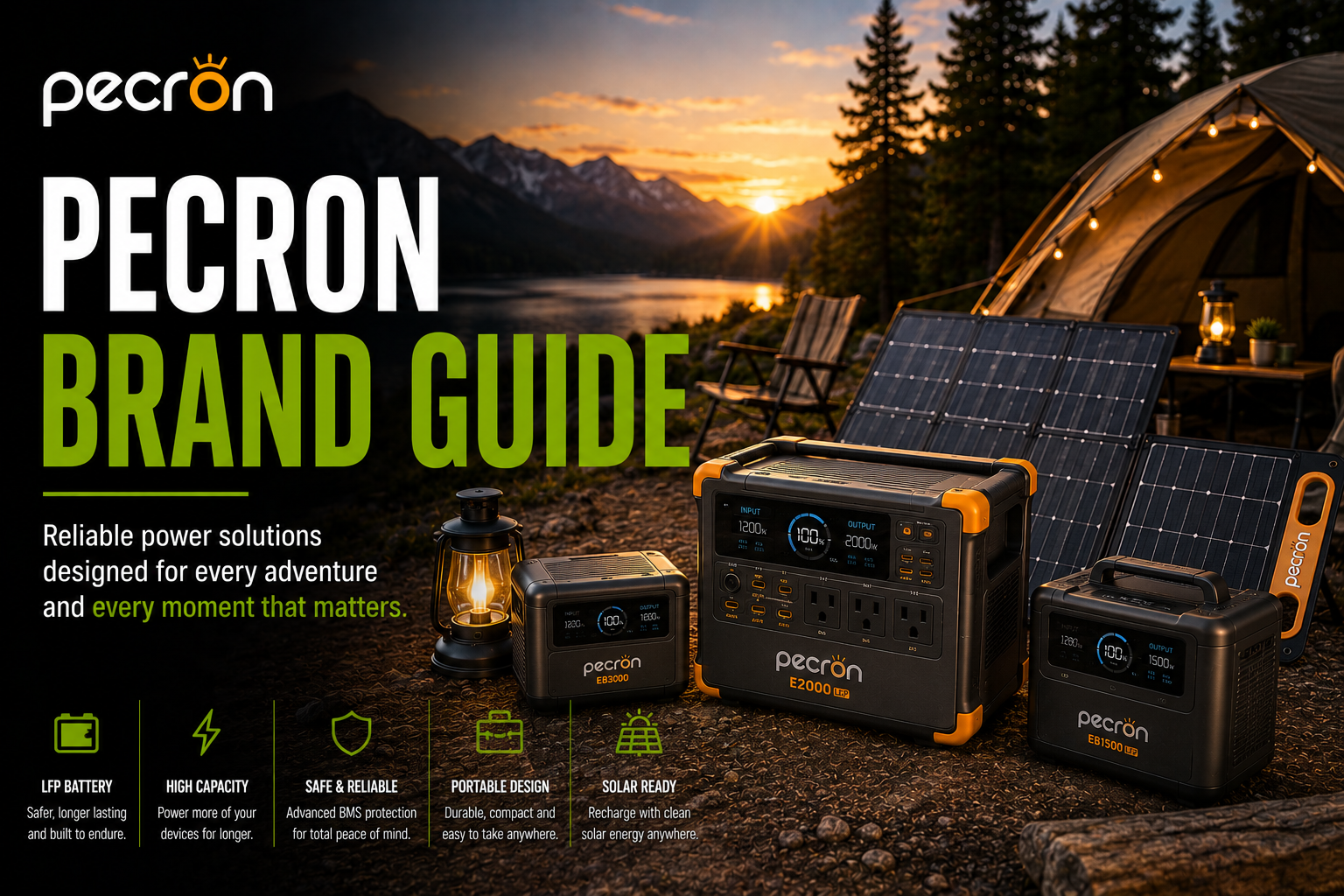
Quick answer: The Pecron E2400LFP remains an attractive 2kWh all-rounder when available. The E1500LFP is the better choice for buyers planning modular expansion, while the E1000LFP offers a practical 1kWh-class balance of capacity and inverter output. For lighter travel, consider the F1000LFP. For substantially larger loads and longer outages, the E3600LFP is the strongest home-backup recommendation among these five.
There is an important availability caveat: Pecron's US catalog now includes newer F-series products and larger E-series systems. Some established models, including the E2400LFP, may have inconsistent availability. This guide therefore separates technical suitability from current purchasing practicality instead of assuming every model is in stock.
Our Pecron Recommendations
Best 2kWh all-rounder: E2400LFP. Its 2,048Wh battery and 2,400W output provide a useful combination for camping, RV equipment and direct appliance backup. Check actual availability before making it your first choice.
Best expandable mid-size station: E1500LFP. A 1,536Wh base, 2,200W inverter and compatible 48V expansion batteries make it appealing when you want to start smaller and grow.
Best balanced 1kWh option: E1000LFP. It provides 1,024Wh and 1,800W output, enough to make it worth considering for selected home essentials and outdoor appliances.
Best lighter travel option: F1000LFP. Its 960Wh capacity, 1,500W inverter and approximately 23.9lb weight make it easier to transport than larger stations.
Best for substantial backup: E3600LFP. Its 3,072Wh battery, 3,600W output and compatible expansion system make it more suitable for demanding backup applications.
Pecron Portable Power Station Comparison
The figures below are manufacturer-published US-market specifications. Battery capacity is expressed in watt-hours (Wh), while AC output is the continuous power rating in watts (W). They describe different capabilities.
| Model | Battery | AC Output | Solar Input | Best Use |
|---|---|---|---|---|
| E2400LFP | 2,048Wh | 2,400W | Check exact manual and revision | General 2kWh power |
| E1500LFP | 1,536Wh | 2,200W | Up to 1,000W | Expandable RV and backup |
| E1000LFP | 1,024Wh | 1,800W | Up to 600W | Home essentials and camping |
| F1000LFP | 960Wh | 1,500W | Up to 600W | Portable travel power |
| E3600LFP | 3,072Wh | 3,600W | Up to 2,400W | Large loads and home backup |
The Best Pecron Power Stations in Detail
Pecron E2400LFP
2,400W continuous AC output
A practical capacity and output combination for buyers who need more than a small camping station without moving into the heaviest home-backup class.
Watch out for: Availability and generation-specific accessory compatibility.
Check PricePecron E1500LFP
2,200W continuous AC output
Its main attraction is the combination of a manageable base unit and a manufacturer-supported expansion path using compatible 48V battery packs.
Watch out for: Exact version and expansion-battery compatibility.
Check PricePecron E1000LFP
1,800W continuous AC output
A useful middle ground for occasional outages, camping and smaller appliances where a 3kWh system would be unnecessary.
Watch out for: Battery runtime at sustained high loads.
Check PricePecron F1000LFP
1,500W continuous AC · approximately 23.9lb
A more transport-friendly option with LFP chemistry, 600W maximum solar input and manufacturer-advertised UPS and app features.
Watch out for: Its lower continuous output compared with E1000LFP.
Check PricePecron E3600LFP
3,600W continuous AC output
Higher-output backup for users who need more power and a larger expandable battery system. A paired configuration can support 240V through specified accessories.
Watch out for: Weight, accessory costs and electrical installation requirements.
Check PricePecron F5000LFP
7,200W-class manufacturer rating · 120V/240V platform
Worth researching separately if you need a larger home-backup system rather than a portable camping station. Its installation and output arrangements should be evaluated against the exact manual.
Watch out for: System complexity, substantial weight and regional availability.
Check PricePecron E2400LFP
The E2400LFP occupies a useful position in Pecron's lineup: its 2,048Wh battery provides roughly twice the energy of a 1kWh-class station, while its 2,400W continuous AC rating accommodates a wider range of simultaneous appliances.
That does not mean it can operate every appliance rated below 2,400W. Compressor and motor starting surges, outlet limitations and the manufacturer's overload behavior still matter. A heater or other high-consumption appliance can also drain a 2kWh battery quickly.
Its strongest use case is a buyer who wants one reasonably capable station for a mix of RV trips, portable equipment and occasional direct appliance backup.
- 2,048Wh nominal capacity.
- 2,400W continuous AC output.
- Useful middle ground between 1kWh and large backup stations.
- Suitable for a broad range of compatible 120V appliances.
- Heavier than 1kWh alternatives.
- Availability may vary by seller.
- Expansion and accessory support require version-specific verification.
- Not a substitute for a configured 240V home system.
Best for: Buyers seeking approximately 2kWh of portable power and a relatively strong inverter.
Avoid if: You need frequent one-person carrying, extensive modular expansion or a guaranteed currently supported product ecosystem.
Pecron E1500LFP
The E1500LFP combines 1,536Wh of nominal storage with a 2,200W pure sine wave inverter. Pecron lists approximately 38.4lb for the base station, making it portable in the technical sense but not particularly light.
Its distinctive feature is the ability to expand with compatible 48V battery packs. Pecron lists configurations reaching 7,680Wh using two EP3000-48V batteries or 9,216Wh using two EP3800-48V batteries.
This creates an interesting buying strategy: start with the base unit for moderate loads, then add storage when longer backup becomes necessary. Expansion increases available energy but does not automatically increase the base inverter's 2,200W continuous output.
Pecron's product documentation lists up to 1,000W solar input through an XT60 connection, subject to its specified voltage and current limits. The manufacturer also lists app connectivity through Wi-Fi and Bluetooth.
- 1,536Wh base capacity.
- 2,200W continuous output.
- Compatible 48V battery expansion.
- Up to 1,000W manufacturer-rated solar input.
- App connectivity.
- Expansion batteries add weight and cost.
- Not every Pecron battery is compatible.
- Older versions and newer V3 configurations require careful identification.
- Single-unit output is not native split-phase 240V.
Best for: RV owners and backup buyers who value the ability to add energy storage later.
Avoid if: You only need a simple portable battery or cannot confirm the availability of compatible expansion hardware.
Pecron E1000LFP
For many people, a 1kWh-class station is a more practical purchase than a much larger backup system. The E1000LFP combines a 1,024Wh LFP battery with a 1,800W continuous AC output rating.
That inverter rating is substantial relative to the battery's size. It allows the station to serve compatible appliances with moderately high running power, but high-power operation dramatically reduces runtime.
Consider a 1,000W load: even with an optimistic 85% usable AC-energy assumption, the 1,024Wh battery provides only about 52 minutes of theoretical operation. The inverter's ability to deliver 1,800W does not mean it can sustain that load for several hours.
The manufacturer lists up to 600W solar input for this model. Verify the panel's voltage, current, polarity and connector before connecting a third-party array.
- 1,024Wh capacity.
- 1,800W continuous output.
- LFP battery chemistry.
- Up to 600W solar input.
- Useful for moderate portable backup.
- Limited runtime at high output.
- Less energy storage than E1500LFP or E2400LFP.
- Not intended to replace a larger home battery system.
Best for: Camping, small appliances, occasional outages and portable electronics.
Avoid if: You expect to run several energy-intensive appliances for many hours without recharging.
Pecron F1000LFP
The F1000LFP is particularly interesting because it trades a little battery capacity and inverter output for a lighter package. Pecron lists a 960Wh LFP battery, 1,500W continuous AC output and approximately 23.9lb weight.
For a traveler regularly lifting a power station into a vehicle or carrying it around a campsite, those physical differences may matter more than the E1000LFP's additional 64Wh and 300W of output.
Pecron specifies up to 1,000W AC charging and up to 600W solar charging. Its product documentation also lists Bluetooth app control, a UPS feature and a manufacturer cycle-life rating of 3,500 cycles to 80% remaining capacity.
The manufacturer advertises a quiet operating mode, but fan noise varies with charging speed, temperature and load. A quoted low-noise figure should not be treated as a guarantee that the station is silent in every operating condition.
- Approximately 23.9lb.
- 960Wh LFP battery.
- 1,500W continuous output.
- Up to 600W solar input.
- App and manufacturer-advertised UPS features.
- Lower inverter rating than E1000LFP.
- Not designed for extensive home-backup expansion.
- UPS suitability must be verified for sensitive equipment.
- Still relatively heavy compared with small camping batteries.
Best for: Road trips, portable workstations, weekend camping and short-duration backup.
Avoid if: Your equipment requires more than 1,500W continuous AC output or you need several kilowatt-hours of stored energy.
Pecron E3600LFP
The E3600LFP is a significant step above Pecron's smaller stations. It provides 3,072Wh of nominal capacity and 3,600W continuous pure sine wave AC output. Pecron lists a 7,000W surge rating, which must not be confused with its continuous output limit.
The station supports up to 2,400W of solar input through two separately specified input paths. Pecron also offers compatible EP3800-48V expansion batteries, with manufacturer configurations reaching 18,432Wh using four additional packs.
That makes it a more credible starting point for extended backup than a standalone 1kWh station. However, a large battery is only one part of a home-power system: circuit integration, outlet ratings, appliance startup behavior and recharge capability all matter.
Important: Its 240V Configuration
Pecron advertises a 240V arrangement using two compatible E3600LFP stations and the specified 240V connection box. One E3600LFP should not be represented as providing the complete paired 7,200W/240V system by itself.
The manufacturer also lists faster AC charging with a supported 30A charging arrangement than with a standard 15A charging connection. These charging modes have different electrical requirements and should not be treated as interchangeable.
- 3,072Wh base capacity.
- 3,600W continuous AC output.
- Up to 2,400W solar input.
- Compatible 48V expansion system.
- Supported paired-unit 240V architecture.
- Heavy for routine transport.
- 240V operation requires additional hardware and another unit.
- Expansion increases total system cost.
- Home integration requires careful electrical planning.
Best for: Larger RV loads, extended outages and buyers planning a substantial modular backup system.
Avoid if: You want a lightweight camping station or assume that one unit can power every 240V household appliance.
How Long Will a Pecron Power Station Run?
Battery capacity is the starting point for runtime planning. The inverter rating tells you how much power the station can supply at once; it does not tell you how long the battery will last.
| Model | 100W Load | 300W Load | 600W Load | 1,000W Load |
|---|---|---|---|---|
| E2400LFP | 17.4 hours | 5.8 hours | 2.9 hours | 1.7 hours |
| E1500LFP | 13.1 hours | 4.4 hours | 2.2 hours | 1.3 hours |
| E1000LFP | 8.7 hours | 2.9 hours | 1.5 hours | 0.9 hours |
| F1000LFP | 8.2 hours | 2.7 hours | 1.4 hours | 0.8 hours |
| E3600LFP | 26.1 hours | 8.7 hours | 4.4 hours | 2.6 hours |
These examples assume a constant load. Real refrigerators, air conditioners and other thermostatically controlled appliances cycle on and off, so their average energy consumption can differ substantially from their rated running wattage.
At low loads, inverter self-consumption may make the 85% assumption optimistic. At high loads, temperature and conversion losses can also reduce available energy. Actual results will vary.
Pecron Expansion Batteries: Compatibility Matters
One of Pecron's strongest selling points is modular expansion. Unfortunately, the product names can make the ecosystem look more interchangeable than it really is.
Pecron has used different battery-voltage families and connectors across its E-series generations. An expansion battery that works with one station may be incompatible with another, even if both products have similar names.
| Power Station | Expansion Consideration | Buyer Guidance |
|---|---|---|
| E1500LFP | Compatible 48V EP-series packs | Confirm the exact V3/version-specific supported battery list. |
| E2000LFP | Legacy 24V EB3000 battery family | Do not assume compatibility with newer 48V expansion packs. |
| E2400LFP | Generation-specific expansion arrangements | Verify the exact product manual and current accessory availability. |
| E3600LFP | Compatible EP3800-48V packs | Follow manufacturer limits for battery quantity and connection. |
| F1000LFP | No equivalent large modular expansion advantage established here | Choose based on the standalone battery capacity. |
When Is Expansion Worth Paying For?
Expansion is most useful when your appliance power requirements already fit within the base station's inverter rating, but the battery does not provide enough hours of runtime.
For example, adding battery capacity to an E1500LFP can extend operation at a 300W average load. It does not change the station into a 3,600W inverter.
If your problem is insufficient continuous output rather than insufficient energy, a larger inverter platform may be a better investment than an expansion battery.
Solar Charging: Match the Panels to the Station
Pecron supports solar charging across these models, but maximum wattage varies substantially. More importantly, a solar panel's advertised wattage alone does not establish compatibility.
| Model | Manufacturer Solar Rating | Practical Implication |
|---|---|---|
| E1000LFP | Up to 600W | Suitable for a moderate portable solar array. |
| F1000LFP | Up to 600W | Good pairing for portable camping panels. |
| E1500LFP | Up to 1,000W | Higher charging potential for its 1.5kWh battery. |
| E2400LFP | Confirm exact revision | Do not design an array from an unverified specification. |
| E3600LFP | Up to 2,400W across two inputs | Designed for larger solar installations. |
Why Maximum Solar Input Is Not Daily Production
A station accepting 1,000W of solar input does not mean it will receive 1,000W all day. Panel orientation, weather, heat, shade and seasonal daylight all affect generation.
As an illustration, a 600W array receiving four equivalent full-sun hours produces a theoretical 2,400Wh before electrical and charging losses. Real output may be lower, and the battery may limit incoming power as it approaches full charge.
For safe array design, verify the panel string's maximum open-circuit voltage under cold conditions, operating voltage, current, connector polarity and the exact power station's limits.
How to Choose the Right Pecron
For Camping and Road Trips
Start with F1000LFP. Its 960Wh battery and approximately 23.9lb weight make it a more manageable option for frequent transport.
Choose E1000LFP instead when the extra continuous output is useful and the physical size is acceptable.
For RV Power
Start with E1500LFP. It offers a useful balance of inverter capability and expandable storage.
Check your RV's electrical distribution, shore-power arrangements and appliance requirements before connecting a station.
For General Portable Backup
Consider E2400LFP. Its 2kWh-class capacity and 2,400W output make it a flexible option if an appropriately supported unit is available.
Compare the complete package with newer alternatives before purchasing.
For Extended Home Outages
Start with E3600LFP. The larger inverter, 3,072Wh base battery and compatible expansion system make it better suited to substantial loads.
For 240V circuits, evaluate the manufacturer's required paired-unit hardware and professional installation.
Five Checks Before You Buy
- Measure your loads. Use appliance labels or a suitable power meter to estimate running watts and startup demand.
- Calculate energy requirements. Multiply average watts by the hours of operation you need.
- Check physical handling. A station that is too heavy to move safely may be unsuitable even if its electrical specifications are excellent.
- Verify expansion and solar compatibility. Confirm exact model revisions, connectors and battery families.
- Check ownership support. Confirm warranty eligibility, authorized seller status and access to replacement components.
Do You Need 120V or 240V?
Most portable power stations in this comparison are intended primarily for standard US 120V loads. A higher wattage rating does not automatically mean 240V capability.
Pecron's E3600LFP paired 240V system requires two compatible units and specified hardware. Larger F-series platforms may offer different arrangements, but those should be checked against their own manuals rather than assumed to operate identically.
What About UPS Functionality?
Some Pecron models advertise UPS functionality, but this should not be interpreted as a guarantee of uninterrupted operation for every computer, router, NAS or medical device.
Verify the transfer time, supported load, pass-through behavior and exact model documentation. For sensitive equipment, a dedicated UPS may be more appropriate.
What About Battery Longevity?
The models discussed here use LiFePO4 battery chemistry. Pecron publishes cycle-life claims for individual products, including 3,500 cycles to 80% remaining capacity for F1000LFP and E3600LFP.
A cycle-life figure is not a warranty of a specific number of calendar years. Temperature, charging conditions, storage habits, depth of discharge and manufacturer test conditions all influence long-term performance.
Newer Pecron Alternatives Worth Checking
Pecron's catalog has expanded beyond the models traditionally featured in its E-series buying guides. That matters because a model that was an excellent choice when launched may no longer be the best value at today's available configurations.
| Model | Published Capacity | Published Output | Why Compare It? |
|---|---|---|---|
| F3000LFP | 3,072Wh | 3,600W | Newer alternative to the E3600LFP class. |
| E3800LFP | 3,840Wh | 4,200W | More base capacity and output for substantial backup. |
| F5000LFP | 5,120Wh | 7,200W-class published rating | Larger 120V/240V home-power platform. |
These are alternatives to research, not automatic upgrades for every buyer. Their weight, outlet configurations, continuous-output limits, expansion hardware, installation requirements and complete purchase costs differ.
For a smaller station, newer does not necessarily mean better. For a substantial home-backup installation, however, the availability of current accessories and long-term support may justify choosing a newer platform.
Frequently Asked Questions
What is the best Pecron portable power station overall?
E2400LFP is a strong 2kWh all-rounder on specifications, but availability matters. E1500LFP is a better fit for modular expansion, while E3600LFP is more appropriate for larger backup loads.
Is Pecron a good brand for portable power stations?
Pecron offers competitive capacity, inverter output and expansion options in several product classes. Whether it is a good purchase depends on the exact model, price, warranty support, accessory compatibility and your intended use.
Which Pecron is best for camping?
F1000LFP is a practical choice when you need approximately 1kWh of storage in a relatively transportable package. For lighter electronics-only trips, a smaller battery may be more convenient.
Which Pecron is best for home backup?
E3600LFP is the strongest home-backup recommendation among the five main models in this guide because it combines 3,072Wh capacity, 3,600W output and a supported expansion system. Larger E3800LFP and F-series platforms are also worth comparing.
Can a Pecron power station run a refrigerator?
Many Pecron models may run compatible refrigerators, but verify the appliance's running wattage, compressor startup surge and voltage. Actual runtime depends on the refrigerator's average energy consumption and operating conditions.
Can I use third-party solar panels with Pecron?
Potentially, if the panel array meets the exact station's voltage, current, polarity, connector and other input specifications. Do not connect panels based only on their advertised wattage.
Are Pecron expansion batteries interchangeable?
No. Pecron has used different battery families and voltage architectures. Confirm the exact base model, hardware revision and manufacturer-supported expansion battery before purchasing.
Is a 2,000W power station the same as a 2,000Wh power station?
No. Watts measure power delivered at a moment in time. Watt-hours measure stored energy. A 2,000W inverter can supply a 1,000W load electrically, but runtime depends on the battery's watt-hour capacity and conversion losses.
Can one Pecron E3600LFP supply 240V home power?
The manufacturer's specified 240V arrangement uses two compatible E3600LFP units and a 240V connection box. Do not assume one unit provides that paired configuration.
Do Pecron stations need ventilation?
Yes. Follow the manufacturer's ventilation clearances, operating-temperature limits and storage instructions. Do not obstruct cooling vents or expose a station to rain unless the exact model is explicitly rated for that exposure.
Sources and Editorial Methodology
We evaluated these Pecron models using published US-market specifications, charging capabilities, battery chemistry, output ratings, expansion arrangements and intended use cases. The recommendations are based on documented features and practical trade-offs, not claimed firsthand testing.
- Pecron — Official Product Catalog
- Pecron — E-Series Product Collection
- Pecron — E1500LFP Specifications and Expansion Details
- Pecron — F1000LFP Specifications
- Pecron — E3600LFP Specifications and Configurations
- Pecron — Current US Product Lineup
Runtime methodology: Estimates use nominal battery capacity multiplied by an assumed 85% usable AC fraction, divided by a constant load. These are illustrative calculations and not independent laboratory results.
Selection methodology: We distinguish between compact travel, balanced portable power, expandable systems and substantial home backup. We do not treat surge output as continuous power or assume that all Pecron models share compatible expansion batteries.
Purchasing note: Verify exact model revisions, current availability, warranty eligibility, seller authorization and accessory support before purchasing. Manufacturer specifications and configurations may change.
Final Verdict: Which Pecron Should You Buy?
Choose E2400LFP when you want a capable 2kWh all-rounder and can confirm suitable availability. Choose E1500LFP when you expect to add compatible expansion batteries. Choose E1000LFP for balanced portable backup, or F1000LFP when easier transport is more important.
For larger home-backup needs, E3600LFP is the stronger starting point among these five, although newer E3800LFP and F-series systems deserve comparison before you commit to a major installation.
The best purchase is the station that safely powers your actual appliances for the required duration, with a charging setup and accessory ecosystem you can realistically support.
Compare Current Options